PX21: Jimbo: Adventures in Paradise

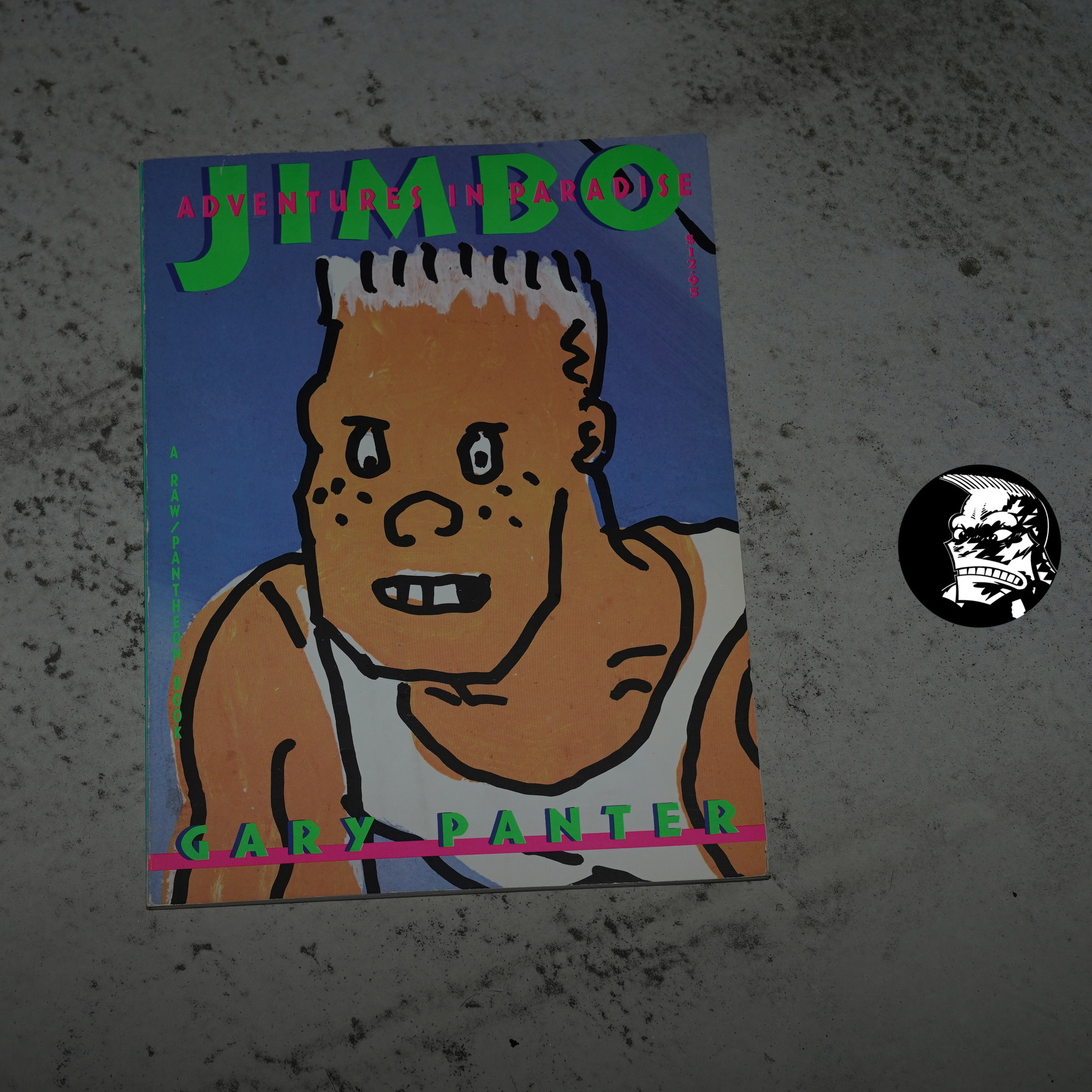
Jimbo: Adventures in Paradise by Gary Panter (230x305mm)

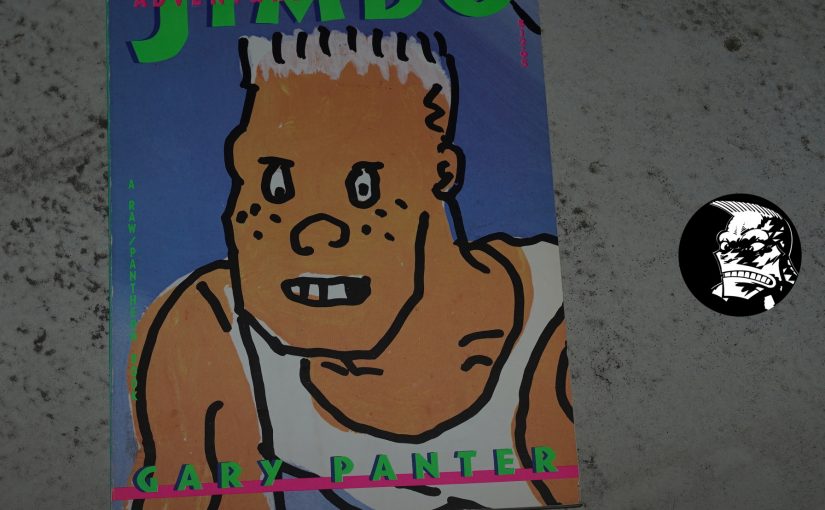
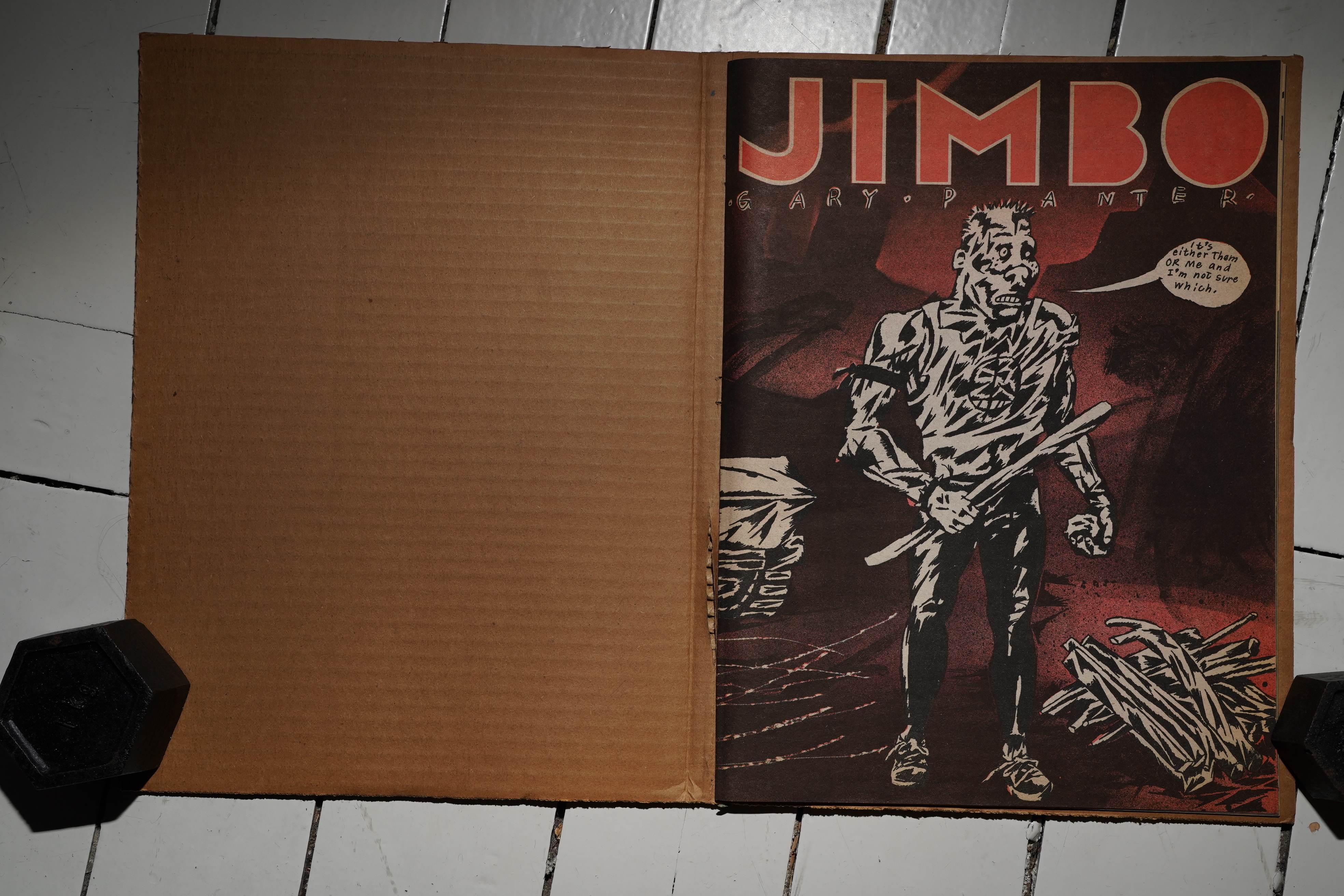
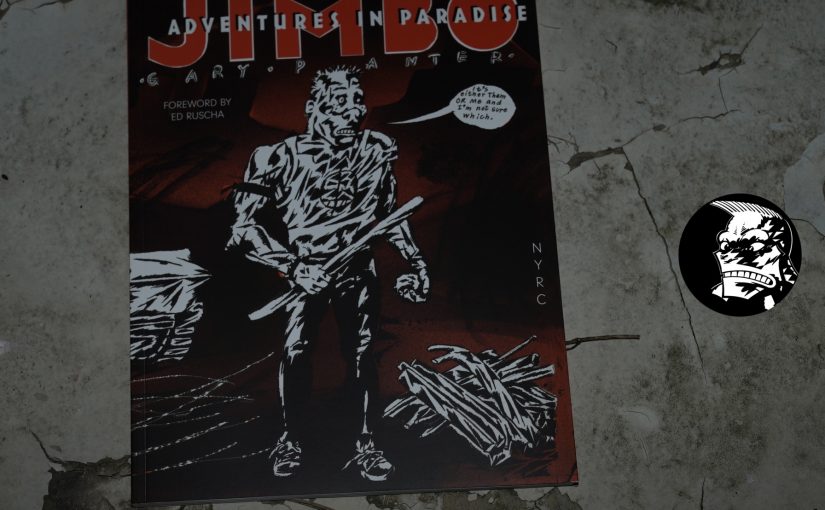
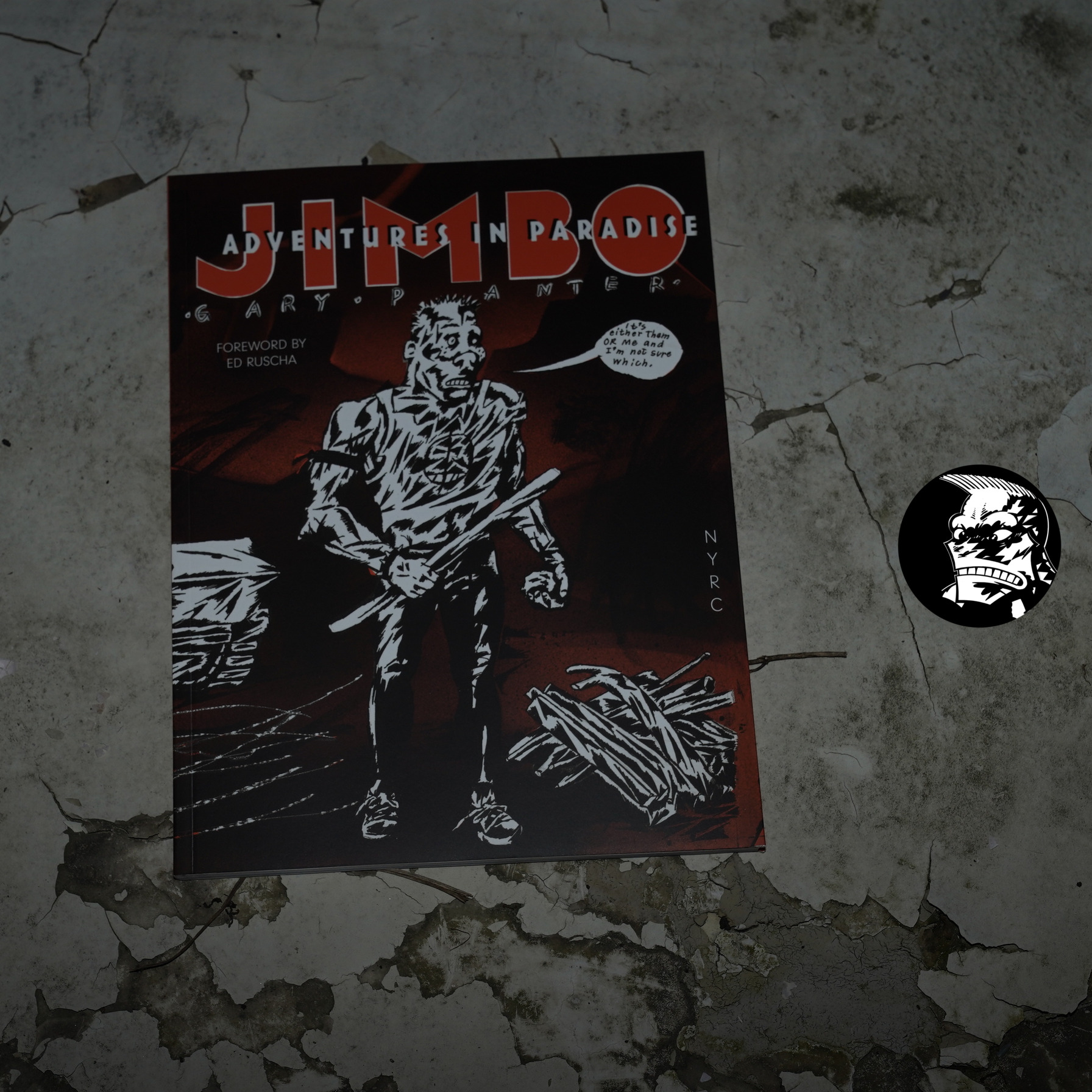
This is a reprint of the Pantheon (1988) edition of this book by New York Review Comics. They wisely didn’t use the cover of that book, though, but went with the inner cover of the 1982 edition.

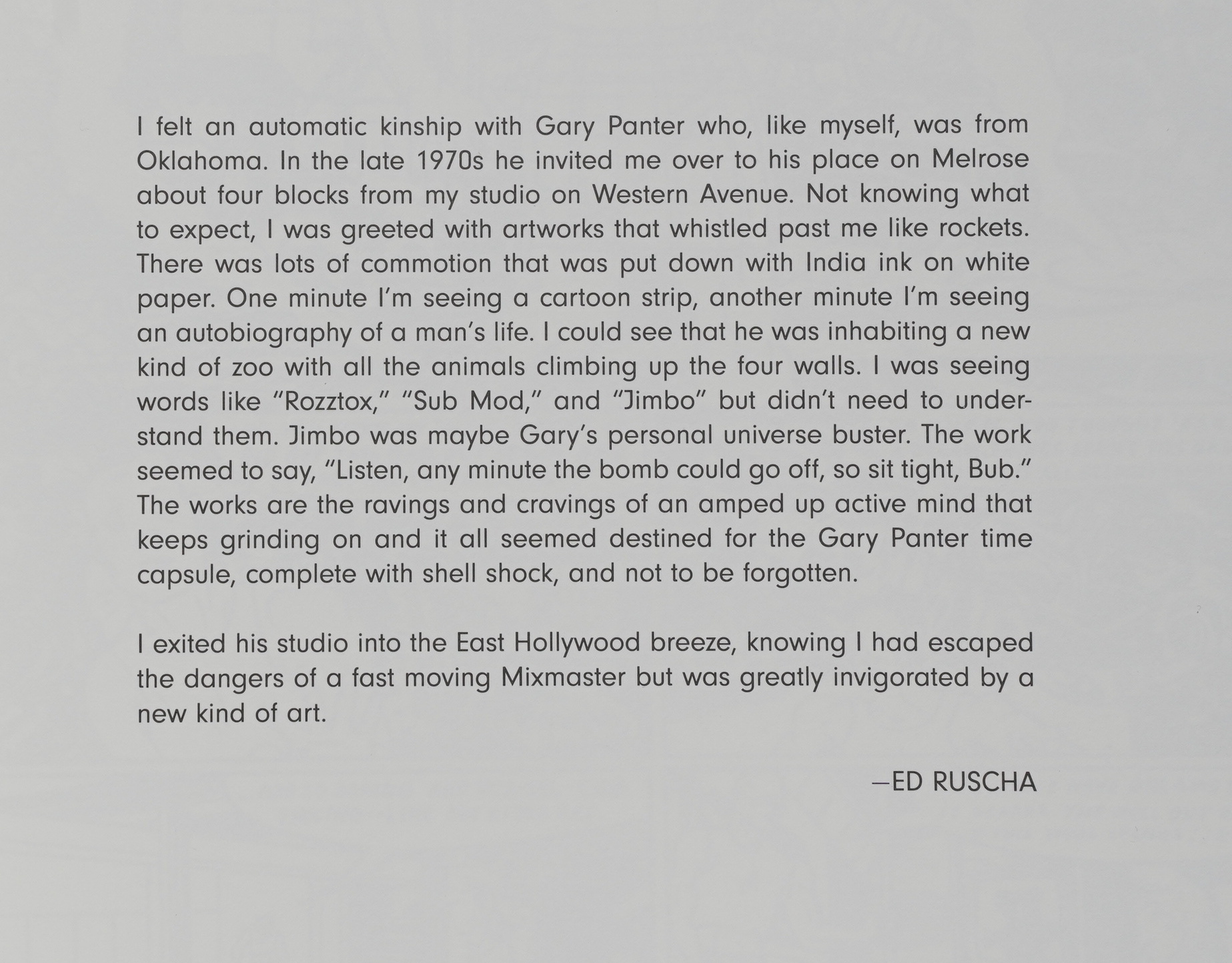
We get an introduction by artist Ed Ruscha…

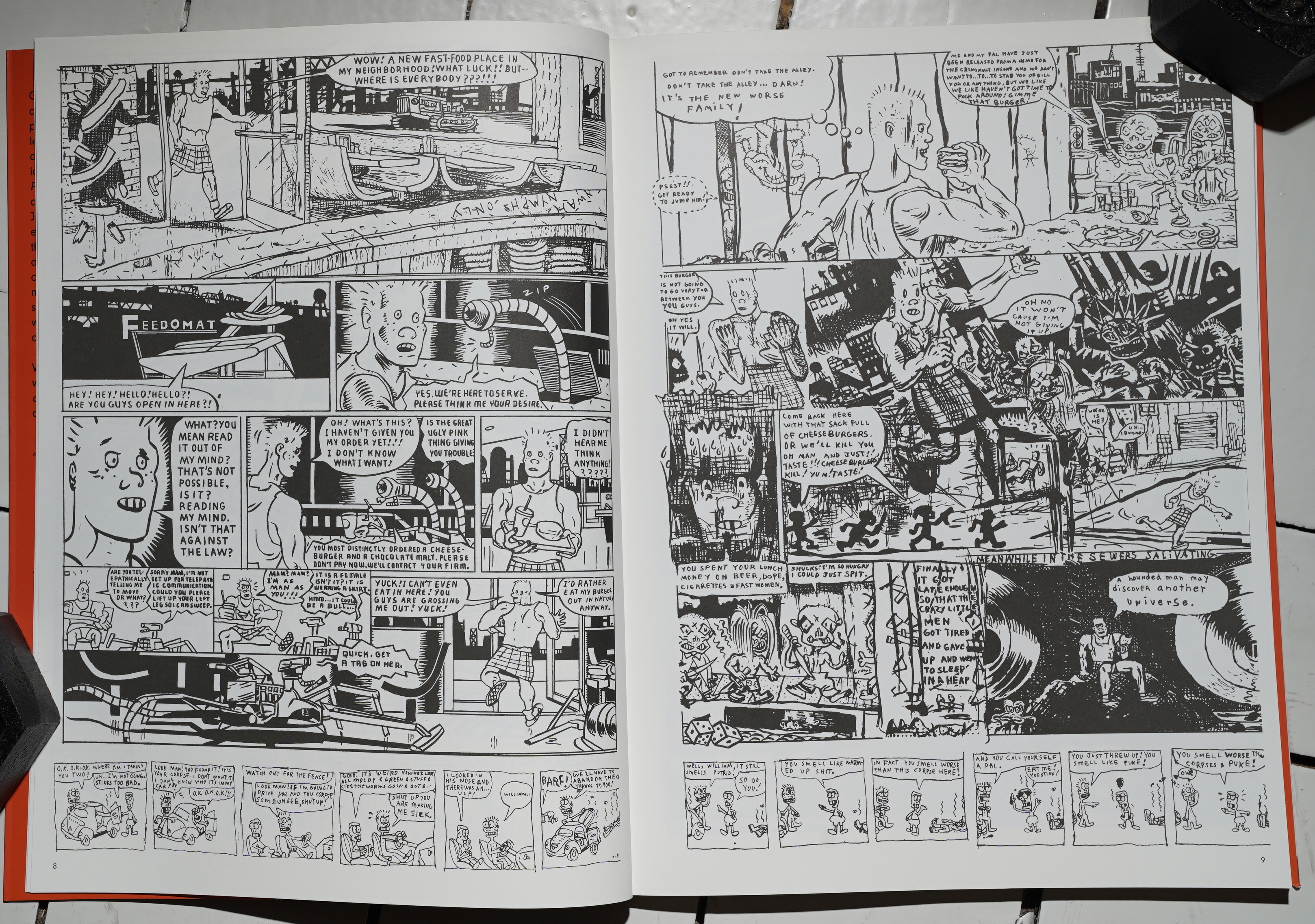
… but the main part is an exact copy of the 1988 edition. Except that that one had a green hue behind these images.

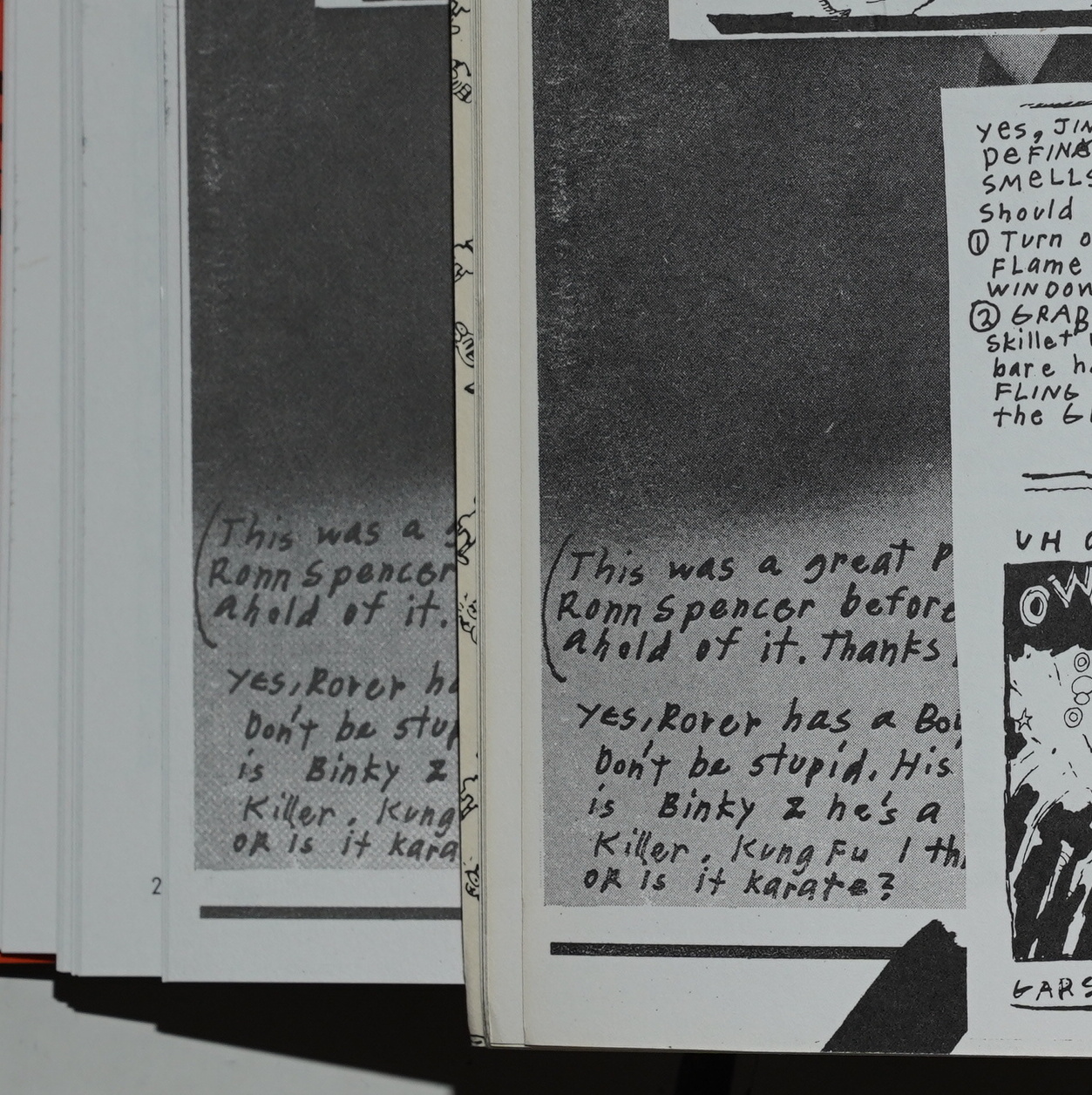
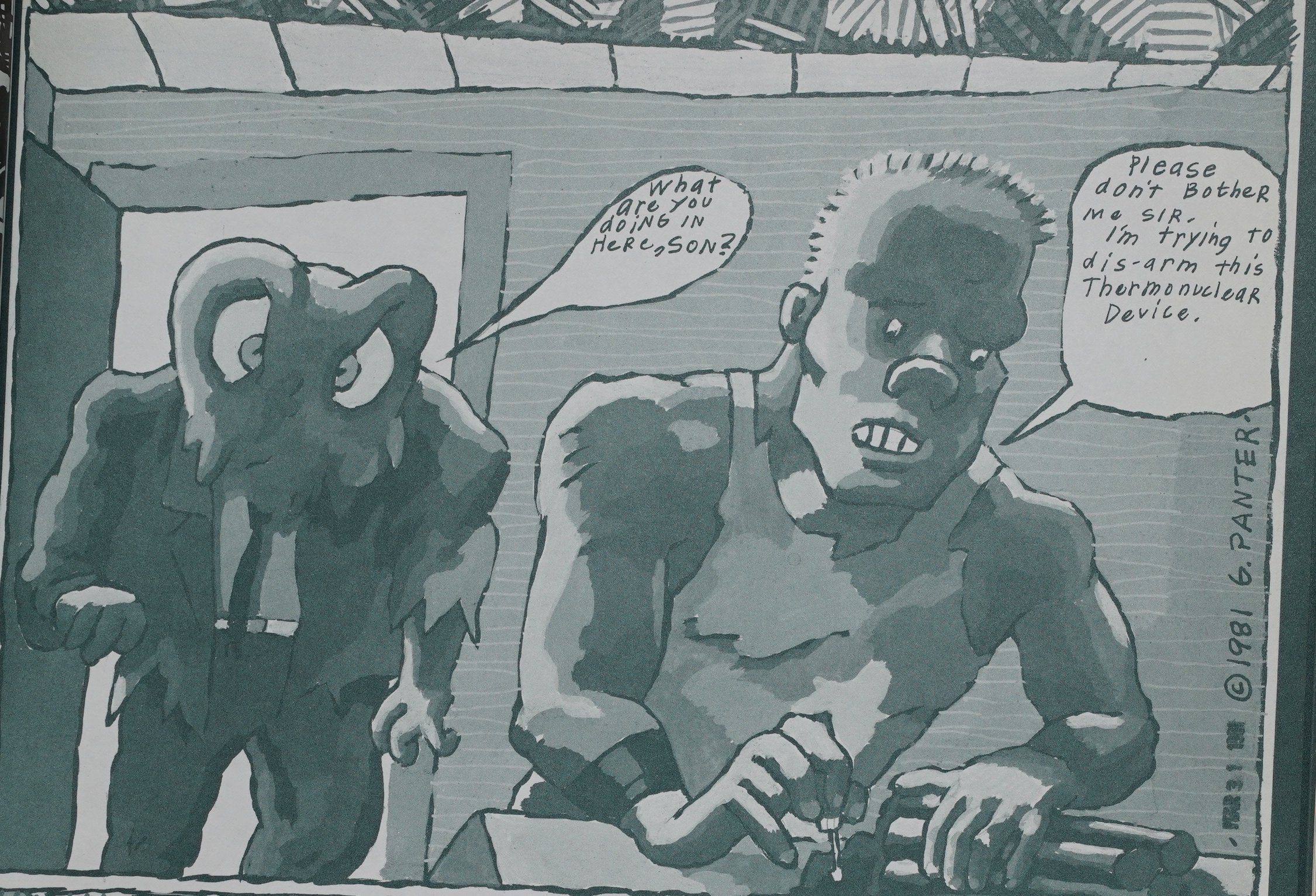
For instance, this page in the 1988 edition used the green to illustrate how reality was bleeding through the trip, with some parts in light green and some parts in white.

Uhm… Did they shoot this edition from the printed copy of the 1988 edition? I think they did! On top (to the right) is the 88 edition and on the left is the 2021 edition. Notice the moire patterns in the greyscale. Tsk tsk.


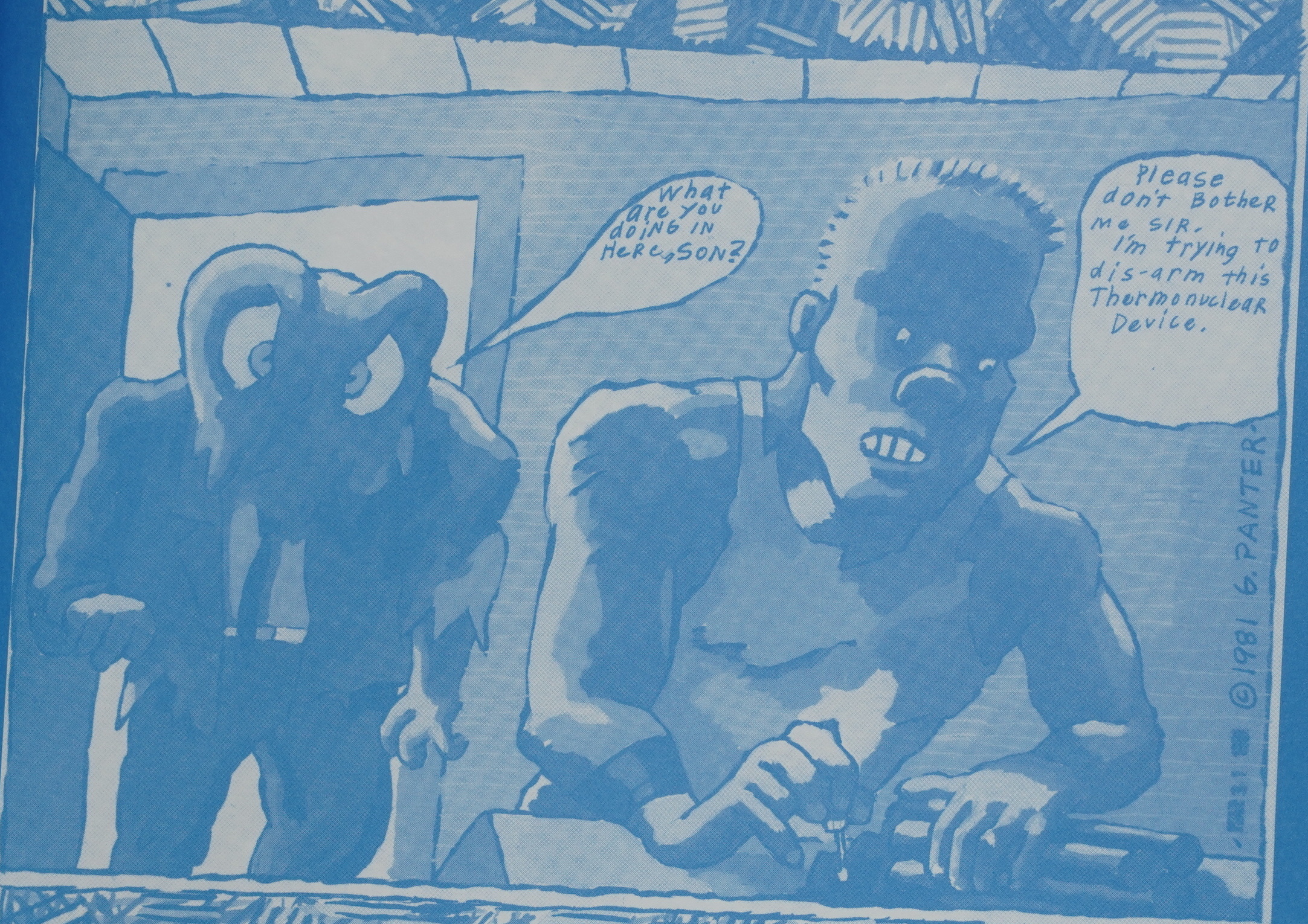
And they went with blue instead of green in these bits, which is fine, but look at that moire!

Here’s how it looked originally — all smooth and stuff.

I guess they didn’t have the originals any more to shoot from, but they could have fixed that unfortunate moire.

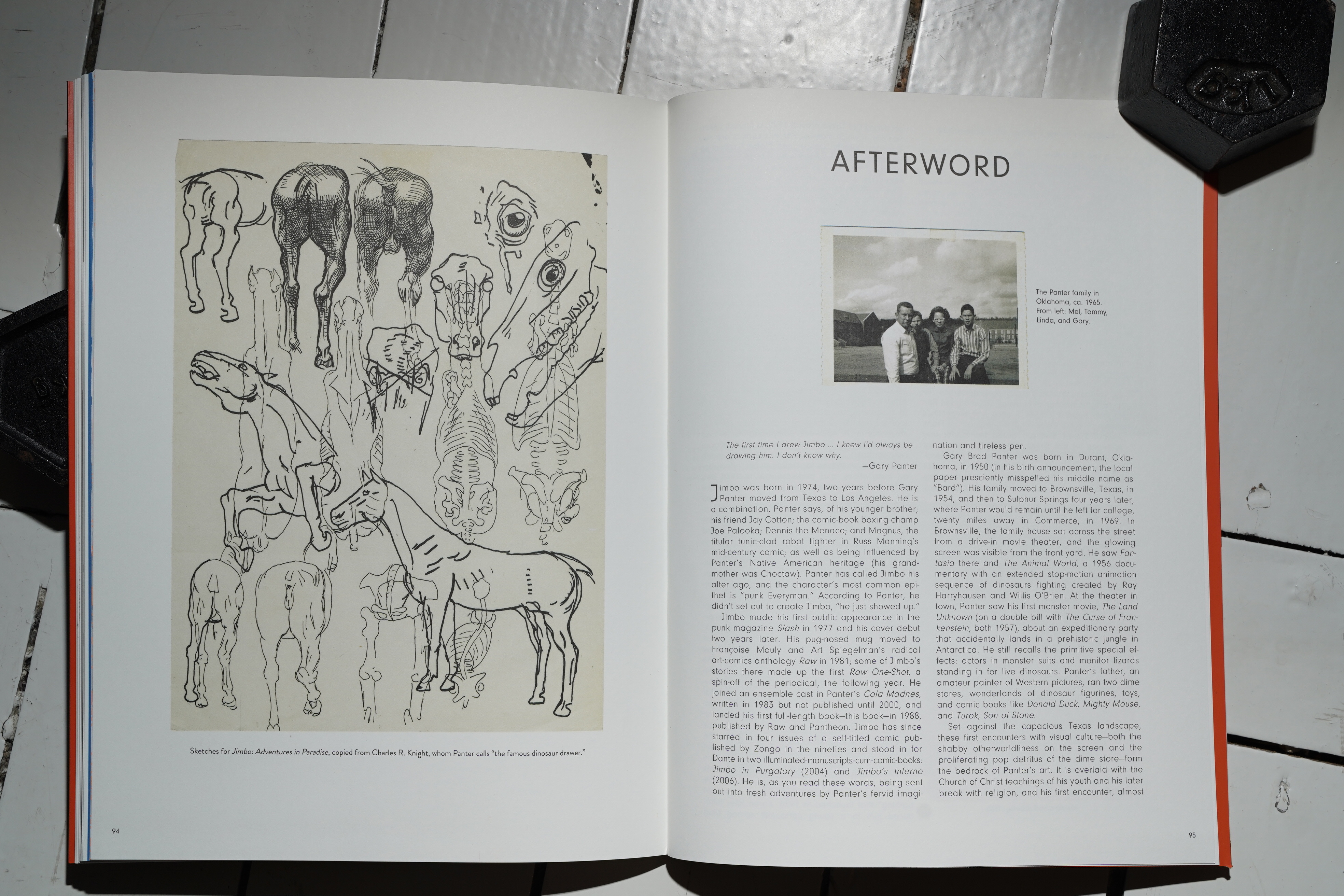
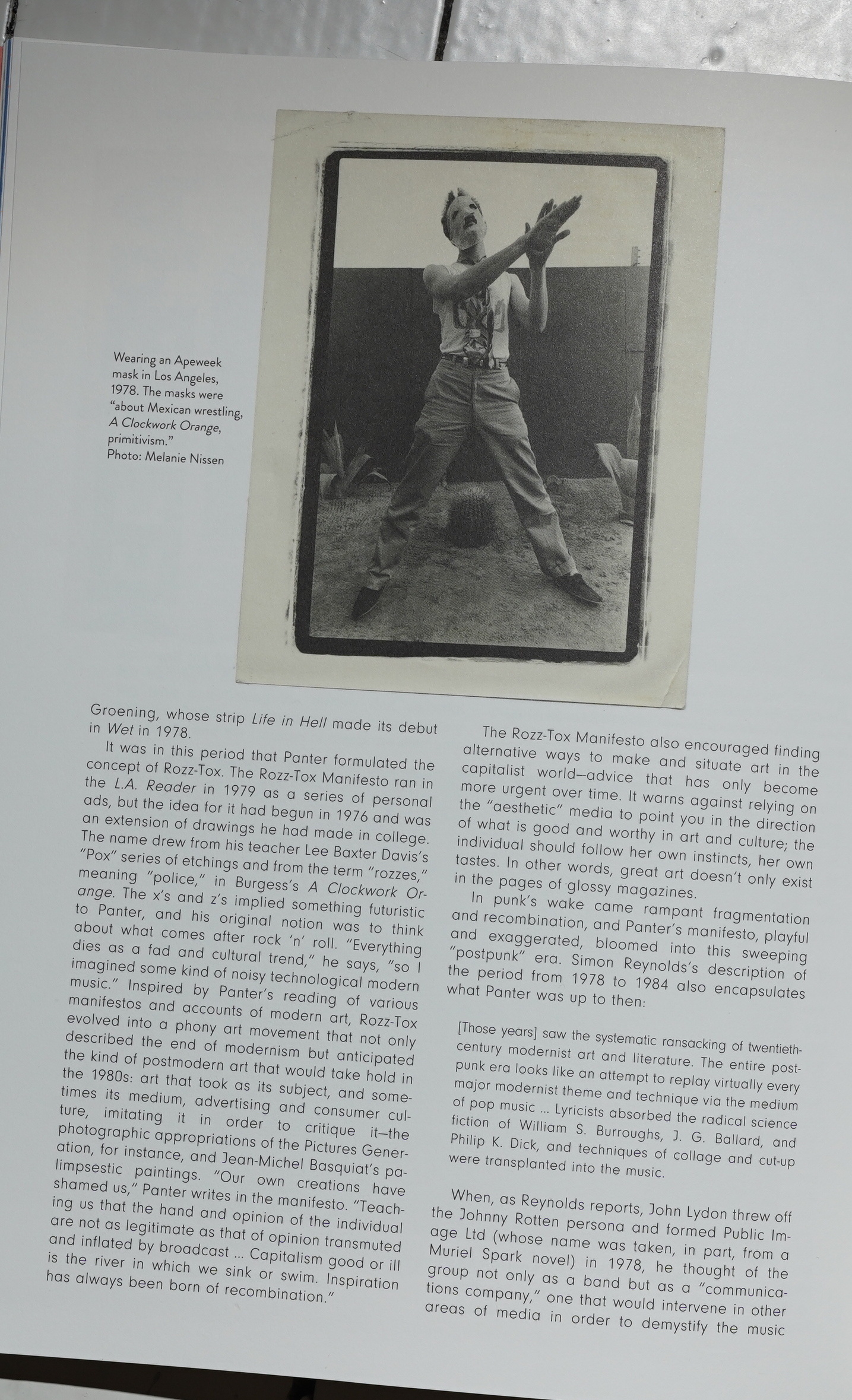
And then we get a biography and stuff (by Nicole Rudick).

It’s pretty interesting.

It’s gotten some attention:

The punctuation takes you back to the beginning, where Jimbo asks, “Have you ever had a dream where you knew you were dreaming, but it was so real that you didn’t trust your judgment?” It’s an exquisite loop, a perfect resolution to this monument of disorder.

Nobody seems to be as nit-picking as I am about the reproduction:

To return things to the subject of NYRC’s new printing specifically, in addition to generally (it must be pointed out there are some issues with cropped art on certain pages) boasting the kind of high production values we’ve quickly become accustomed to from them, and that work of this level of import both deserves and, frankly, demands, perhaps the greatest service it does is to demonstrate how so much of what we take for granted today in small press and self-published comics — from visual and narrative experimentation to subject matter that is as challenging and rewarding conceptually as it is aesthetically — only came to be the prevailing state of affairs because Panter did it first.

This blog post is part of the Punk Comix series.

PX88: Jimbo: Adventures in Paradise

Jimbo: Adventures in Paradise by Gary Panter (230x305mm)

This Jimbo book is published by Pantheon Books in a less extravagant size than the previous two incarnations. And instead of being saddle-stitched, it’s squarebound, and both of those things make this seem like a more serious, less wild publication.

Perhaps it’s to counter that that they’ve gone with this illustration on the cover? It doesn’t look much like Panter, unfortunately. OK, I’ll say it: This cover is just really ugly, what with the drop shadows and a colour palette from hell. It’s very 1988, but in all the wrong ways.
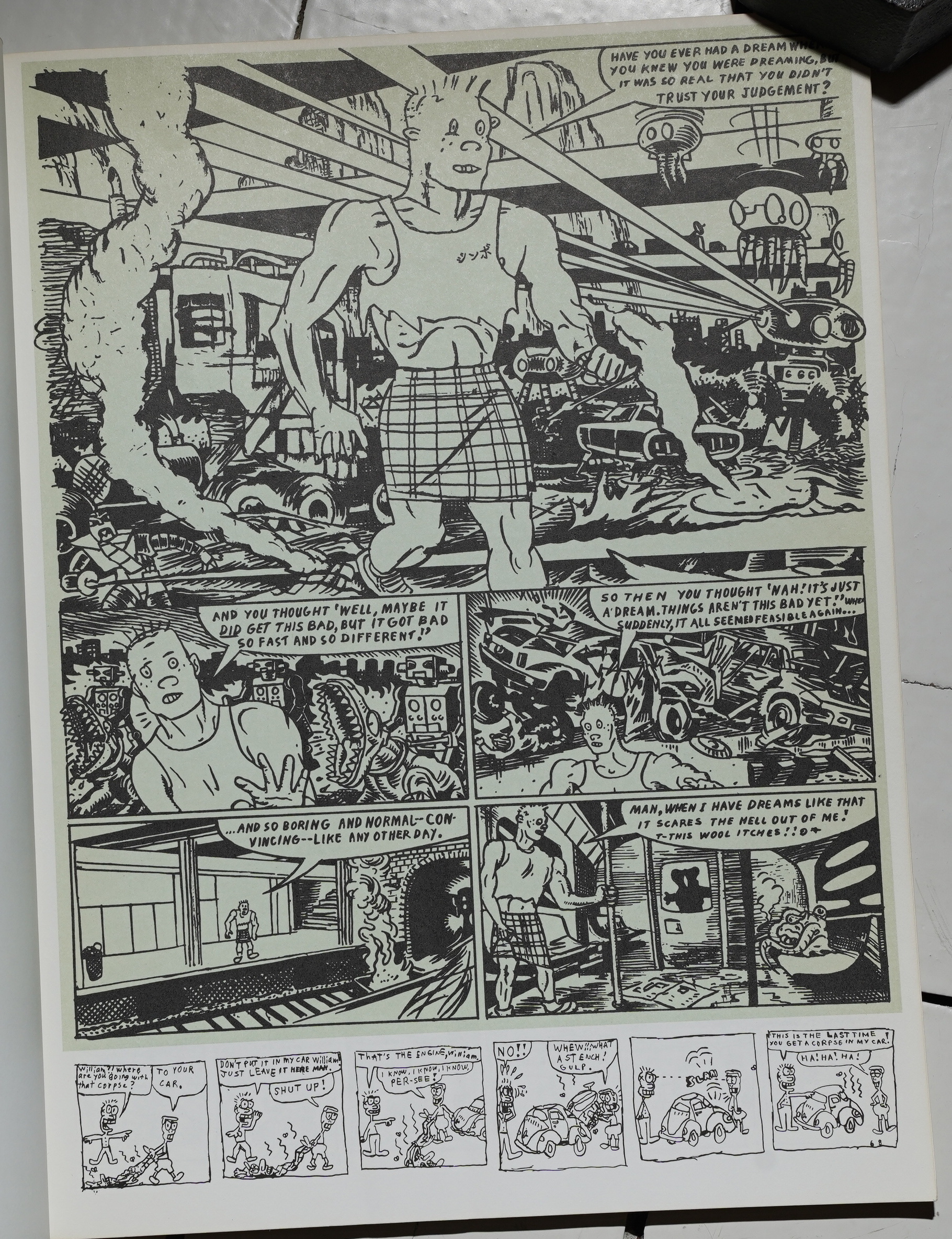
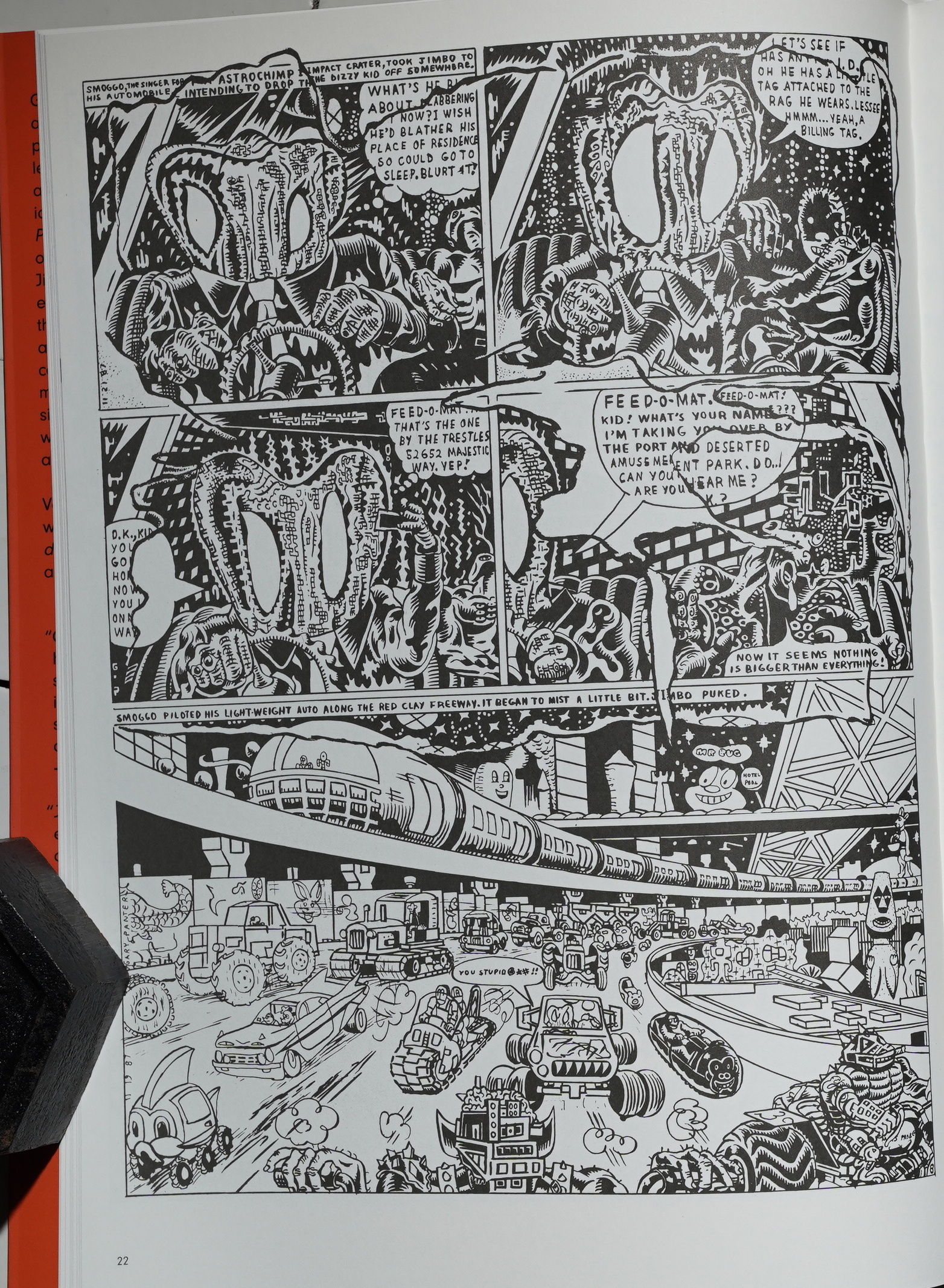
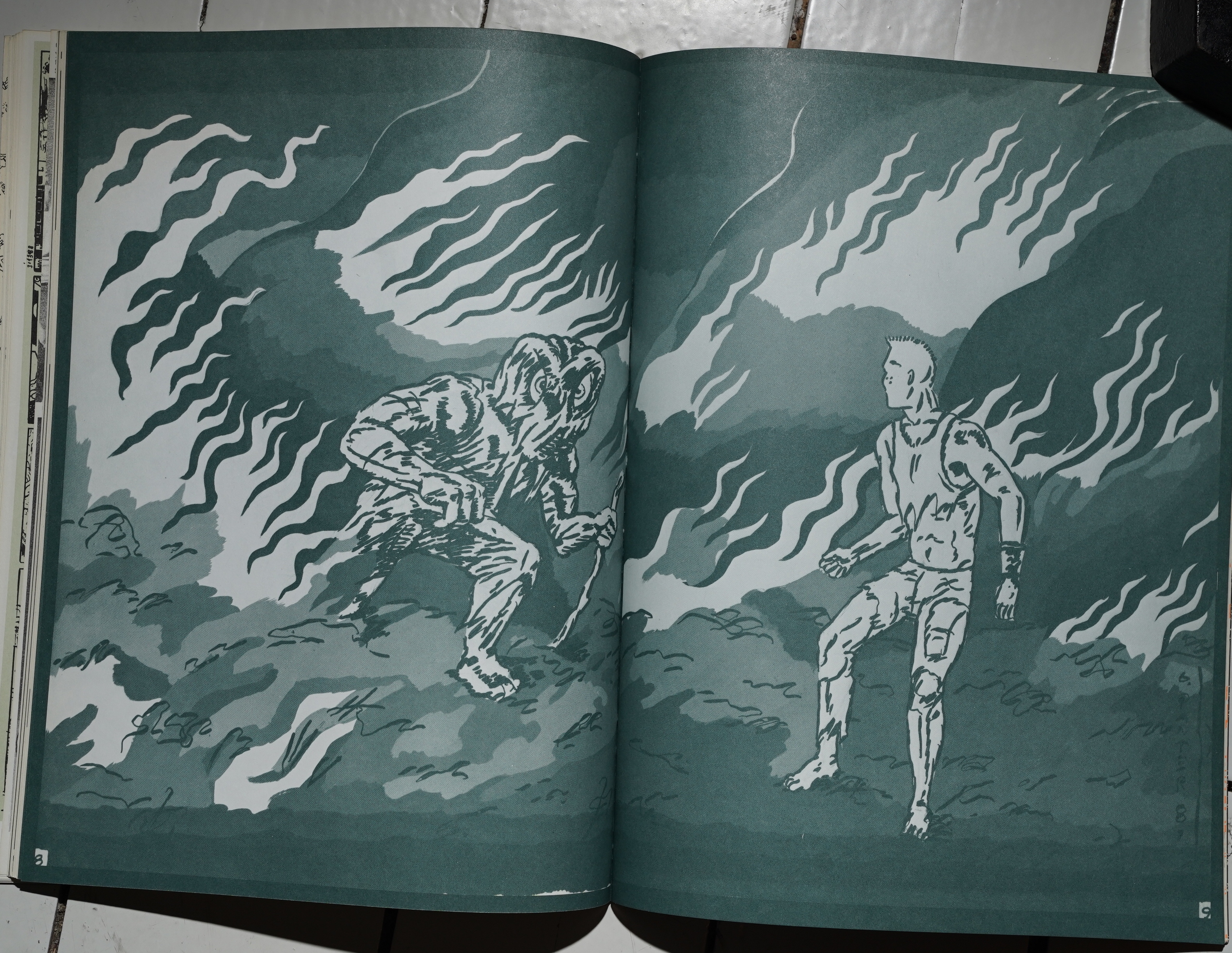
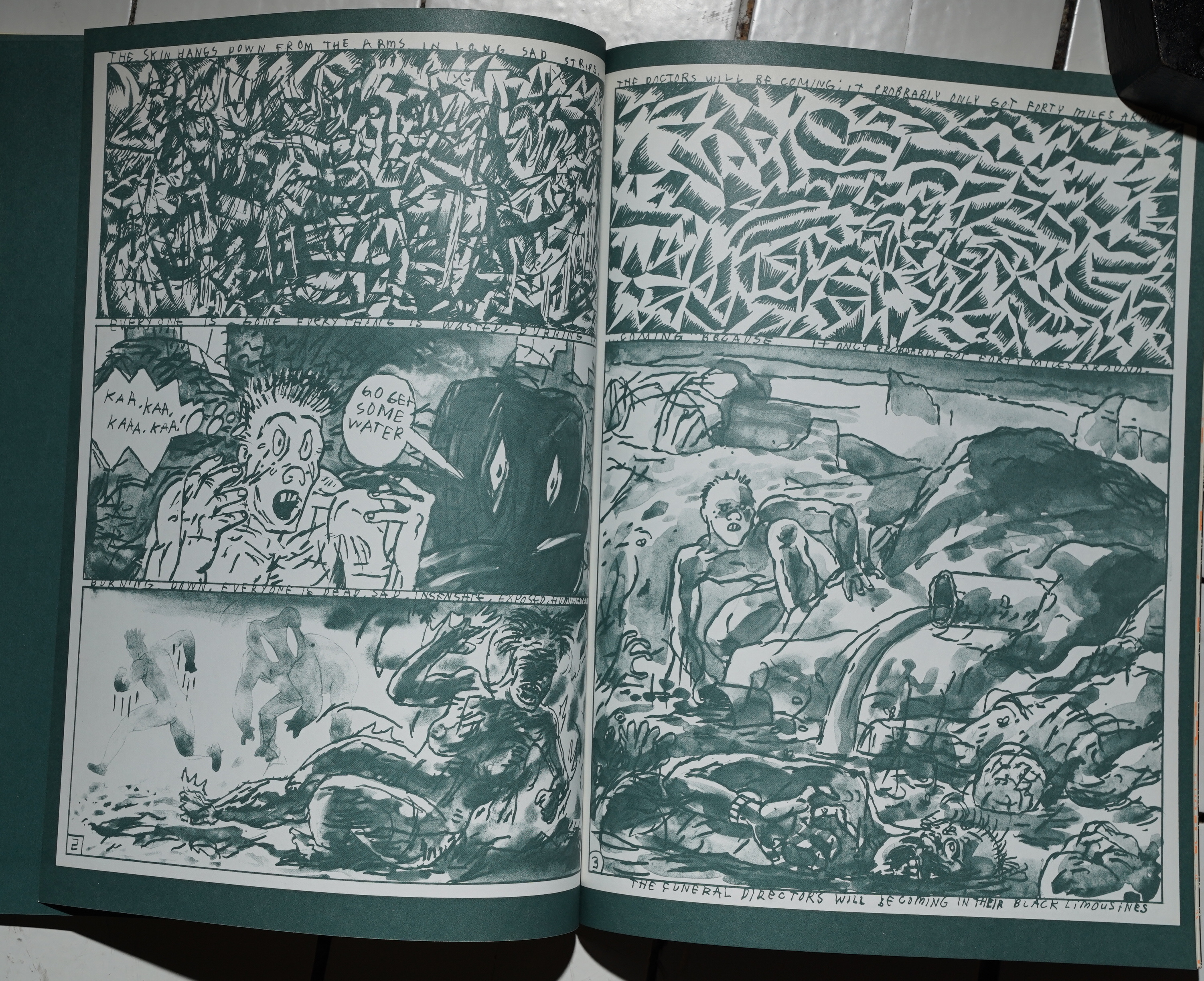
We start off with two prequel stories to the main story (sort of). These are printed on these sickly green-looking backgrounds, and seem to be drawn in 1987 (while the original stuff was made in 79-84).
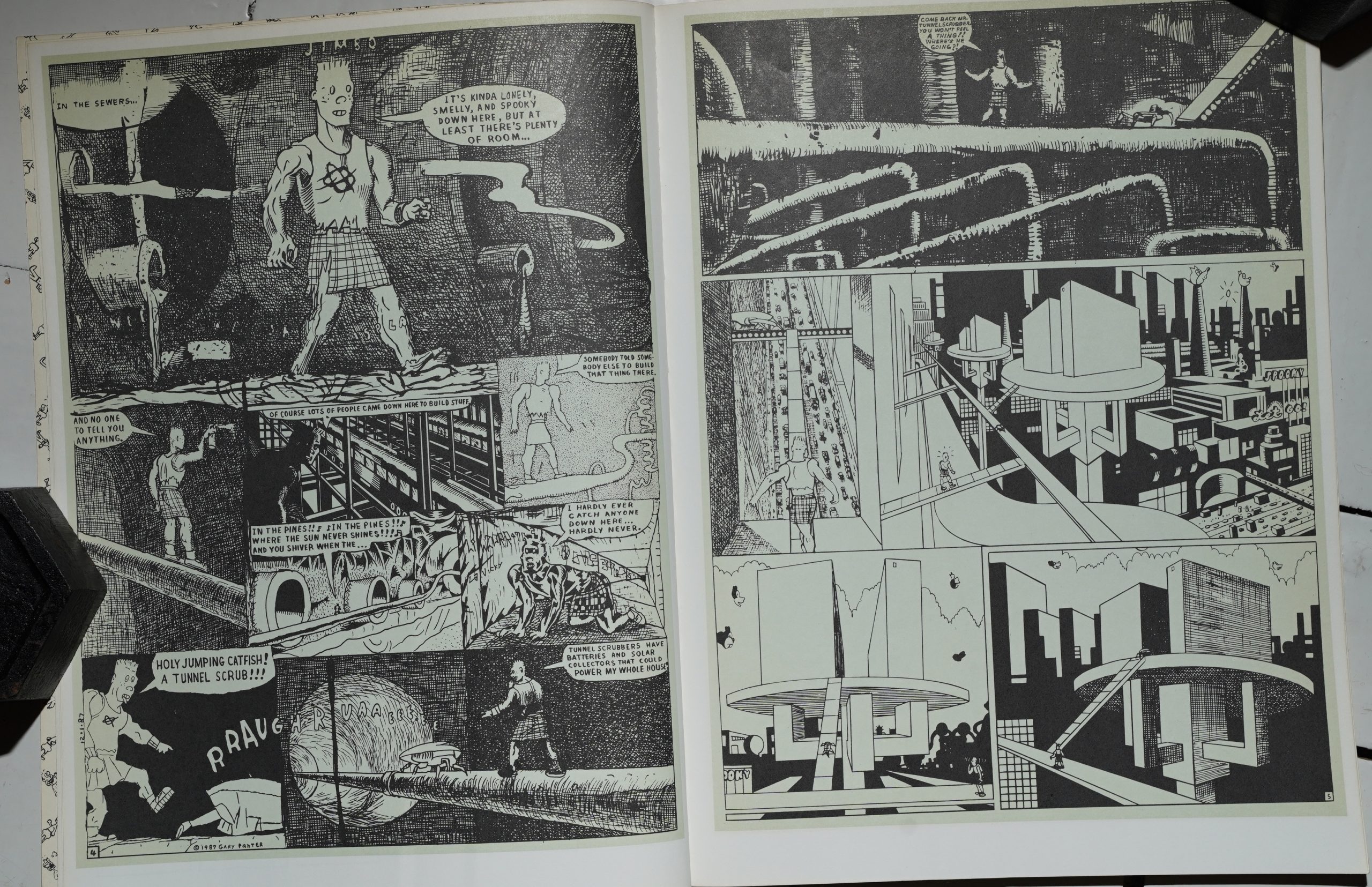
The artwork’s definitely more consistent — Panter was trying out new things on every page back in 79 — but it’s kinda… staid, almost?
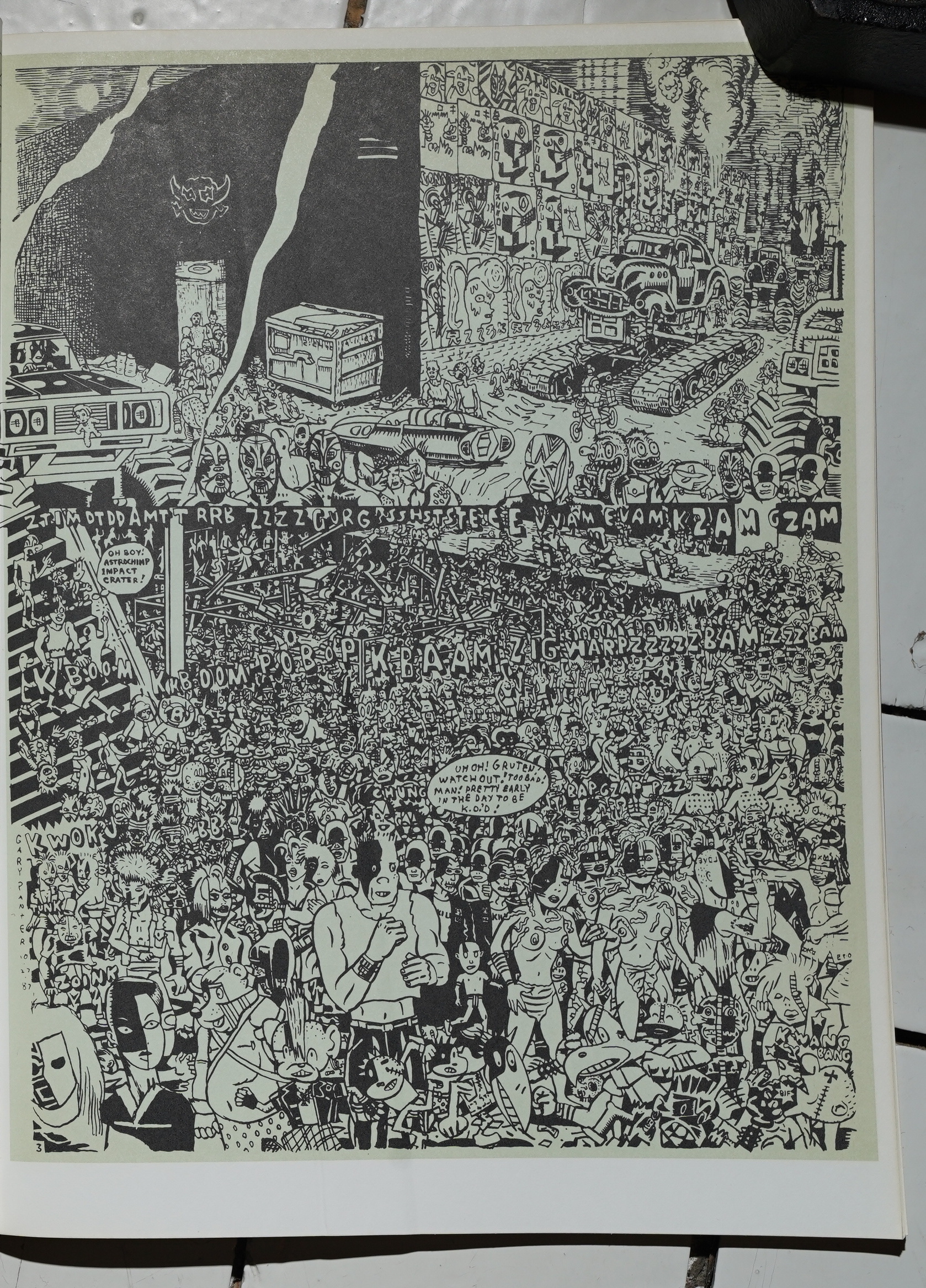
There’s fun stuff, though.
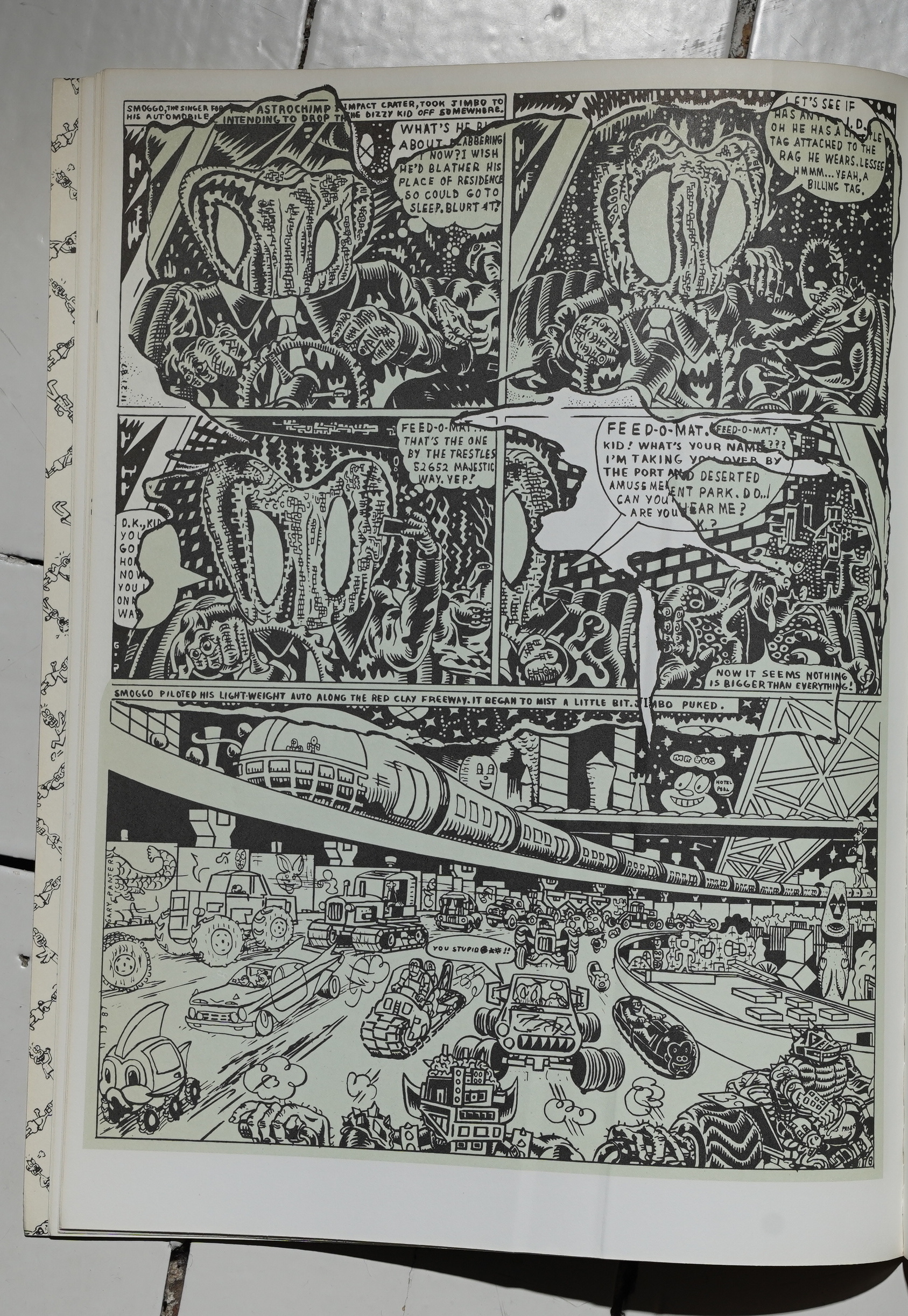
After having just read the original series, I was pretty impatient with this stuff: The original Jimbo was funny and goofy; sure, but it felt vital and important. This is basically just a druggy joke.

I mean, it looks good, but…
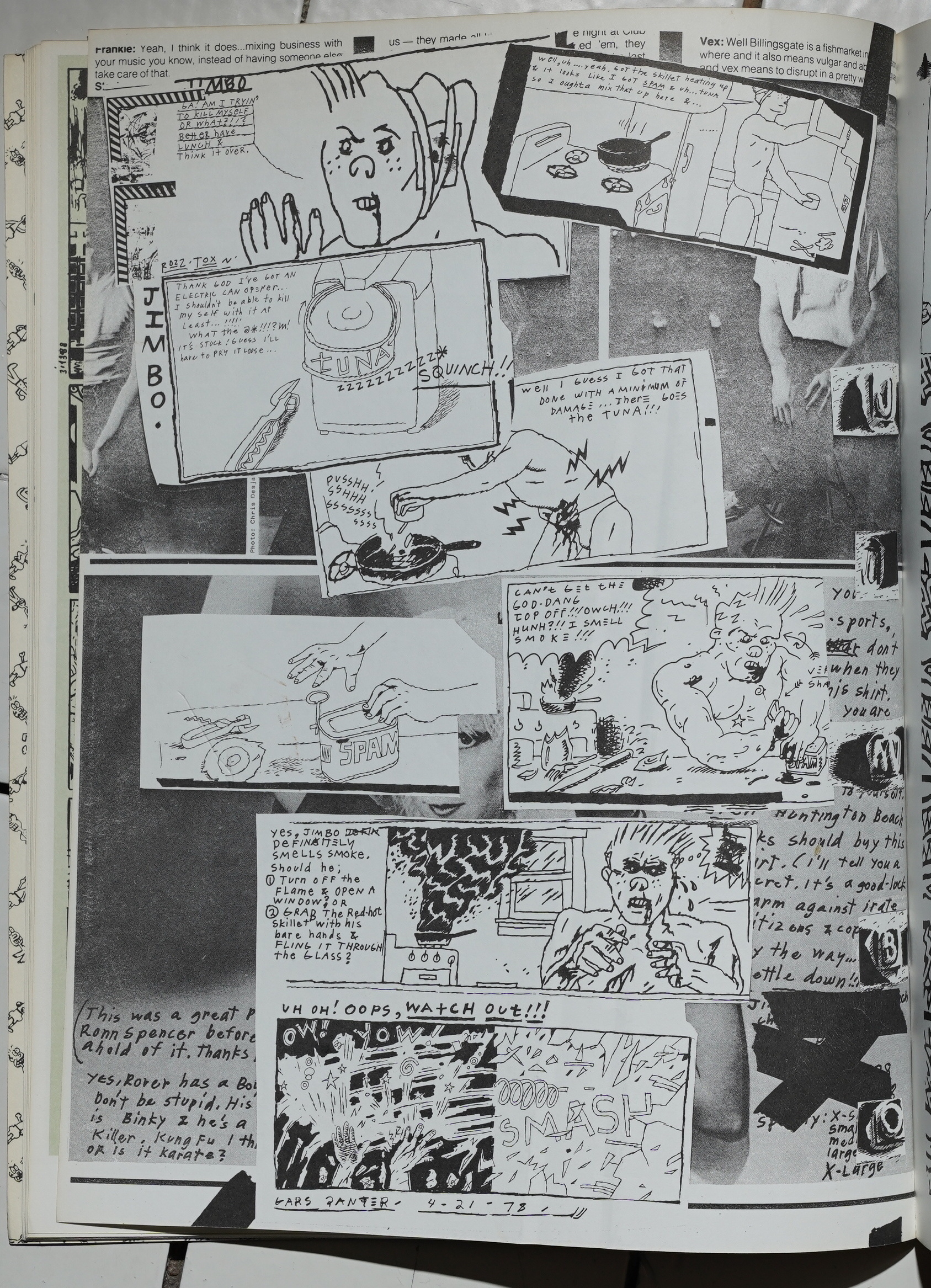
And then we get to the meat of the book: The Jimbo strips that originally appeared in Slash magazine. This is probably the best reproduction they got (so far): The Raw One-Shot version was on newsprint, and the Japanese edition had some ink gain. I guess the printers Pantheon used were more… er… professional.

But I still think it looked better in the One-Shot edition.
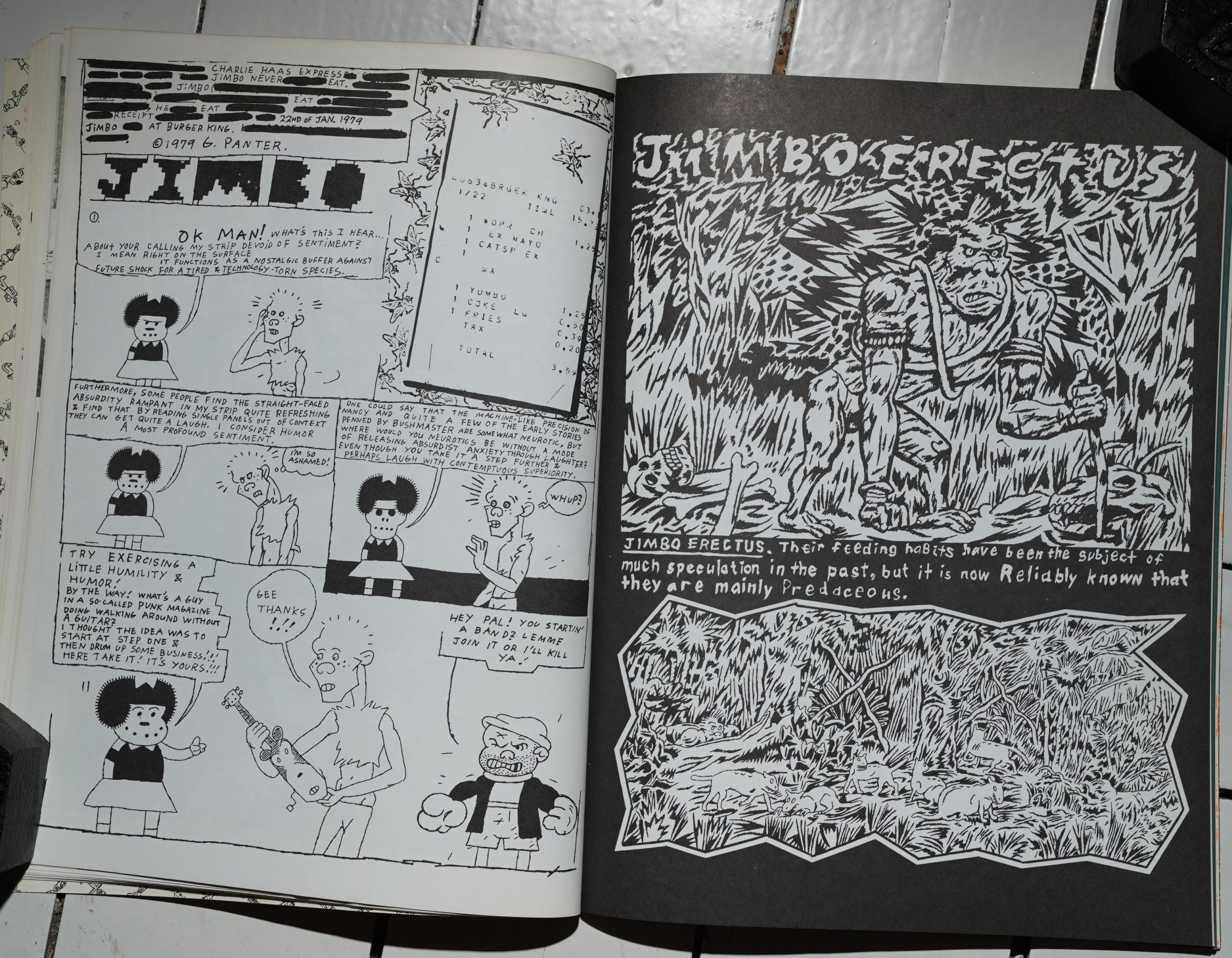
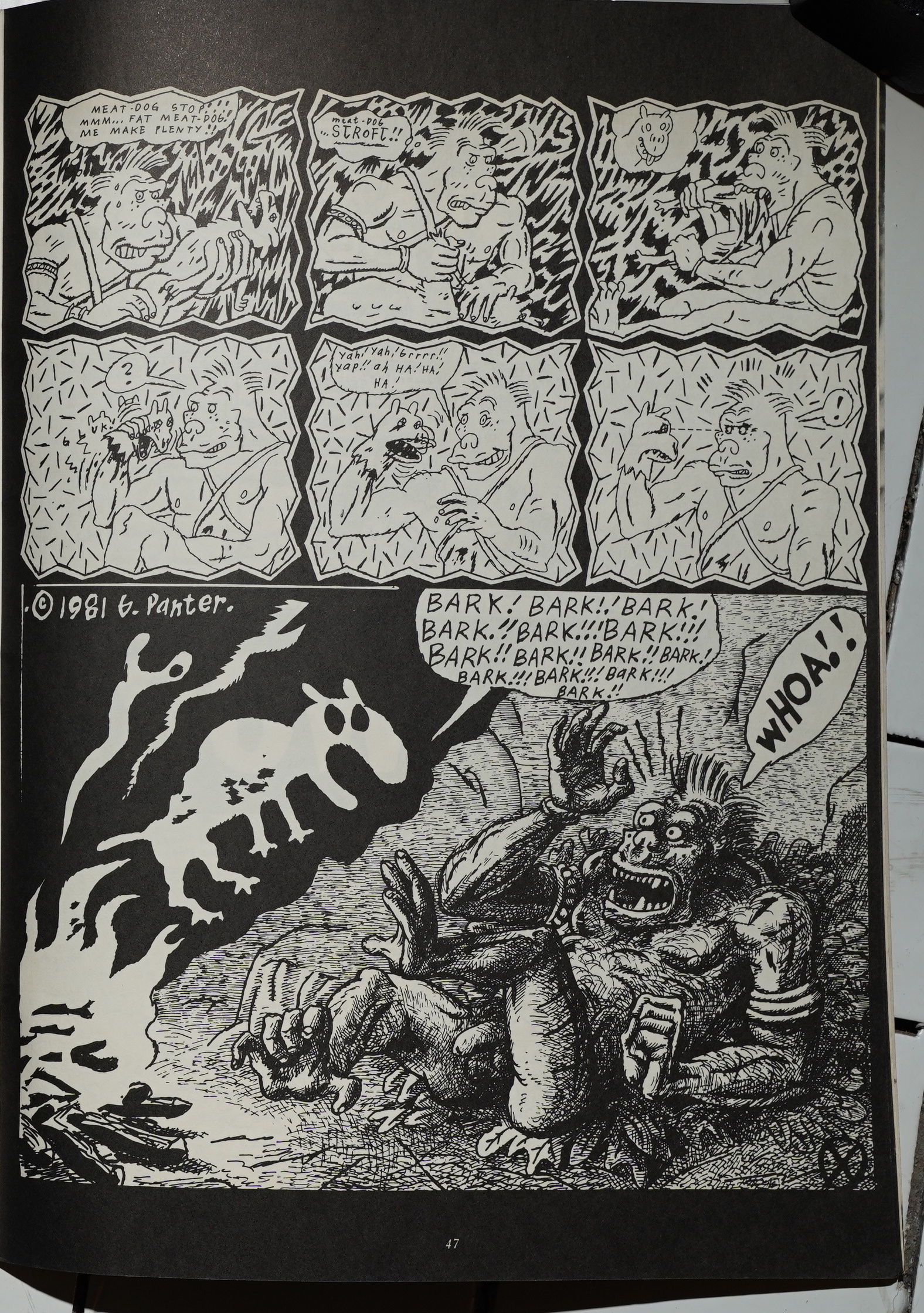
The Japanese edition also included some Jimbo pieces from Raw (like Jimbo Erectus), but not like here: In this edition, these stories are included in the middle of the Slash strips, and seem to be part of the storyline. Sort of.
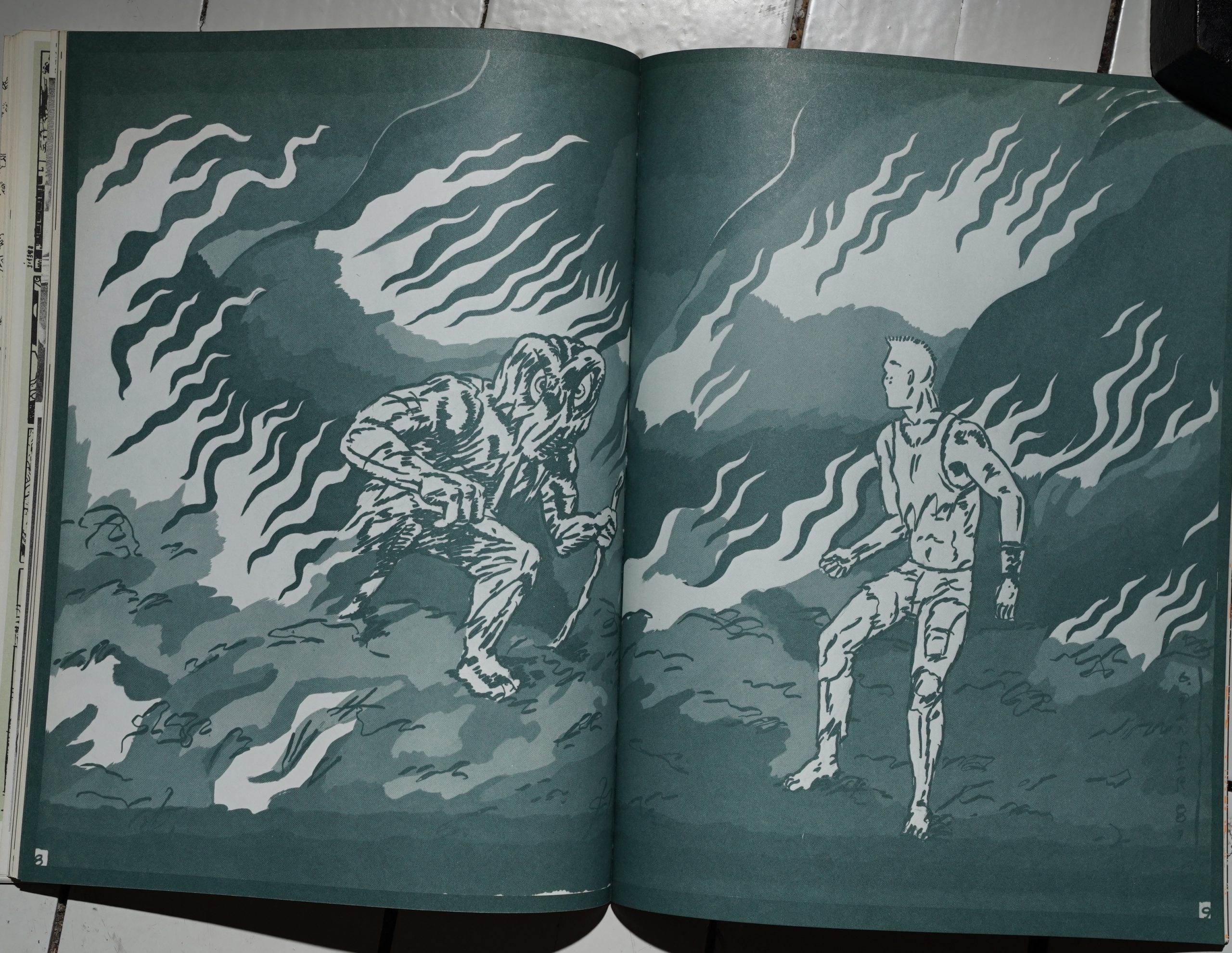
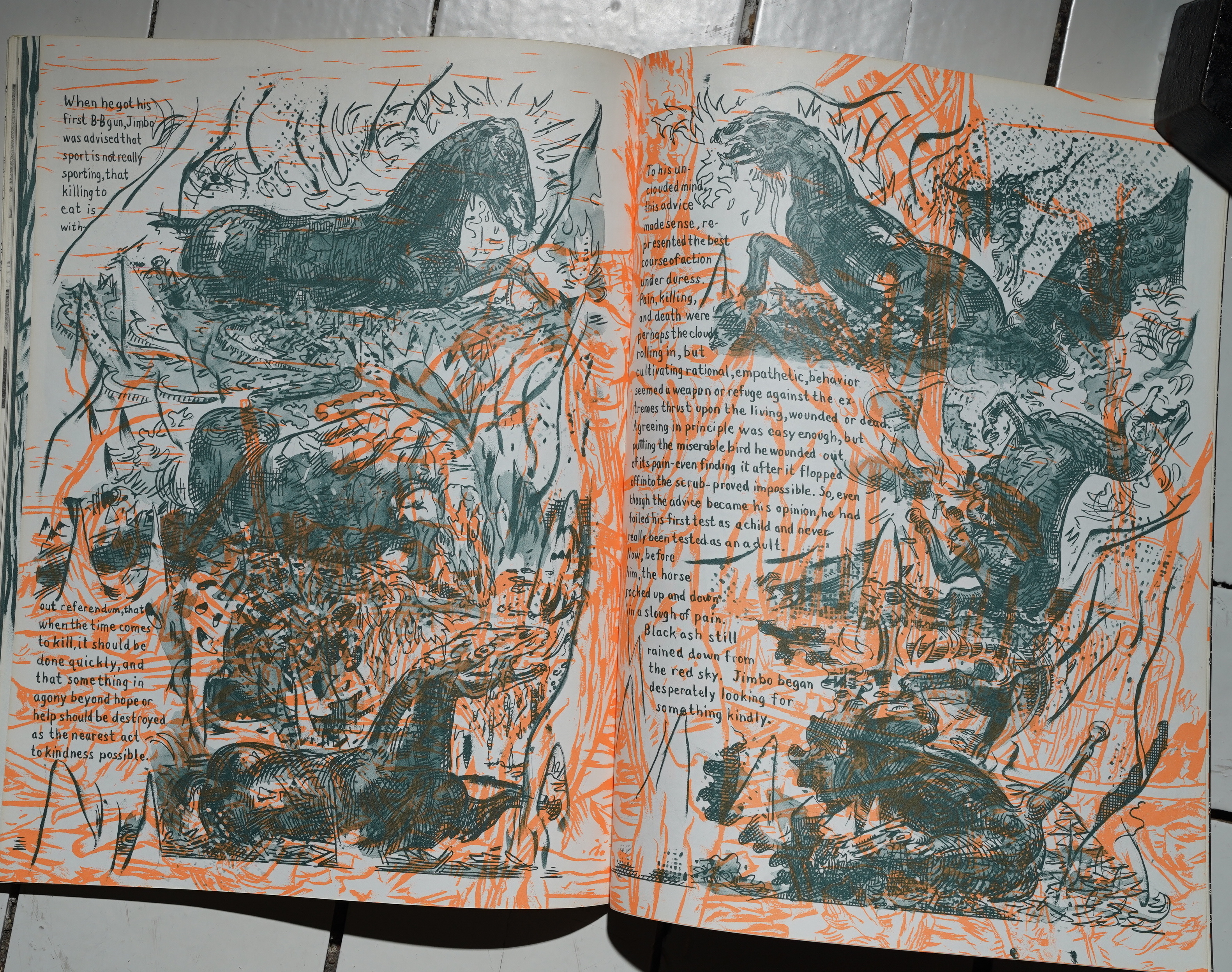
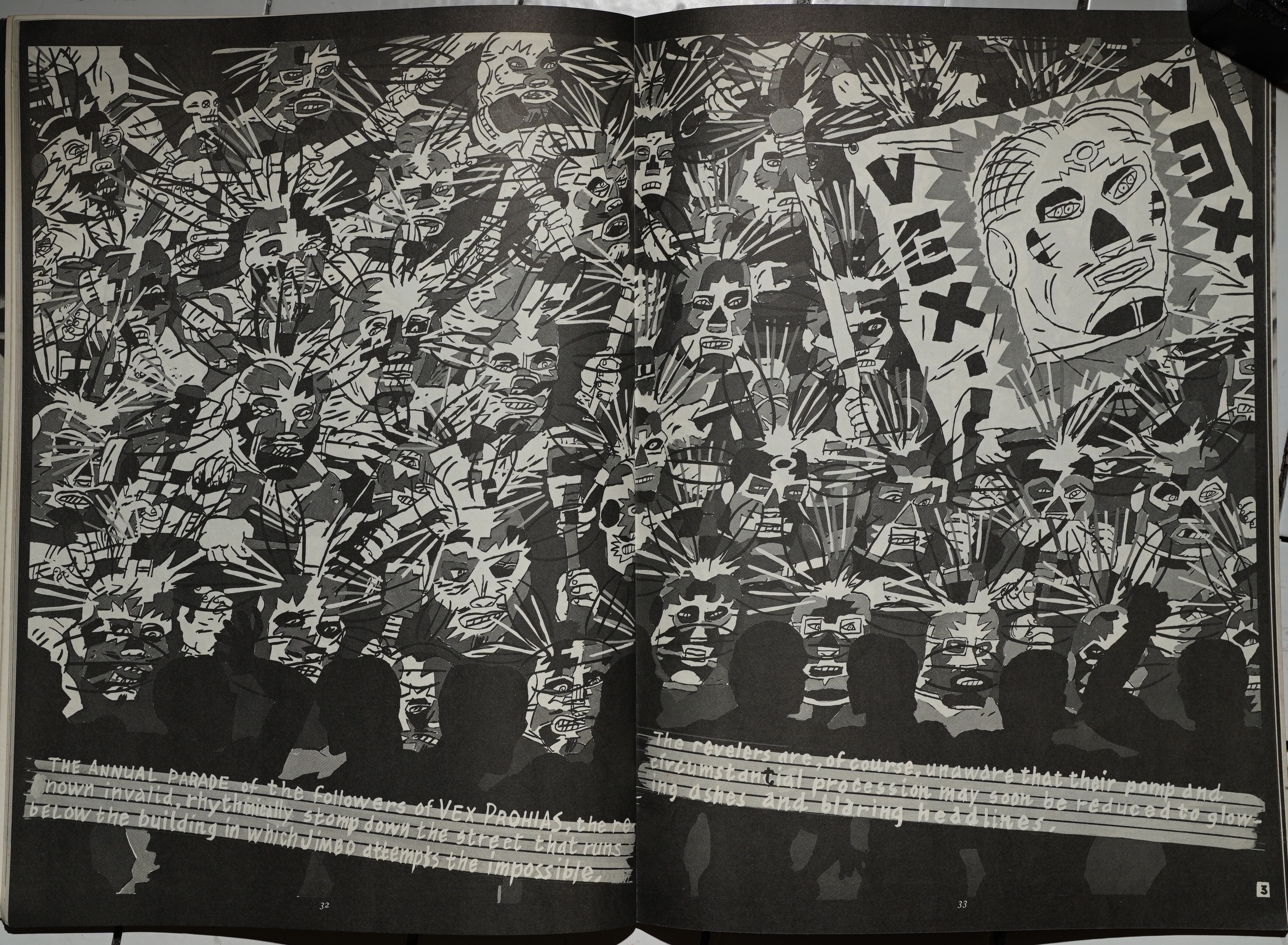
When we get to the end of the One-Shot pages, they switch the ink colour to green…
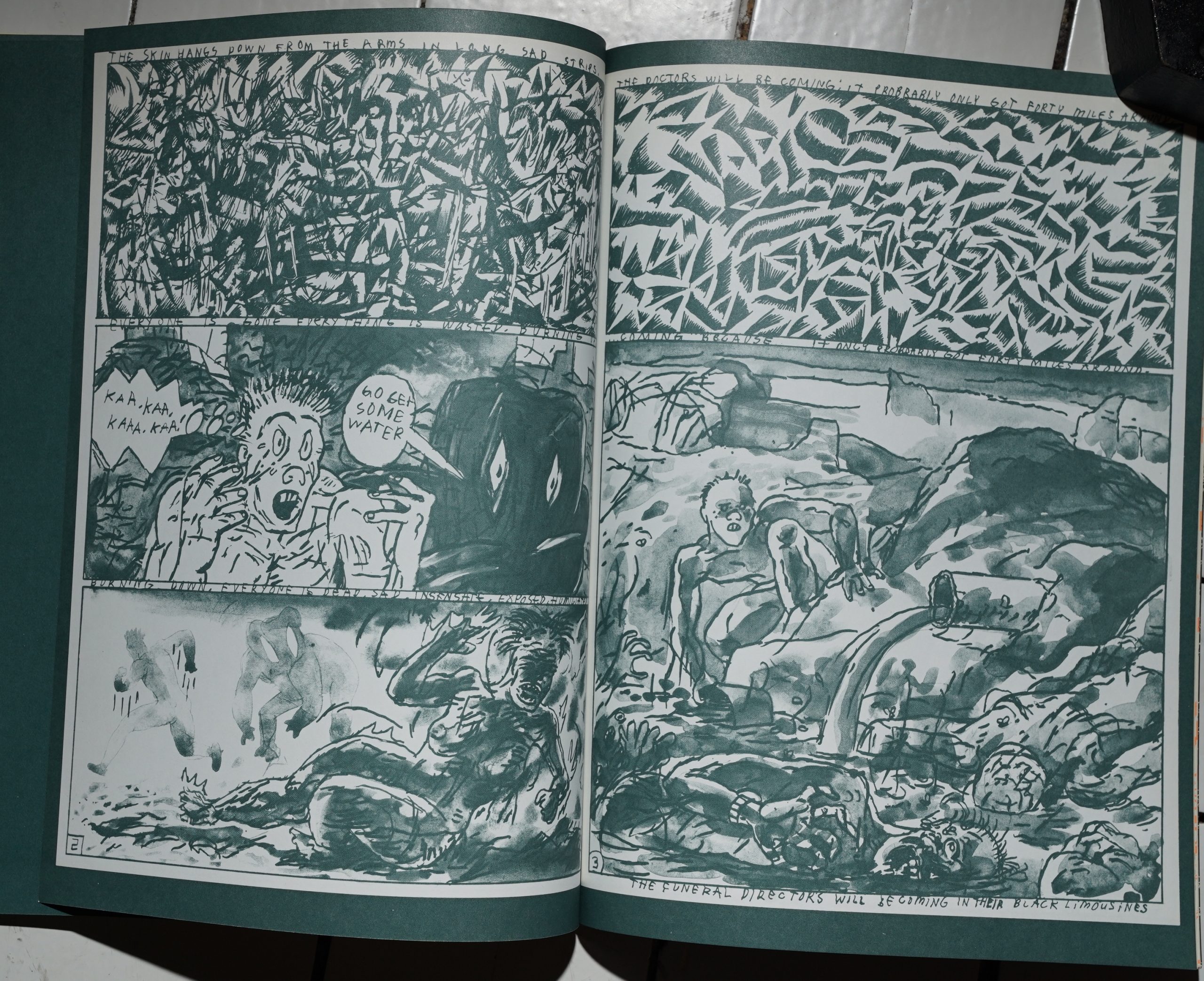
… which was how these pages, originally from Raw, were printed. These pages follow on right from where the One-Shot ended, so they feel very natural here (as opposed to the other stories that were inserted in the middle).
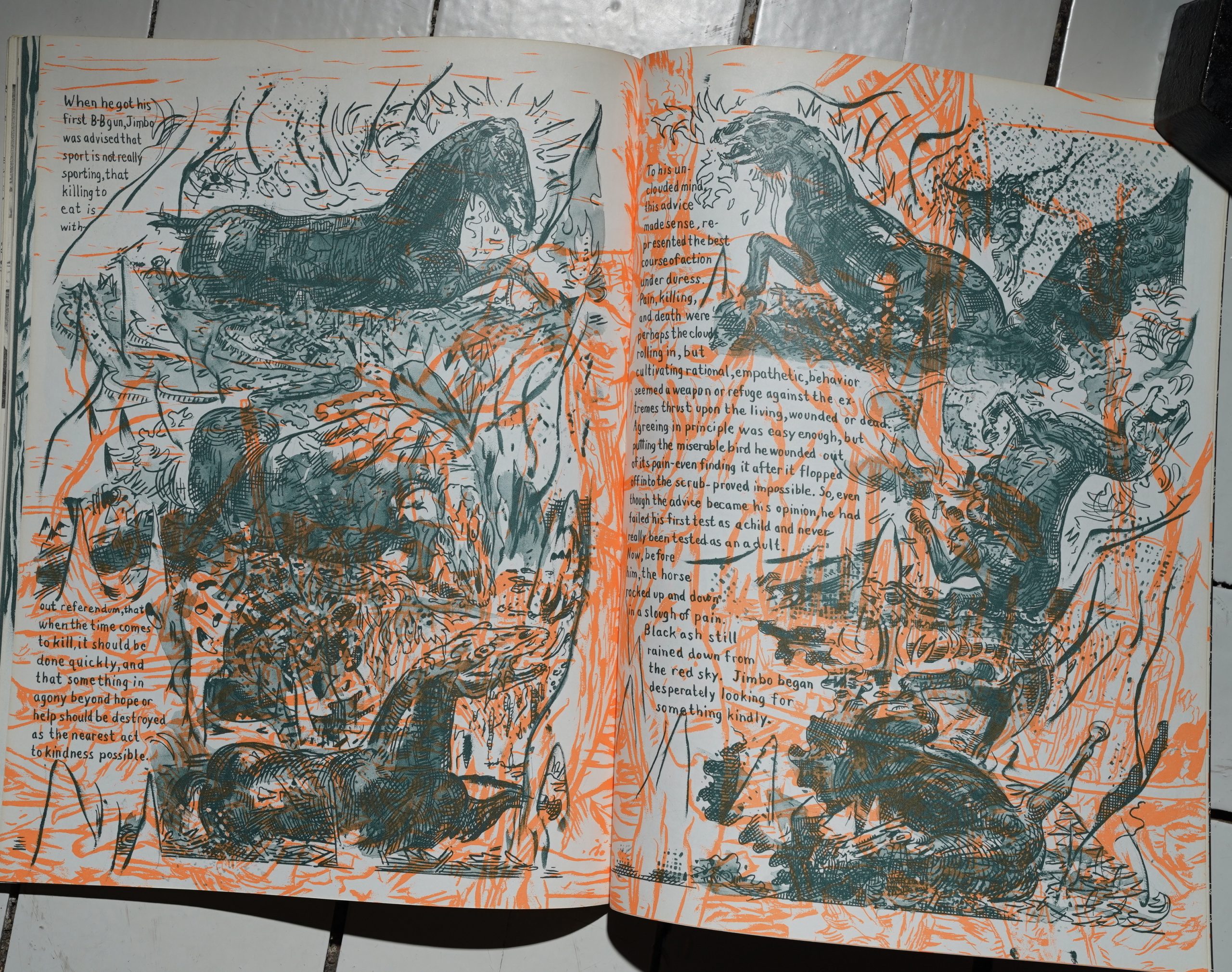
It’s very powerful.

But it’s an odd book. The “prequel” additions don’t seem to add much of anything, and the Jimbo Erectus bit inserted in the middle made no sense, but the addition of the ending from Raw was perfect.

Panter is interviewed in The Comics Journal #250, page 220:

KELLY: Can you walk through the pro-
cession of getting involved With the Raw
crowd?
PANTER: My memory is faulty on-this I
started appearing in Slash magazine in
’77, I guess, the end of ’77, and if I’m not
mistaken, Art and Frangoise saw Jimbo,
or someone showed it to them, and they
approached me and asked me to con-
tribute to Raw, but there may be anoth-
er true story, but that’s the one I remem-
ber. And I think I was in by issue two or
three, I’m not really sure. Thads basically
how it went. I’m not sure if ld come in
contact with Charles Burns at that point.
I had seen his work through Matt
Groening, and Lynda Barry in the free
papers, and in self-published minicomics
and stuff like that. I was really excited
because I’d been doing this kind of work
since the early ’70s. I went to college in
about ’69 and started doing cartoons in
’71 and ’72. Jimbo actually dated from
about ’74, I think. And so it was really
ideal, and Art and Fransoise were great
and they were very dedicated editors and
very involved in putting out a good,
high-quality magazine, not just putting
anything in it.
KELLY: HOW much they push you to
stretch yourself
PANTER: They praised and encouraged
me to be myself. I was just ready to go. It
was more they have a real Art wants
things to cohere, so sometimes he would
help me make it make more sense. Like
when we did the Pantheon book, he
came up with a scheme to sequence all
the strips I had done. In my mind it was
just one big continuity, and all part of the
same thing, and I wasn’t really thinking
about the reader as much as what I was
trying to do in a scene. I always appreci-
ated that criticism. I really like
doing things over, but they never really
asked me to do things over. There was
just a lot more discussion and brain
power applied to the whole enterprise.
KELLY: Those are the strips that were includ-
ed in the mprint book that came out later?
PANTER: The Raw one-shot at first
and then the Pantheon book, and there
was also a collection of Jimbo right
before the Pantheon book. I unas
already interested in doing ambi-
tiously weird, experimental
comics, and even moreso after I
was contacted by Bruno Richard,
and Bruno played some role. Art
may have shown my work to
Bruno, or Bruno became aware of
it. Bruno took this world tour, in
I’m not sure what year, ’78 or ’79,
just visiting all the weird artists
and underground cartoonists that
he could find and really put a lot
of people together. And his work
with Pascal Doury and (Marc)
Caro, in the publication Sont
de Sortie, “The Girls Have Gone”
— it was really inspiring because it
was two or three guys working on
one piece of art, so they would
make it really dense, where I upas
dense to a certain level, they were
really going far beyond that, in
terms of density. It challenged me
to make my stuff denser, and I did,
visually.
KELLY: Were those pieces chat
appeared in Raw your first extended
narrative? The longer pieces that you
did?
PANTER: Well, I was working on
an extended narrative in Slash, but it was
just one page a month.

So it sounds like it was Spiegelman’s idea to interweave the Jimbo bits and pieces…

This blog post is part of the Punk Comix series.
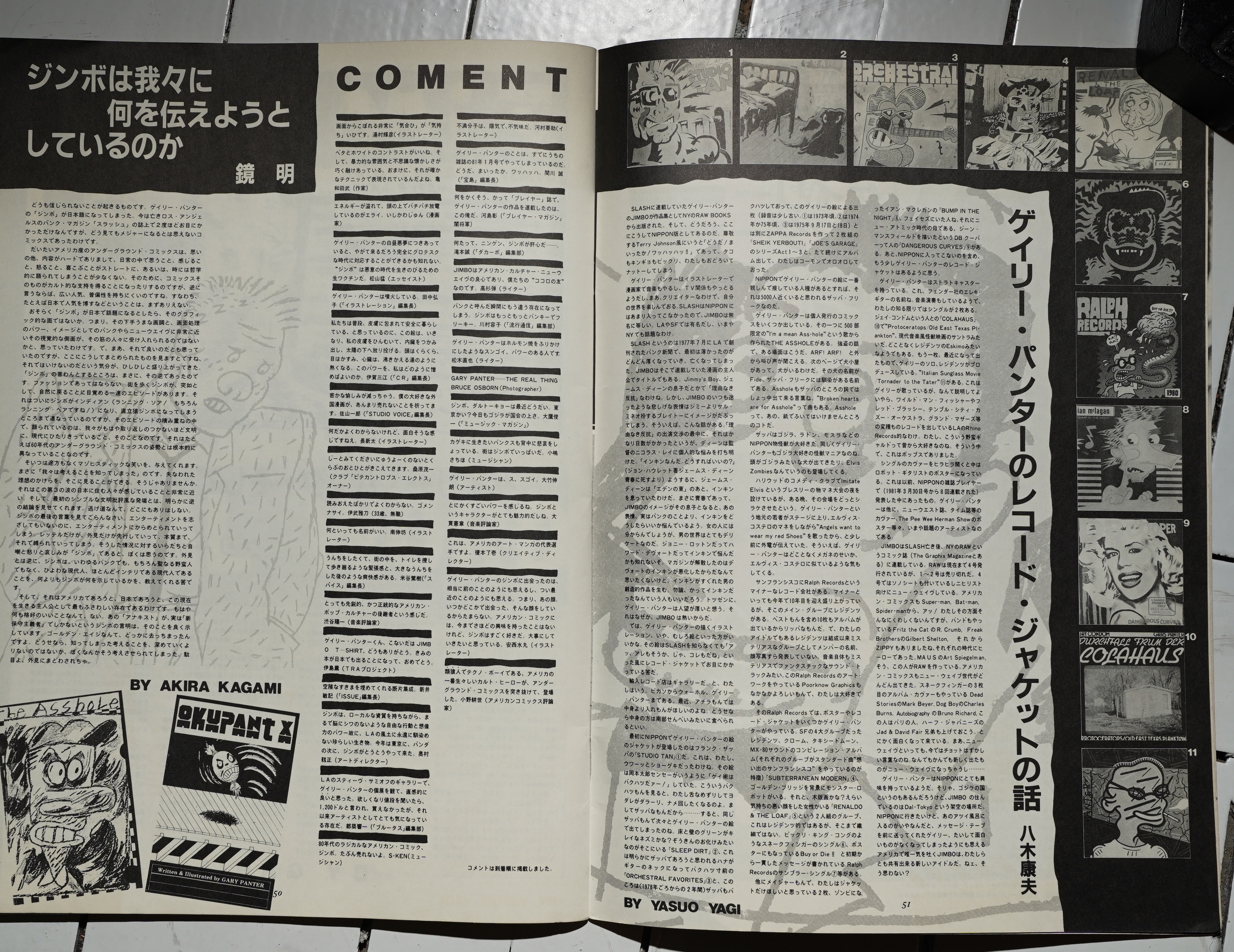
PX83: Jimbo: A Newwave Comic Art

Jimbo: A Newwave Comic Art by Gary Panter (260x364mm)

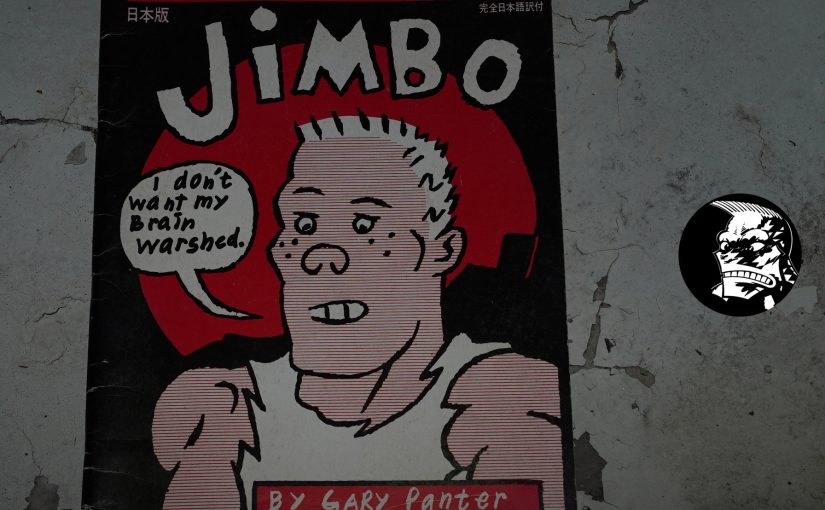
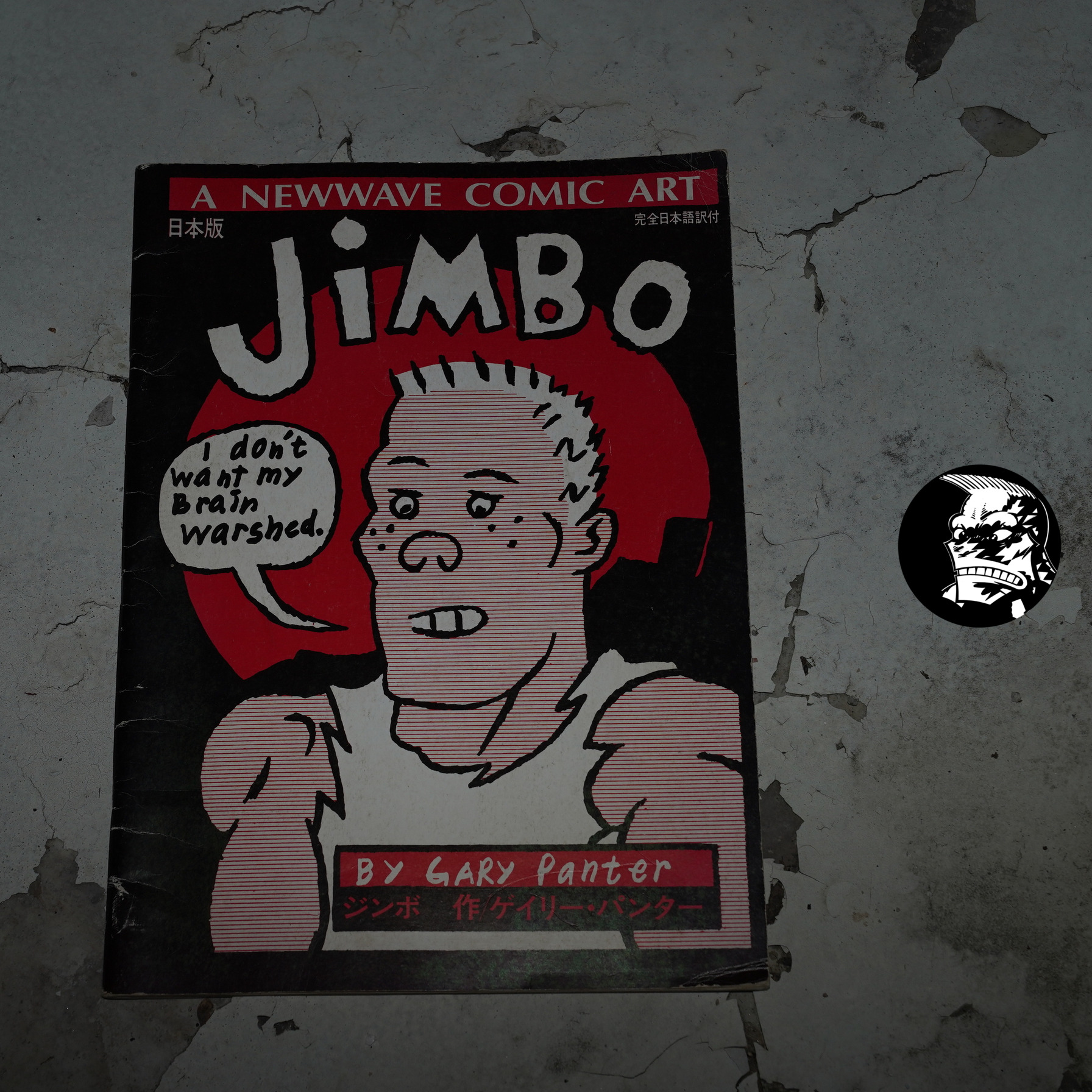
This is a Japanese edition of the first Jimbo book, and was apparently published the year after. I don’t know what the story behind this was — somebody in Japan saw the book and were so enthused that they had to do an edition straight away? But then again, the Japanese have always had good taste…

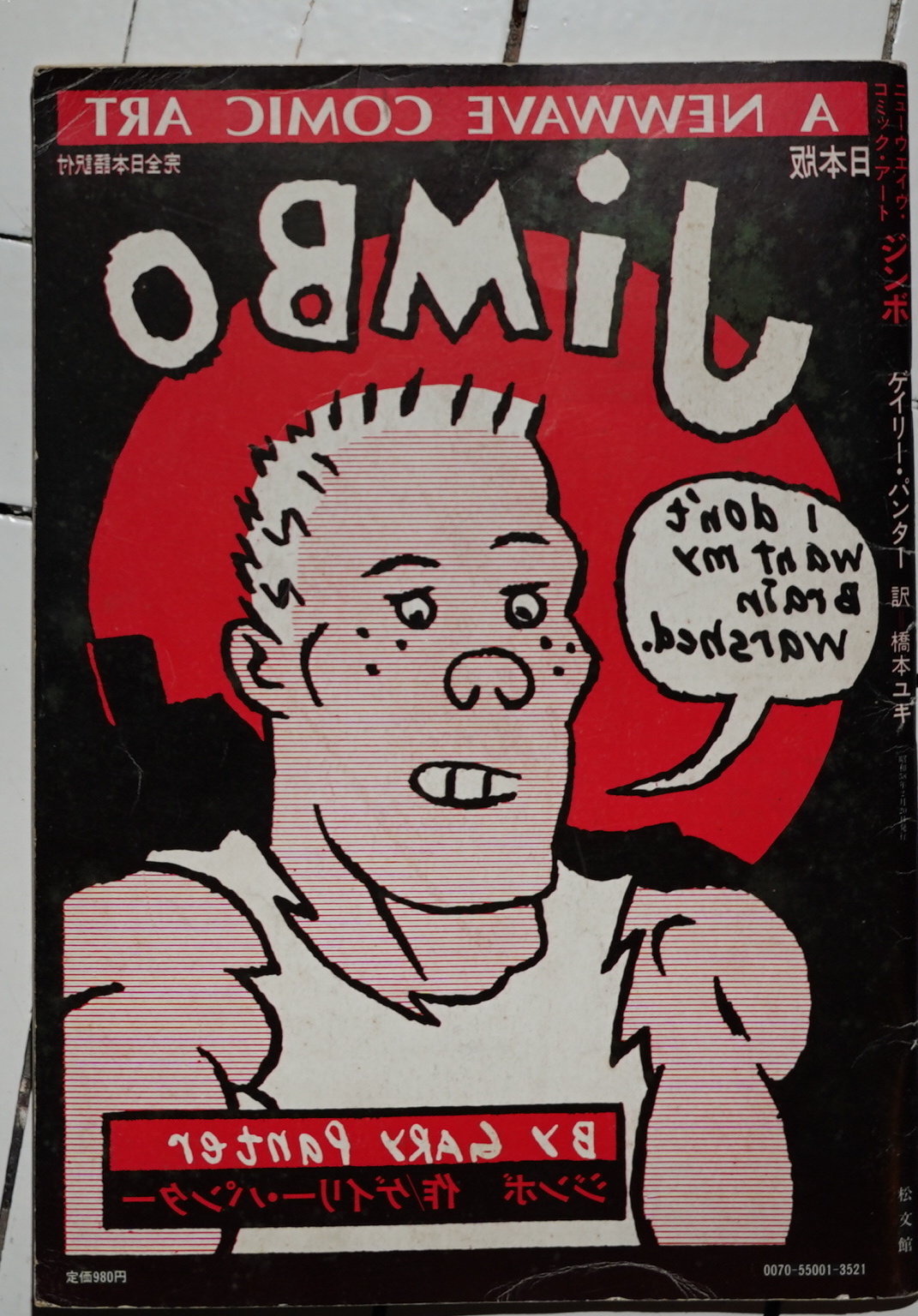
The cover is the same as the inset on the original edition — but enlarged.

The publisher is apparently Shobunkan, and I got this copy just the other week (from Japan via ebay).

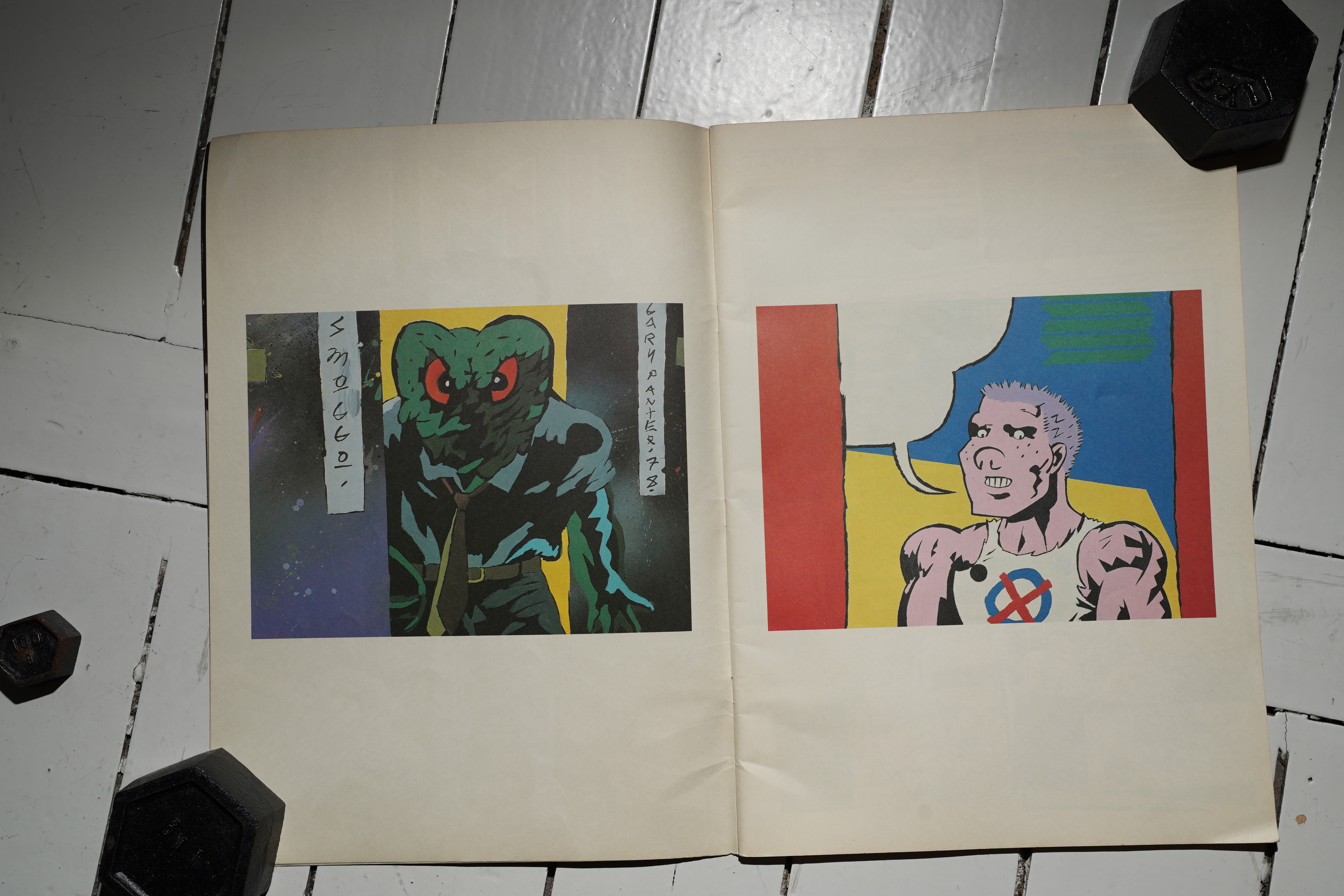
It’s not a straight-up reprinting of the cardboard Jimbo — it has a colour section in the front and the back.

But then the bulk is a reprinting. This is on better paper, so everything looks … clearer. But perhaps not as exciting, somehow?

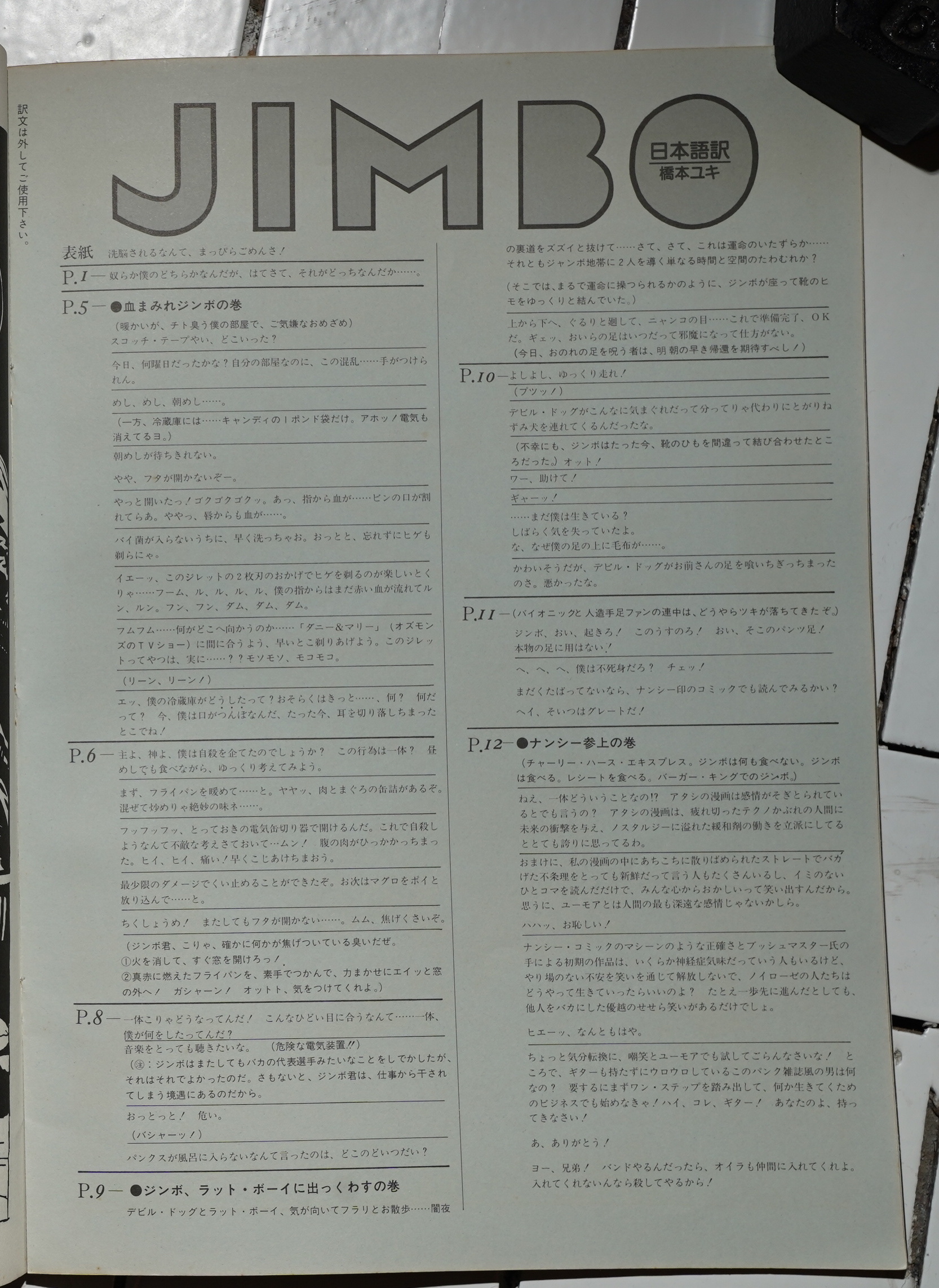
You may have noticed that the pages aren’t translated, but there’s an insert with Japanese translations.

These portions (in shades of grey) were pretty much illegible in the original edition, but are easy to read here.

And then we get two of the Jimbo pieces that had appeared in Raw before. Neat.

And finally, what I assume is a comprehensive bibliography…

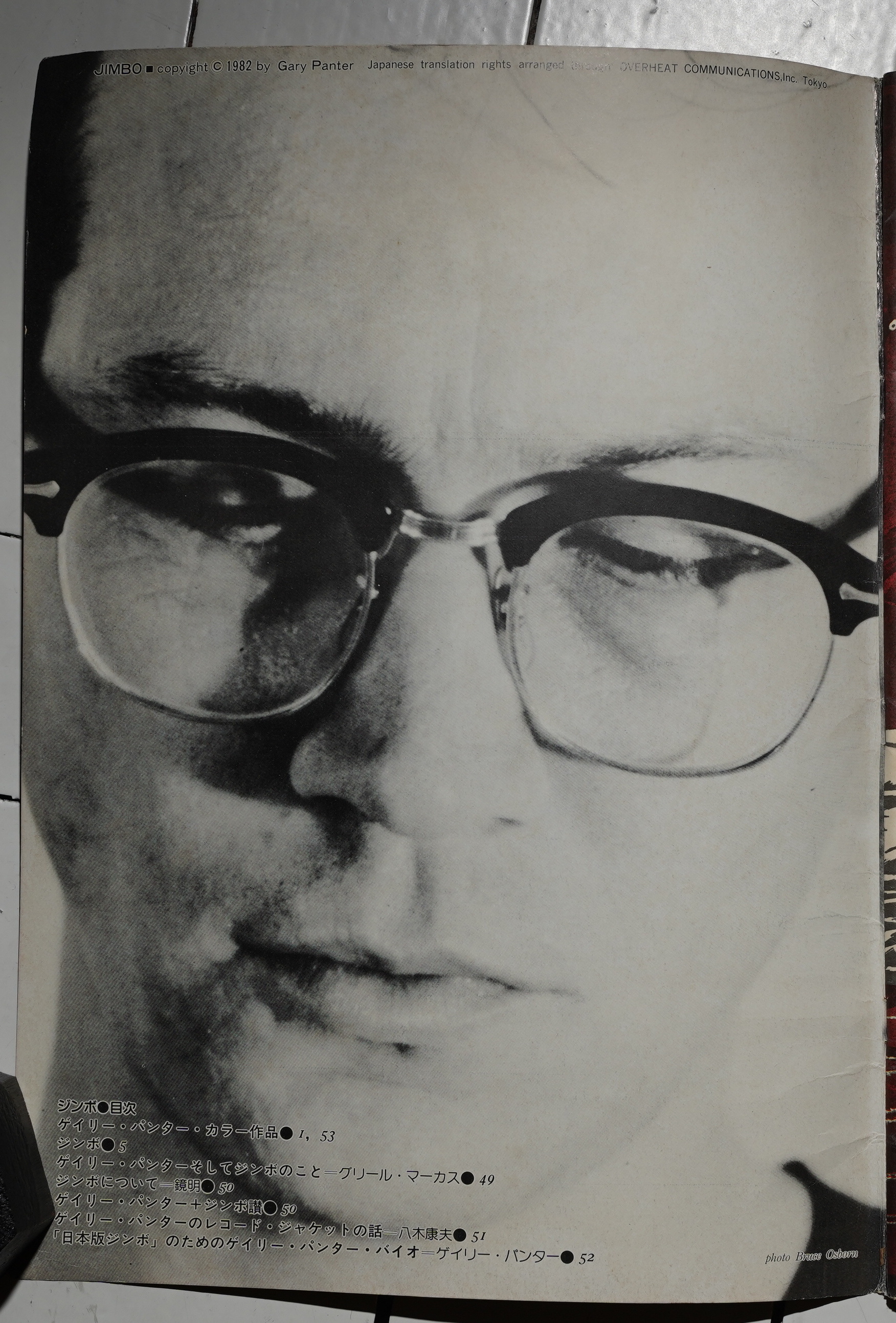
… and a short biography, along with some pics of Panter, looking very punk.

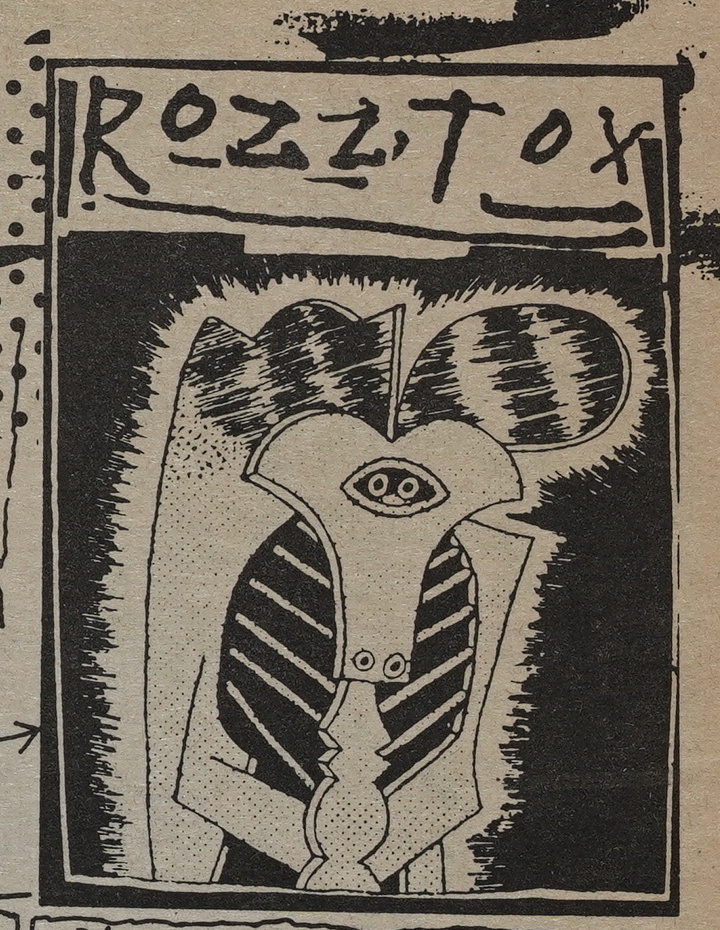
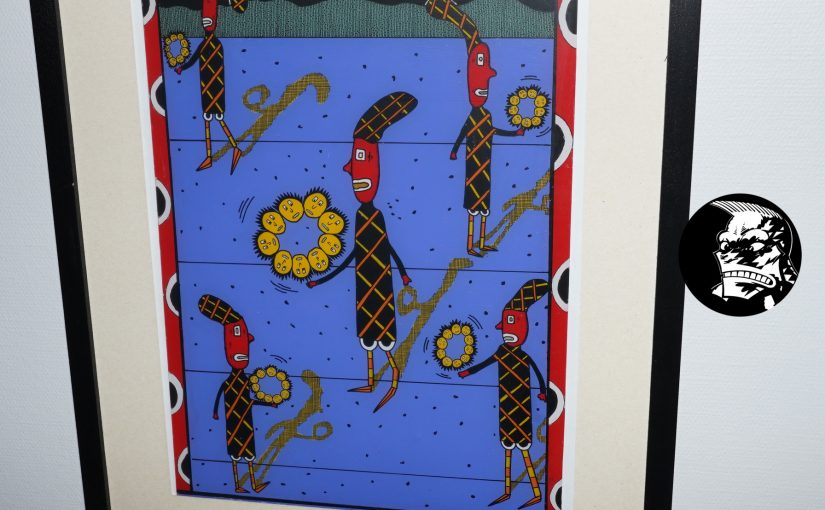
And colour paintings of the Rozz Tox guy!

And the back cover is reversed.

So. It’s a very handsome book.

This blog post is part of the Punk Comix series.
PX82: Raw One-Shot #1: Jimbo

Raw One-Shot #1: Jimbo by Gary Panter (278x368mm)

Let’s do a Jimbo mini-series in this blog series: The rest of the week we’ll be looking at various Jimbo permutations.

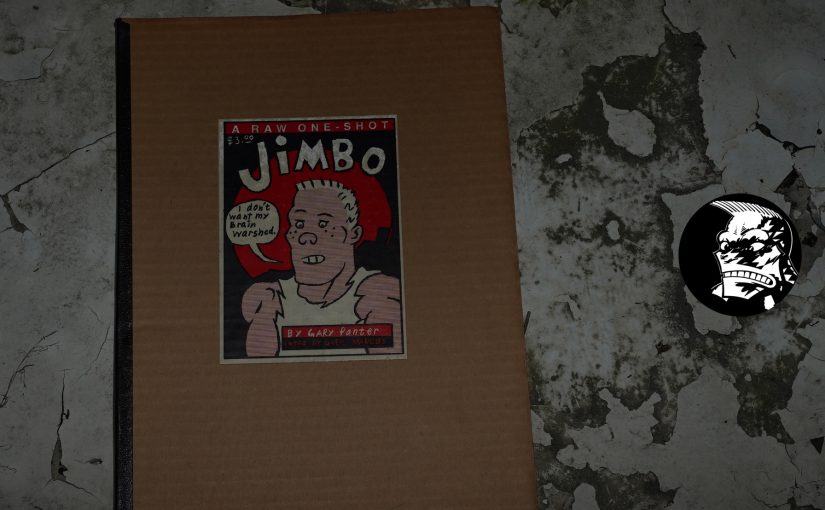
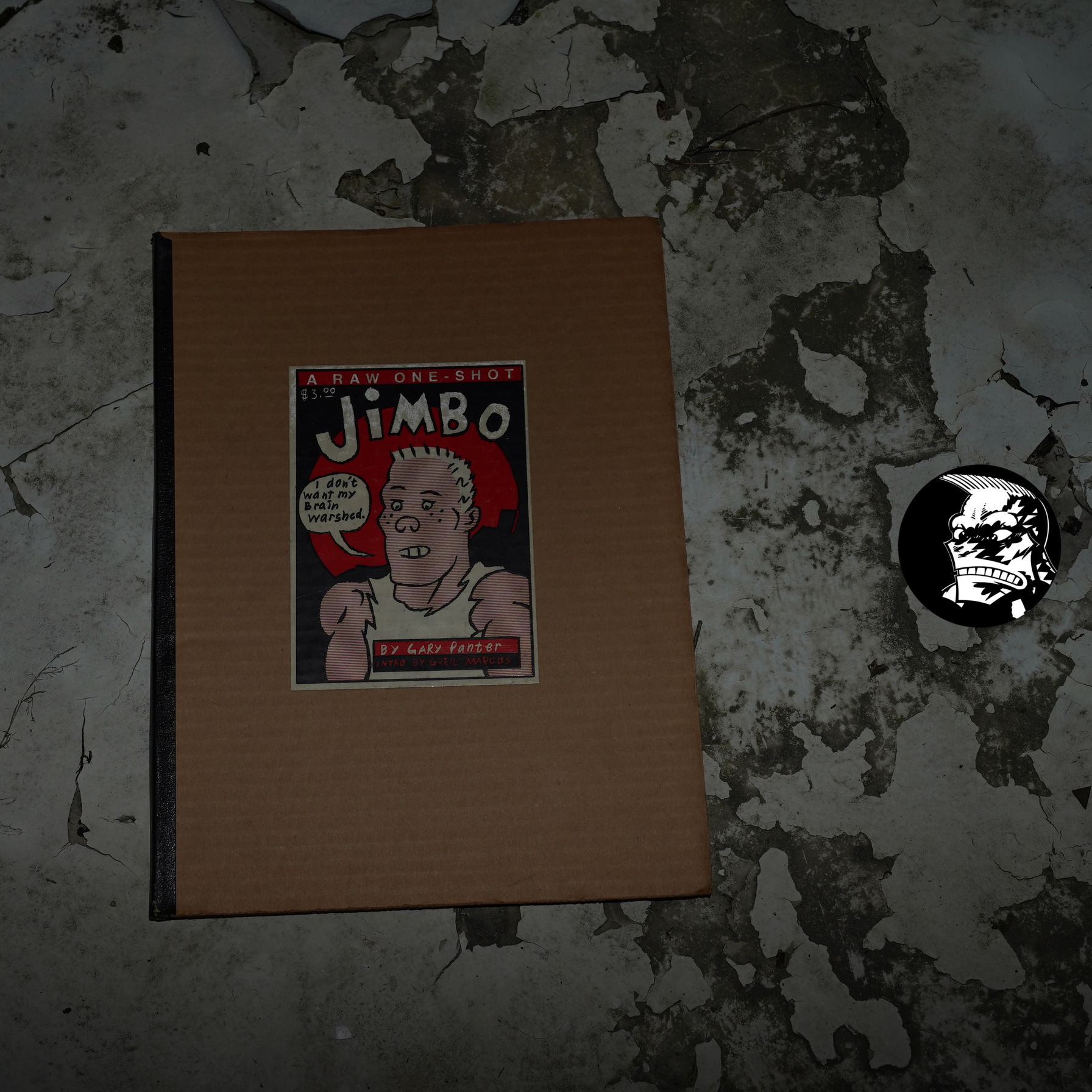
The cover here is corrugated cardboard with a coloured inlay glued to it. And I guessed by looking at it on the intertubes that it was two pieces of cardboard with gaffa tape as the binding…

But nope. It’s one solid piece of cardboard that’s been bent into shape.

Shocker!

Anyway.

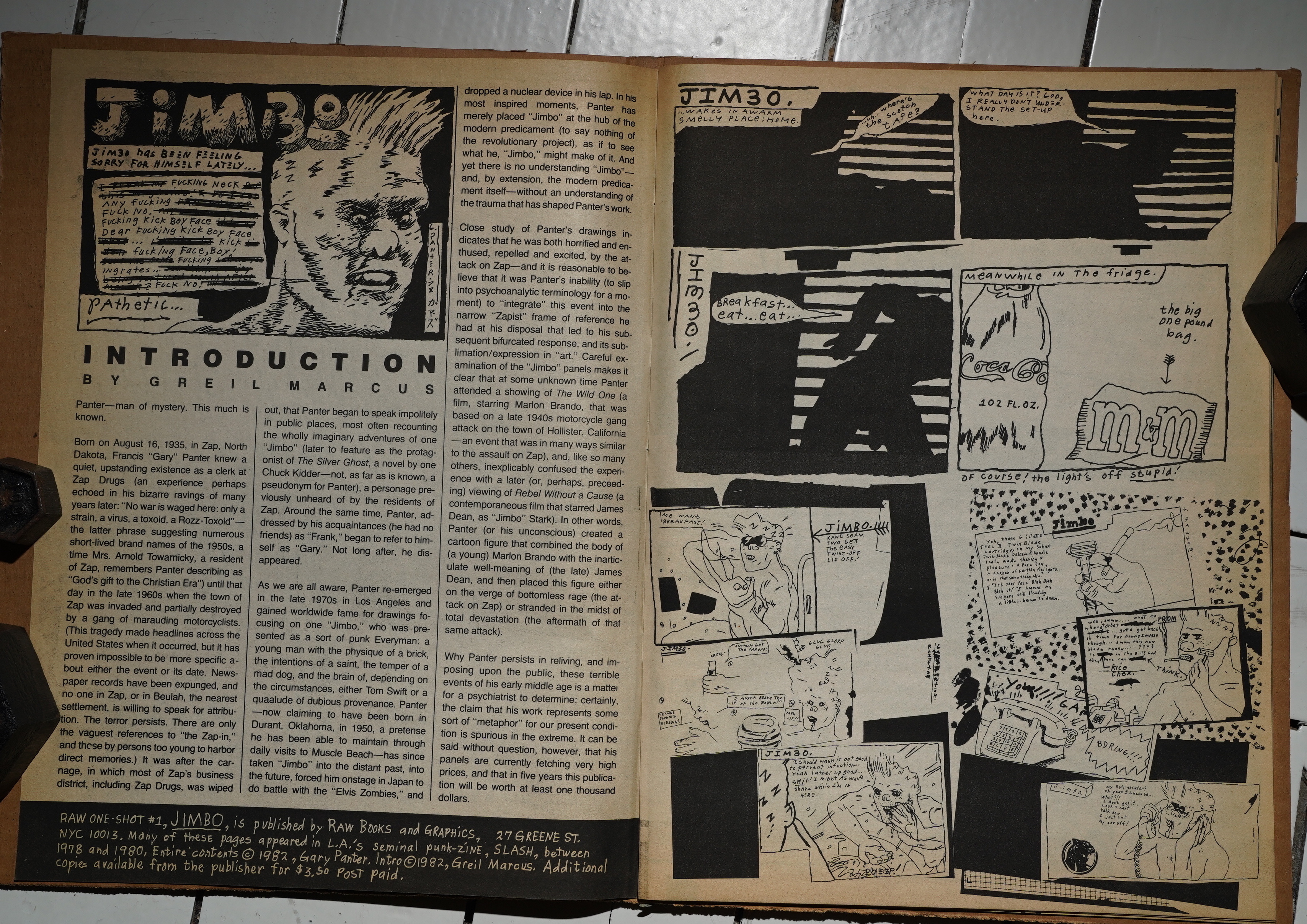
These pages originally ran in Slash magazine, and I’ve tried scoring some copies off of ebay, but has had no luck so far. So I’m guessing punk music nostalgia is a huge thing still? Or perhaps no copies survived? In any case, Greil Marcus, the noted music critic, provides the introduction — and is even namechecked on the front cover, so I guess that was a major selling point?

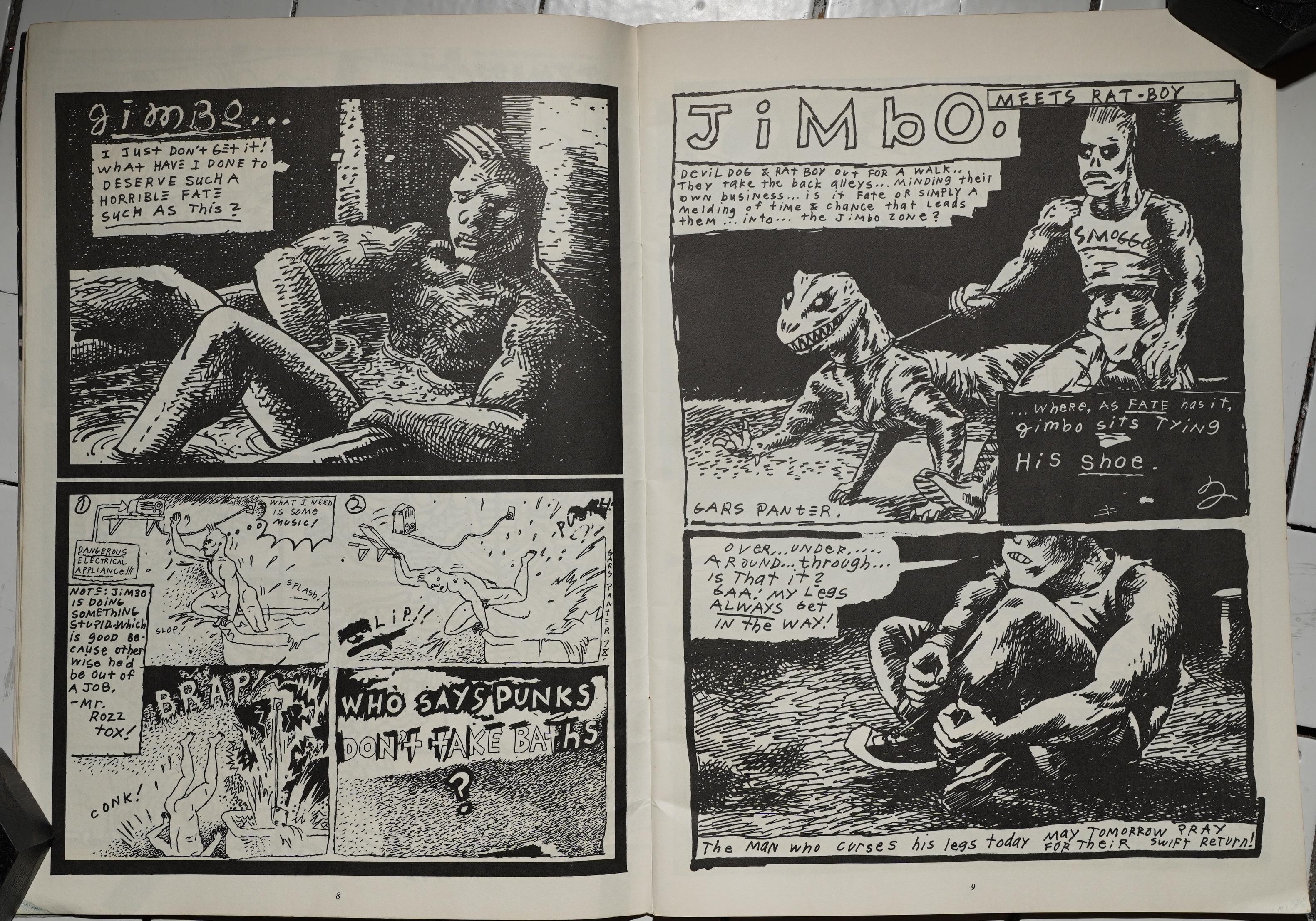
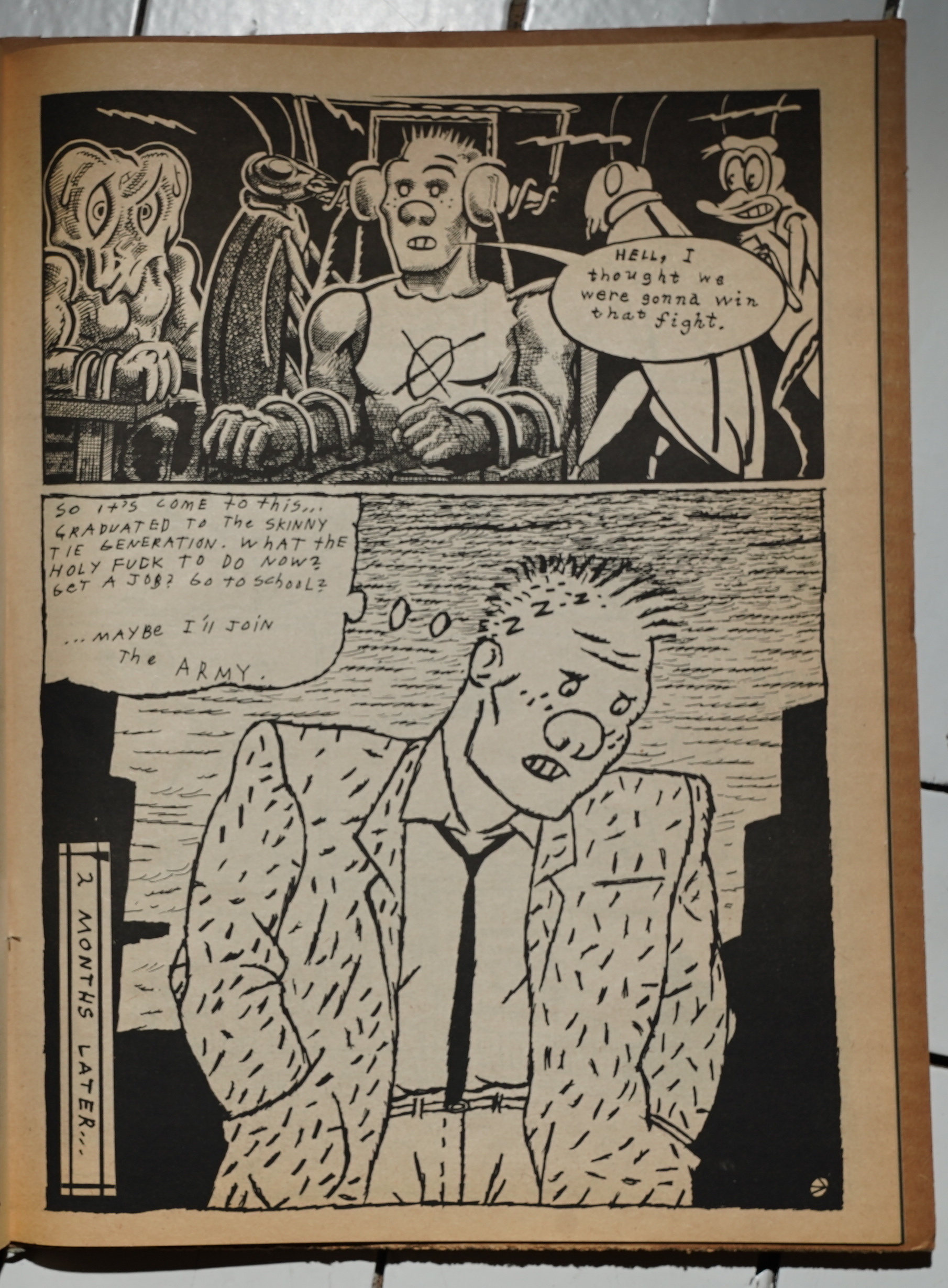
The first few Jimbo pages are all about Jimbo being a klutz and hurting himself…

… but it’s not all ratty slapstick.

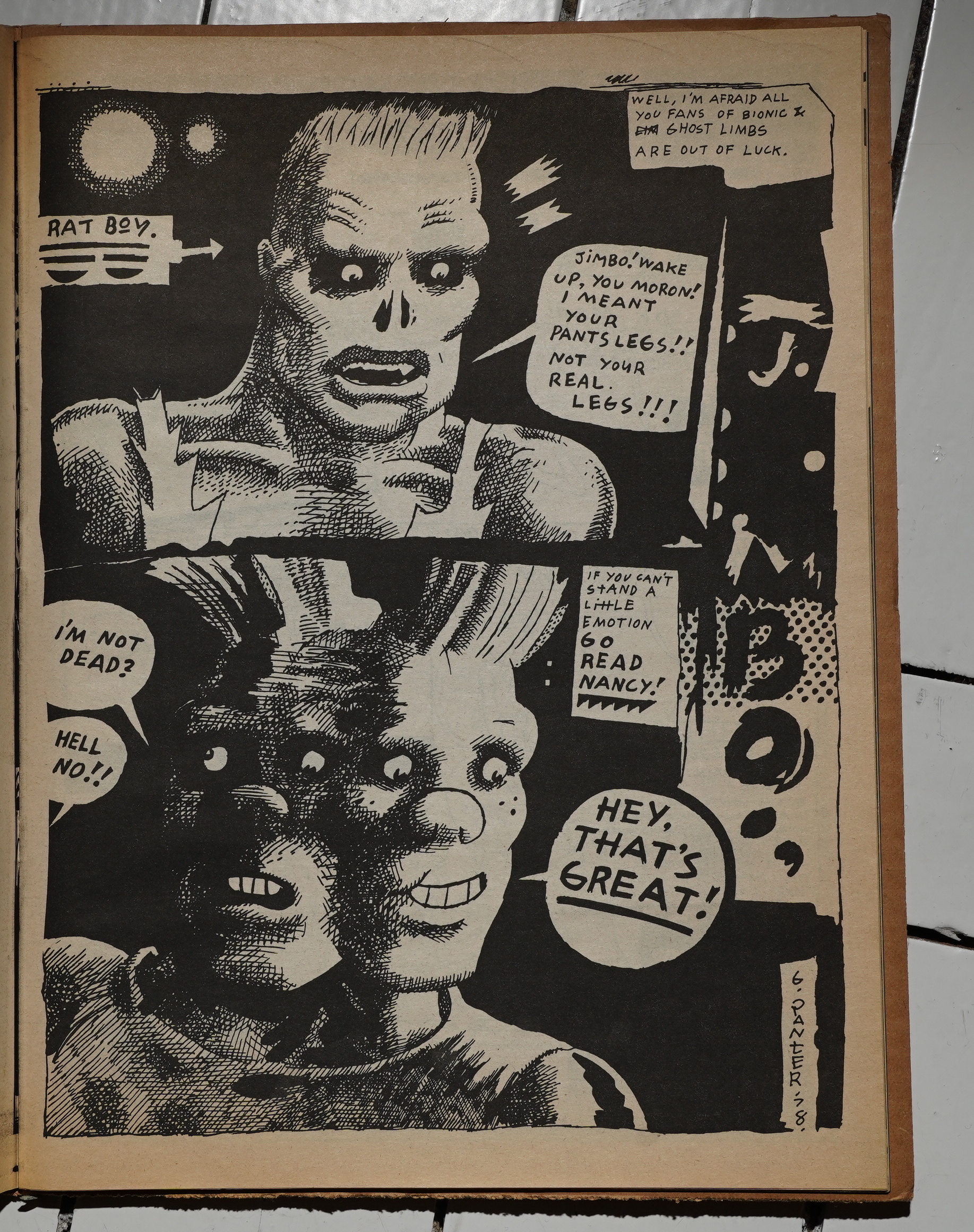
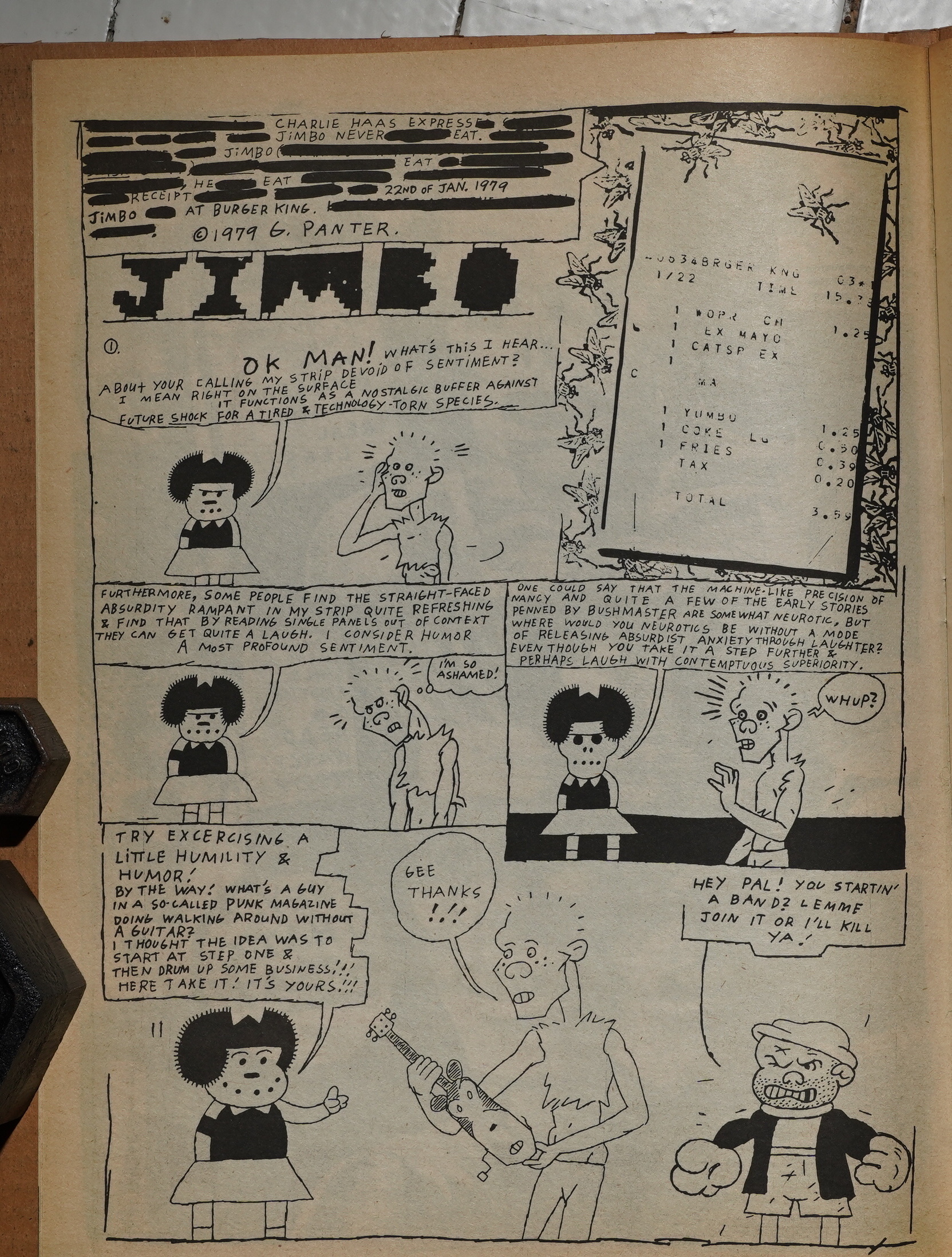
Panter’s rendering techniques shift wildly. And… *gasp* He’s dissing Nancy! That’s controversial: Nancy was becoming a cause celebre in those days.

And indeed, the next strip walks the Nancy diss back.

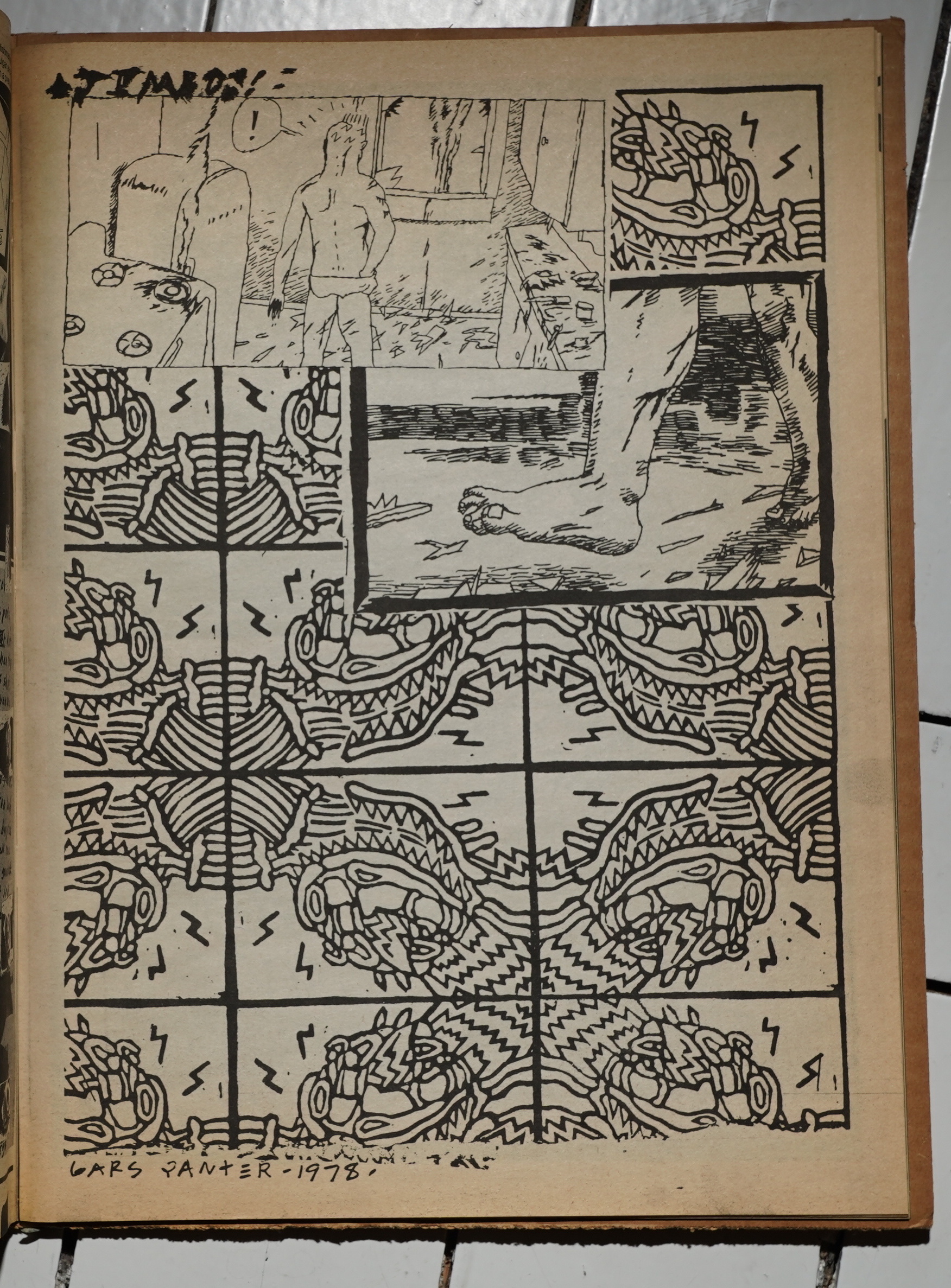
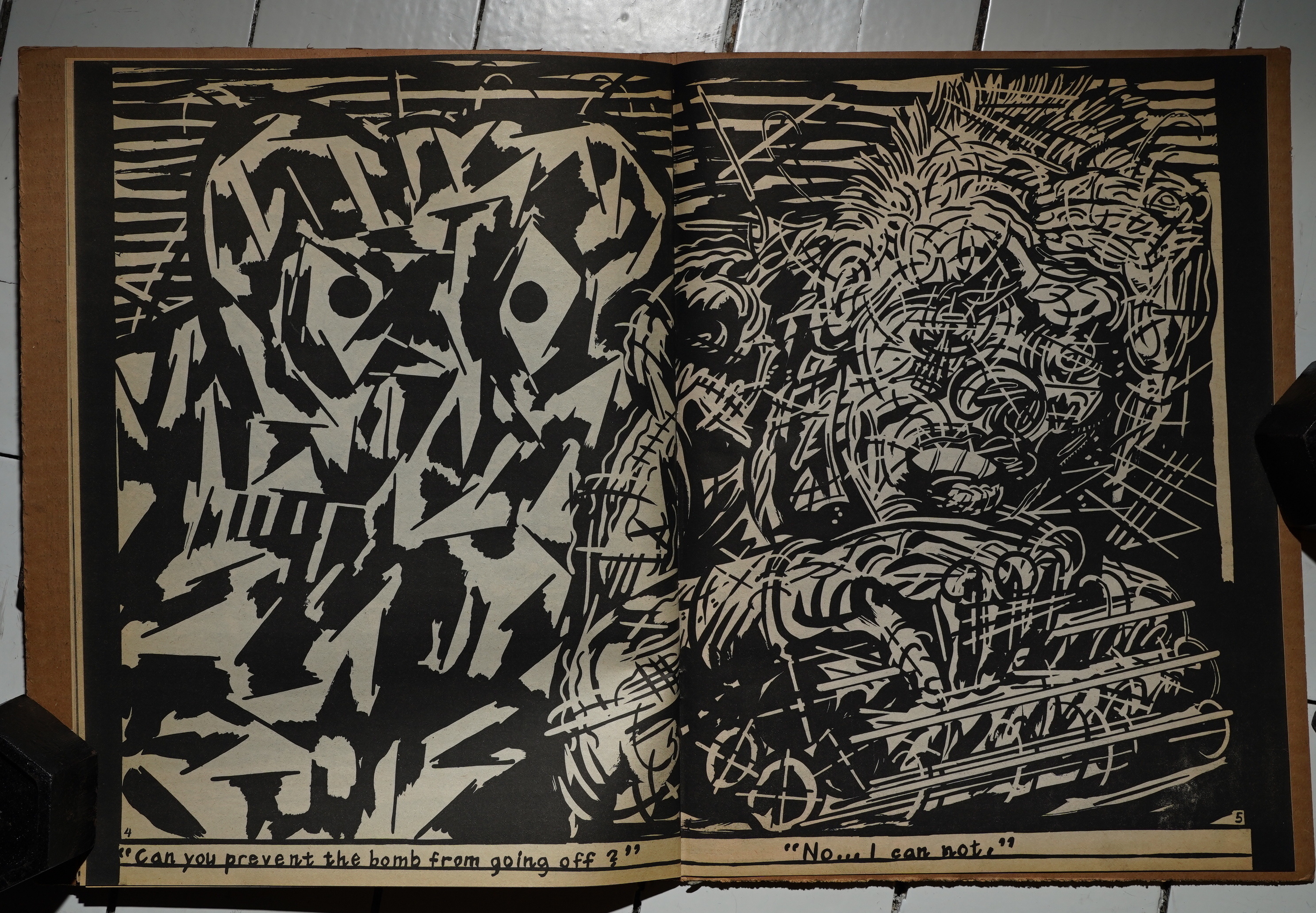
I love the artwork on all these pages, but there’s something just kinda mind-bogglingly amazing about this panel.

That’s the image that was used on that Rozz Tox manifesto, isn’t it? It sure is.

The story here is pretty er slight: Jimbo’s girlfriend is kidnapped, and then Jimbo is brain warshed (sort of), and then a nuclear bomb is set off. Oops spoilers. But it’s a really entertaining read — it’s funny — but it also has a surprising emotional depth.

I’m guessing the last few pages didn’t appear in Slash.

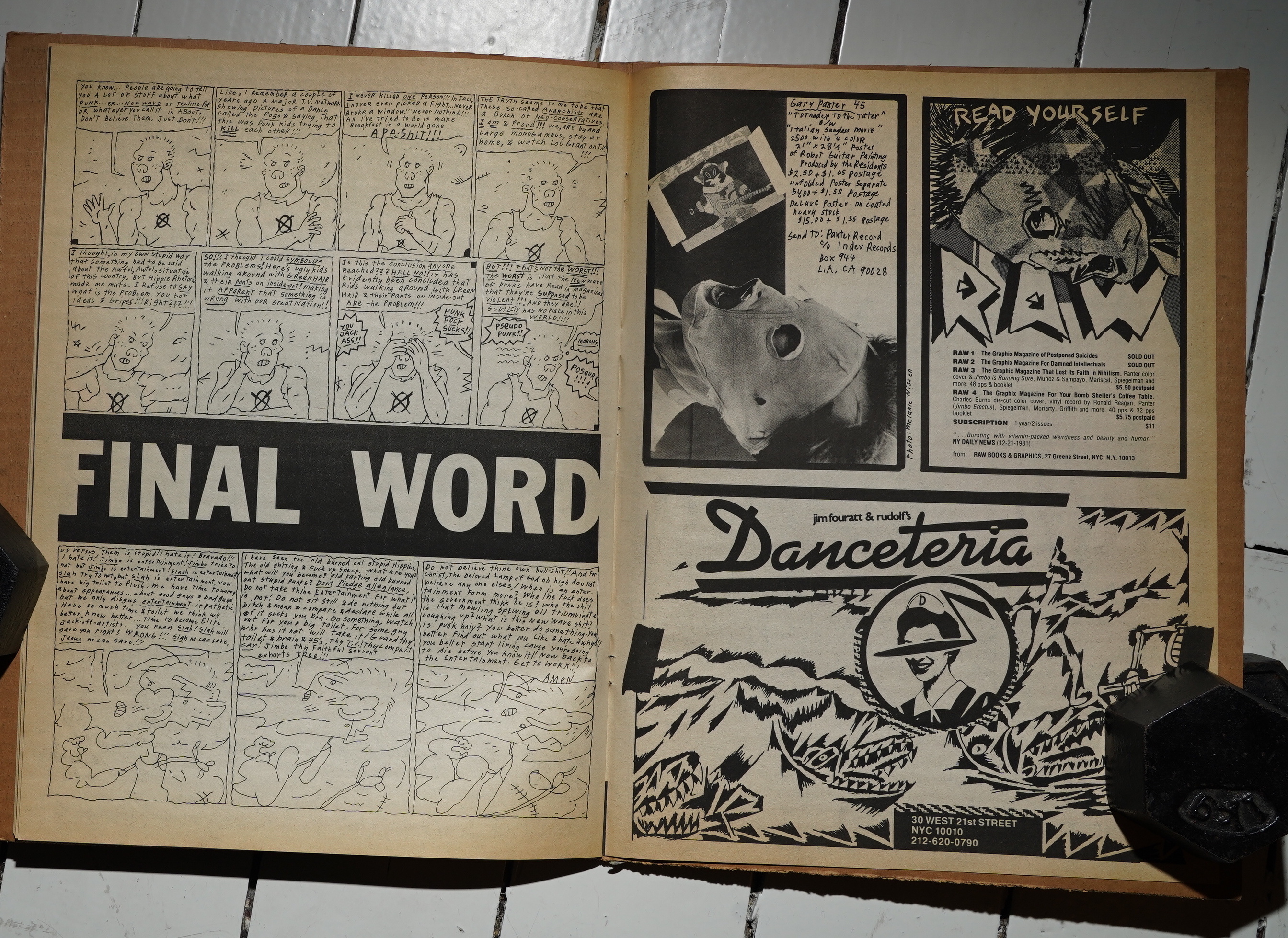
Panter signs off by talking about how punks these days aren’t real punks, but that hippies still suck.

And I love that Danceteria ad.

As an object, this book is such a thrill: Everything about it is totally perfect. Holding it makes my entire brain and body go “wheee”.

Bill Mason writes in The Comics Journal #93, page 32:

Increasing the dosage has served to
remove my reservations about Gary
Panter’s work, as well. “Subtlety has •no
place In, this world!” complains Jimbo ae
the end of the collection Of Panter pages
(Jimbo, Raw One-Shot recently issued
by Raw Books, and it amazes me noQv that I
mistook the first two pieces by Panter •L sgw
CTimb0 is ‘Running Sore”‘ in Raw 3 and
“Freaks’ Amour” in Young Lust as
amples of wilful) ugliness and adolescent
whining masquerading as expressionism:
Panter’s formidable draftsmanship and
design qualities remained invisible to
until I had familiarized myself with the.
range of lettering, breakdown, and inking
techniques (Often used in •combination
with halftone washes, collage elements,
crayon drawing, and zipatone overlays)
displayed to full advantage in khe Jimbo
one-shot, just as Jimbo remained inscru-
table to me as Running Sore until I had
gotten to know him as Jimbo.
This seems an appropriate place to men-
tion that the Jimbo one-shot is th*ltimate.
gift item for the bibliophile on ur list
who also happens to be a connoisseur of
Punkgraphismus: bound in two-ply corru-
gated cardboard and black electric tape,
the large-format (IOV2 X 14″) newsprint.
guts do ample justice to Panter’s linear and
tonal subtleties and are a stunning ex-
ample—a hackneyed phrase, but no other
will do—of Francoise Mouly’s mastery Of
the printer’s art. As for the contents: while
Jimbo thinks aloud and incurs frequent
•personal injury in the course of experiences
with safety razors, kitchen appliances,
girlfriends, mutants, cultists, giant
cockroaches, and thermonuclear devices,
Panter cheerfully plunders the world Of art
for stylistic analogs. Everything from
Picasso’s crinkled-tinfoil draperies and syri-
thesized monsterpeople to Sharaku’s bug.
eyed Japanese actors to Jasper Johns’s
obsessive pattern-making and crosshatch-
ing to who’s got a gag for me
today?”) Bushmiller’s equally obsessive
rendering of Nancy’s hair, is grafted onto
Panter’s own funky and abrasive drawing.
style. The resulting hybrid is a plant that
many people will hesitate to talk to, but it
lives.
Greil MarcuS’S description of Panter’s
hero in his” witty introduction to Jimbo
contains a surprising blundeq. The Writer
who began his admirable Mystery Train
with an account of what haÖpened wheri
Little Richard appeared as a guest on the
Dick Cavett show along with John Simon
and Erich Segal surely knows that there is,
by definition, no such creature as a Ypunk
Everyman.” punk Zippy the Pinhead?
would have been ah, the point.

This blog post is part of the Punk Comix series.