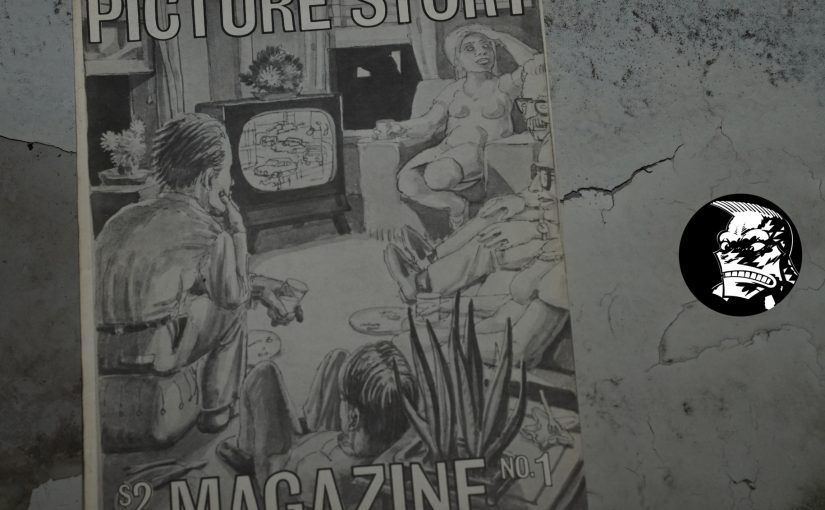
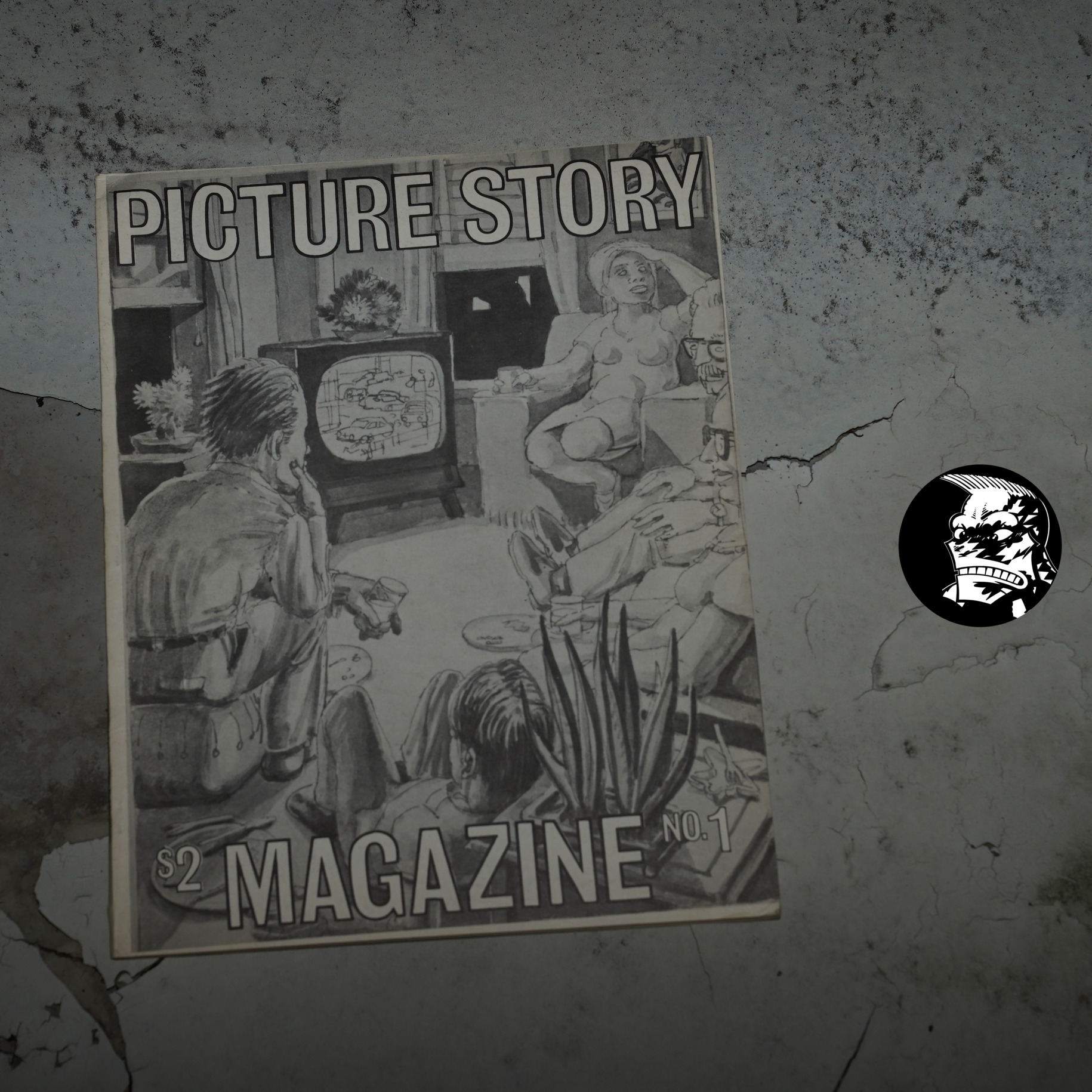
Picture Story Magazine #1 edited by Ben Katchor (215x276mm)
A lot of the comics I’m covering in this blog series I’ve had since I was a teenager — but more obscure ones, like this book, I’ve picked up over the last few years while thinking about doing this blog series. (Believe it or not, picking up oddball comics from New York wasn’t trivial in the early 80s when you’re living way north of the Polar Circle.)
So this is new to me… and it’s an early book edited by Ben Katchor, published by Brooklyn Bridge Publication. Which you may perhaps guess is Katchor and friends? I’m unable to find any mentions of the thing, but this says that the first issue of WW3 Illustrated was put together there.
It does share some of the obsessions that Raw would later display — like avoiding the word “comics” (going for the very serious Pictory Story Magazine, while Raw would go for more punny names), and making connections between comics’ (pre-)history and contemporary art comics. So here’s a Dutch thing from 1840…
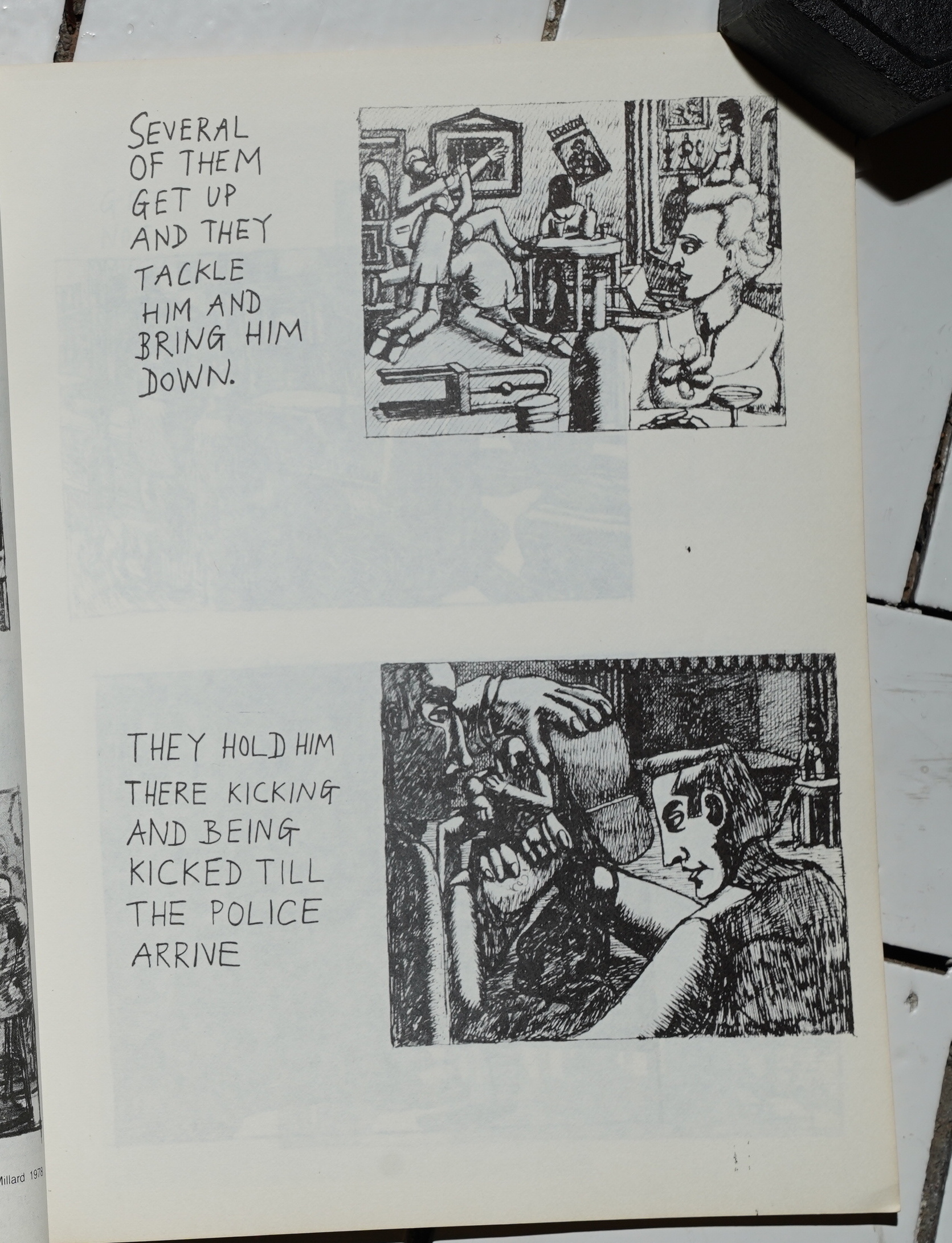
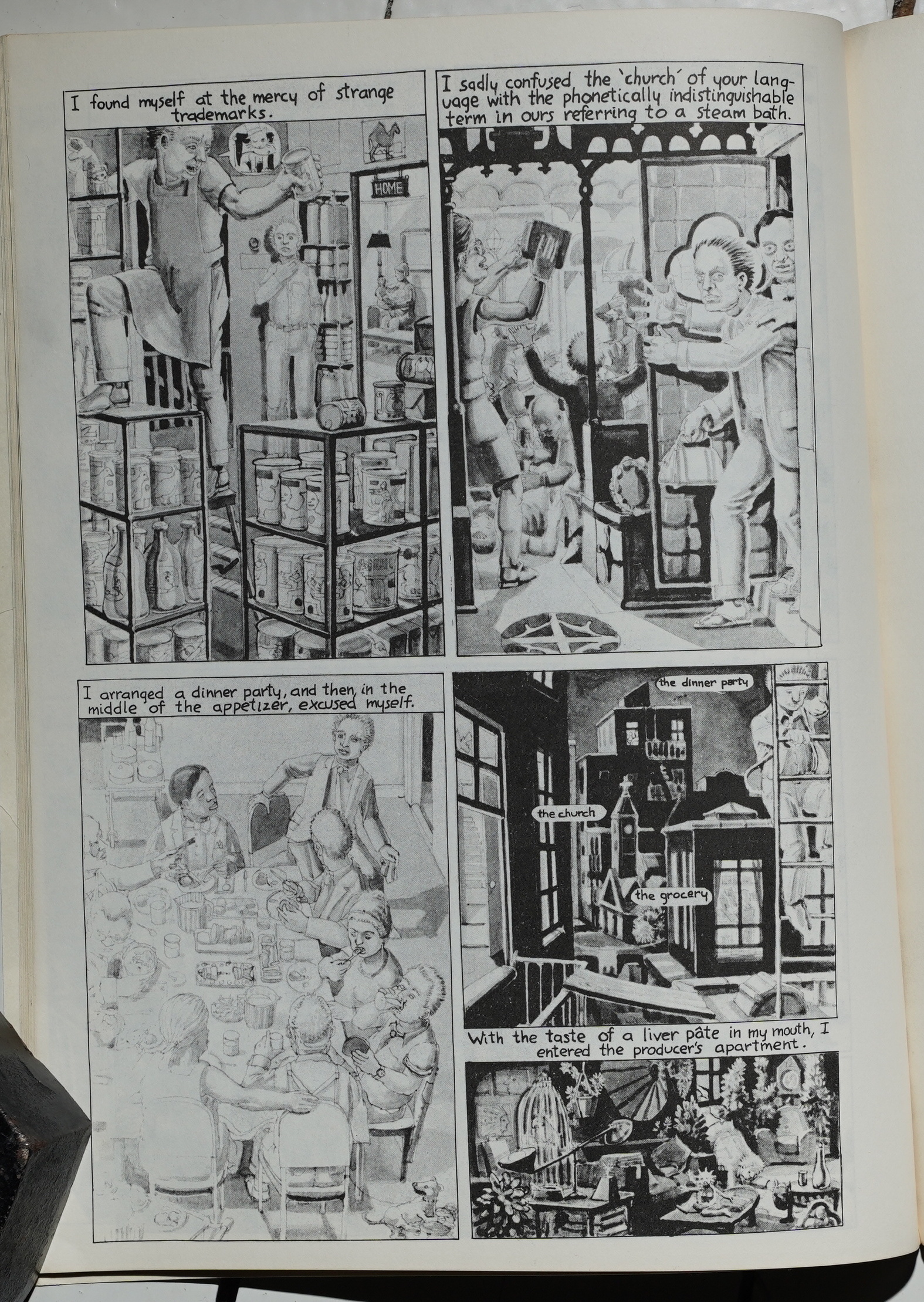
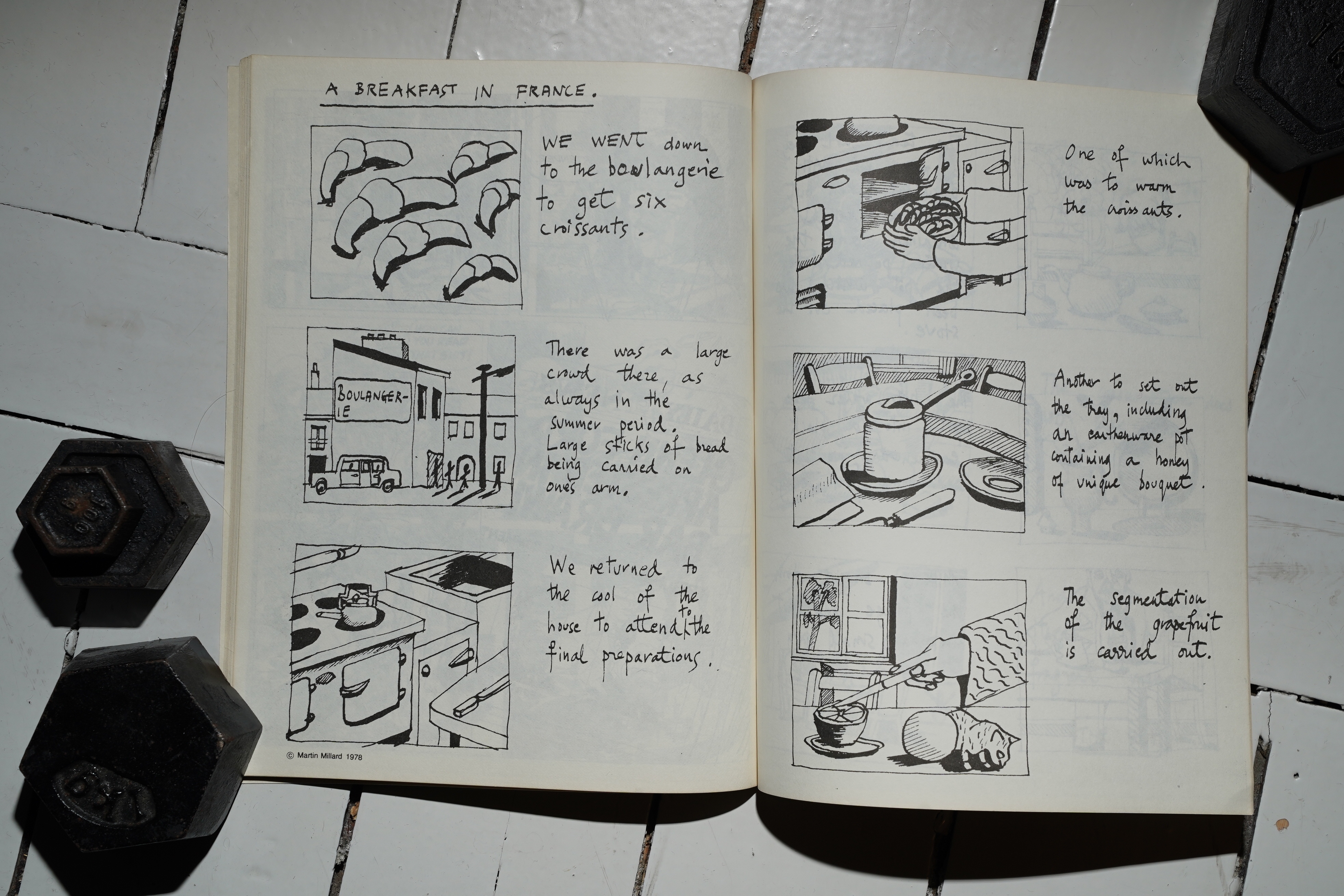
… and then a 20 page story by Martin Millard (possibly; it’s hard to make out the name) that kinda has echoes of the Dutch thing.
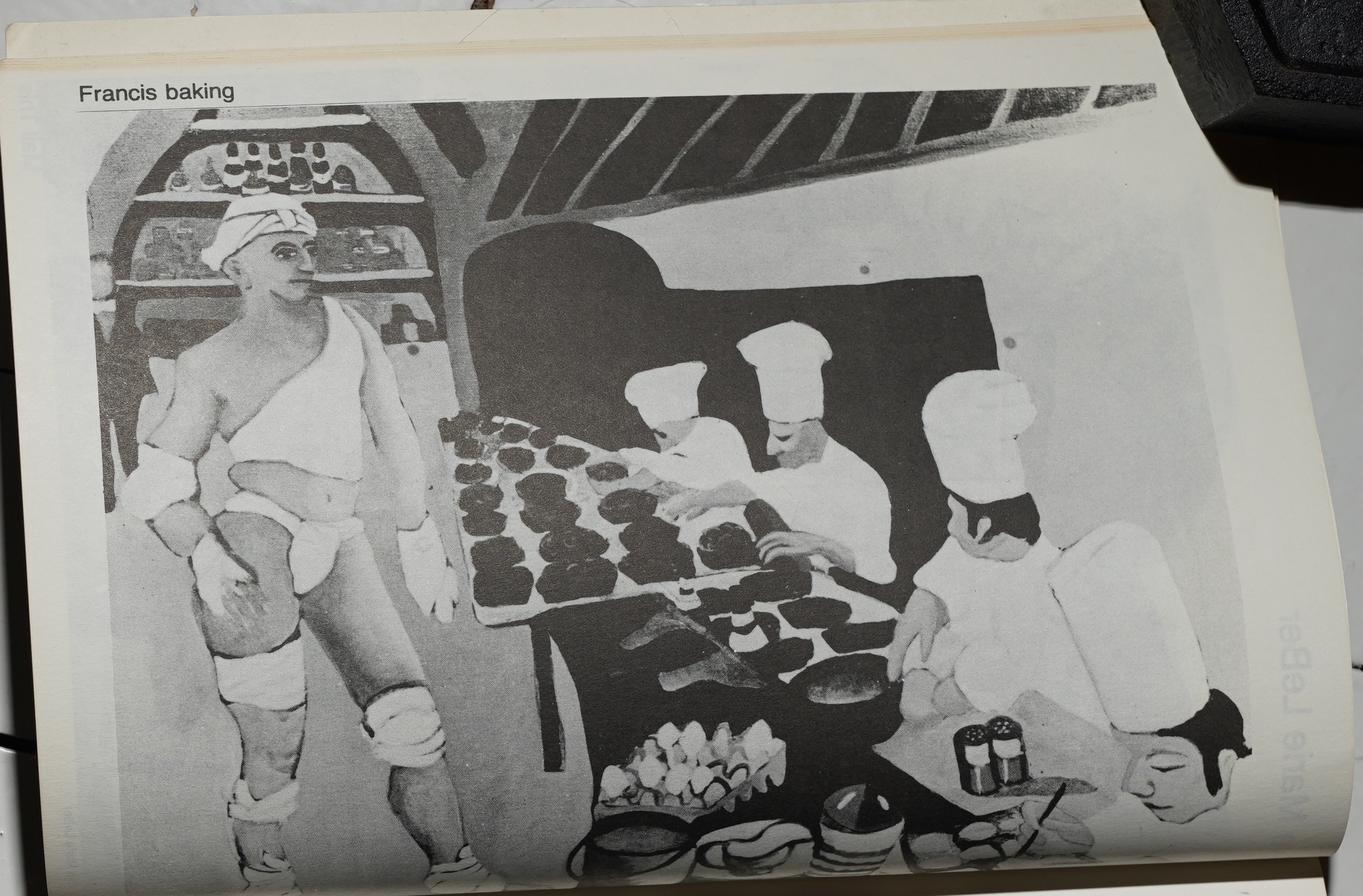
Most of the pieces are pretty long, and are narrative, but there’s a few illustrations, too, like this one by Eve Marie LeBer.
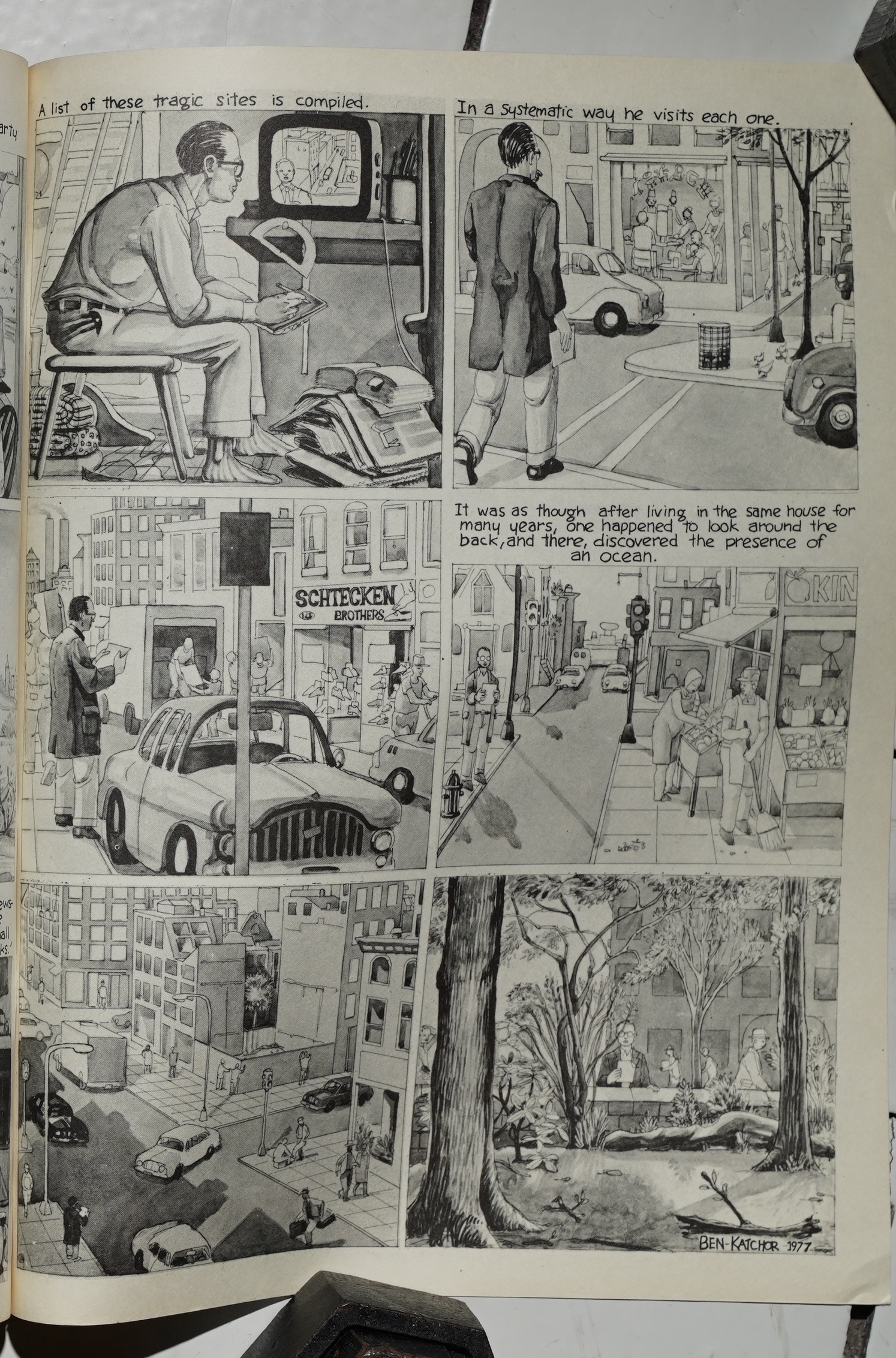
The main interest here, though, is reading two early pieces by Katchor himself. And it’s such a surprise to read these, because Katchor’s style in Julius Knipl, Real Estate Photographer seems like it’s always been like that, and always has to have been like that. Reading a Knipl page is experiencing something that seems so obviously right and correct that it’s never occurred to me that Katchor could have been making comics in a different style.
There are some echoes of later Katchor here, though, and the two stories themselves are interesting in themselves. The artwork is more clearly underground-ey than it would later become, but he’s got that strange logic working on some of these pages.
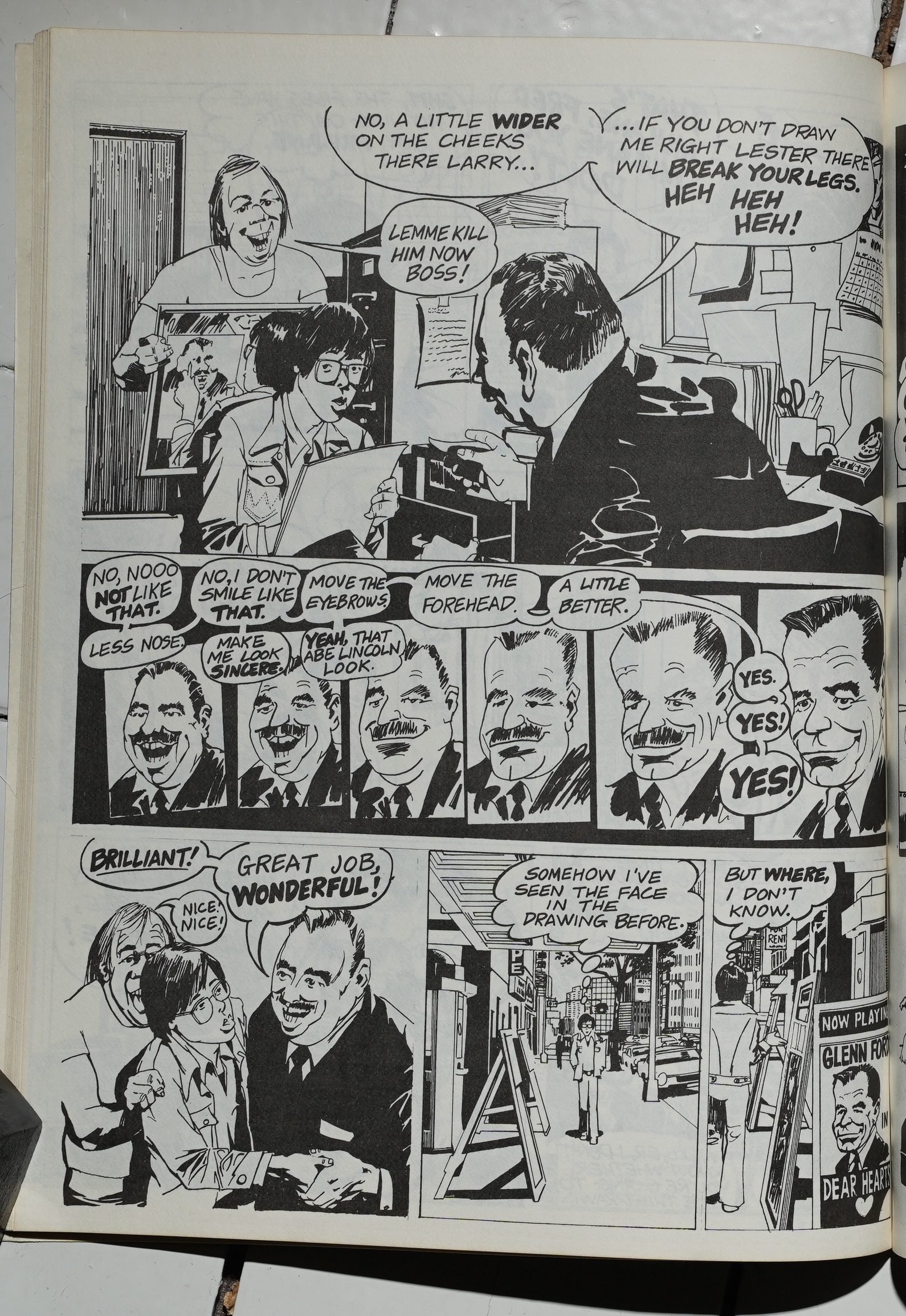
There’s one “traditional” story in here (by Larry lee). The artwork’s fine, I guess, and the story is amusing, but…
Martin Millard’s second (and much shorter) piece is more successful. Reminds me a bit of Rick Geary? But Geary draws more interesting objects.
The final Katchor page seems to point towards Julius Knipl, perhaps.
So I’m guessing that this book was put together by the featured artists? It’s pretty nicely printed, and it’s squarebound, so it’s not a throw-away item, either.
FLA:In 1975, Art Spiegelman’s and Bill Griffith’s Arcade, The Comics Revuepublished underground comic creators and in 1980 Art Spiegelman with François Mouly published Raw.Both seem to be important moments in the growing of a readership for the kind of work you began publishing.
BK:The models I was looking at were the underground comics andArcade was publishing really interesting work that provided new models for creating text/image stories for adult readers.
By the 1980s I was self-publishing fanzines and later Picture Story Magazine where Art Spiegelman saw my work. There was a store downtown in Soho that carried small circulation zines thattook my work on consignment. By then I was aspiring to create some kind of literary/art comic strip. I wanted to bring together what I thought were the most interesting ideas in figurative art with the most interesting literature that I had been exposed to. I wanted to write serious fiction but in comic-strip form. There was a very small audience for alternative comics at that time and comic shop dealers would look at Picture Story Magazine and wonder what it was. They didn’t recognize it as comics, nor would most of their customers.
It’s been three month since the last post in this series, and that’s because… I took a few months off. I had meant to take a vacation lasting just a couple of weeks, but I have a very one track mind: Either I’m doing This Thing, or I’m doing A Completely Different Thing.
So I did A Completely Different Thing for two months.
But I’ve been back at it for some weeks now, and this time I thought I’d try something different: Try to establish some sort of work/life balance. But since Emacs is life, Emacs is love, and (now) Emacs is work, that’s difficult to achieve.
My methodology has been thus: I’ve removed the laptop charger from the couch area. So I get up in the morning, have some breakfast, collect my laptop from the awkward charging area, and plop myself on the couch, doing Emacs stuff until the battery runs out.
And after that, I’m not allowed to do any more Emacs stuff the rest of the day: I close the Emacs topic (cleverly called “Gnuses”) where all the Emacs groups live, and I’ve removed the indicator that says whether there’s anything new there, so I’m not tempted to open it and see whether there’s any responses to what I’ve been doing, or somebody complaining that my latest commit blew up Emacs completely, or or or
Let me tell you: It’s hard. It’s just hard. This is not how my mind works: I’m always 100% in on whatever I’m doing, compulsively. When I look at my laptop now, I have to force myself not to open that topic — if I let my mind wander, my fingers will automatically move point up there and open it.
And there’s days I’ve failed completely, and have just been doing Emacs stuff all day.
Perhaps I should have a separate Emacs laptop and put it in a time lock vault! Yeah! That’s the ticket!
But I’ll try to keep at it… to get some routine in there, and be able to do this on a regular basis without getting burned out.
We’ll see.
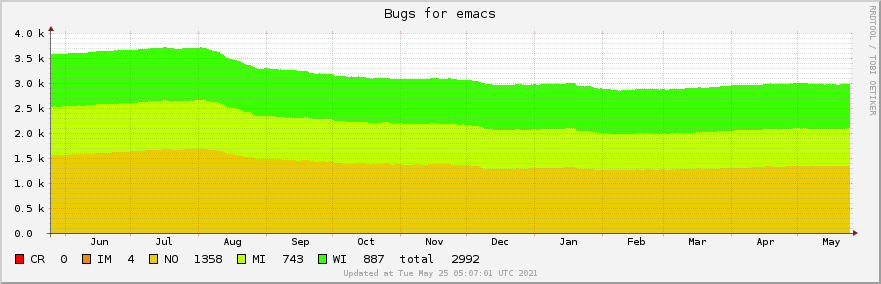
Anyway! This 10% stretch started at 2850 open bugs on Feb. 9th, and after closing 286 bugs, there’s now…
… 2992 open bugs.
DARN IT.
More stats: In this period (Feb 9th to May 26th), 701 new bug reports were opened, and 593 were closed.
So, I basically took all of March and April off, and since I got back and started the work-until-recharge methodology, it’s pretty flat.
Well, we’ll see what happens… I think I’ll try to see whether I can get the “work sensibly” thing to stick… but I’ve never been sensible.
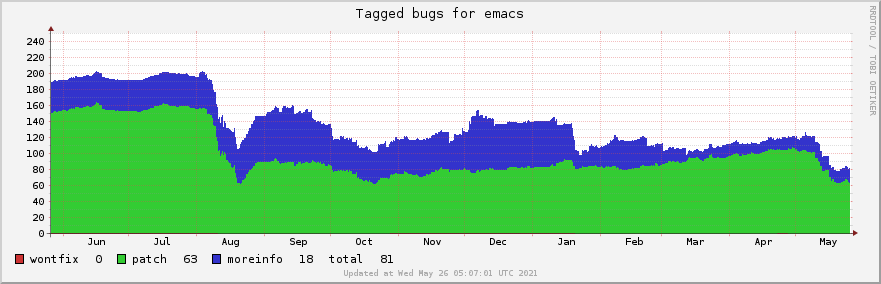
The past couple of weeks I’ve concentrated on getting patches sitting in the tracker pushed, so that’s down to 60 again… which is still too many, but reasoning about other people’s patches is kinda exhausting. And it seems like every time we hit 60, we bounce back again. So technical analysis of this chart clearly says that 60 is the natural level of patches to have hanging around.
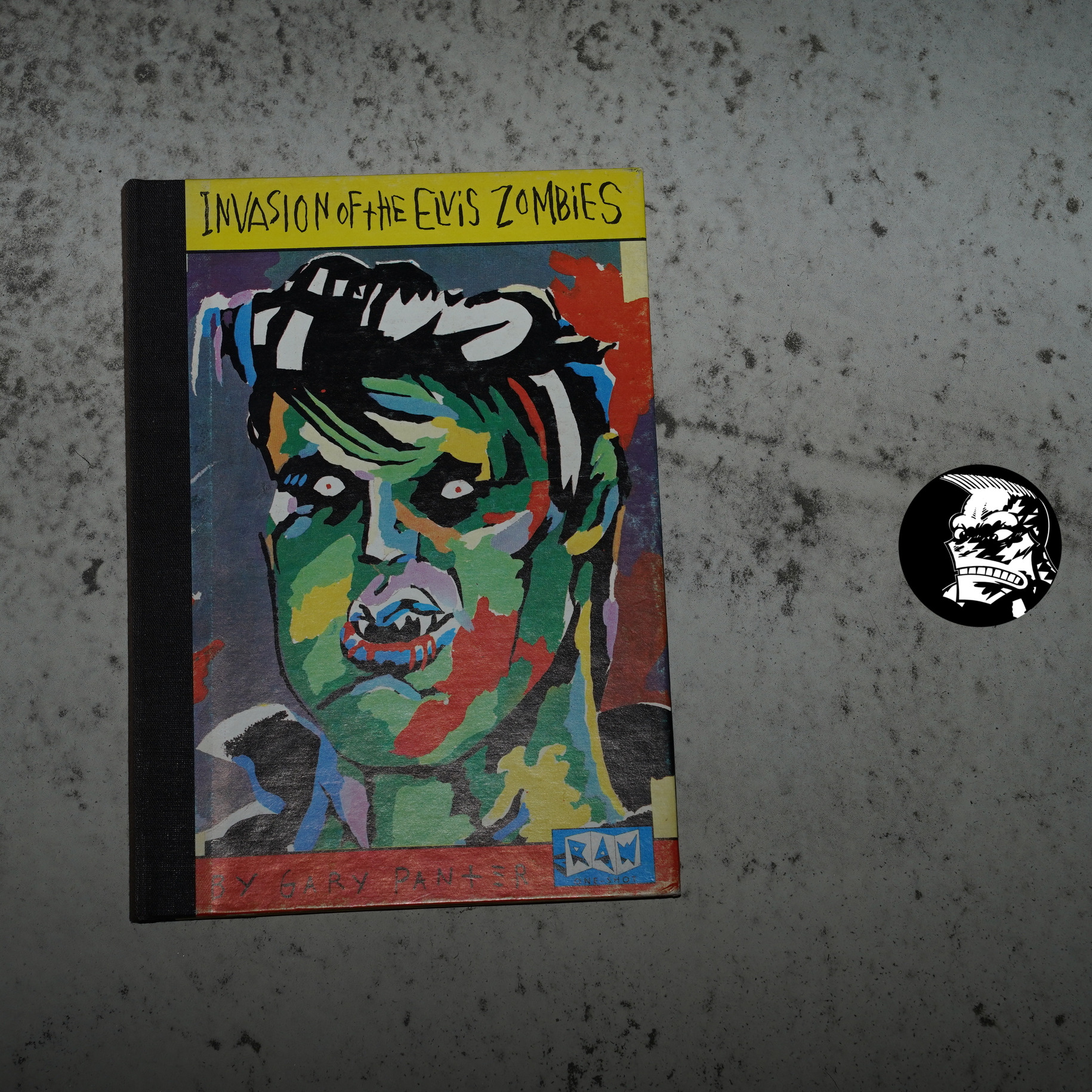
Raw One-Shot #4: Invasion of the Elvis Zombies by Gary Panter (165x233mm)
This was published in 1984, and I was 16 at the time. I remember being very puzzled by the book: I’d read a couple of issues of Raw at the time, but this was … something else?
First of all, the format: It’s book size, with hardback covers, a serious-looking binding, not a lot of pages, and this:
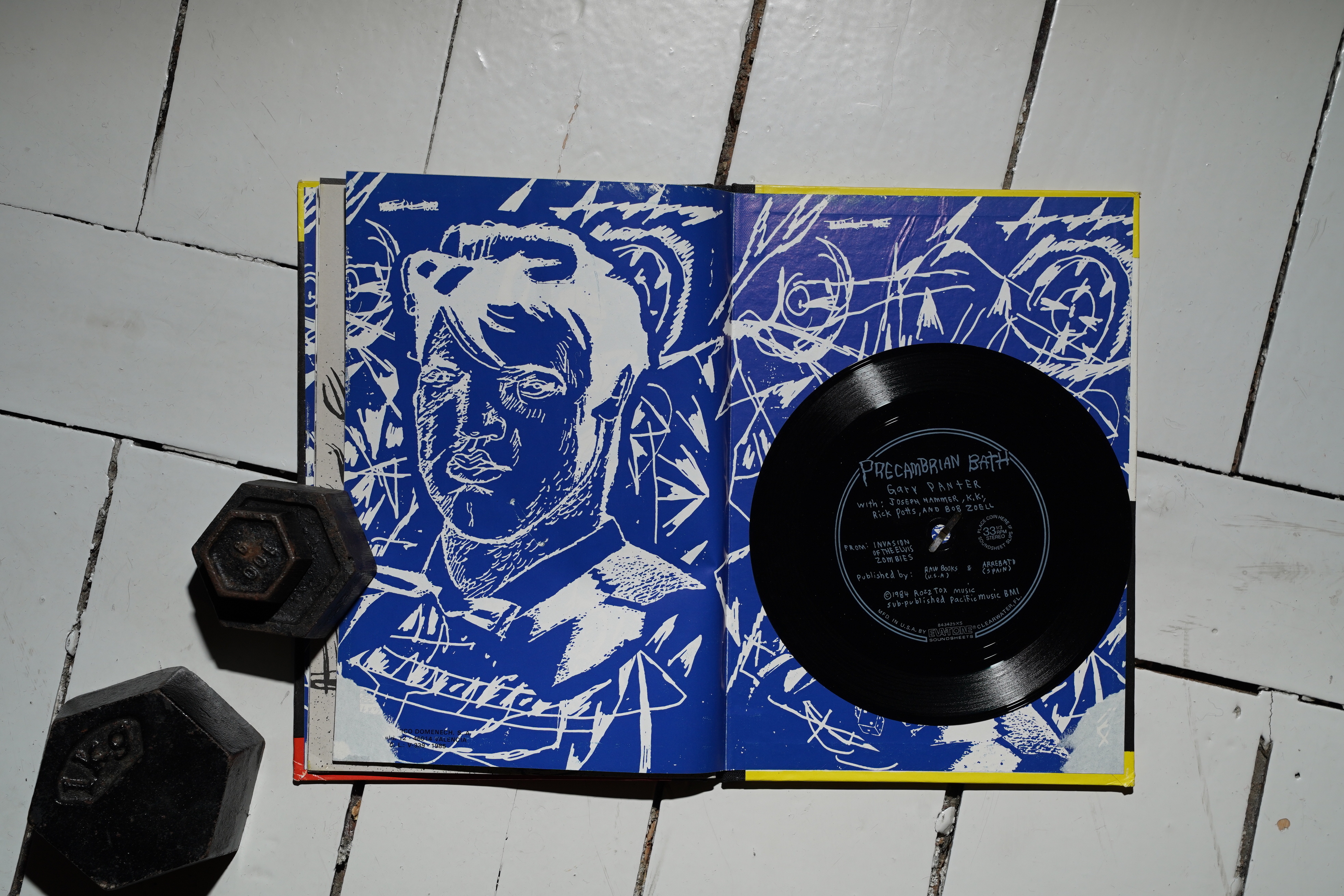
A flexi disk fastened with a split pin to the back cover. It’s all black and white except these end papers, so as an object it feels like it wants to be both “respectable” and playful.
You can listen to it, too! (I put it on repeat while re-reading this book now.)
“Rozz Tox Music”.
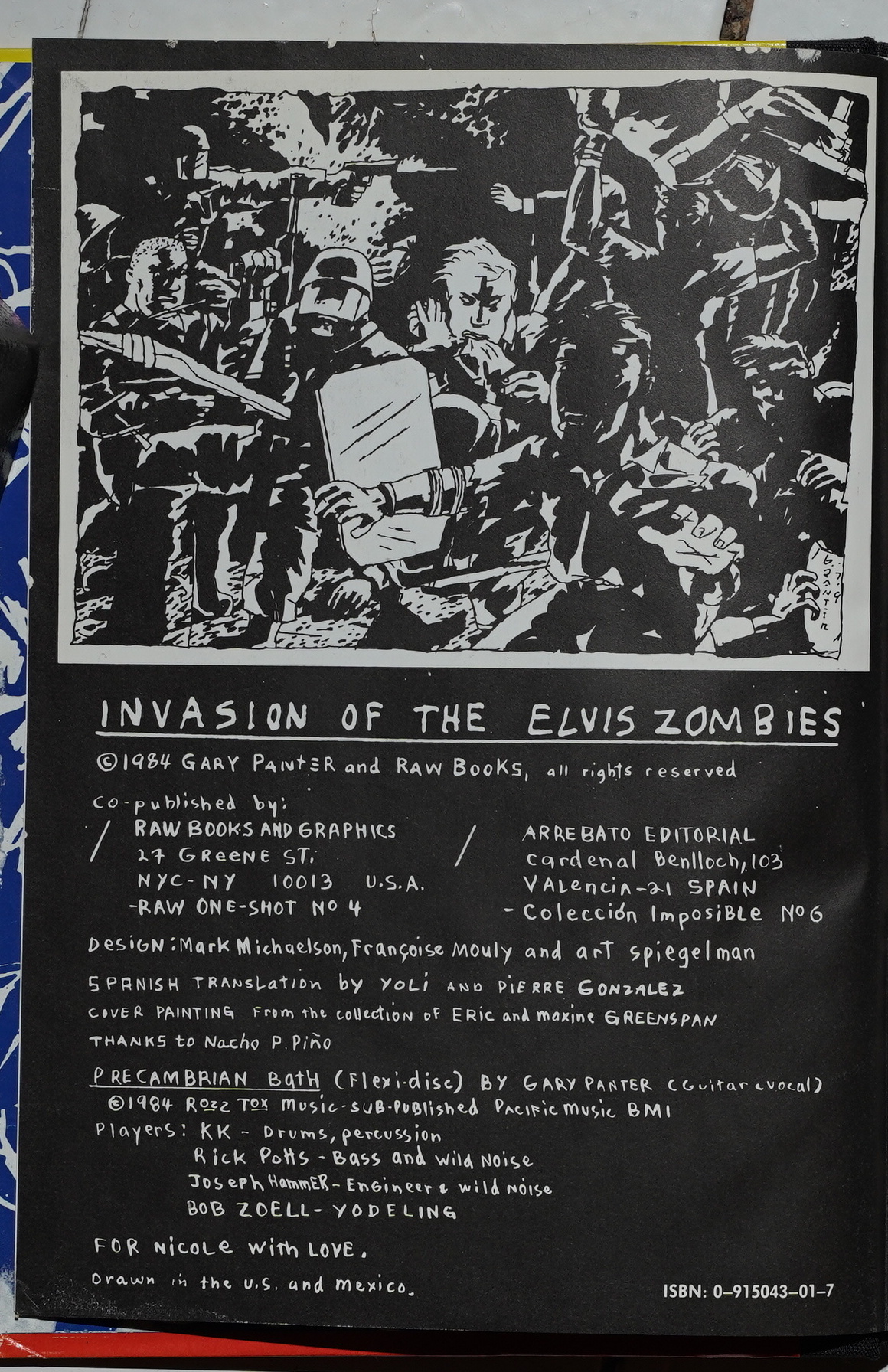
The indicia here seems to indicate that this was published both in the US and in Spain simultaneously, and that there’s a Spanish translation?
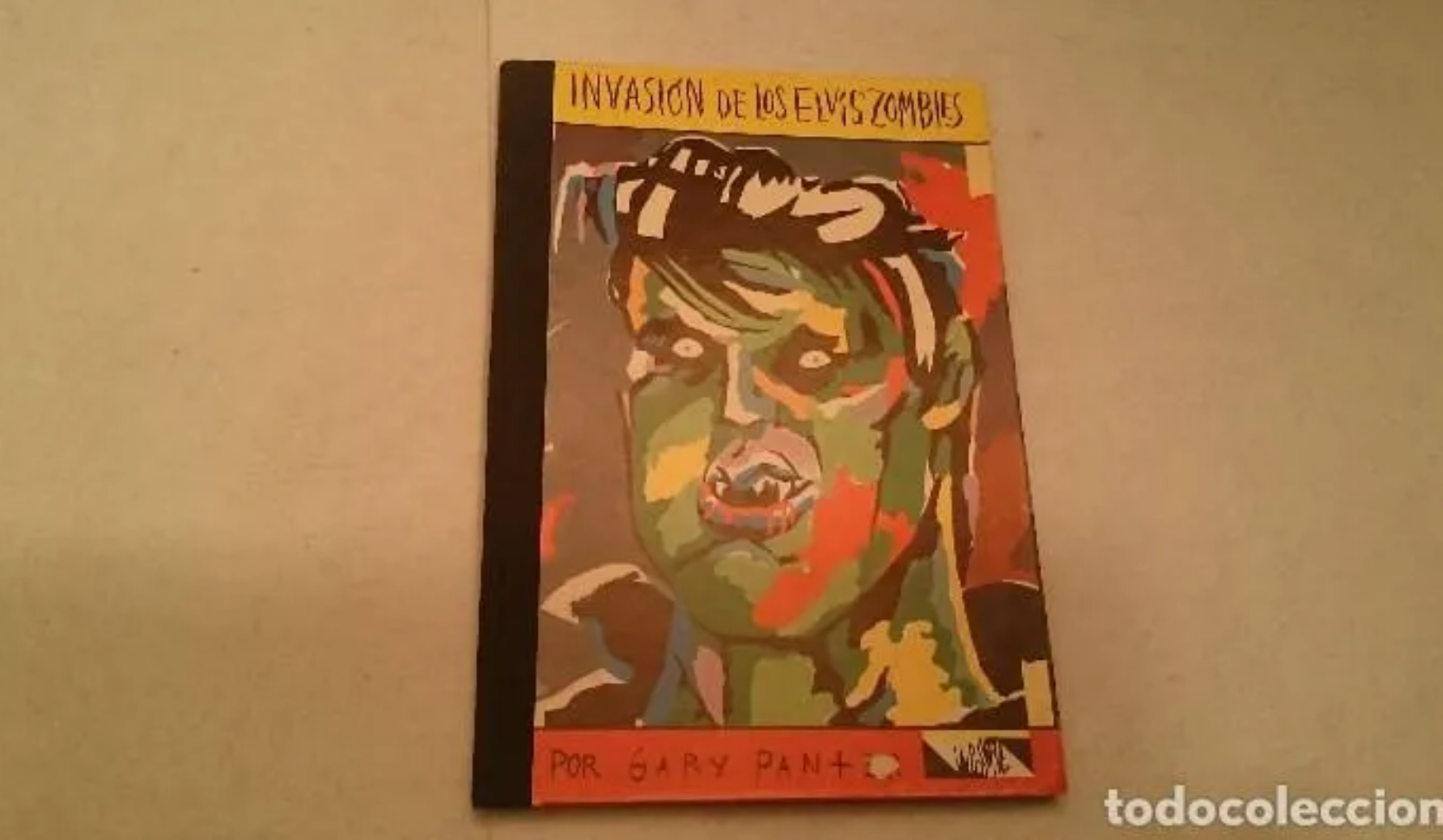
So there is! Invasion de los Elvis Zombies.
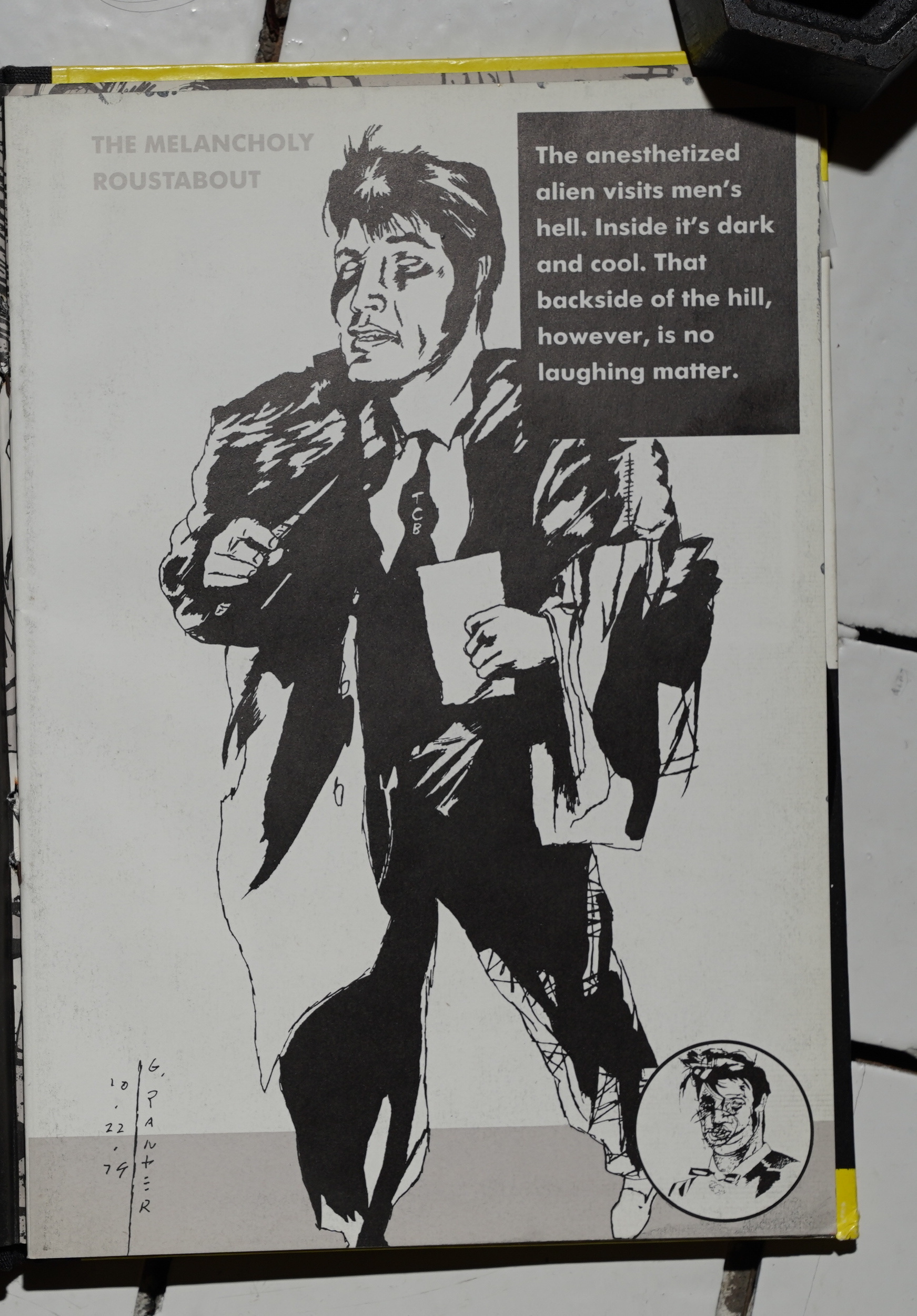
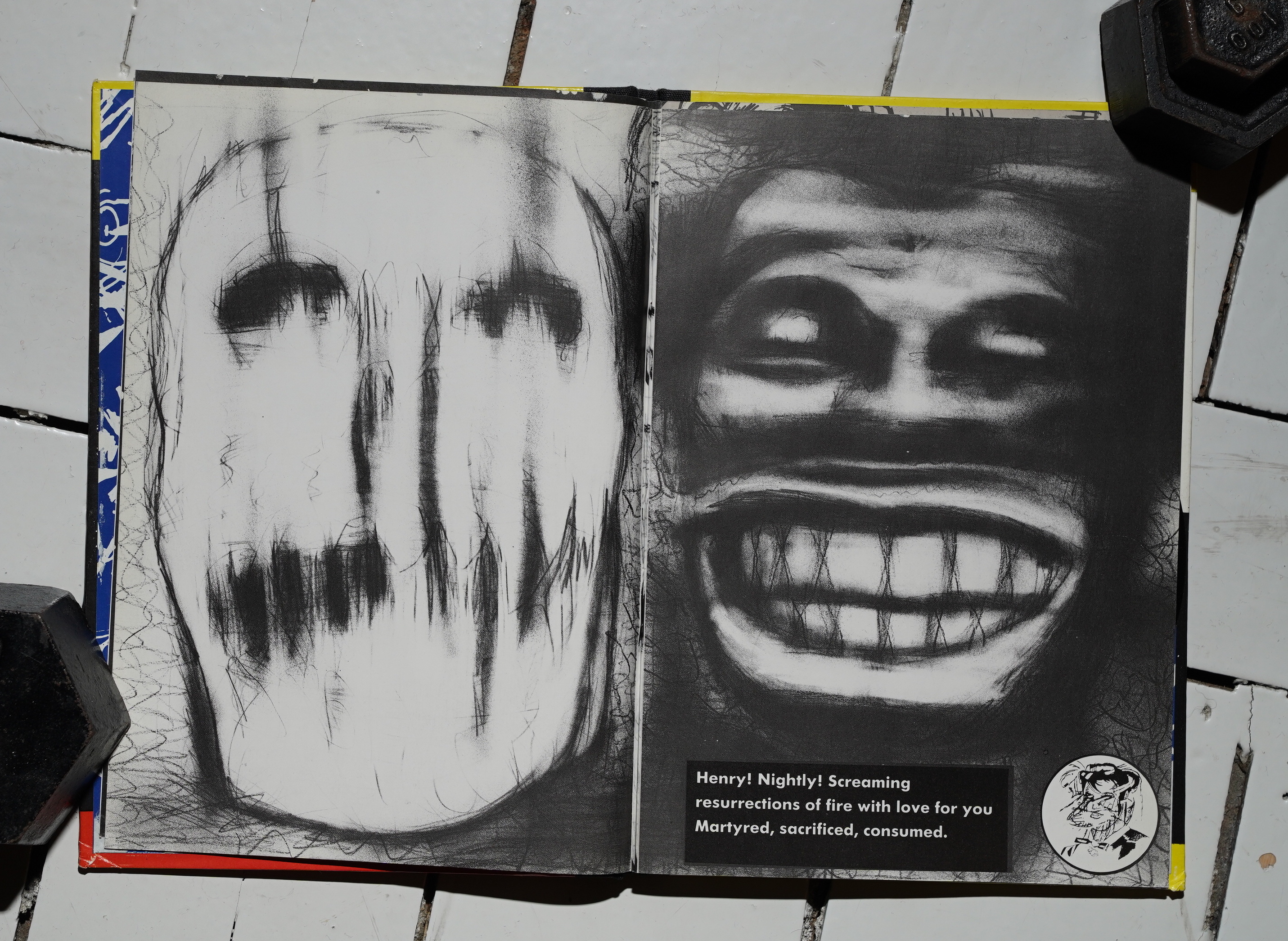
I remember reading this little book quite a few times — it’s a bit slippery. It’s a narrative work, but it’s not quite clear just what’s really happening. The Melancholic Rustabout somehow becomes a zombie and then terrorises some girls, and … that’s it. But it’s so…
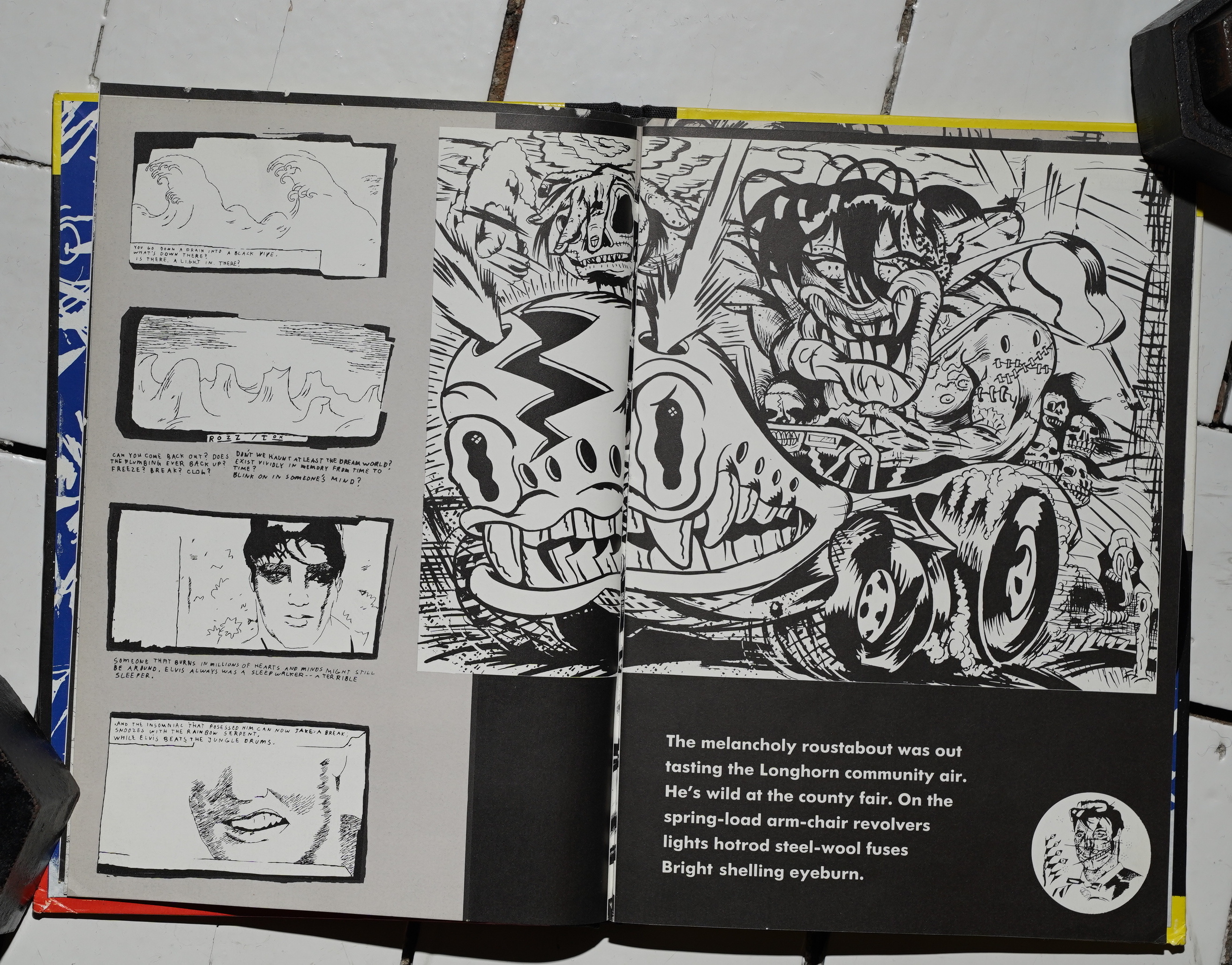
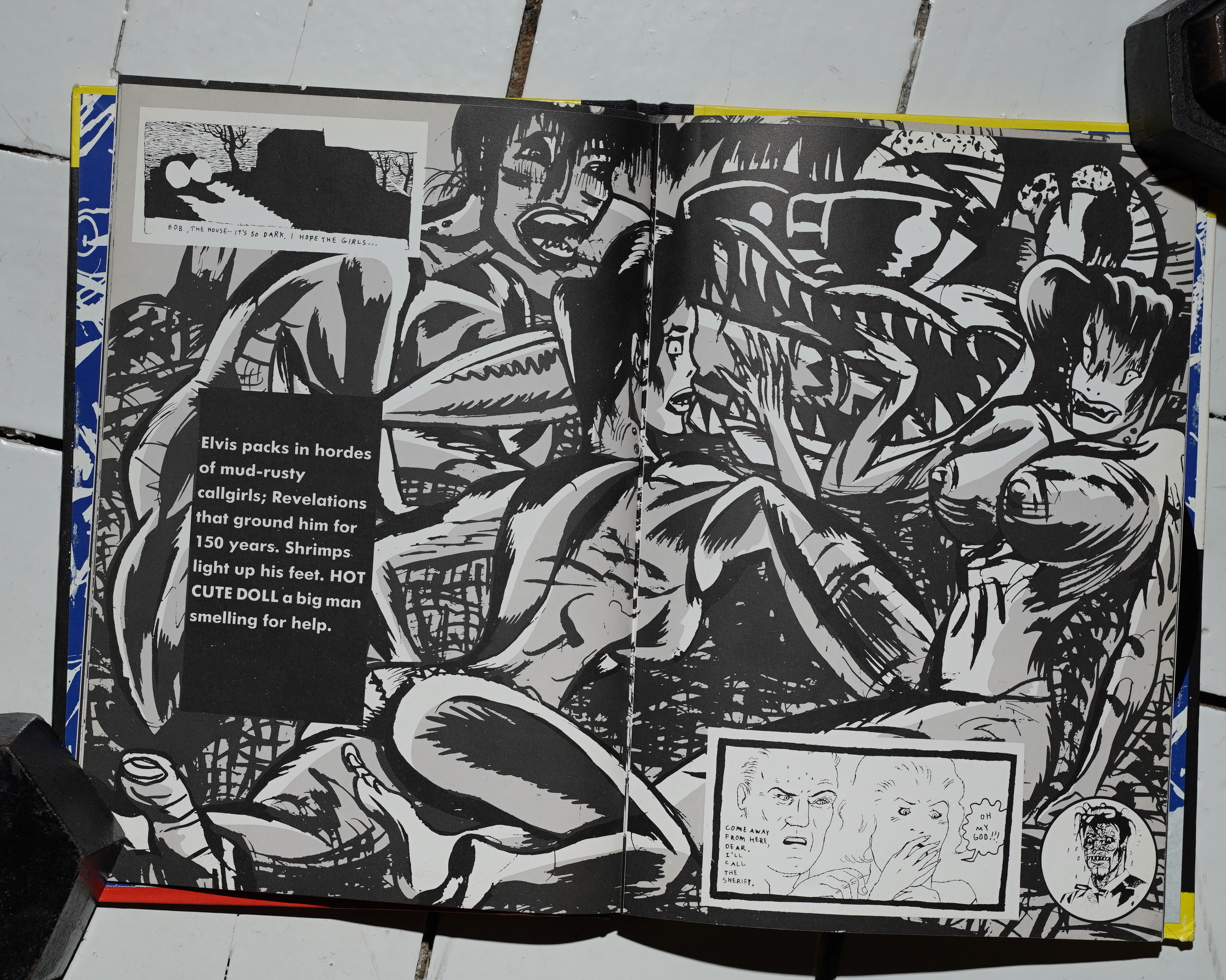
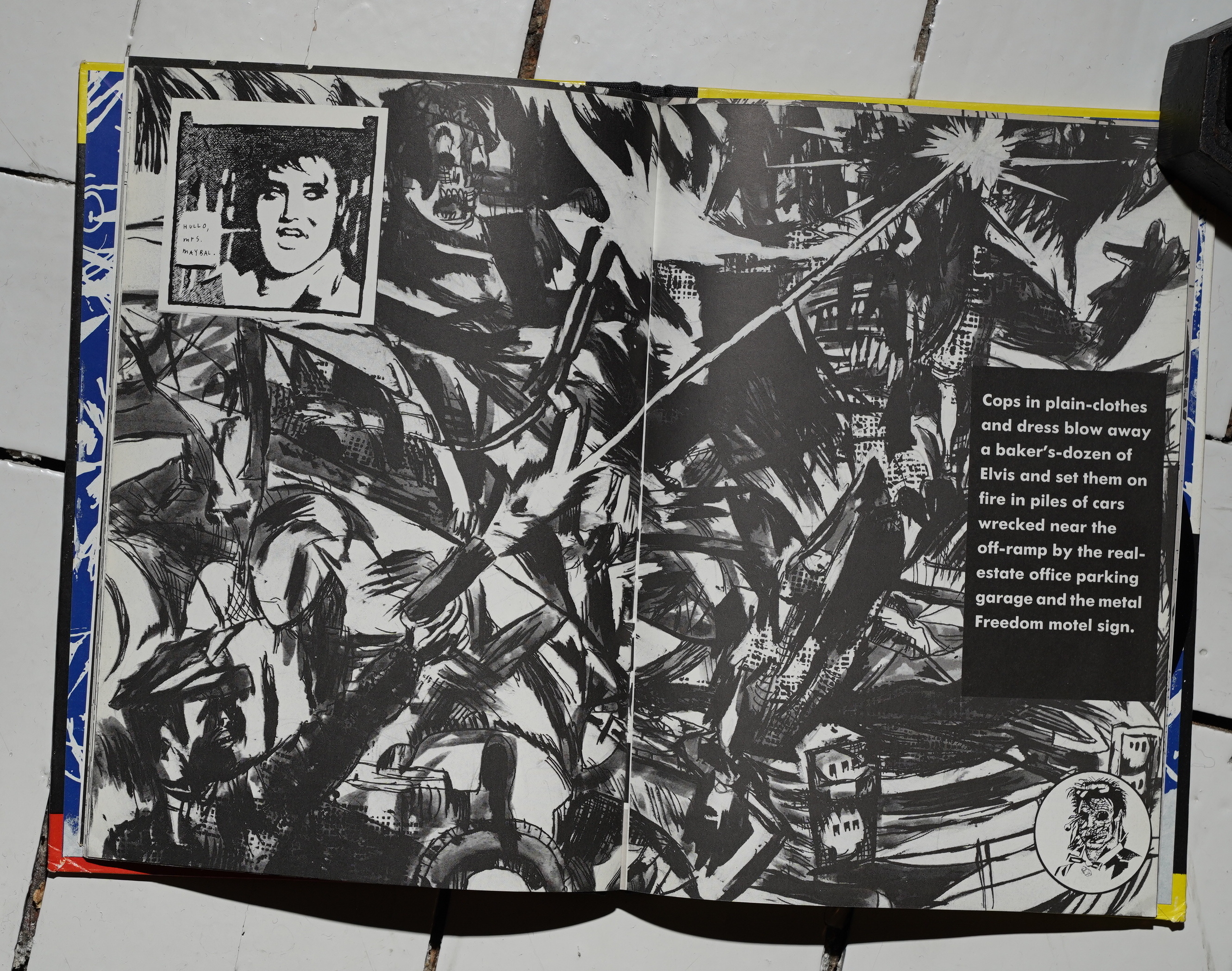
Panter uses a number of different art techniques and different voices, kinda overloading the pages with things to consider. For instance, there’s the kinda-sorta flipbook thing going on in the lower right hand corners, and there’s the typeset text (in Futura, of course)…
… but there’s also these inset panels in a different style.
It feels like reading four different things at once, that somehow connect.
And did you know that the plural of “Elvis” is “Elvis”?
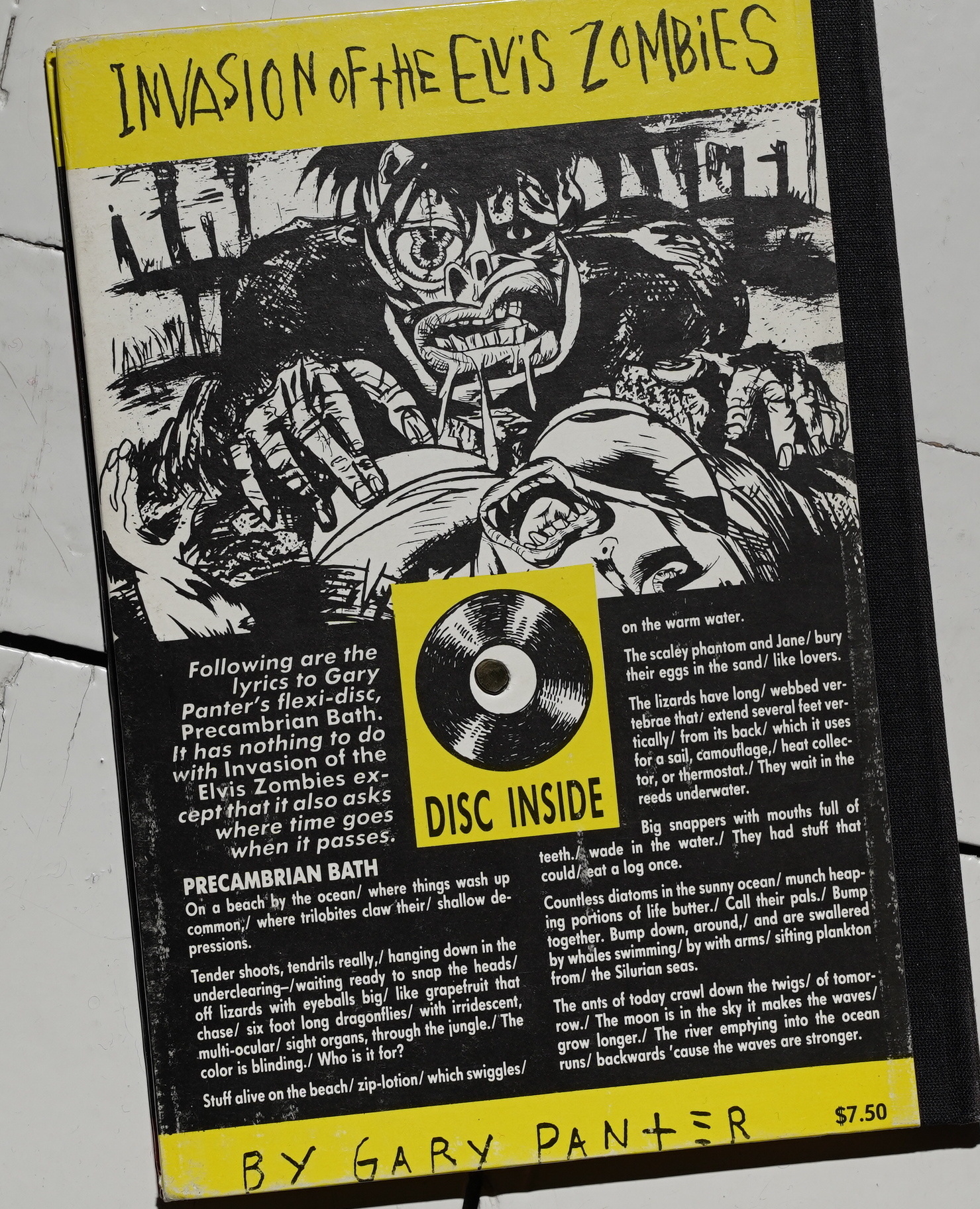
The back cover explains that the flexi doesn’t really have anything to do with anything. And note exorbitant price: I’m guessing comics nerds were just going “LOOK AT THIS! LOOK AT THIS PRICE! THIS IS SO PRETENTIOUS!”
I really adored this book as a teenager — it made me feel very clever indeed to own such an object. I remember thinking that the narrative bits could perhaps have been developed more, but reading it now, I think it’s perfect.
Gary Panter’s Invasion Of The Elvis Zombies, like Sue Coe’s How To Commit Suicide In South Africa, is a RAW One-Shot of -probably more limited appeal than RAW itself. Maybe “appeal” is not even the word, since Panter’s style is bent on putting a grisly facade over an already grostesque subject, and the immediate impact Of the first, as well as its second and third, impression—is Ofthe sort Of aesthetic cacophony that RAW itself is, at its extreme. A revie.ver, reaching for an ade- quate phrase, might even wish that the language offered such an option as “caco- appearance or revelation of the evil and foul or ugly—since this pro- duct, unlike a horror comic that only wants to play with surface emotions, seems relentlessly to lay that ghastly emotion in- side the reader’s soul, to make a permanent redecoration Of that inner apartment from which the hapless culture-consumer peers forth. As with Coe’s book, there isa deeper rationale—not political, as in her case, but cultural—for this horror, a kind of pro- found twist designed to make us reinterpret forever the necrophilia that passes for mass-cult. Panter’s book makes a devout attempt to change the primal flavor with which we sample popular experience.
Yes, exactly!
He goes on like that for several pages and ends with:
The strategic initiative in our culture, our history, has gone under- ground, to infernal regions of our psyche; and art is left equivocating whether it is an xssertion or only a symptom, To play these subliminal novelties—the new styles in punk coupterculture—only for effect, blindly and without forethought as to the eventualities they may contribute to, seems criminally irresponsible to me. American culture, shaping as it does the conscience and sympathies of an awesome super- mower, needs to come to terms con•stantly with the changing course of its history and its options; it needs to recapture some tangible sense not only of its ideal values but also of its actual motives. Elvis Zombies, like virtually every one of R.AW”s produc- tions, seems gratuitously out Of tune With those tasks: they are distractions that can Ex• mass-distributed to the alienated many. The privilege of alienated isolation is not something that history tends to respect for very long: freedom that does not play an organic, political role in its society com- monly becomes (in Edgar Friedenberg’s phrase) another dispensable “industrial waste.” But then, all delusions are a kind Of fool ‘s paradise.
Epater la bourgeoisie! was once a common cry in Paris cafes. It came from artists, of course, and meant, more or less, “confuse the yuppies,” or “spit on the fuckers.”
[…]
This brings us to Art Spiegelman. Spiegelman is an instructor at the School of Visual Arts in New York. He is the originator of RA W. The aesthetic Of RAW is close to epater la bourgeoisie, to the line which runs from Alfred Jarry to Dada to Surrealism to punk. Spiegelman is a tireless promoter of new talent. Spiegelman’s latest offering is Raw One. Shot a 36-page hardbound book, printed in duotone, for $7.50. It is Invasion Of the Elvis Zombies, by Gary Panter. It in- cludes a flexi-disc recording of Panter’s song ‘ ‘Precambrian Bath,” which has noth- ing to do with the book, “except that it also asks where time goes when it passes.” The disc is faintly punkish, but even more reminiscent of early Zappa. Gary Panter does not have what you would call a normal mind. Invasion of the Evis Zombies includes many full-page and double-truck drawings in ink, wash, and pencil, vaguely in the manner Of a Ralph Steadman with serious drug problems. Each of these is accompanied by a short typeset text, sometimes grammatical, not, and never linear. Each page also includes a few panels from a more linear comic strip, drawn in Panter’s Jimbo style. The two “stories” sort of interlock; at least, Elvis figures in each. I am not about to pass judgment on this work. It is certainly no madder than, say, U.S. foreign policy. All I will say is that Panter’s vision is authentic, and Spiegel- man shows considerable and continuing Courage in bringing work like this out.
I think Smith found more to say about the book, so I think he wins.
(Several copies of Raw 7 and this book were stolen from a warehouse.)
Mystery salesman: Cutler said he came into the books when a stranger came into his shop and offered to sell the copies Of RAW and Elvis Zombies at a discount that Cutler uouldn•t divulge. He added that he didn’t think the copies were illicit because he had heard that copies had just recently become available. had a couple Of friends Who went to a party at Art’s. and they said they were copies on sale there: • Cutler said. Spiegelman hotly denied that. according to Cutler. and Spiegelman also told the Journal that no copies had been sold when Cutler had them in his Mouly said that when Cutler realized that she and Spiegelman were intent on pressing chargers. Cutler•s immediate reaction was. • •If can get the COPS out Of here, I can make a deal With you.” Cutler said that the deal he wanted to make was to give the two the books they claimed were theirs. rather than fighting through legal channels for them. wasn’t trying to do anything underhanded.” he said. “l just didn’t want the voliee involved.” However. Spiegelman and Mouly proved intractable: they had Culler booked and taken in handcuffs to the milice station. “The guy isn’t evil—I didn’t feel great about having him booked: • Mouly said. “But the choice was to dismiss it as if there were no law enforcement.”
[…]
Charges dismissed: On November 25. Cutler had the allegation against him dismissed due to the overly long time involved in bringing the case to trial. Cutler said that While he is glad the ease is finished. he still hasn’t received the S52 worth of Elvis Z»nbies that the police confiscated. although he expects to. Spiegel- man said that although he didn’t Win the case. he did learn from it. having installed greater security on his warehousc_ “l guess it’s a lesson in civics.” he said.
LUCIANO: The uork in RAW seems much more painterly than some of the other uork. PANTER: I’ve finally got my sketch books—I just draw in these sketch books all day long. just draw-out of my head or copy from photos. Then I make paintings from those, so the cartoons and the pain- tings are starting to overlap with one another. Jimbo’s the closest I’ve come to combining all the stuff. Let me mention one other thing. There’s a book I’ve been working on for some time entitled Invasion of the Elvis Zorhbies… [ pause] LUCIANO: Nothing surprises me any more. Invasion of the Elvis Zombies? PANTER: Yeah. And RAW’s going to publish it simultaneously here and in Spain. It’s being published by… well, I’m not sure what the publisher’s name is… uhhhh… IRummaging around in search of something with the publisher’s name on it]. uh, here’s something.. Carnival de los Ciervos. That’s it. LUCIANO: Carnival of the Deers? That’s the Spanish translation of the title or the name Of the Publisher? PANTER: I guess that’s the publisher. [Reading some more from a letter] Collection Impossible… Arregato Cardinale.. .l’m not sure what… Spiegelman will know. Can you ask Spiegelman? LUCIANO: Why don’t we just transcribe that as is and call it ratty interviewing? PANTER: Anyway, that’s the big project for the fall. LUCIANO: Invasion of the Elvis Zorn. bies! PANTER: It’s supposedly going to be out in time for Christmas!
For a book that’s kinda famous, there isn’t much writing about it on the net, but here’s somebody:
Surreal, almost dada-ist in delivery, this is a challenging read but shows just how far the medium of comics can push its own envelope.
But the book has never been reprinted, I think? Except tree pages as part of this anthology. So I guess few people have read it.
Raw One-Shot #3: Jack Survives by Jerry Moriarty (268x358mm)
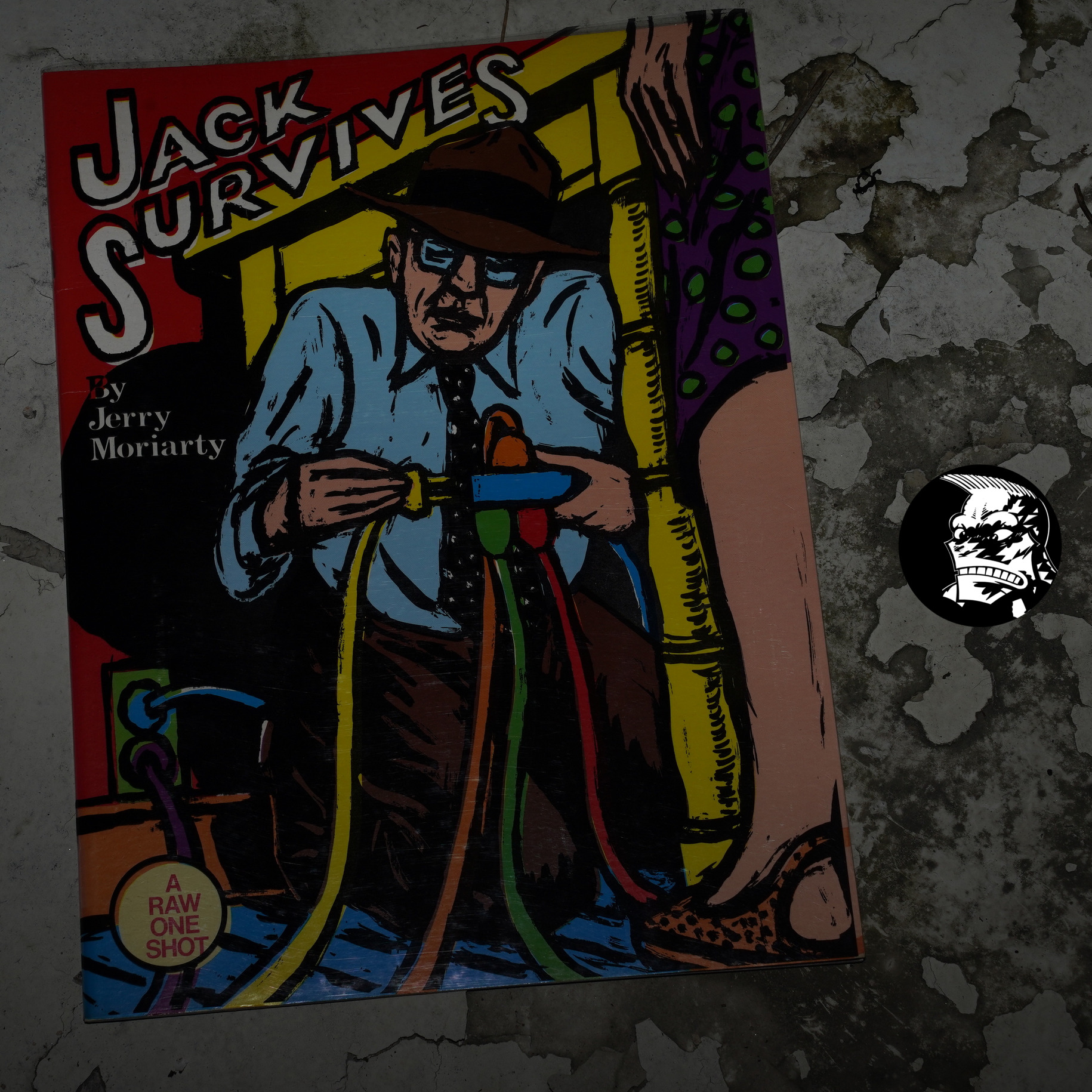
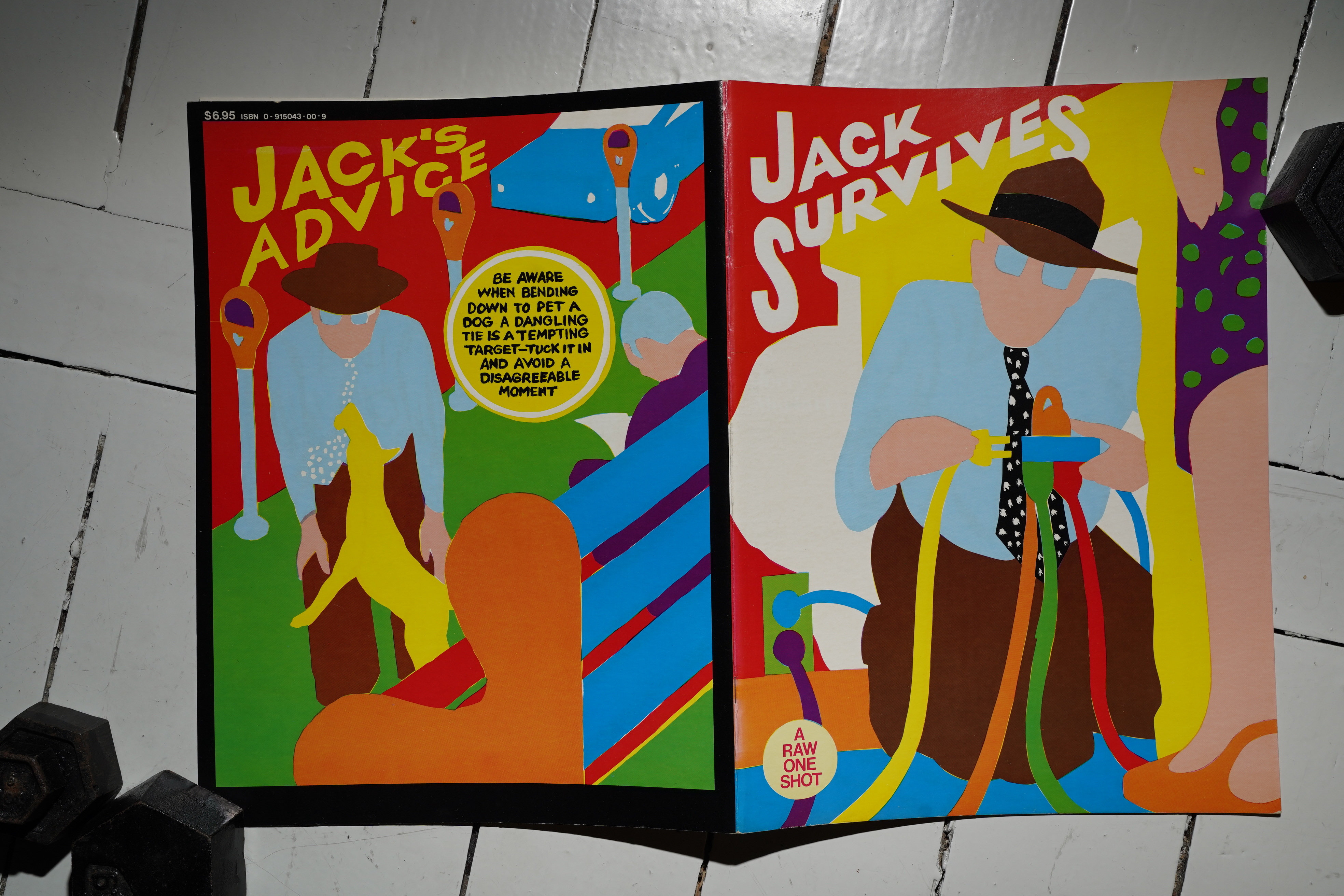
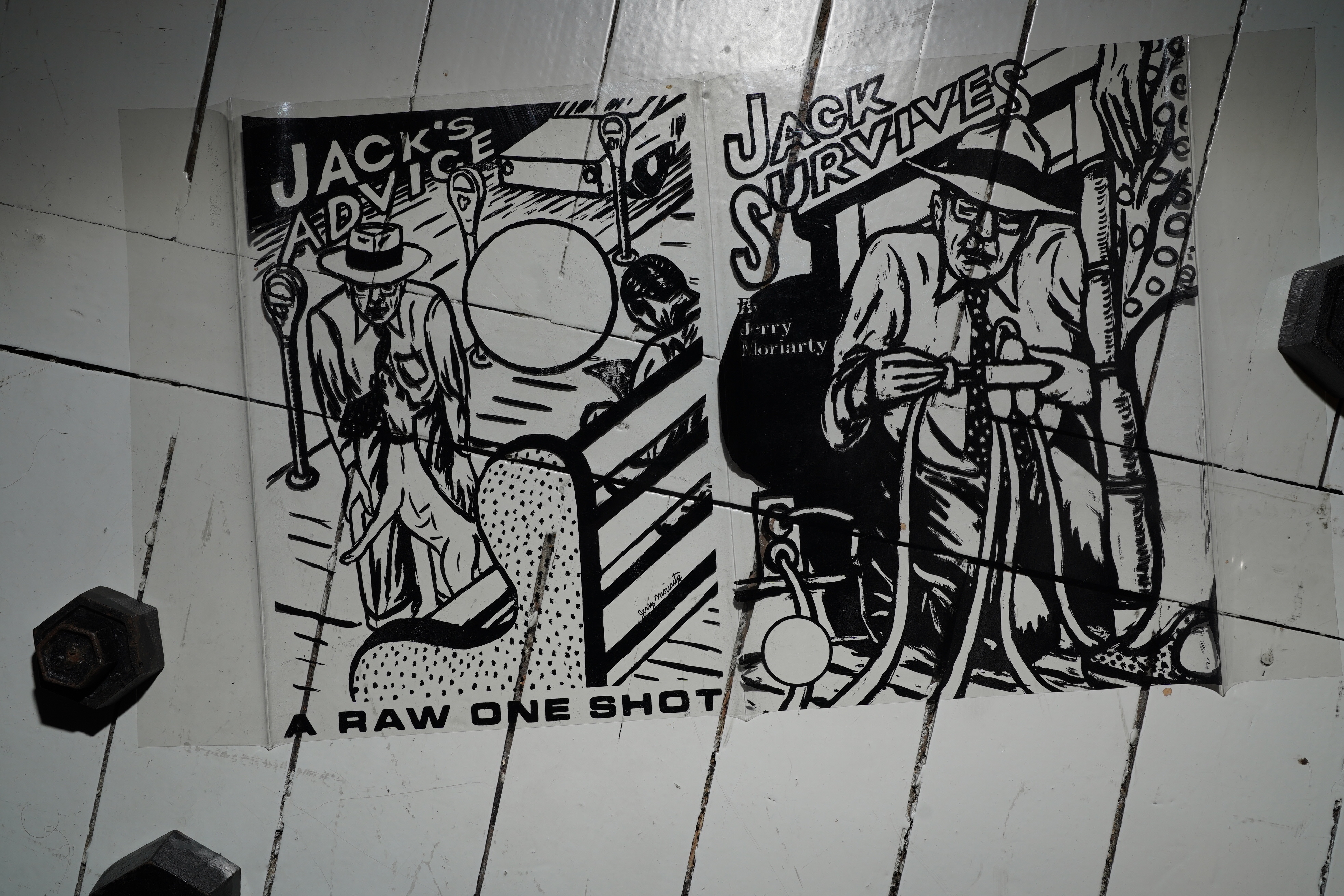
This is a book I wasn’t able to find when I was a teenager — I didn’t score a copy until about a decade ago… But I’d seen Moriarty’s pages in Raw, and I’d seen pics of the book itself on the interwebses. But I didn’t realise that the cover was in two parts: A transparency wrapping around a four-colour cardboard cover:
The rough underprinting…
… and the overlay. Gorgeous!
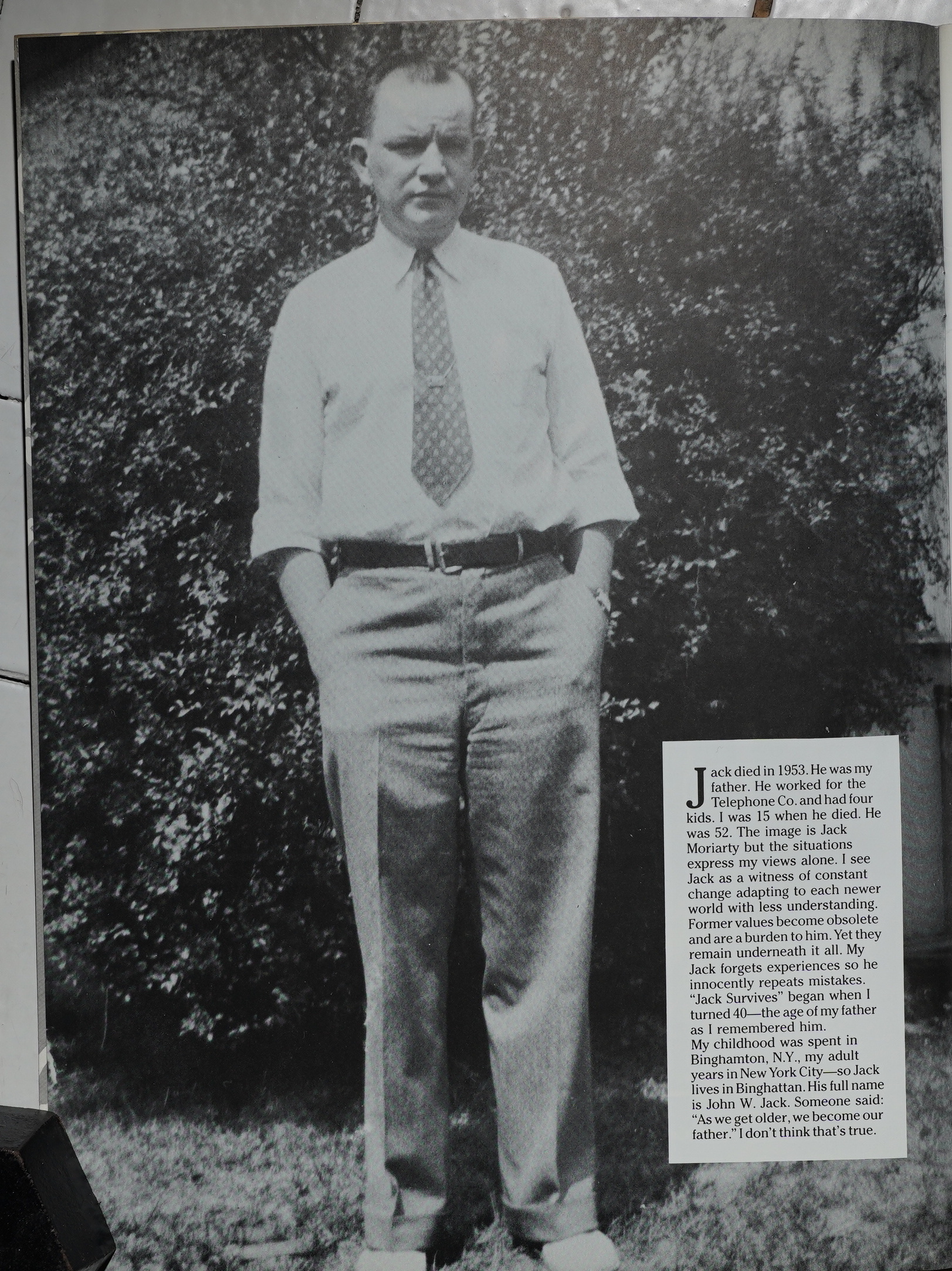
Moriarty explains that the titular “Jack” is his father. Sort of.
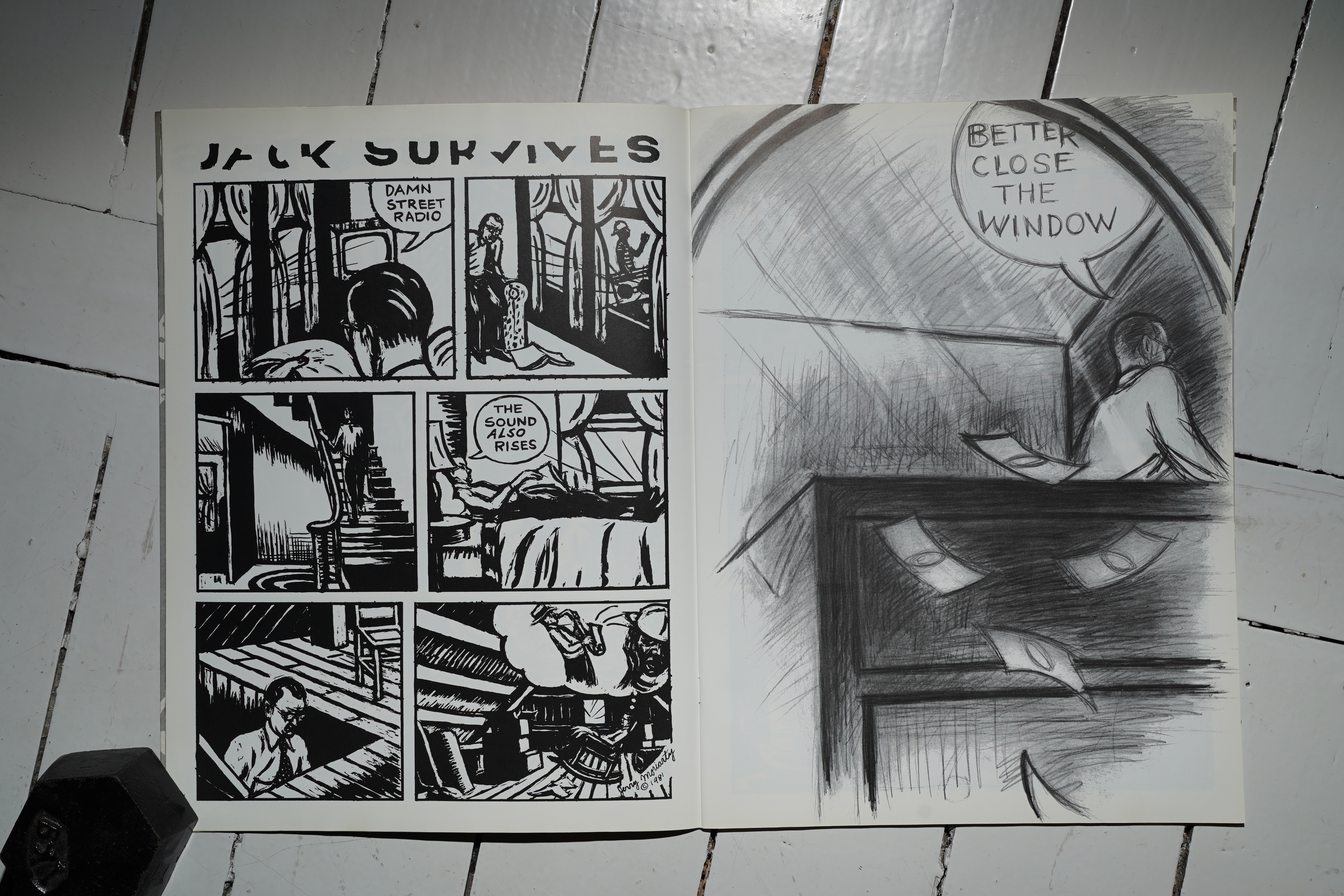
The book is mostly one- or two-page strips that have a kinda vague flow… but also these single page illustrations in a different style (reproduced from pencils, I guess?)
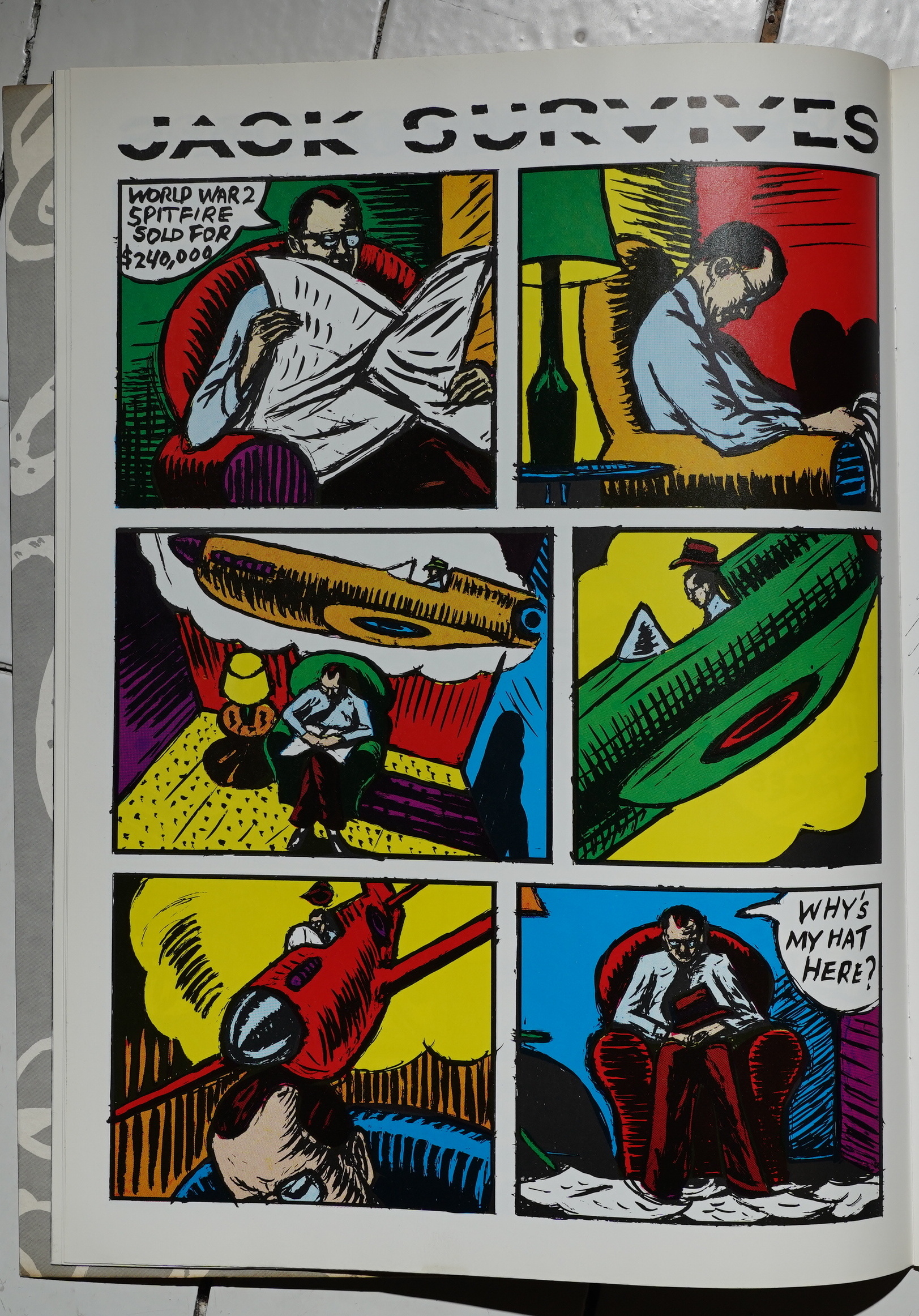
And also the occasional colour page. So it’s a printing puzzle — if this was printed on a big press, eight pages to a sheet, then one side of one sheet was printed in colour, giving us four colour pages. (And then there’s the complication with the cover.) It feels very luxurious.
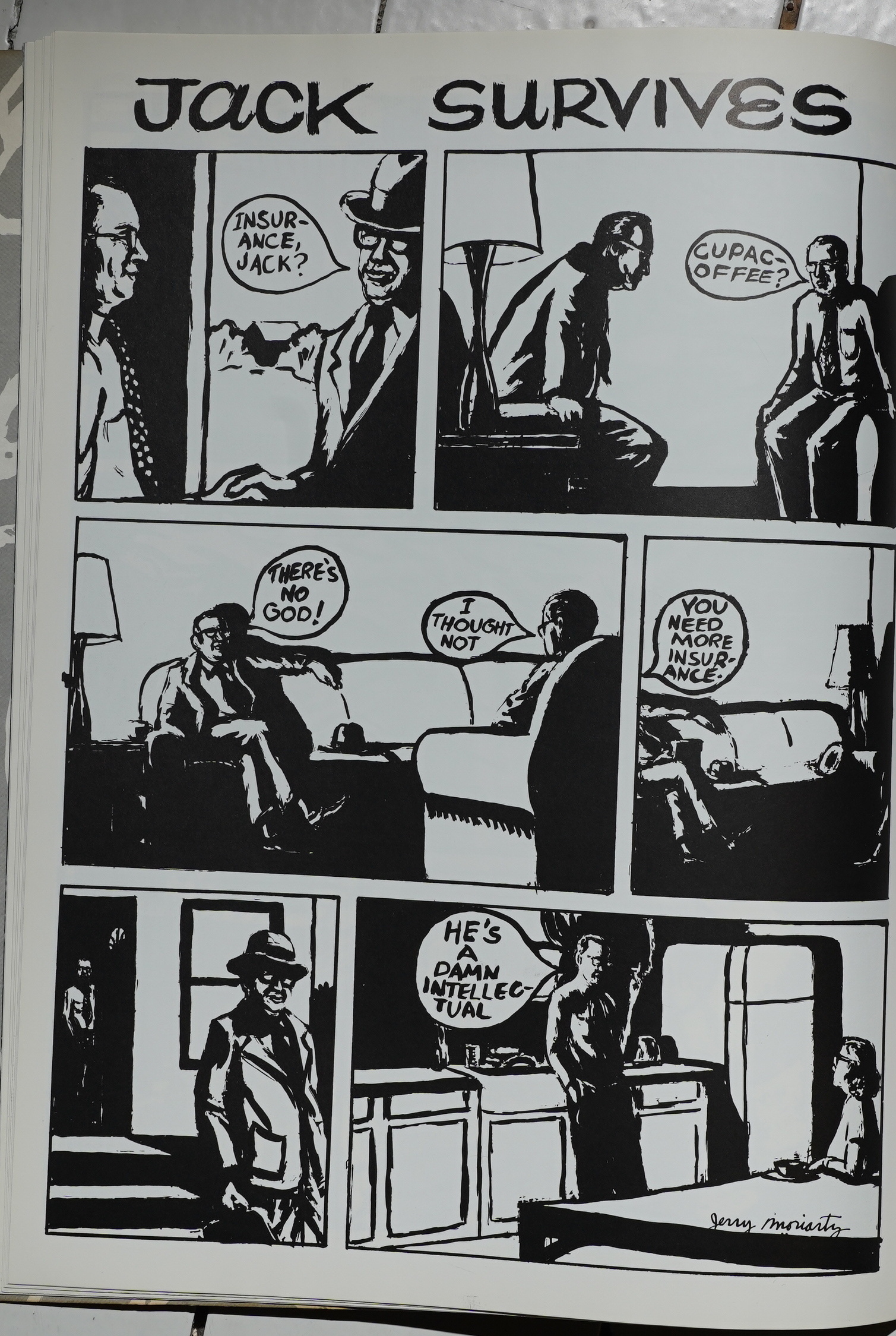
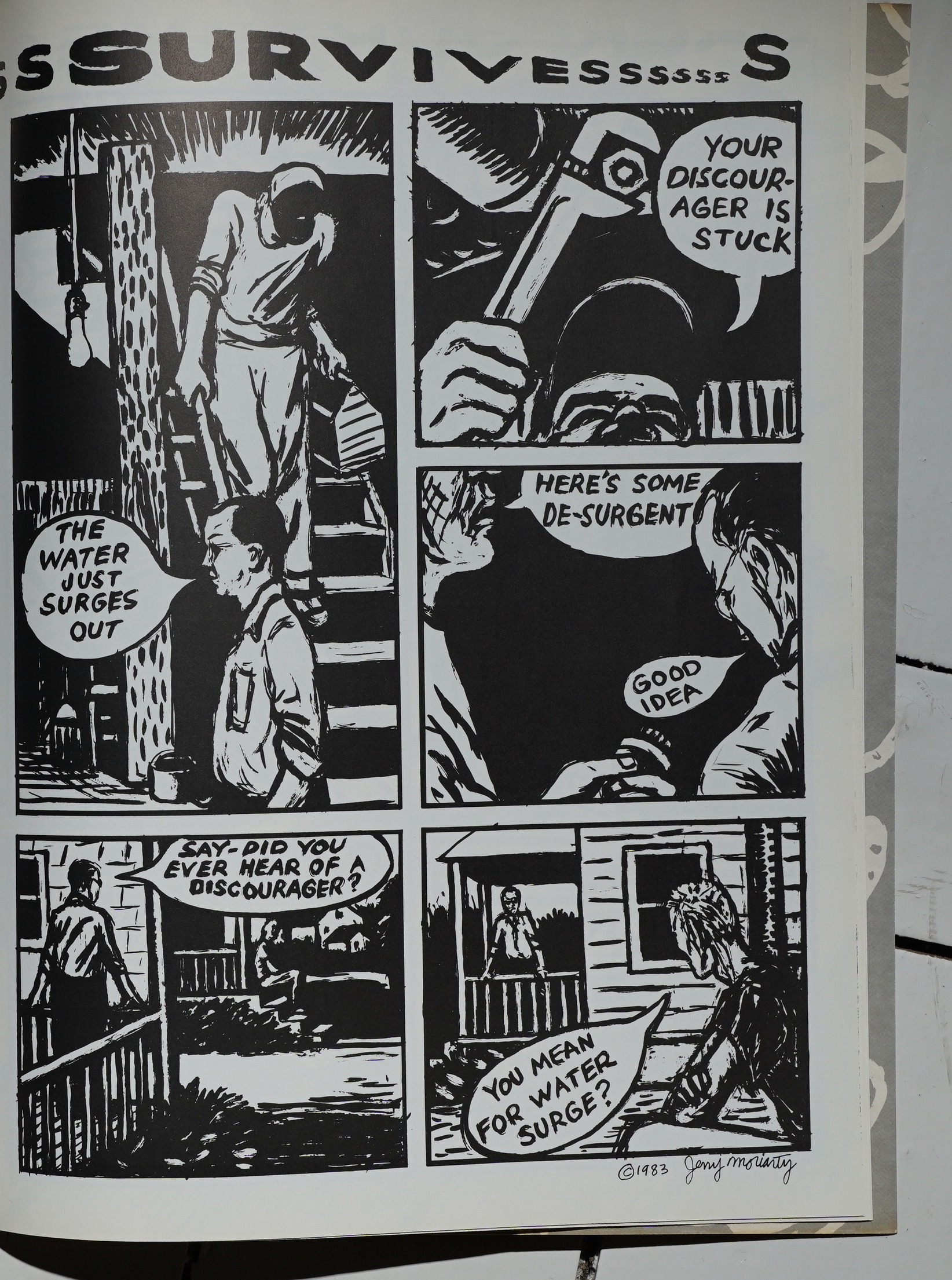
Some of these pages a straight up gags, and the above made me LOL out loud, but most are just kinda vaguely disturbing, while being amusing… it’s a strange effect. And, of course, Moriarty’s artwork is just so beautiful…
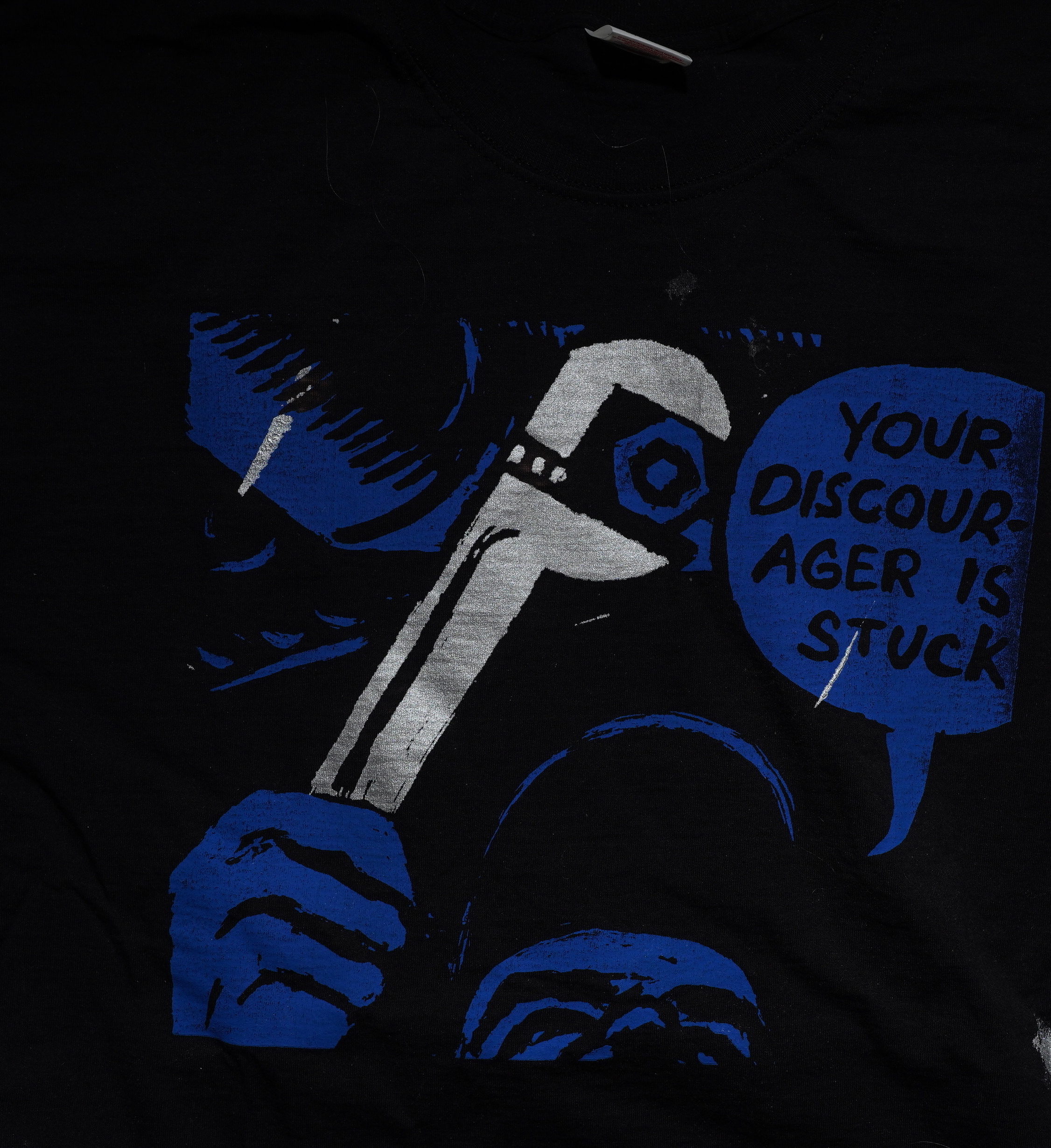
I was so taken by that panel that I used it for when I was teaching myself screenprinting t-shirts:
I fucked that one up, though. Screenprinting’s hard!
Anyway, it’s a lovely book that I’ve read many a time. It’s got a calmness to it that’s super attractive.
The latest in the Raw One-Shot series is Jack Survives, a 44-page, oversized collec- tion of strips by Jerry Moriarty. Jack Sur- vives, which Moriarty has been drawing since 1977, is a reflection on the life and times ef the artist’s father, a phone come pany employee who died in 1953. It is also a, meditation on the nature of common-place events in What might fairly be described as an unexceptional life. In a tangible sense, Moriarty projects himself into the strips, living through the moments of banal inci- dents that, in some odd, ambiguous ways, distill and summarize the tome of an ordi- nary urban existence.
[…]
Moriarty’s painterly technique has a ‘lot to do with the strip’s melancholy aura. The human figures in Jack Survives are rendered indistinct, often glimpsed from an obscur- ing perspective or only partially visible within the panel. (lack is often the Central figure within a panel, and subsidiary char- acters are most often glimpsed frorrq be hind: in the two-page centerfold, however, most of Jack’s face is hidden by a staircase.) For the artist,’ this probably approximates something like the function of memory, in which the outline of an image or incident is recalled but the particulars are blurred or obscured •from sight. Moriarty also in. cludes a few actual photographs of his father. In one, reproduced as a full page, John W. Jack stands, hands Qucked inside his pants pockets, an ordinary middle-class guy with thinning hair probably caught by the camera in a casual, leisurely moment gazing out at uS across a span Of more than three decades. The ambiguity of these photographs, images frozen in time and each imparting its own mystery, reverbe- rate throughout the strips, lending an added poignance. Who was this man?? We cannot possibly know or touch his life, but when Moriarty gives us Jack, painting chairs in the basement of his hoose while daydreaming of painting pictures on can- vast we catch a somewhat forlorn glimpse of a man’s hopes and dreams.
[…]
Jack Survives is a beautifully imagined use of the graphic narrative form, and Fran- coise Mouly, Art Spiegelman, and Mark Michaelson have edited and designed the book with exceptional skill and taste. Inoking•through this book, you may find yourself ceaselessly pondering the distance between the expansive possibilities in a use of the form like Moriarty’s and the con- strictive adherence to formulae in main- stream comics. Worlds and worlds and worlds apart.
KELLY; You used to edit a comic anthology, Bad News. How did that come about? NEWGARDEN: It started in Spiegelman’s class. It was after I had graduated and he had a bunch of students doing this magazine project which he asked me to get involved in. The first issue I wasn’t too involved in. All I really contributed was the Pud and Spud strip and I think I helped put together the contents page. I didn’t edit it. On the second one, Paul Karasik and I independently did it. We published it, edited it, went out and got ads for it, got it printed, the whole thing. A painful experience. We leamed a lot, but I’d never want to go through it again. The third issue happened years later when Paul and I were teaching experimental comics at SVA We had some good students’ work and we had been kind of collecting some strips we liked and somehow we wound up with enough material for a third issue and we did that through Fantagraphics, which was a lot less painful. KELLY: It seems like Bad News somehow evolved into Snake Eyes. NEWGARDEN: Yeah. I think at a certain point Glenn Head was lobbying for another Bad News and I said, “I don’t want to have anything to do with it. Why don’t you be editor?” And ultimately it was renamed Snake Eyes and he and Kaz took over as editors, They’ve done a great job. Also RAW was kind of instrumental in killing Bad News. When we were doing the second one, about to go into a third one, suddenly Spiegelman got all paranoid about our little comic book. Like we were muscling in on his turf. I got into this big fight with him. At a certain point he said, “I’m gonna bury you.” Just like Kruschev! And a lot of stuffthat ended up in the very next RA Wwas actually intended for a third issue of Bad News. My Nancy strip, “Love’ s Savage Fury” was done for Bad News and Drew ‘ s great illustrated piece using Leo Gorcey’ s poetry and that strip that Richard McGuire did, “Here,” were all projects initially done for Bad News. We kind of got muscled out of business for a while. Eventually [Spiegelmanl I guess got over it, but he saw it as some kind of threat to RA W’, which was pretty ridiculous.
!!!
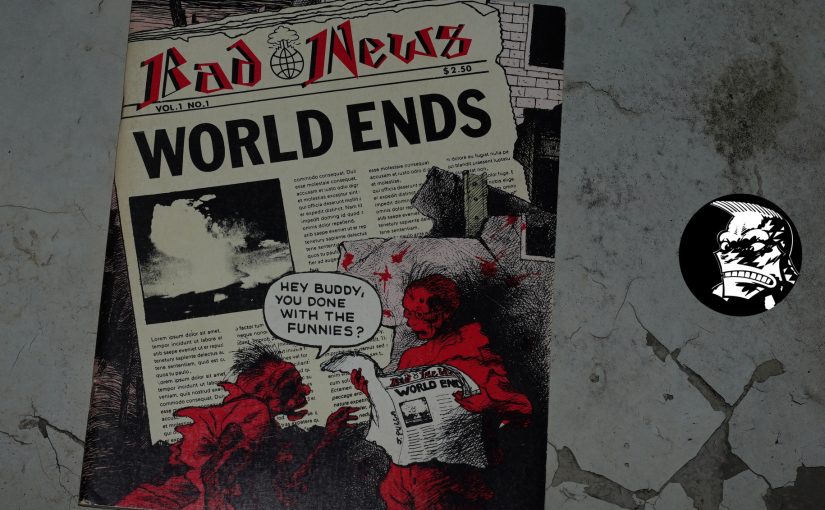
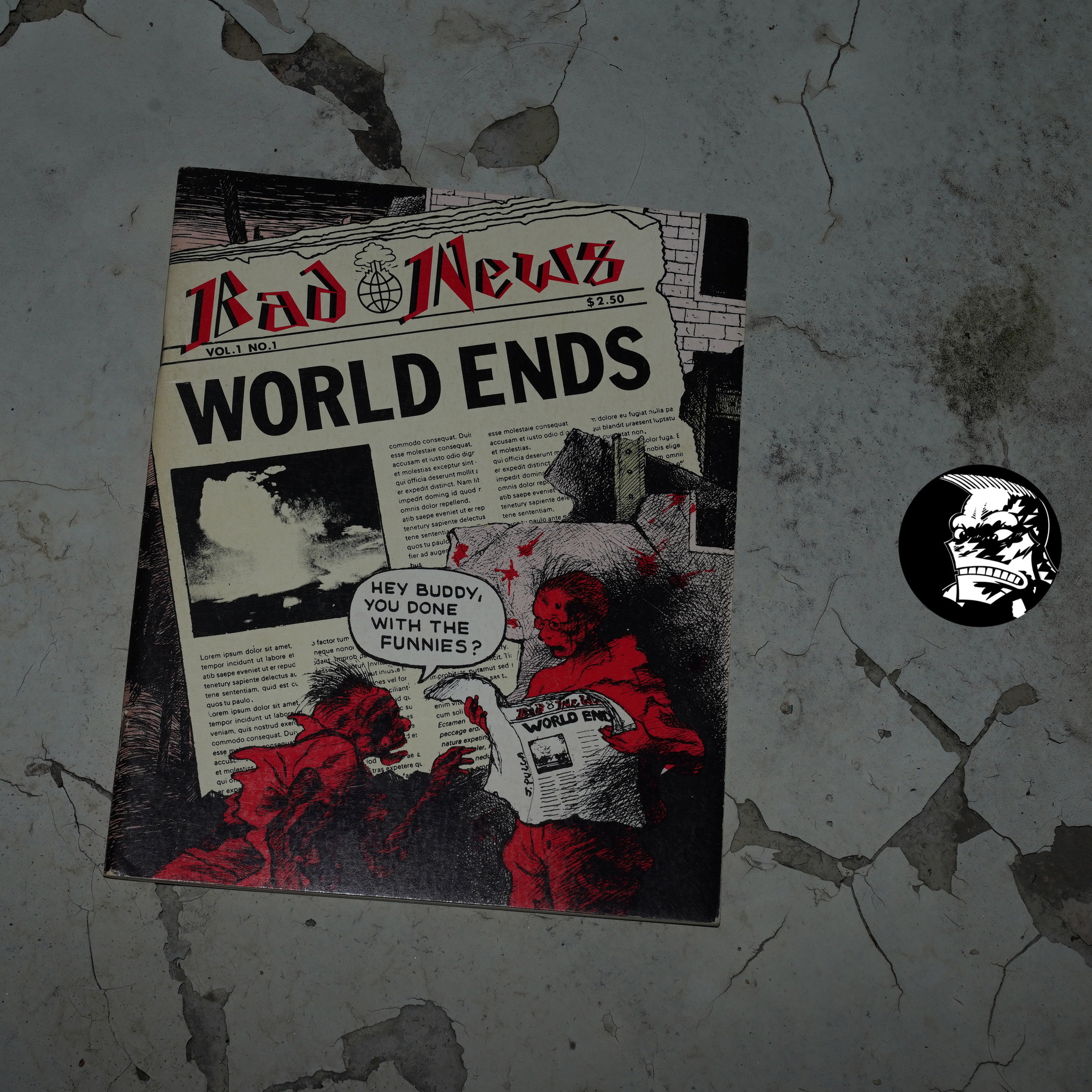
Anyway, that’s later, and what we have here is the first issue, which was published by the School of Visual Arts.
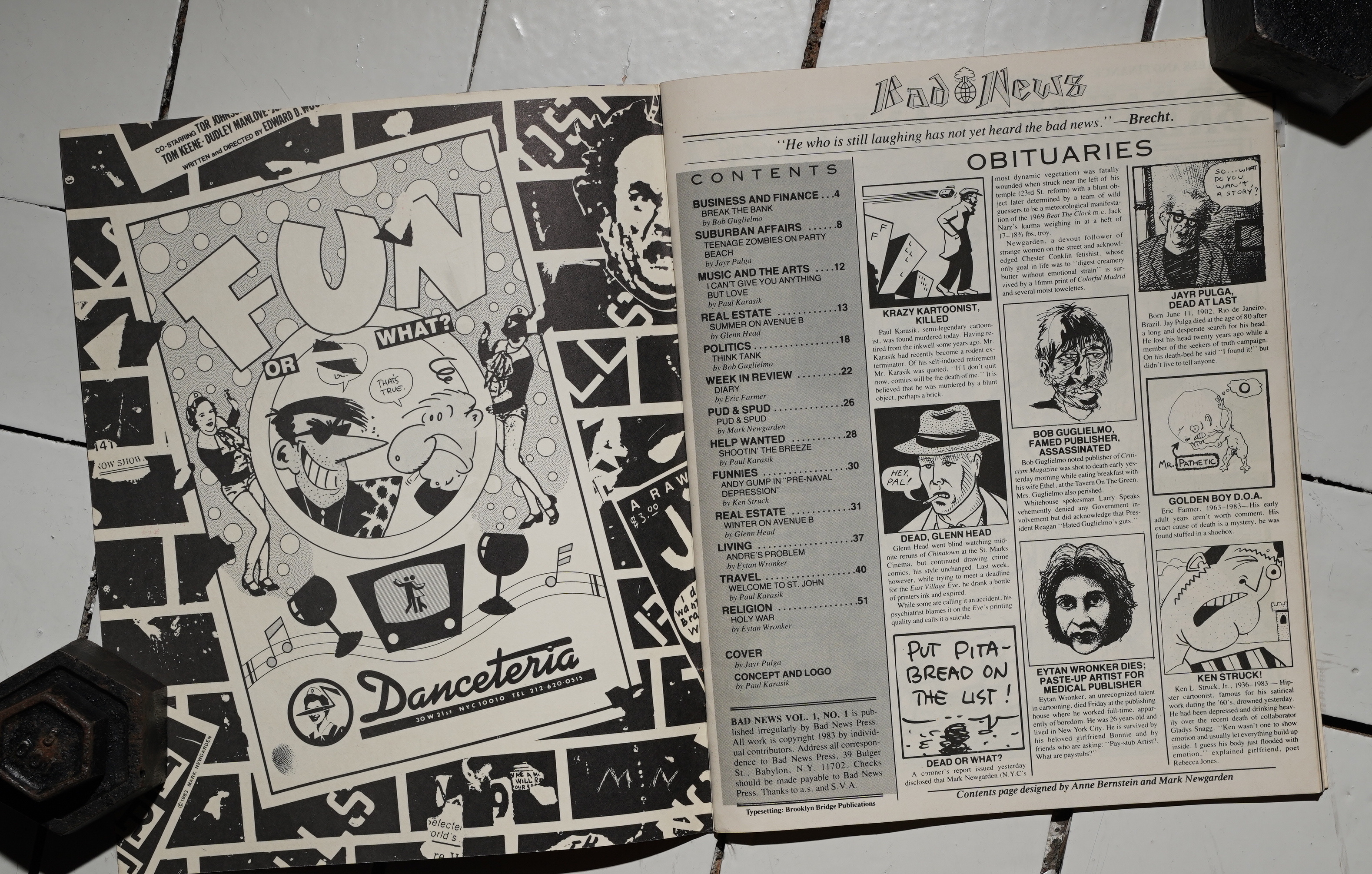
Heh. An ad for Danceteria?
Instead of an introduction to the creators featured, we get their obituaries. I’m surprised that there’s only eight contributors — it means that they get about eight pages each, which is more than I’d expect of a classroom project like this.
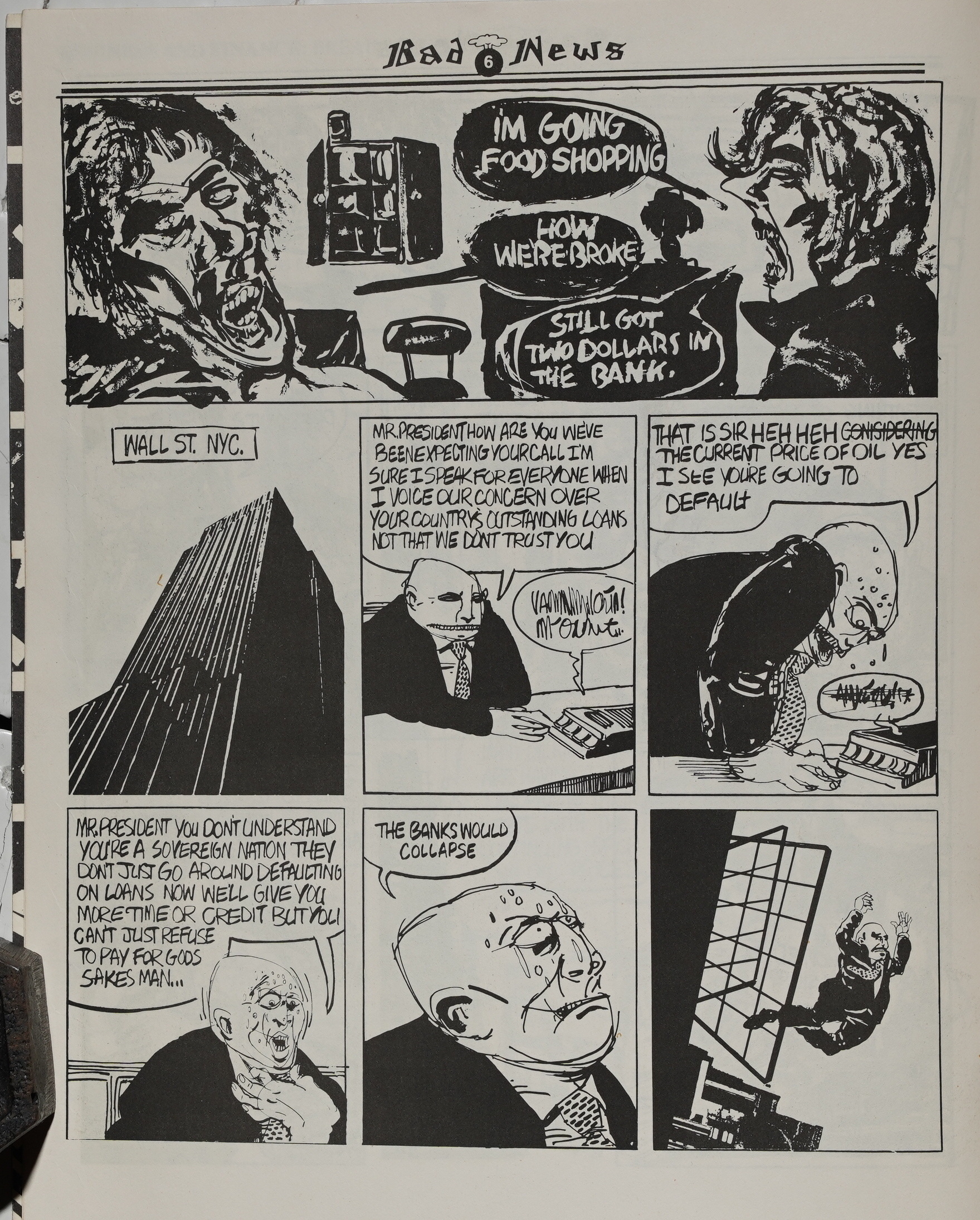
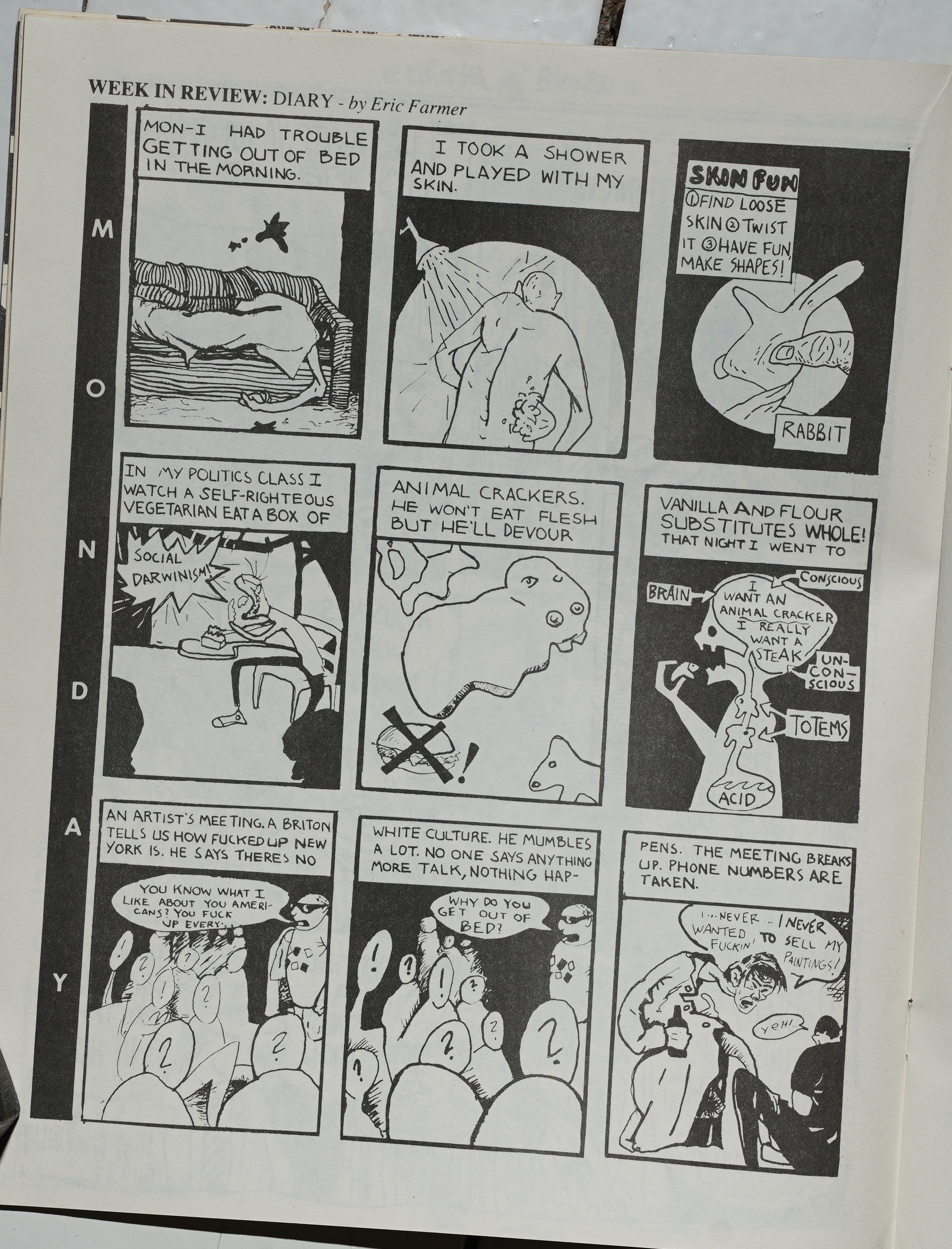
And it’s… it’s not very accomplished work. Bob Guglielmo’s work is pretty typical: The plot’s vaguely “political”, and the artwork seems to crib styles, sometimes several styles at once, from more established artists. I mean, it’s student work, so that’s what you’d expect.
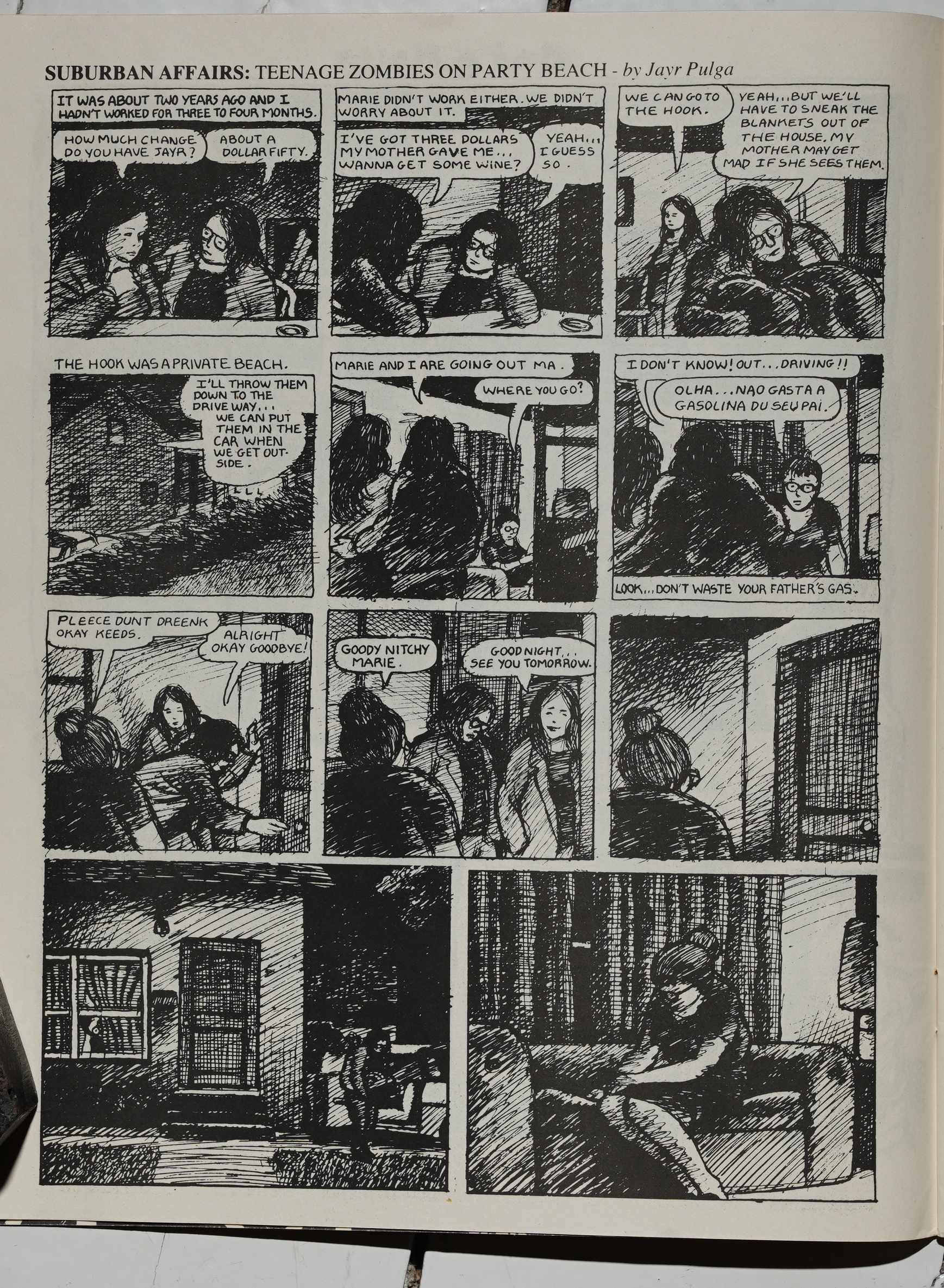
Jayr Pulga’s line is good — perhaps a bit overly influenced by Jerry Moriarty?
There doesn’t seem to be much inspiration behind many of these comics — they’re just kinda… there…
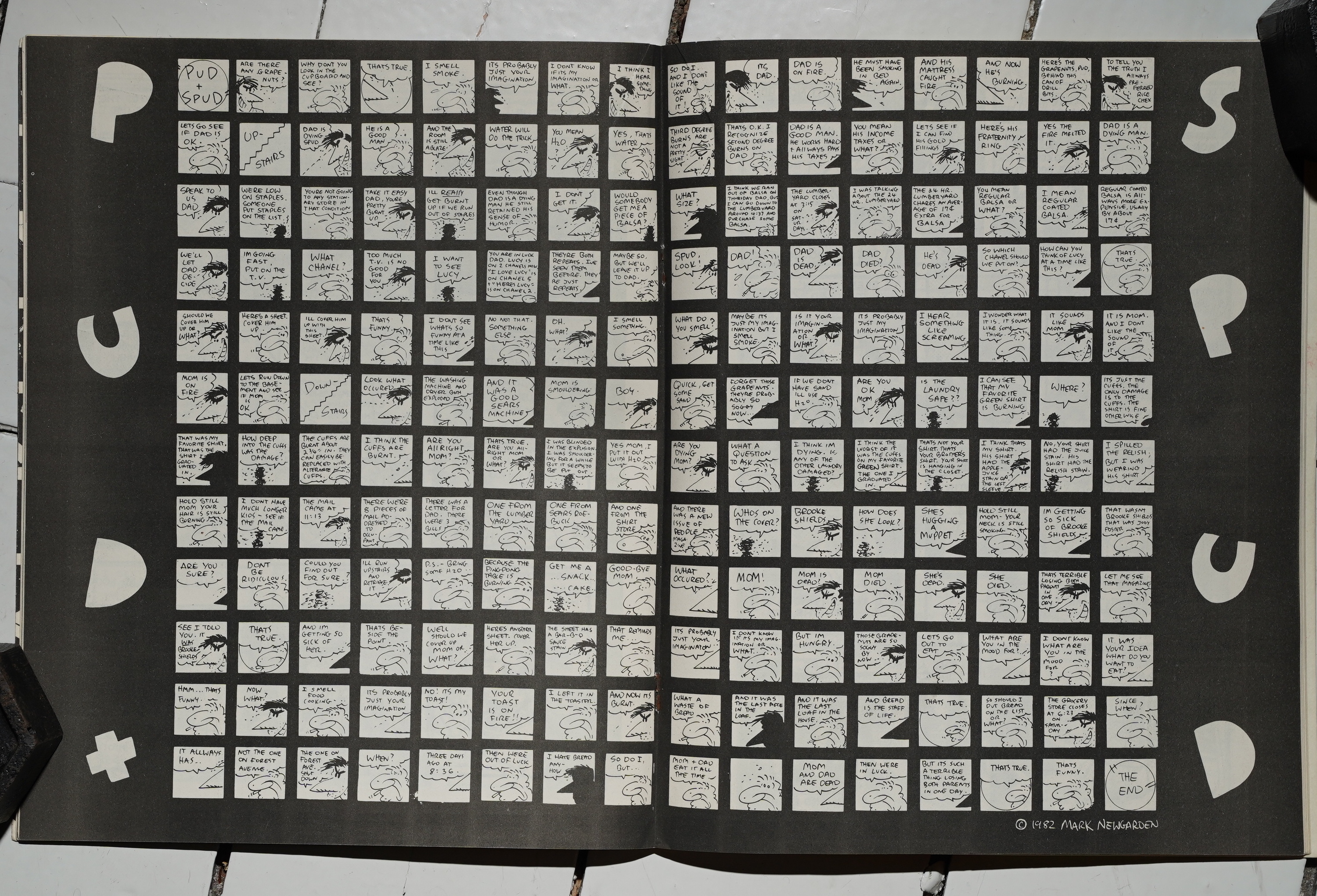
Perhaps predictably, the only thing in here that’s interesting is Newgarden’s Pud + Spud two pager. It’s not as good as the later Pud + Spud thing he did (which works along the same lines, but had more resonance), but it’s still something.
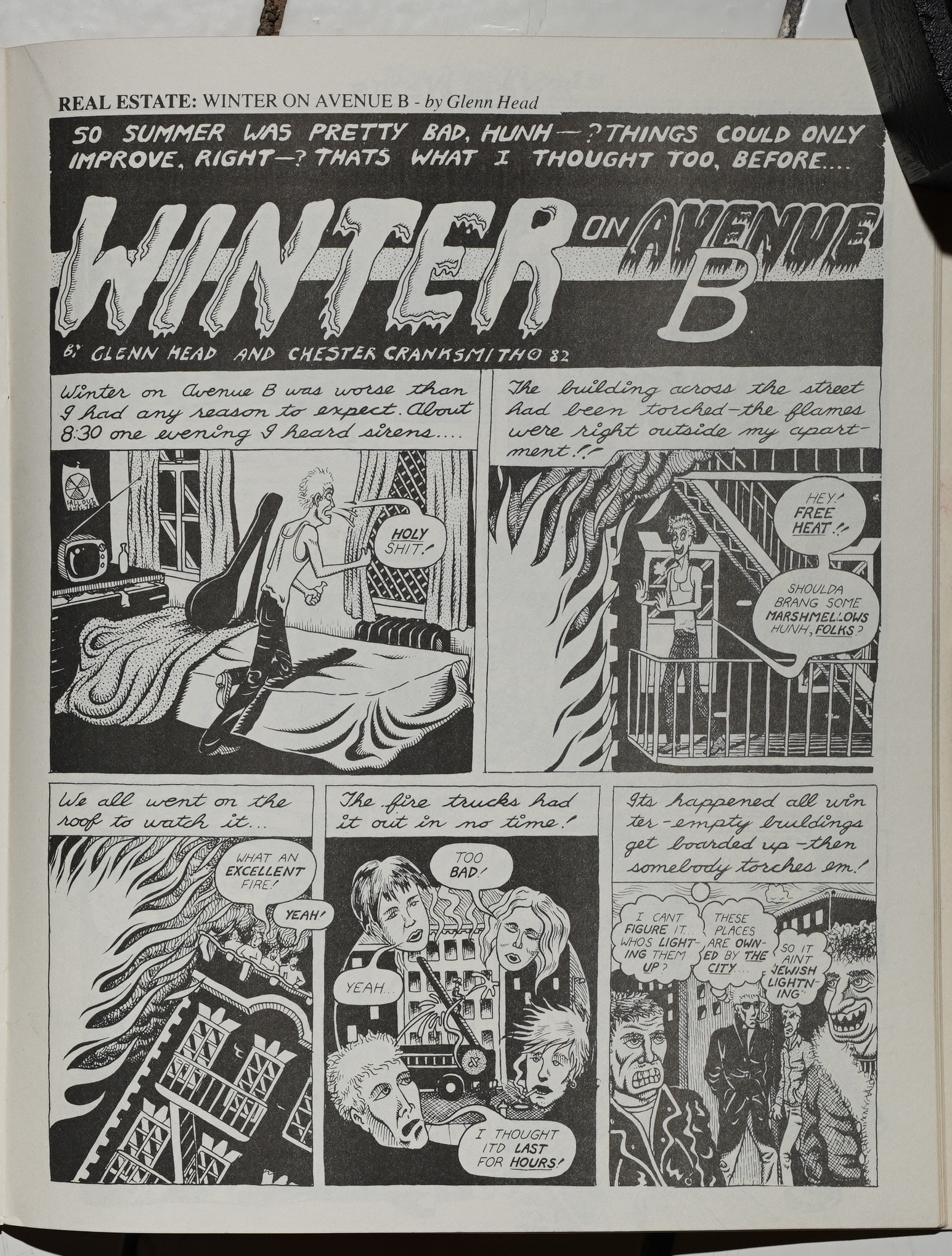
Glenn Head does a couple of autobio things (I assume), and as usual it’s about what a tough and hard life he’s living. But… “Jewish lightning”? Dude! I guess this just reminds me of sloppily anti-Semitic mid-70s undergrounds more than anything: It’s not really graphically interesting, and uses very traditional storytelling.
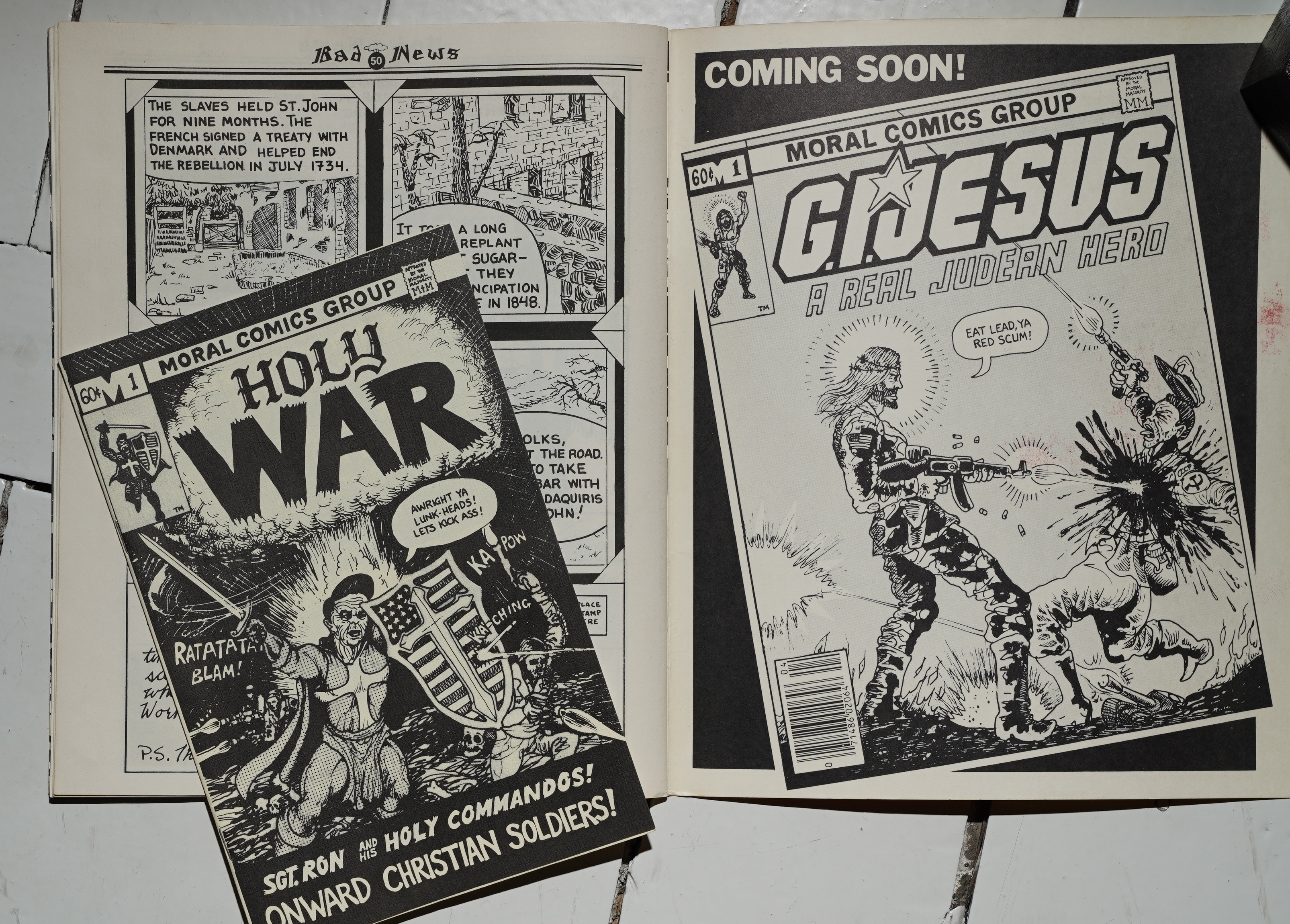
I guess Paul Karasik is more known as a writer and editor than an artist, but this story about a slavery uprising on St. John has some graphic interest. But it’s pretty sloppy.
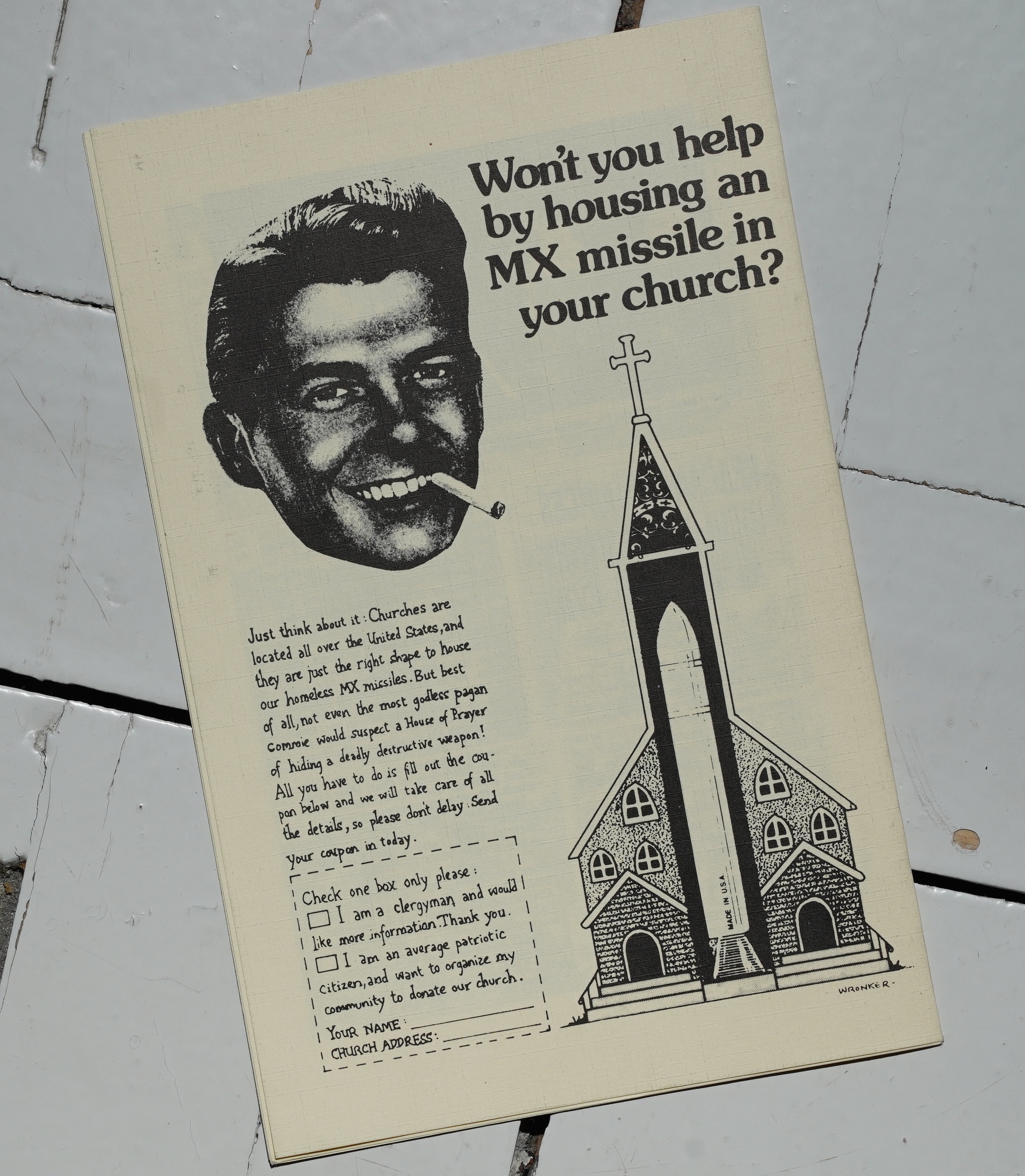
Finally, we have a an insert by Etyan Wronker…
It’s totally unreadable, but it does have this one gag.
Targeted advertising!
So… that was… pretty awful? And I’m also wondering whether there were no women at the SVA?
Born Of Raw and the urban art school experience, Bad Neu’S is the 1980s’ answer to such apocalyptic-themed undergrounds as Hydrogen Funnies Of 1970. Printed on the heavy stock paper Of today’s Seriously Artistic Comix Book, Bad News offers a sardonic series of takes on Reagan’s America, much the same as early undergrounders like Shelton and Irons took on the Nixon gang. That there is a discernible dif- ference, both in tone and style, between these two period titles says much about the state of alternative comix today and the way they differ from their forebears. […]
Harvey Pekar and his cohorts may look at the streets of Cleveland and see Americap splendor, but to the artists of Bad News the Vista is nightmarish. The Pekar comparison -is apt, for most of News’s con- tributors owe a debt to his comix-scripted naturalism. Jayr pulga’s “Teenage Zom- bies on Party Beach” and Glenn Head’s Avenue B strips in particular follow the Pekar mode: small vignettes of life in the ‘burbs and East Village respectively, with lifelike dialogue and open- ended structures. In Pulga’s autobiographical strip, two solemn suburban teenagers drive to the beach to drink and ineffectively comfort (Shelton, Jaxon, Sturgeon, et al.).
[…]
Bad News is paaaged like a small-scale Raw, down to the inclusion Of an insert comic, and opens with its own self- characterizing epigram: ‘ ‘He who is still laughing has hot yet heard the bad news.” But where Raw’s contents reflect the rather broadly inclusive vision Of editors Mouly and Spiegelman, Bad News’s material is more self-consciously restric- tive. Darkly urban and fre- quently just plain depressing, the title reflects both the grim relities of life in the new Depression and on the city streets. Harvey Pekar and his cohorts may look at the streets of Cleveland and see Americap splendor, but to the artists of Bad News the Vista is nightmarish.
[…]
Of all the Bad Netes artists, Karasik immediately strikes the reader as the most visually smooth.