V1987: Transit

Transit (1987) #1-5
by Ted McKeever

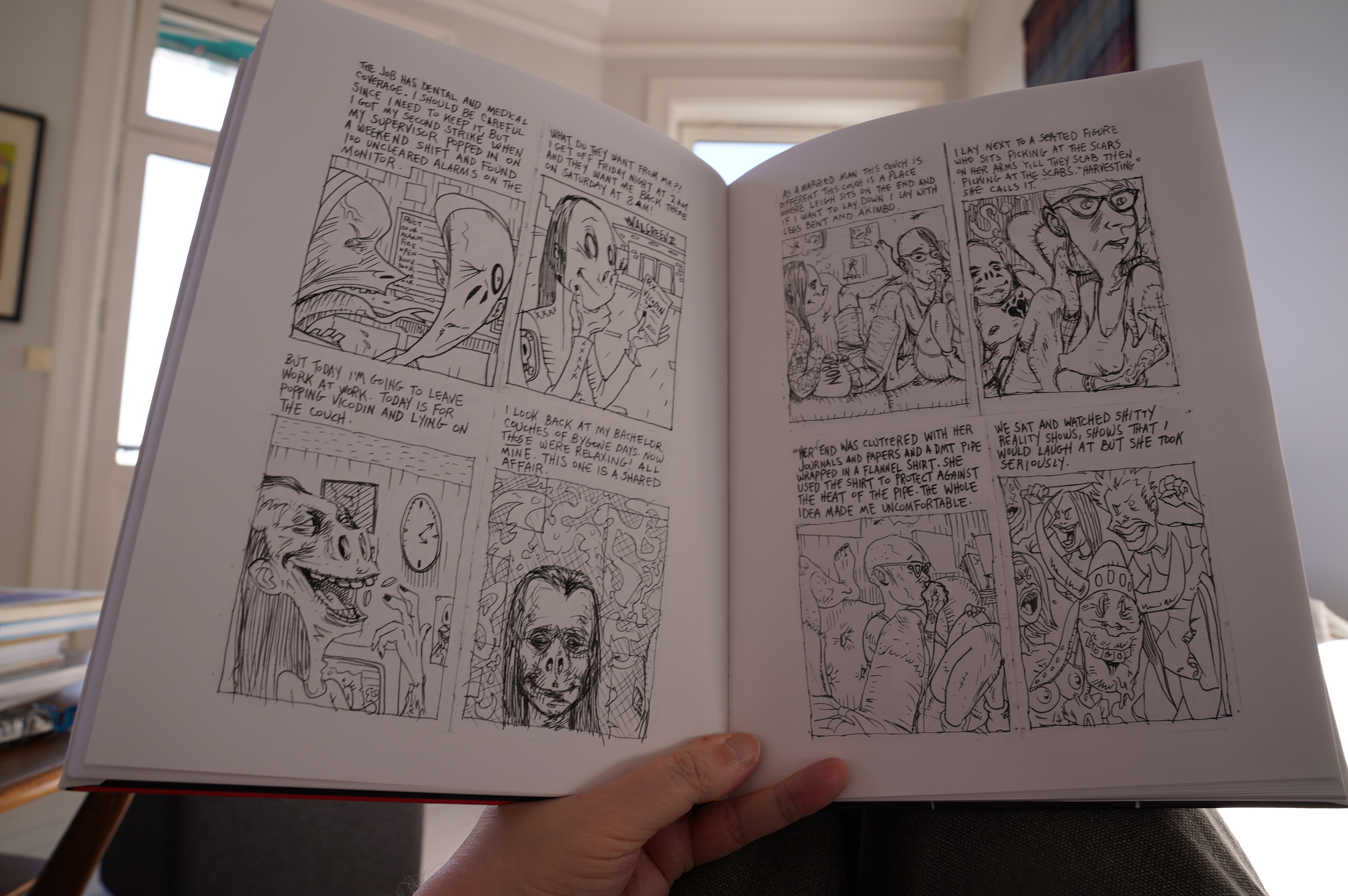
As a teenager, McKeever’s artwork fascinated me. All my doodles turned into McKeever faces, replete with way too many teeth.

Lou Stathis, the editor, writes an introduction to the series. I think he’s going for punk smart aleck, but he lands at hard-sell card salesman with delusions of grandeur.

And… Gary Panter is Throbbing Gristle? Frank Miller is Roxy Music? What? That just doesn’t scan. So let’s read the first three pages of this comic instead.

This is not the McKeever I remember! This super-deformed awkwardly cartoony stuff looks more like prime Black & White Boom garbage. Was this series originally meant for Aircel or something?!

I wonder whether these opening pages were done several years before the rest, because…

… the artwork evolves in leaps and bounds on every page, and McKeever is no longer doing Marc Hansen, but is now doing Frank Miller by Keith Giffen without access to his Muñoz swipe pages.

You can tell that this is a fantasy comic, because that cop (possibly) killed someone, and then he gets chided by his boss. That just never happens.

I know! Peak resistance!

And then… he’s doing Dave Sim?

Stathis helpfully tells us that Transit is going to be all valuable one day! Let’s see…

It’s true! I think that beats inflation?

That’s a good joke (the artist isn’t finished drawing him; he just has the nose), but the newsprint that Vortex was using in 1987 was so bad that it kinda ruined the joke: It looks like a finished drawing because of the bleed-through from the previous page.

Or perhaps McKeever planned it that way!

Anyway, McKeever’s artwork just gets better and better… he’s not at his style that won him fame and acclaim with Metropol yet, but it’s plenty fun. And the storyline is puttering away nicely, too: There’s political intrigue, and several intersecting plot lines, and interesting characters…

Oh! There’s that guy from Metropol AD that I was reading just the other month. I guess I knew that he was a returning character, but I didn’t remember that he was from Transit. In the McKeeververse, it all ties together… even if McKeever probably didn’t plan it out in advance.

Nope. The teeth aren’t all there yet, but we’re getting there…

Heh. He should do more in this style. (This is from a dream sequence.)

In Stathis’ third and final introduction, he says that McKeever is doing a separate book over at Mad Dog, and that it’s… “more engaging” than Transit.

Well!

I’m wondering whether McKeever was having doubts about this book at this time. He starts putting in a lot of verbiage to explain everything… moving things along instead of letting things happen naturally…

Now the teeth are starting to pop! So to speak.

Hey, nice pic from the subway. That cop looks so… reassuring…

McKeever starts using the Xerox machine more, and more creatively. That zoom-out is pretty cool, with the lines becoming more fine-grained (because the panel to the right is the original drawing).

OK, we can all have toothy mishaps while trying to develop a style.

And then McKeever basically gave up: He kills off at least one central character, seems to forget most of the others, and just sets fire to all of New York. This is the final issue published, so it’s basically a variation of the “oh, god, I’m tired of this, let’s blow up the earth”.

But I may be wrong, because he did add an ending to this when Image reprinted the series in a collected issue a while back. And I have that collection here somewhere… but where?! I just can’t find it.

I’m especially curious as to whether he redrew those first pages that were in the totally different style…

An interview in The Comics Journal #163, page 63:

JEREMY PINKHAM: I’ll start didactically. How did you get
the opportunity to create Transit?
TED McKEEVER: I’ d been working on ideas and coming up
with different things while I was working at The Miami
Herald doing editorial art and working at the TV stations
doing courtroom sketches. There was a lot of political stuff
going on, a lot of news coverage based on corruption and
elections and so forth, and that was basically where my
focus was. At that point I saw there were stories to be told
that really delved into that kind of situation and didn ‘ t have
the necessity for, say, a superhero or someone who could
fly. There were interesting stories just based on reality. I
said, “Let me sit down and see if there’s something here.”
I was always fascinated with subways and trains, and
industrial stuff— and that’ s from childhood — and those
two things came together. I sat down and started to play
with ideas and write out some premises and different
situations. I would go to work in the morning, come home
around five o’ clock, and work on the book from about six
until about one or two in the morning. It took me three
months to do the first issue.

[…]

PINKHAM: I’ll step backfor asecondand ask whyyou didn ‘t
finish Transit.
MCKEEVER: Two reasons On that—and they just so happen
to coincide with each other. The book at the time was bi-
monthly; six issues basically took care of a year. So after
doing book two, I got a call from Mad Dog saying, “We
like Transit.” And I said, ‘Well, I’m already doing it for
Vortex,” They said, “Do you have any other ideas ?” I said,
“Well, I have this Eddy Current idea.” They said, “Well,
we have a slot in this book called Splat! , and we would like
you to do a short, five-page story. ” Those were the first five
pages of Eddy Current, book one, and that was it. It ended
with those five pages; it was just this little, odd short story.
When they got it in, they turned around and said, “We like
this. Does it go any further?” I said, “Yeah! It goes a lot
further — but you guys just wanted five pages.’ ‘ They said,
“Well, we’d like it if you could do more.”
So back then, as I still do now, I said yes. “Sure! I got
plenty oftime! Icould do two books at once.” Sol sat down
and did book two, three, and four of Transit immediately
and figured, “Okay, that takes care of six months. Now I’ll
do Eddy. ” Eddy started to take off and Transit was doing
fine, but Vortex then released two, three, and four within
almost a two-and-a-half-month period because, finan-
cially, they figured, “We could use the money. The books
are done. Let’ s put them out!” Which basically did nothing
for me, because there was no way I could do the two books.
I said, “I have five on the board right now; I’m going to
finish five, and then that’s it. I can’t do anymore.”
I had to decide between Eddy and Transit, and since
Transit was open-ended and Eddy was finished, as far as
story goes, I opted to go with Eddy. Also, Eddy, at that
point, started to pick up coverage and was starting to get
recognized. So I went with Eddy, more in the sense that it
seemed to be a little bit higher-profile. I figured, “Well,
this isn’t an open-ended thing, so I can end it.” My
intentions were to end Eddy and go back to doing Transit.
When I ended Eddy, then people started saying, “What
other ideas do you have?” And Comico said, “What do you
have in mind?” And I said, “Well, geez, I’d like todo this
book called Plastic Forks.” And they said, “Okay, fine!
You can do it in color!” So I said, “Goodbye, Transit!”
[laughter]

Here’s some cool ads for Transit:

A preview in Amazing Heroes #133, page 185:

In #4, if you recall, Spud was indoctrin-
ated into Reverend Grisn’s Church of the
Slack. “He dresses nice, his hair is cut—-
he’s kind of scary,” says Ted McKeever.
His involvement in the next issue is
minor, as he travels with thee rest of
Grisn’s “mognies” and makes speech-
es. Grisn and Boss Traun take center
stage in a major discussion that reveals
more of their motivations. It all leads into
#6, which contains Grisn’s last speech
before the mayoral election. Meanwhile
Joe Bone, the ex-con hit man, has been
dispatched to assassinate the candidate
by one of Traun’s minor rivals. The bulk
of the issue takes place on the elevated
train platform Bone has chosen for his
vigil. Somebody dies.
In #7 Spud is brought into the seedier
side of the city by Bone and depro-
grarnmed. They link up with Rex, the
pimp who had hired Bone. All goes well,
considering, but Traun is an ever-present
danger. He will remain a threat farther
down the line. “I don’t uant it to be a
book where the villain poses a threat that
is dispersed later on. It usually goes,
‘Well, whoops! He almost made it.’
Again, Transit is a book where the
villain is going to win at some point.”
The issue with Traun triumphant is most
likely to fall between #9 and #12, and
will almost definitely be a full-color
issue., Watch this space for further
developments.

OK, so McKeever did have further issues planned.

Here’s a review of the collected edition:

Transit is not a tightly plotted book: it starts from Spud and the nasty mayoral election, and wanders around its grimy city from there, bringing in more oddball characters and bouncing between energetic scenes that don’t always completely track to each other. It always makes it way back to Spud and the evil guys eventually, more or less, but each loop seems to have less and less to do with the initial setup. And then, of course, we hit the “lost finale,”a series of quick scenes of the characters, to close out all of their stories and provide something like an ending. I don’t think it’s the ending McKeever was aiming for back in 1988, but Transit feels like a book that was plotted as it went along, so I may be making an unwarranted assumption to say he was aiming for any particular ending.

This blog post is part of the Into the Vortex series.

V1987: Paradax!

Paradax! (1987) #1-2
by Peter Milligan, Brendan McCarthy and others

These are the people that did Johnny Nemo and Strange Days at Eclipse, right? And one of the characters in the latter series was Paradax…

So let’s read the first four pages:

Wow! That’s a lot. An explosion of colour and silliness, and also (of course) so much politics. (It turns out that Ronald Reagan was a bit stupid? Who knew!)

This is a lot of fun: It’s about a super-hero called (yes) Paradax who’s saving New York… after getting paid. It’s told in a way that you’d think it’d fall apart at any time, but it’s instead a fast-moving fun little story.

Yes, little: The first issue is three eight-page stories, and now I’m wondering whether they’ve been reprinted from somewhere (some British magazine)?

The second story doesn’t have Paradax at all, but instead have these dapper gentlemen… and, wow, when we got to the second panel there, I was like “yes!” Being out to sea in your bed: That feels like something I have to have dreamt at some point, right?

It’s a very silly story.

I love it! Gotta be polite while shooting people.

The third story has smaller lettering and these extra borders at the top and bottom, so I’m guessing this one was reprinted from a magazine-sized er magazine?

So that was a pretty good first issue: The first two stories were solid, and lots of fun, and the third was… weird…

Then the second issue turns out to be a reprint of three Paradax stories from Strange Days, which is a disappointment.

Because I re-read these the other year.

They’re more traditional than the stuff in #1, but still pretty wild.

Maximalism doesn’t begin to describe it.

From an interview in Amazing Heroes #119, page 52:

Although Paradax! is both the
•main character and main selling
point of the comic, both Milligan
and McCarthy hope that the suppor-
ting strips will. prove equally or
more popular, as McCarthy told me
“We love Paradax:, of course. but
there’s so much more we want to do.
We’d like to produce a Milligan and
McCarthy comic featuring widely
and wildly different characters and
stories. The point is, Milligan and
McCarthy create these things. We’re
bigger than our creations. This is the
first comic that is pure Milligan and
McCarthy, even though Tony Riot
did the pencils on Paradax! The
situation we’d like to get to is where
people want to see us perform,
where they buy a piece of Milligan
and McCarthy, and not necessarily
a particular character.”
And his partner Milligan backed
him up. “It’s a case of seeing what
happens, of seeing how people react
to•the other stories in Paradax! If
everything goes well, I suppose
there’s a good chance we’ll continue
working with Bill Marks. I know
Bill is supposed to have a reputation
in this industry, but so tnany people
do! All you can do is go by how peo-
ple treat you, and so far Bill has
been great. Very keen and positive,
there have been no problems, he
doesn’t interfere with us editorially,
which is very important, so every-
thing’s fine. We’ve never had any
doubts about Vortex’s ability to put
out as really quality product, of
course. You just need to look at
some of the other things they’ve pro-
duced.”

A news item in Amazing Heroes #102, page 15:

Vortex is picking up the rights to
the new-wave super-hero title
Paradax, which will be released as
a two-issue, full-color”Scratch Mix
Micro Series.” The issues will in-
clude some “re-mixed re-colored
jazzed-up versions” of some of the
earlier Paradax material, which saw
print in Eclipse•s Strange Days
book.

So it was originally planned as a two-issue series? Hm, perhaps Marks changed his mind?

McCarthy wrote:

I invented Paradax! in the early 80s, and asked the question, ‘what would it be like if an ordinary guy down the road became a superhero?’, which over 30 years ago, was a fairly novel approach: He would drink, smoke pot, fuck girls, watch himself being interviewed on TV, be an annoying self-infatuated asshole obsessed with stardom, have a manager, and take the money and run.

These stories were probably included in the collected edition.

People like it:

These are quirky, psychedelic, multi-layered comics that will both befuddle and entertain upon repeated readings.

This blog post is part of the Into the Vortex series.

V1987: Ken Steacy’s Summer Rerun

Ken Steacy’s Summer Rerun (1987)
by Ken Steacy

So what’s this then?

That looks very familiar… From the Vortex anthology, I guess?

Yes.

Oh, it’s all from the Vortex anthology? Which I read the other week.

Well, that’s a disappointment.

The introduction at the back explains that, indeed, it’s from the Vortex anthology. But that Mister X wrestling thing (an homage to Jaime Hernandez, I’m guessing; well done) I haven’t seen before. But that’s that about fooling people into thinking it’s the first issue of the Vortex anthology?

Oh, the back cover is a reproduction of it. Clvr.

Well, there’s not much to say about this one… I really like Steacy’s artwork, but…

This blog post is part of the Into the Vortex series.

V1987: Bloodlines

Bloodlines (1987) #1-4
by Rob Walton

I know, this is a blog series about Vortex, but this series started at Aircel, before moving to… Blackburn Videos + Comics (!!!)… before moving to Vortex. 1 issue at Aircel, 2 issues at the video store, and 4 issues at Vortex, so you’d expect 8 issues at the next company, but that didn’t happen.

So let’s just read the first four pages of the first issue.

So this is a comic that has been a long time coming — Walton started working on it four years before Aircel picked it up. Presumably because the Black & White Boom “collectors'” craze was in full swing, and Aircel was one of the main perpetrators, pumping out all the amateurish crap they could manage to produce.

But this is a pretty strange thing for them to be pushing… it seems… er… to be about… well, I’m not sure what it seems to be about, but it’s not about Elves or Lords or Elflords, so it’s an odd fit. I’m no Aircel scholar, though.

There’s a couple of striking things about these first pages. First of all, the black spotting seems so precise and appealing that you think Walton must be a seasoned professional. The other is that the heads and faces on these characters look like Walton has never seen an actual human being. Those incessantly staring eyes, that seem to be looking at… something, never quite clear what it is… are unnerving, but probably aren’t meant to be?

And another thing: When drawing children, Walton seems to drop into a very cartoonish mode. Was he an animator, by any chance? That face from the lower right panel on the left-hand page seems to come straight from some cartoon. Some limited-animation cartoon.

I like comics that don’t explain what they’re about, but Walton pushes the reader pretty far here. We’re dropped in the middle of a bewildering number of characters, and what seems like a half-dozen intersecting plot lines, and nothing is explained — not even who these characters are. That several seem to have multiple names doesn’t help with comprehension. (Or perhaps it’s different characters drawn the same; the main way to tell characters apart is remembering who has what hairdo.)

It’s not even clear if “lost soles” is a joke or has some deeper meaning.

Super-deformed mode, I guess.

Oh, not just elves. Dragons, too.

The editorial in the second issue (published by Blackburn Video + Comics (!) (allegedly)) is all about how censorship (of violence?) is wrong, because there’s a lot of gnarly stuff in the bible. Which begs the question.

Walton is a has a religious education (a master’s in voodoo or whatever he was saying in the first editorial; you should look it up — I may be misremembering, perhaps it was hoodoo), and it’s obvious he’s got religious damage. So there’s a ton of religious references in Bloodlines that… I just don’t get, or even care to get, because it sounds really boring.

This thing Walton does with their chins is odd, and kinda makes it looks like he’s drawing his characters in profile and straight-on at the same time. Cubismo!

I guess this is why he had that editorial about violence.

For a comic that’s published by a video store (?), there’s a lot of ads for Aircel stuff in here…

In the next issue, the mystery (of the publisher) is semi-revealed: Aircel didn’t want to publish Bloodlines any more (for unspecified reasons, but not “in all good conscience”), and Blackburn is an “imprint” (of Aircel?), but the book is moving to Vortex in the next issue.

So all this makes me more curious — what was it that Barry Blair (the Aircel owner, I think) had against the book? Was it too violent? I thought I remember Blair being notorious for publishing semi-porny and violent elf comics? But I’m not an expert.

Did he object to there being too much talk about christian stuff in the book? Did he find it blasphemous? Too little blasphemy?

THE MYSTERY! THE MYSTERY!

Heh. Somebody had to hand-stamp “printed in Canada” in all the copies…

OK, back to the comic: The artwork is getting better. The eyes are still staring out into nothingness, but not as much as before. But there’s just So Much Drama. On every page. The book is basically people shouting at each other on every page, and sometimes they shout while they’re slapping each other, and that’s it. (OK, sometimes they kill themselves while shouting.)

I don’t think that fashion ever took off…

That guy asks the questions we all want to know the answer to.

In the first Vortex issue, Walton explains that that the series is going to be about 30 issues, and that it’s structured after Gustav Mahler’s second symphony.

OK.

He also explains that the structure isn’t accidental, but that he wants to let the story reveal itself slowly. I dig that, but the reader has to have confidence that there’s something of interest to puzzle out from the obliquely told story, and… I can’t say that Walton has convinced me. The answer is probably going to be “evil is bad, says the Christian god”, I’m guessing?

Walton is having a lot of fun with various storytelling approaches…

… and so am I. The framing here is a very stylish, and very 1988: Everybody had read Keith Giffen’s Muñoz rip-off pages and been inspired, and this is another example, I guess?

It’s also edumacational. I had no idea what “ziptop” and “maytag” meant. And… I still don’t, I guess. [citation needed], as they say: I googled for “ziptop” and didn’t find anything derogatory. “Maytag” seems to have some provenance, though.

The next Vortex issue is just a bunch of tableaux like this…

The next issue has a recap of all the previous issues though, and now Walton spells it all out. I think I’d gotten about a third of this?

And the tableaux issue: I had gotten exactly none of that.

Herp derp I eat paste, I guess.

I do love these little … animals? … that sit at the bars and drink without any explanation. They seem to be manhandled by the human(ish) characters a lot; one of them is killed and then shoved into a trash can without anybody commenting much.

And then in the sixth issue, the charmingly named Treblinka character suddenly starts thinking in thought balloons, conveniently explaining everything to the readers.

So here Walton had totally given up on his plan to let the characters and story reveal itself slowly, and is just infodumping on us.

And then the series is cancelled. Dedicated to Seth!? Wat

The final issue is all like this. We get most of the er characters we’ve er followed over the issues, and they stand there talking at us, telling us their thing.

This guy is the most cogent. What were those things!?

And a bibliography, of course.

Well!

What can I say? It’s a very odd way to end a very, very, very odd comic book. It’s clear that Walton had impossibly high ambitions for this series, and he does almost have the chops to pull it off. Perhaps people who are religious would find the book really, really intriguing? I have no idea; I have no qualifications in that area.

Walton would go on to self-publish the Ragmop series, which is seriously hilarious. Or at least I thought so back then; I haven’t re-read it in a few decades. If I remember correctly, his art style was totally perfect for that series. Like Bloodlines, I think it ended kinda without any resolution? And like Bloodlines, it was also quite ambitious?

Well, let’s research that strange Aircel thing.

“CM” writes in The Comics Journal #124, page 17:

When Aircel Publishing recently
announced that their comic books
would no longer include nudity and
strong language [noted in last issue’s
“Miscellania ‘I, the company was
actually only publicizing what has
Aircel’s in-house policy for over a year,
according to Aircel Publisher Ken
Campbell.

[…]

According to Campbell, the last
flash of nudity in an Alrcel comic was
in a single panel of Elflord which con-
tained an exposed breast. It appeared
nearly a year and a half ago.
Since that time only one major con-
flict has arisen over the policy, with the
comic book Bloodlines, Campbell
said. Rob Walton, the creator of
Bloodlines, produced three issues of
the title for Aircel, which were
published beginning last fall, and was
then told that the comic was more ex-
plicit than his pmposal had indicated.
Walton was given the choice of toning
down the book’s content or leaving the
company. He chose to take the book
to Vortex, Campbell said.
Walton confirmed those events, but
noted that he had discussed Bloodline’s
violent and religious content with
Aircel chief artist Barry Blair before
producing the comics. Walton said the
explicitness only became a problem
when it caught Campbell’s attention.

There… was nudity in Bloodlines? I er didn’t notice?

Somebody writes in Amazing Heroes #133, page 28:

Now that Vortex is publishing Blood
Lines, the company has its first monthly
title. Publisher Bill Marks is very enthu-
siastic about the book. “It’s exactly the
kind of unusual material we look for at
Vortex,” he says. He adds that the book
has been cut to 24 pages frotn 32 in order
to give creator Rob Walton more time to
produce his best work.
Walton is in the process of telling an
ambitious tale which he has structured
after Gustav Mahler’s “Resurrection
Symphony” (#2). The first three issues
of the book correspond to the Overture
and with #4 and 5. we are squarely into
the first movement, “Dreaming Inno-
cence.••
During the “Dreaming Innocence”
issues, we learn a great deal more about
Deborah Judges. We will learn a bit more
about her past and watch her as she
reaches a decision as to whether she will
take up the duty for which she has been
chosen.
The story will progress in a slow
deliberate manner. Being a mystery of
sorts, clues will be laid out to make the
reader think. After all, part of the fun
of mysteries is their unraveling. So things
will slowly become clear to the reader.
This first movement will also set up
adversarial boundaries for Deborah and
Manasseh in a most dramatic manner.
Meanwhile, the roles of the deities
involved (Asrnodeus and Abba) will
remain ambiguous both in terms of their
relationships with each other. and with
Deborah.
Abba, who is also the Grey Monk,
will exert a certain amount of influence
with Deborah. He will figure in her
decision to accept (or not) the duties with
which she has been charged.
The “Dreaming Innocence” storyline
will cultninate in the death of a major
character. It will be dramatic. and it will
be final.
Some items of inteyest for the reader
will give the series a bit tnore depth.
Creator Walton tells us that “Everyone•s
name has literary and philosophical
implications. There is a link between
Abba and Asmodeu.s as their names will
show.
“We’ll be taking a serious look at
Deborah’s fa:nily background. will
find out what happened between her and
her father on the farm that day.
“We will also see these things through
Deborah’s eyes—it will be her interpre-
tation of the events. With her father being
unable to give his interpretation, we will
see only one side.”
Although there is a lot of violence in
Blood Lines, most of it occurs “ofE
camera.” What you see is not gratuitous.
“There are specific purposes behind
everything that happens in the series.
Everything, including the violence,
moves the story along,” says Walton.
According to Walton, we will also
learn more about the cop’s relationship
to Deborah. will find out who knows
whom, and why. And, Maxine will move
up in prorninence in the storyline.
Blood Lines is a complex series that
relies heavily on the form of Mahler’s
second Symphony for its structure and
the Bible for its substance. But above all,
it is a rousihg yarn with vital characters.
fast-paced action and a dash of philos-
ophy.
Creator Walton says that he wants to
tell an intelligent. moving and involving
story. Publisher Bill Marks says that he
is doing just that.

Somebody writes in Amazing Heroes #145, page 41:

In something ofa surprise move, Vortex
has cancelled Blood Lines. The last issue
was #7.
Creator Rob Walton says that for the
time being he will put the title on hiatus
rather than shopping around
for a new publisher.
In the meantime, he is busy giving
Dean Motter an art assist on the Prestige
Fonnat PHsoner series for DC. It should
be out in August and you can find more
info on it a little farther along.
Also, Walton and Charles Vess have
a series planned around the ancient
Norse gcxidess, Skade. spent four
years researching the series, so the book
will be authentic. He says it may seem
a bit like a “Norse Blood Lines.” It will
feature theological underpinnings, as
well as a fast-paced, adventurous
storyline.
Also by then, Walton hopes that he can
have Blood Lines back on track. “It’s a
story I really want to finish,” he says.
“It is ambitious and not like anything
else on the market. It would be a shame
for it to trail off into limbo unfinished.”

Bloodlines has never been collected or reprinted, but you can pick them up cheaply from (for instance) the Koch brothers:

Oh! Walton has written a bit about Bloodlines:

In 1987 I embarked upon an ambitious project that pushed my fledgling abilities to the breaking point and tested the limits of my reader’s patience.

[…]

The non-linear storytelling was unconventional and confusing for readers who put little trust in an unknown artist-writer. Publishers too, lacked support and courage for the project. Aircel abandoned it after three issues due to its controversial material. Vortex canceled the series after issue #7 precipitated by my experimental and disastrously printed fifth issue.

And Miramax was considering a movie based on it, apparently…

This blog post is part of the Into the Vortex series.

V1987: Savage Henry

Savage Henry (1987) #1-13
by Matt Howarth

This series is a spin-off from Those Annoying Post Bros, and is, if I remember correctly, less concerned with atrocities and more fun? At least that’s what I’ve gleaned over the years — I’ve been picking up an issue here and an issue there, but I’ve never read Savage Henry in sequence. And some of these comics I haven’t read at all.

So let’s read the first three pages together.

The artwork is Howarth’s usual slightly obsessive one, but look: Not even a single being is tortured on the first pages! Was I right or was I right?

Is Howarth spelling Cthulhu that way to avoid getting sued or something? I thought Lovecraft was in the public domain anyway…

The smattering of meta references keeps things fleet footed.

Oh, yeah, perhaps I should mention what the book is about. It’s about a band called the Bulldaggers, and Savage Henry plays guitar there. That’s some of the other members of the band: A couple of Caroline clones, Boche and C’thulu.

It’s a pretty solid set-up: A band is a malleable gang, and they can go on adventure (and tours), and they can meet other musicians… which is a gimmick Howarth leans into hard.

Howarth also reviews albums that exists on this reality plane in the back of the issues. At least I think they exist… like that Monk tribute? With Arto Lindsay? And Joe Jackson!??! I have to check.

Yes indeed! And I’ve now bought a copy. Looks amazeballs.

Yeah, those guest appearances from real musicians?

He has some real musicians that are reoccurring, like Nash the Slash and The Residents, and they play a real part of the plot. The other guest appearances are mostly… pretty stilted and superfluous. And without much character — I guess Howarth doesn’t feel as free to make them do outrageous things, which might make the real musicians pissed off?

Oh, I thought there wasn’t going to be any atrocities in this.

*sigh*

And… Where’s the second issue? What? I’ve got two copies of the second issue of the Icongraphix Savage Henry series? GAH!

Which is really unfortunate, since issues #2-7 is one long epic; probably the most epic epic I’ve read from Howarth. It’s all about how Hiroshima, the nuclear goddess, wipes out Bugtown, and how a Caroline clone fights her. It’s kinda like a horror story, in that the tension is real, and it all seems to overwhelming…

It’s a lot of fun!

Which reminds me… I’ve got a Hiroshima t-shirt… that I don’t use a lot, because it’s in kinda bad taste, eh? But it looks cool.

Howarth experiments a bit with alternate rendering techniques in an issue here, which is kinda unusual for Howarth? It’s fun, although his normal rendering style is awesome.

Yeah yeah.

As if it’s not enough with the music references in the comic itself, we also get a snapshot of what Howarth is listening to. I think… I’ve got… like three quarters of those albums? Howarth’s taste in music is the best.

Howarth is very productive, and I guess using cheap tools saves a lot of money…

After the big epic is over, we get a somewhat whimsical issue as a breather. It’s nice.

Unfortunately, Howarth also starts a series in the back of the issues called Con & C’thulu. (He’s also got a series called Konny & Czu, but Conrad Schnitzler doesn’t appear in that one.) I say “unfortunately” not because it’s bad or anything, but it takes space away from the main Savage Henry serial, which I thought had picked up speed and drive, and seemed to be going somewhere.

*gasp* Computer art! By Guido Endlich. It’s fine, but…

But I think Howarth had basically run out of enthusiasm for Savage Henry. Structure basically disappears, and everything becomes meandering, and we even get more music reviews in the middle of the Savage Henry serial…

Professor Ed is the deux ex machina — he controls all realities, and can rewrite them, which is a convenient get-out-of-plot-conundrums free card. And what he’s saying there is… that’s really… creepy. (Plex is Ed’s lover.)

So I was wandering whether this was building to a major Strike Against God kinda rebellion, but it just goes nowhere, really.

Instead we get an issue with The Wire. Howarth is somewhat awkward when drawing real people (they look a lot less real than his imaginary characters), but that’s a very good Graham Lewis.

Howarth usually reviews albums from the bands he features in the main stories. As you can imagine, they’re all positive. In fact… I think Howarth only writes about music he likes? Well, why not?

The final Vortex issue seems totally phoned in: The plot is a non-sequitur, and the artwork looks half-assed. I think Howarth was having problems getting money out of publisher Bill Marks at the time, so perhaps that has something to do with it.

Half the issue is a reprinting of a story Howarth created a decade earlier. It’s OK.

And that’s it. Series over… except that Howarth then took the series over to Rip Off Press, where it continued for at least a dozen more issues, and after that there’s been a bewildering number of mini-series featuring Savage Henry. I’ve got a goodly stack of these, and I vaguely remembering it continuing on in this vein: A bunch of guest appearances by real bands, and a lot of goofing around. Some good issues, some bad, but… it doesn’t really go anywhere?

I may be misremembering.

Nancy Collins writes in Amazing Heroes #150, page 67:

Wow! The Last Remaining Caroline
Clone has discovered she can now
shift between• realities and is
conspiring with professor Ed’s Max
drones to rid Bugtown of the insane
nuclear goddess, and ex-Bulldagger,
Hiroshima, who has blown up the
whole reality level and shaped it in her
own image! The Residents, Cthulhu,
Savage Henry, Nash the Slash and the
Neo-Cantonese Guy are all dead and
living inside Hiroshima’s pocket uni-
verse! Is Hiroshima really defeated or
are our heroes (and anti-heroes) in
deep doo-doo, as the last page
suggests? I can’t wait for #7 so I can
see how this comes out!
What? You didn’t foll(N any of that?
Well, I hate to admit it, but unless you
have a working knowledge of
Howarth’s previous tales of Bugtown
and experimental music, you’re going
to be left scratching your head with
this one. The only thing more con-
fusing than walking into a Howarth
storyline cold is picking up a Marvel
mutant crossover. Despite this,
Howarth is probably the most
innovative comics creator working
outside the major commercial houses.
I’ve been a fan of his since Changes
was serialized in Heavy Metal nearly
ten years ago (yipes!). He also writes
the toughest and smartest females of
all reality, in the persons of the
ubiquitous Caroline, Clones.
Howarth’s graphic manipulation of
imagination and his unconventional
attitude toward storytelling conven-
tions makes his work one of the few
things I can look at and say, ‘ ‘BW, this
is gonna be good!” Give Savage
Henry (or its quasi-companion book
Those Annoying Post Brothers) a look
and maybe you’ll see what I mean…
GRADE: MINT

Richard S. McEnroe writes in Amazing Heroes #144, page 21:

[…]
And when you’re talking frustra-
tion, you’re talking the Howarth
Woman. They’re rather like the
women you meet in the real world,
pragmatically exasperated by the
posturings and obsessions of the men
around them, unable to understand
why we’re unable to function like
reasonable, adult human beings and
convinced that on the bottom line
they ‘II have to keep the whole insane
mess together until we come to our
senses or no one will. Howarth’s skill
with expression is given its fullest
play here: one time or another we’ve
all been on the receiving end of one
of those annoyed stares or the lucky
recipient of one of those surprised,
delighted smiles.

Edd Vick interviews Howarth in Amazing Heroes #144, page 24:

AH: I See in Savage Henry that
Hiroshima’s back. There’s just no
getting rid of those pesky goddesses,
is there?
HOWARTH: 1 have a real soft spot
in my heart for Henry, which pro-
bably shows in the work.
Now with Hiroshima, I have a real
large ulcer in my brain for her. It
bleeds all the time. It was complete-
ly unintentional for Henry to begin
with a long continued story, but—
literally the minute I knew that my
mystery villain was going to be her—
it overtook me. I went off into a ma-
jor binge. I did a lot of reading in the
occult, not for reference but to put me
in a real evil frame of mind.
She’s back again, yeah. From your
point of view she’s back again,
because you’ve read some of the
earlier publications, which not every-
one out there has read.
AH: A lot of people aren ‘t going to
know what she is; why she’s there.
HOWARTH: That’s why I had that
flashback scene in number four to talk
about the old days, with her being an
ex-member of the Bulldaggers.
AH: C’thulu smokes and reminisces.
HOWARTH: Oh yes. 1 clearly see
C’thulu smoking stogies and having
the gaudiest, tackiest ties you can
imagine.

[…]

This blending of music and art is
a personal vice. Being able to have
the Bulldaggers regularly in the
Savage Henry comic pleases me
immensely. And now, Conrad
[Schnitzler] is a member of the
Bulldaggers! Having one of the
founding members of Tangerine
Dream in my nonexistent band from
Bugtown–this is a crowning
achievement.
AH: Among the many unusual things
about your work, the introduction of
so many real people, mostly musi-
cians, stands out. Do you do it as a
tribute to them, because they fit the
stories you tell, or just because it’s
a strange thing to do?
HOWARTH•. Why can’t it be for all
three reasons? I enjoy blurring the
distinctions between the real world
and realities in my work.
AH: Has being an innovator, both
artistically and structurally, helped or
harmed you in the long run?
HOWARTH: What long run?
[laughs] I’m just getting started,
building momentum. Remember: ‘It
may stop, but it never ends.’

This blog post is part of the Into the Vortex series.