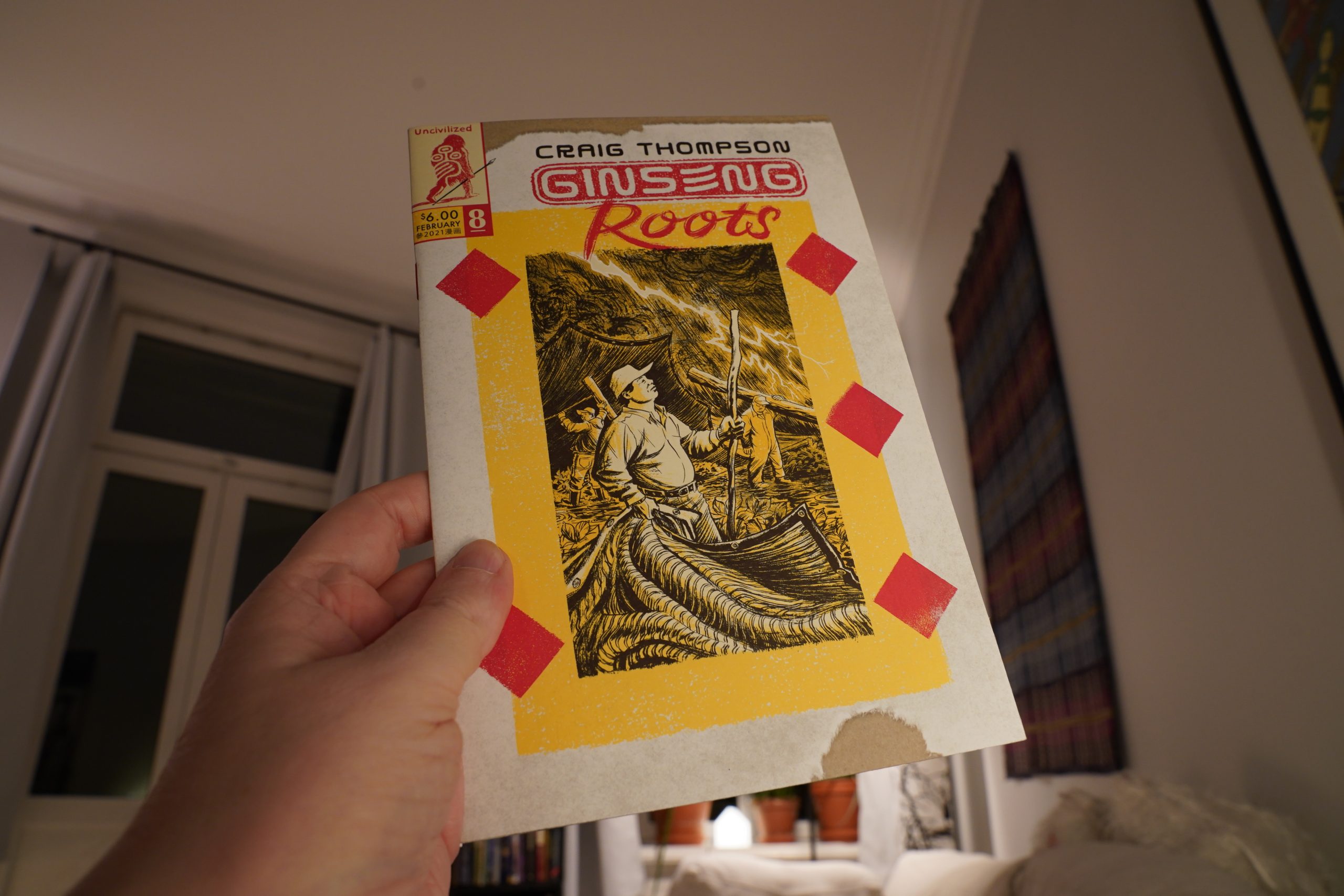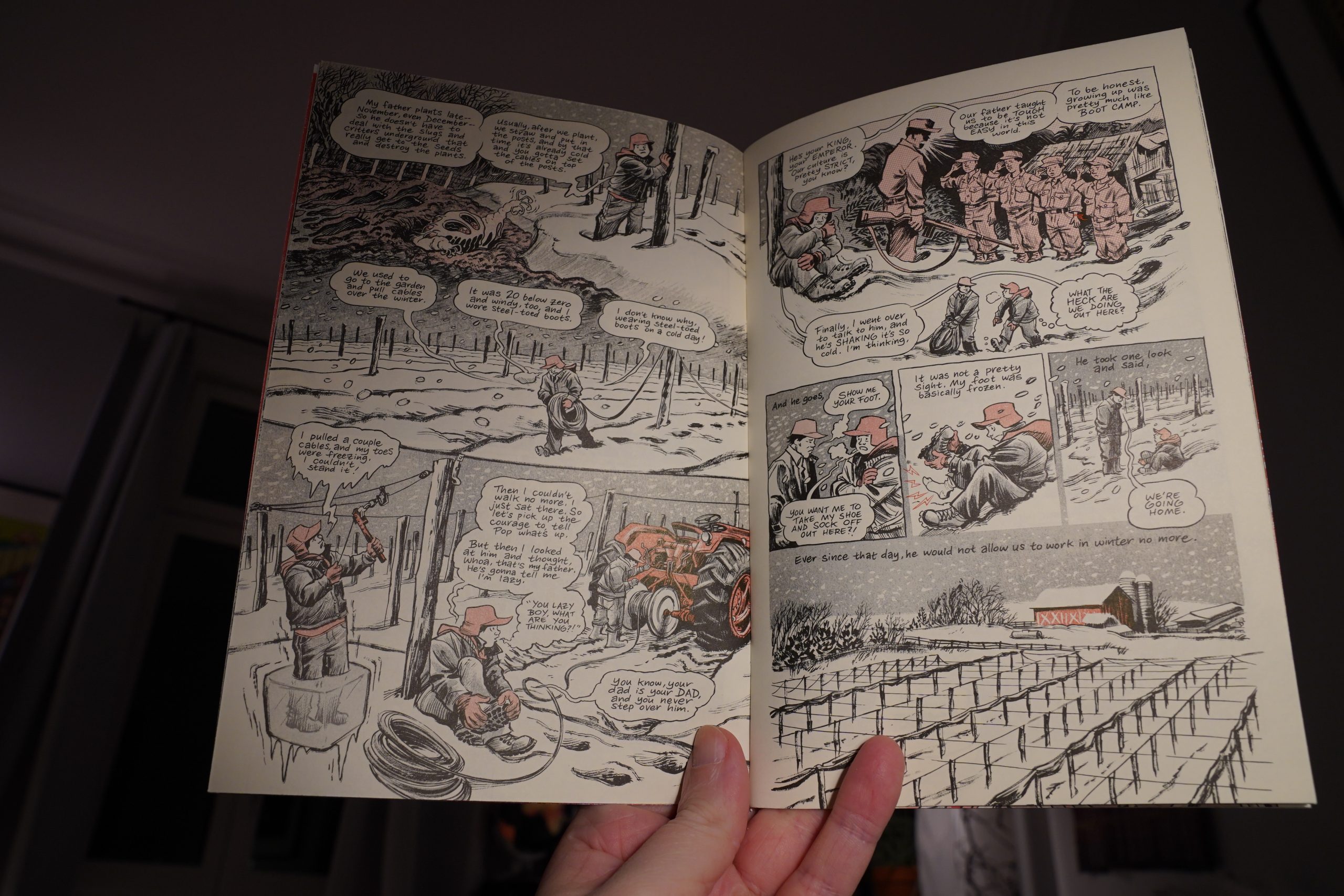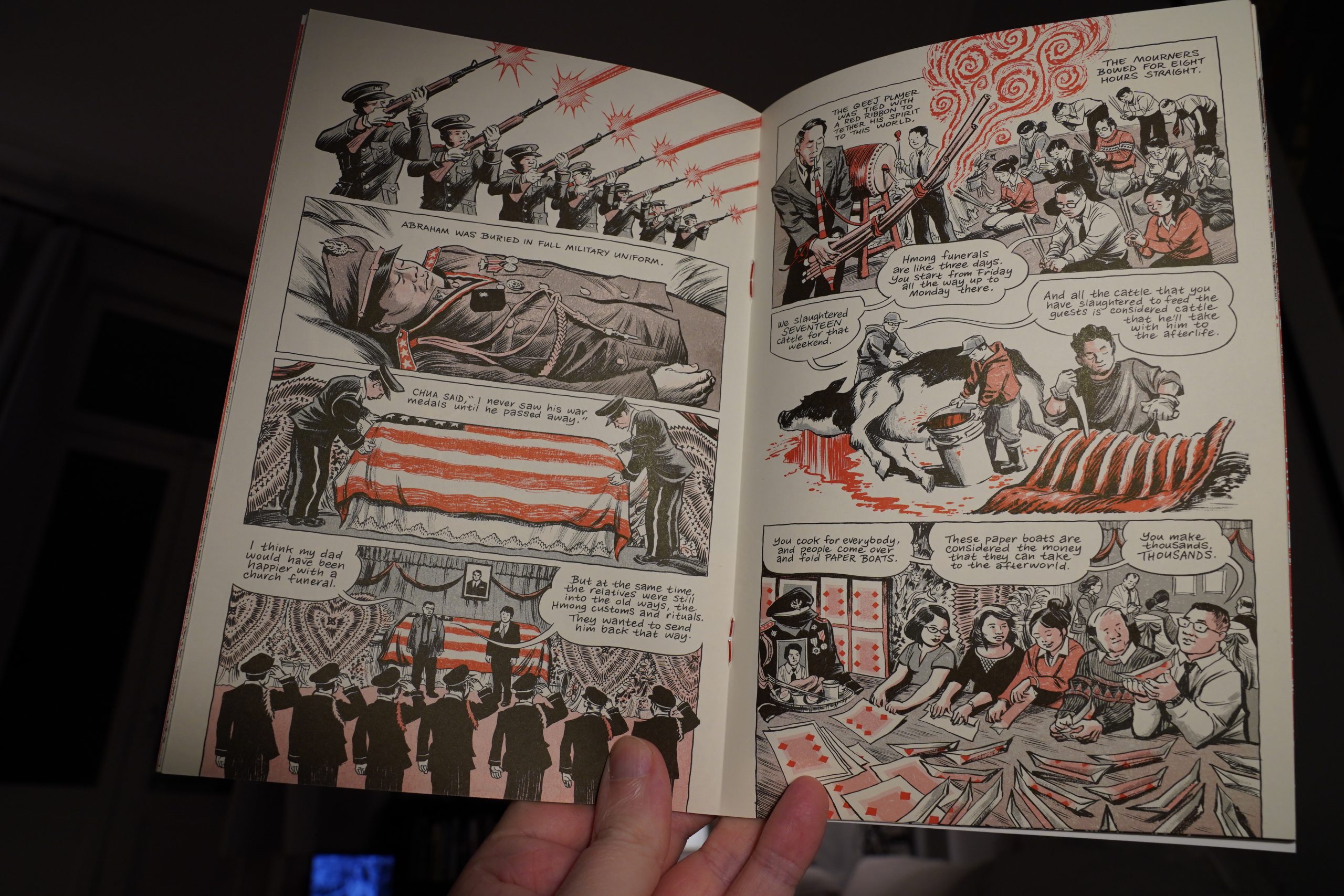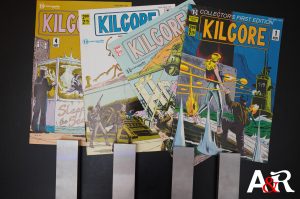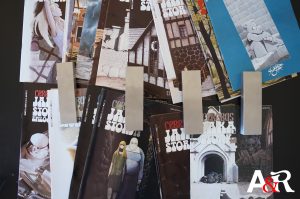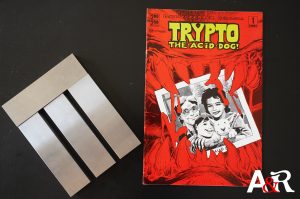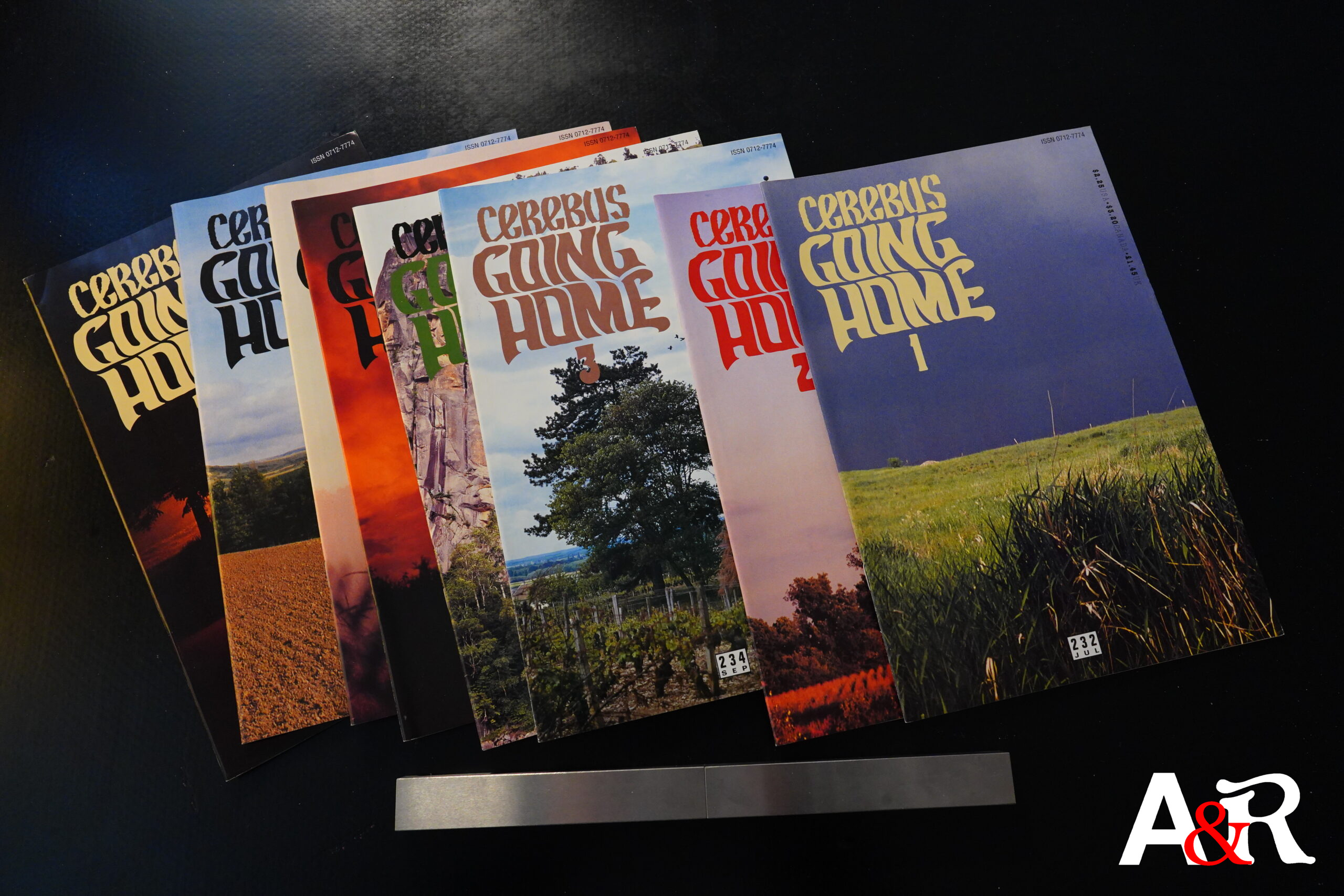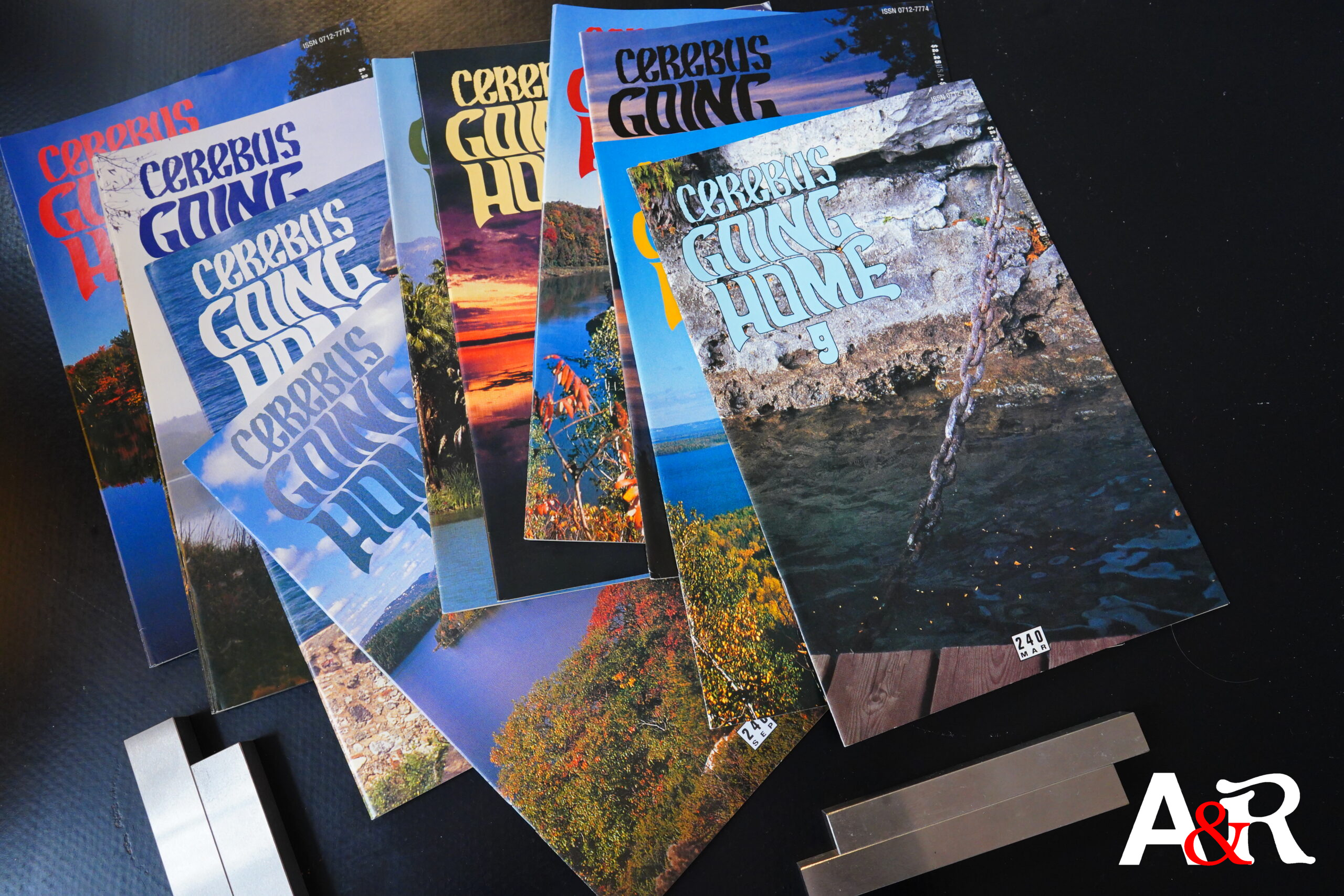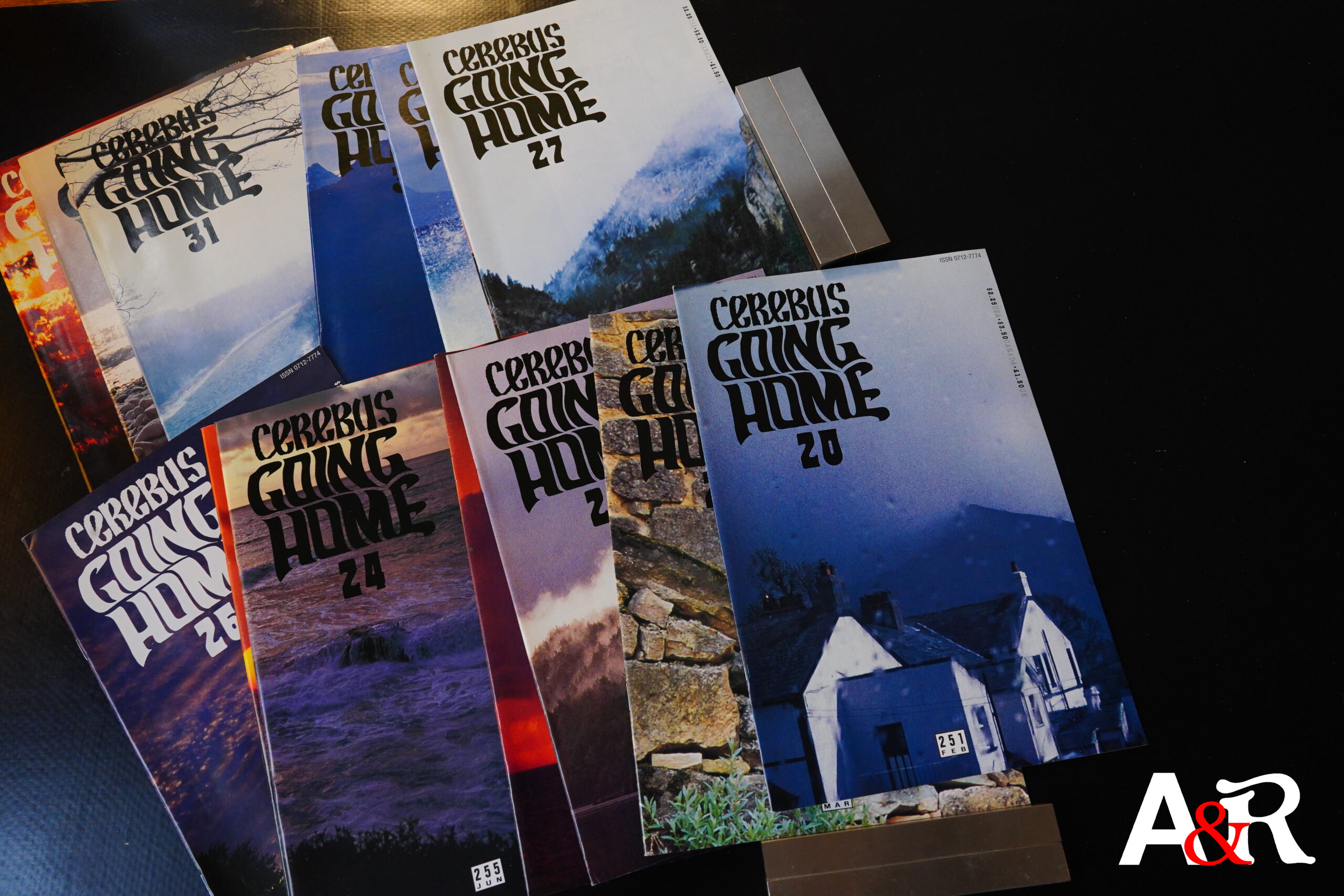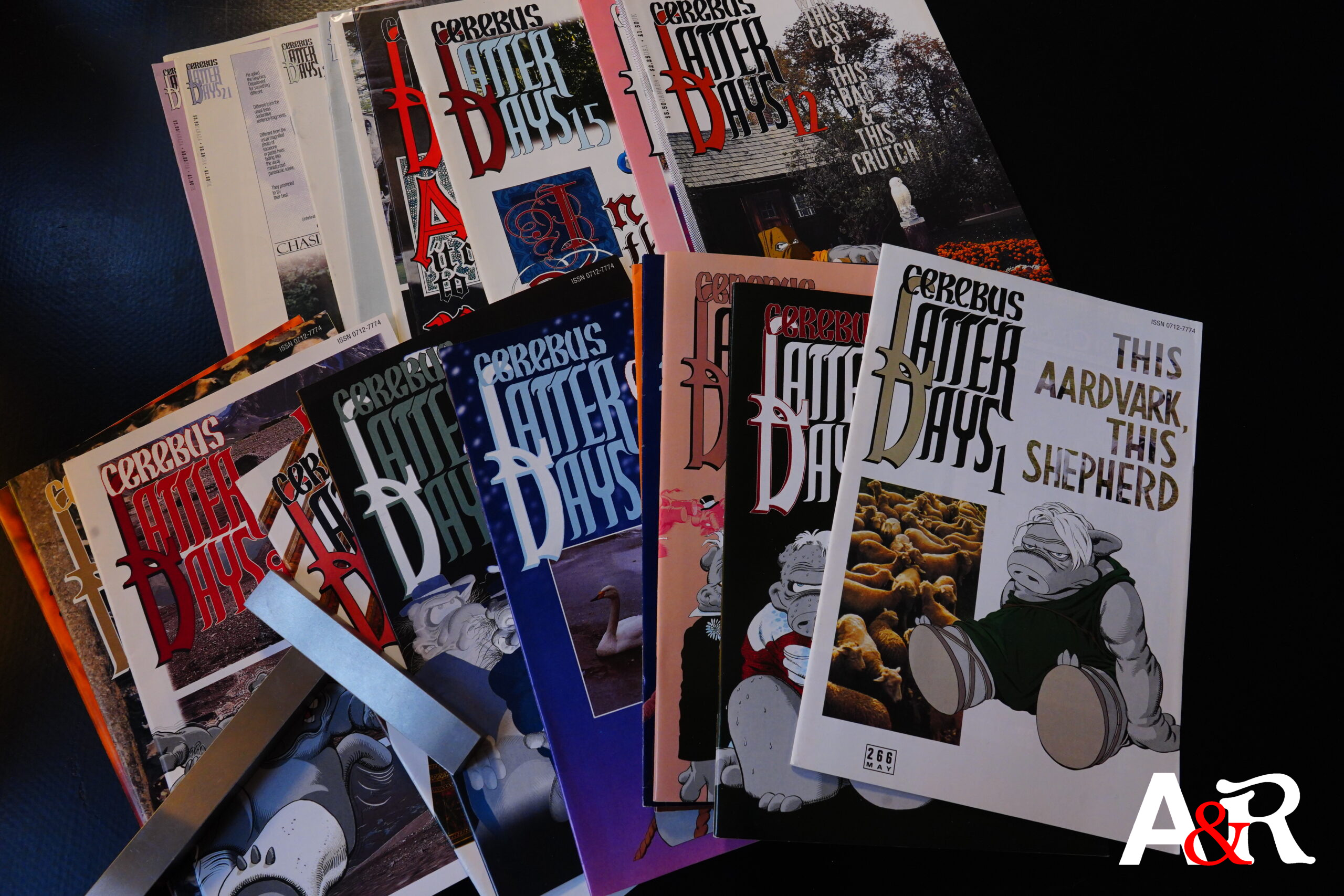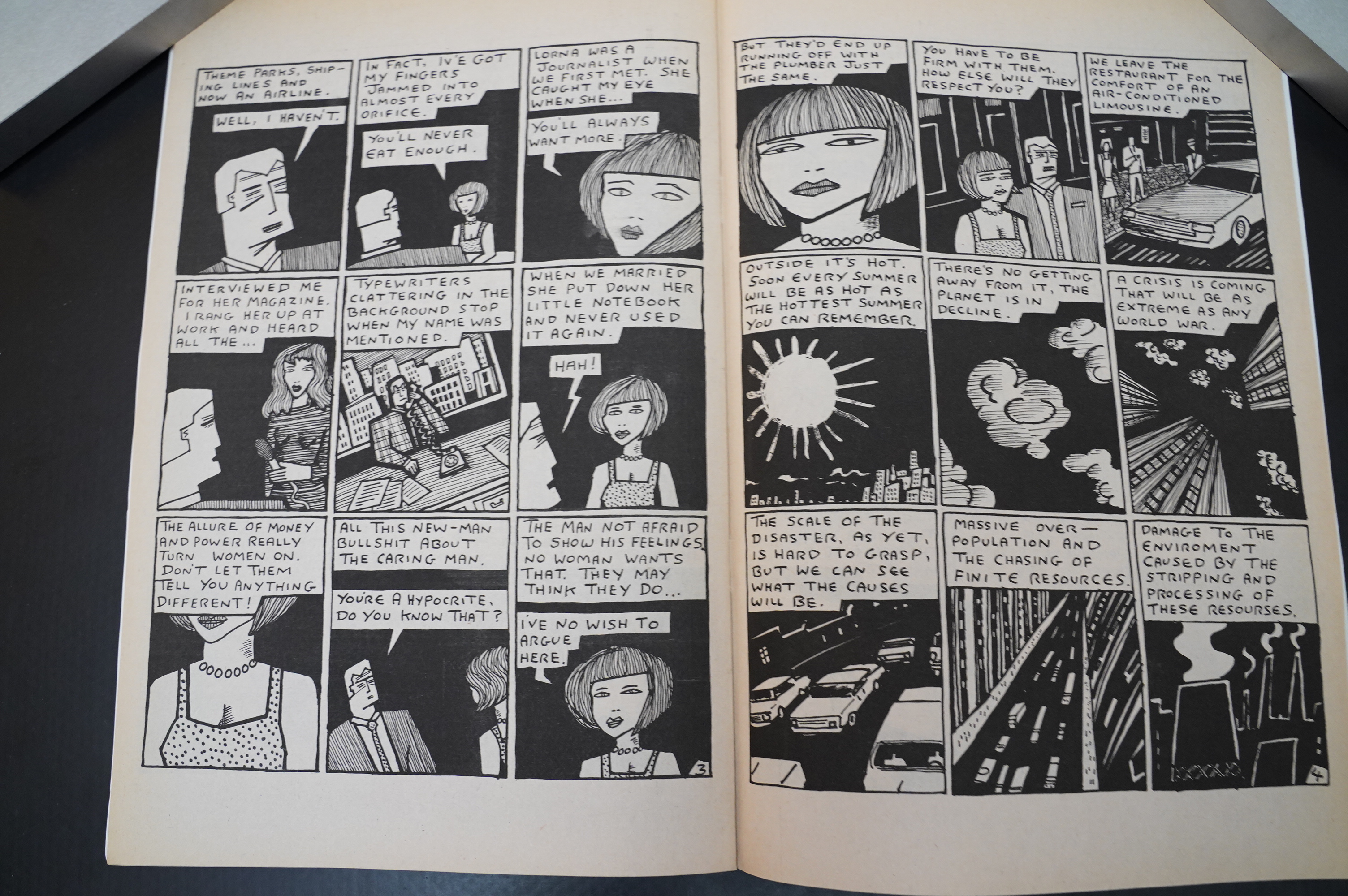

A&R1986: Strata

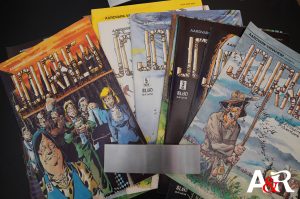
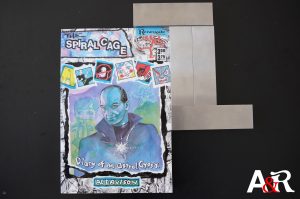
Strata (1986) #1-5 by Joe Judt, Ray Murtaugh, Jim Brozman and others

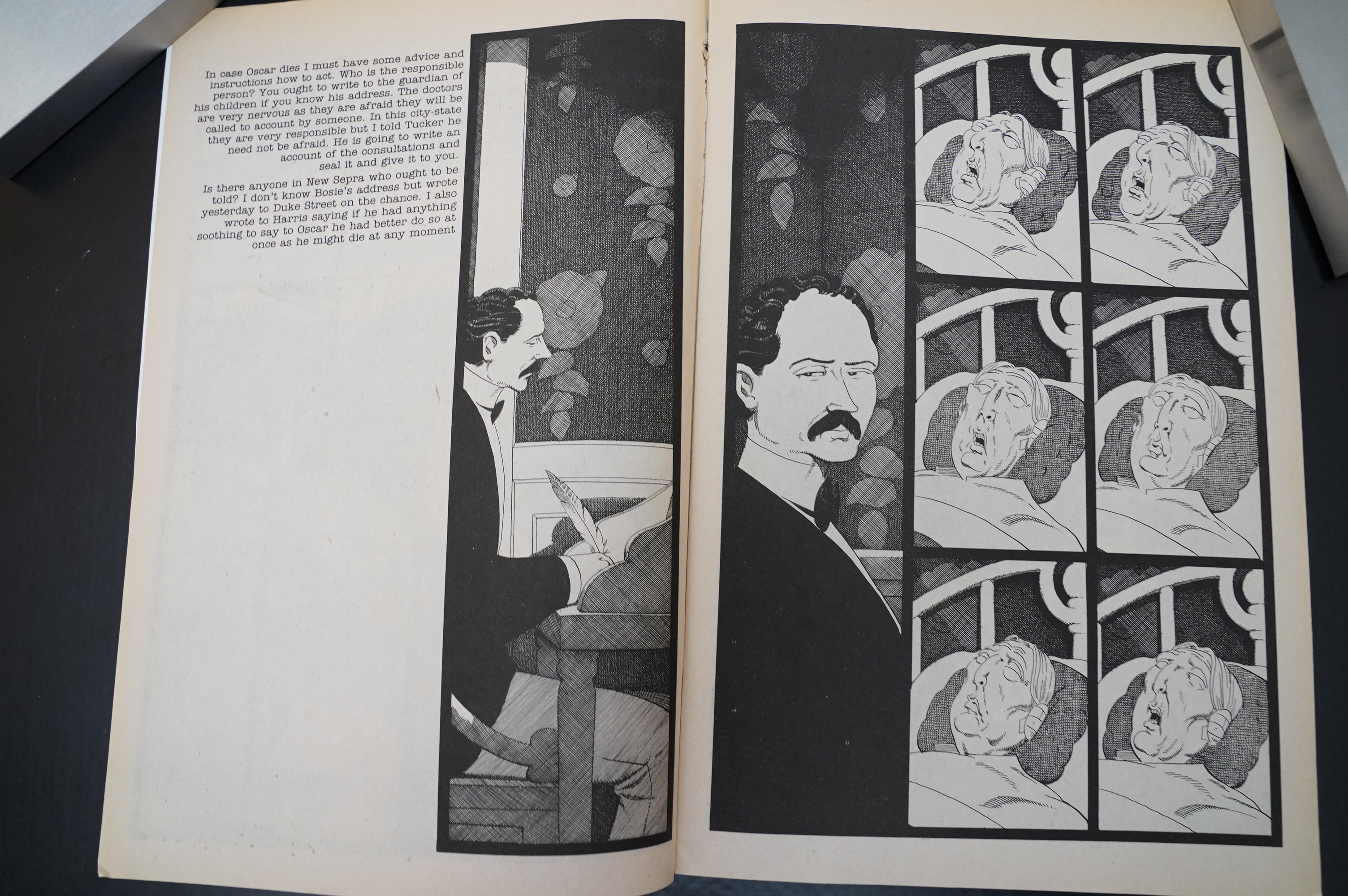
Renegade’s publishing profile is pretty odd, to say the least, but most of the series published by Loubert up till now had been by a single creator, or at most a writer/artist pair. This is the first that has a writer/penciller/inker line-up, I think?

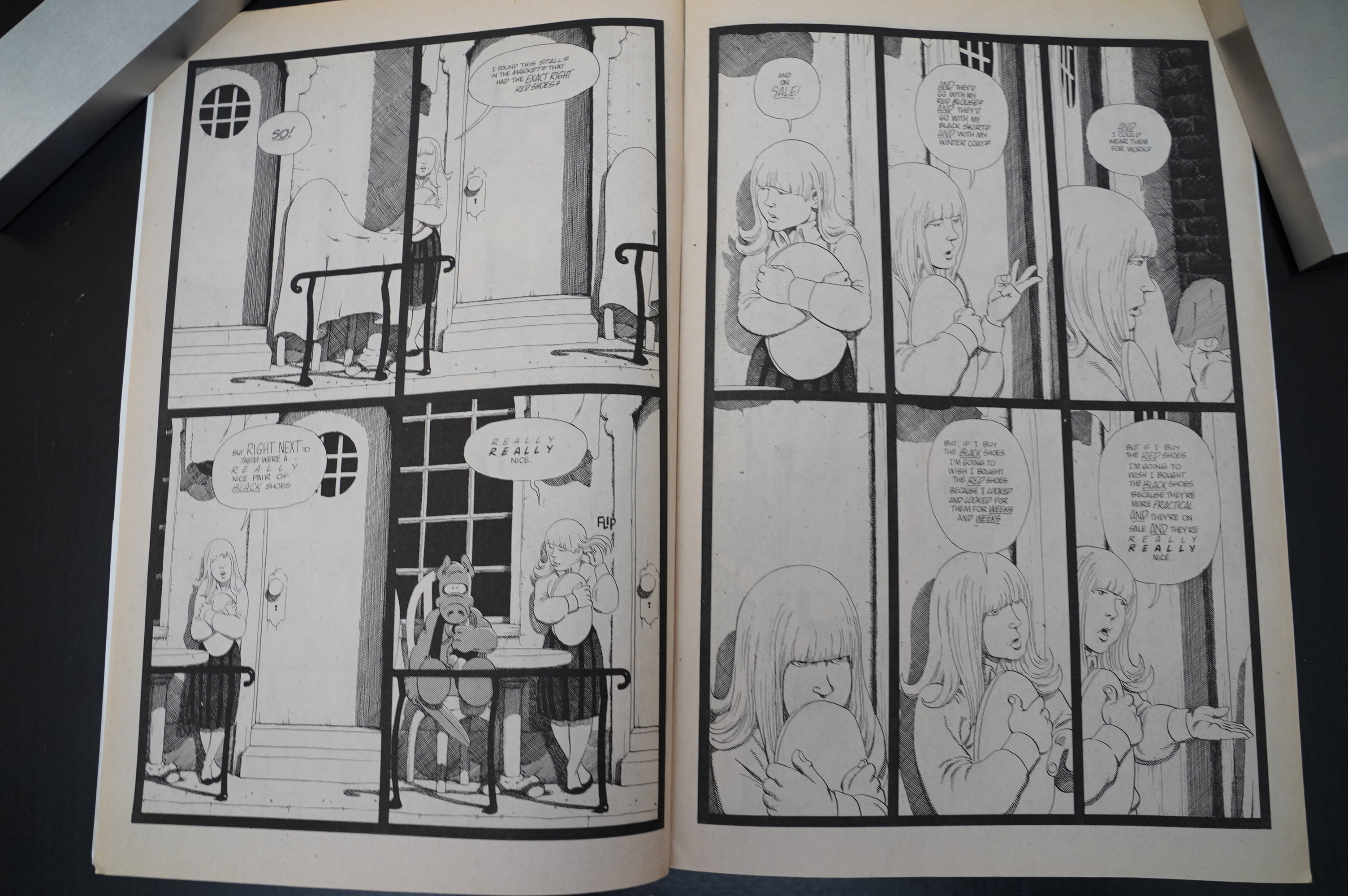
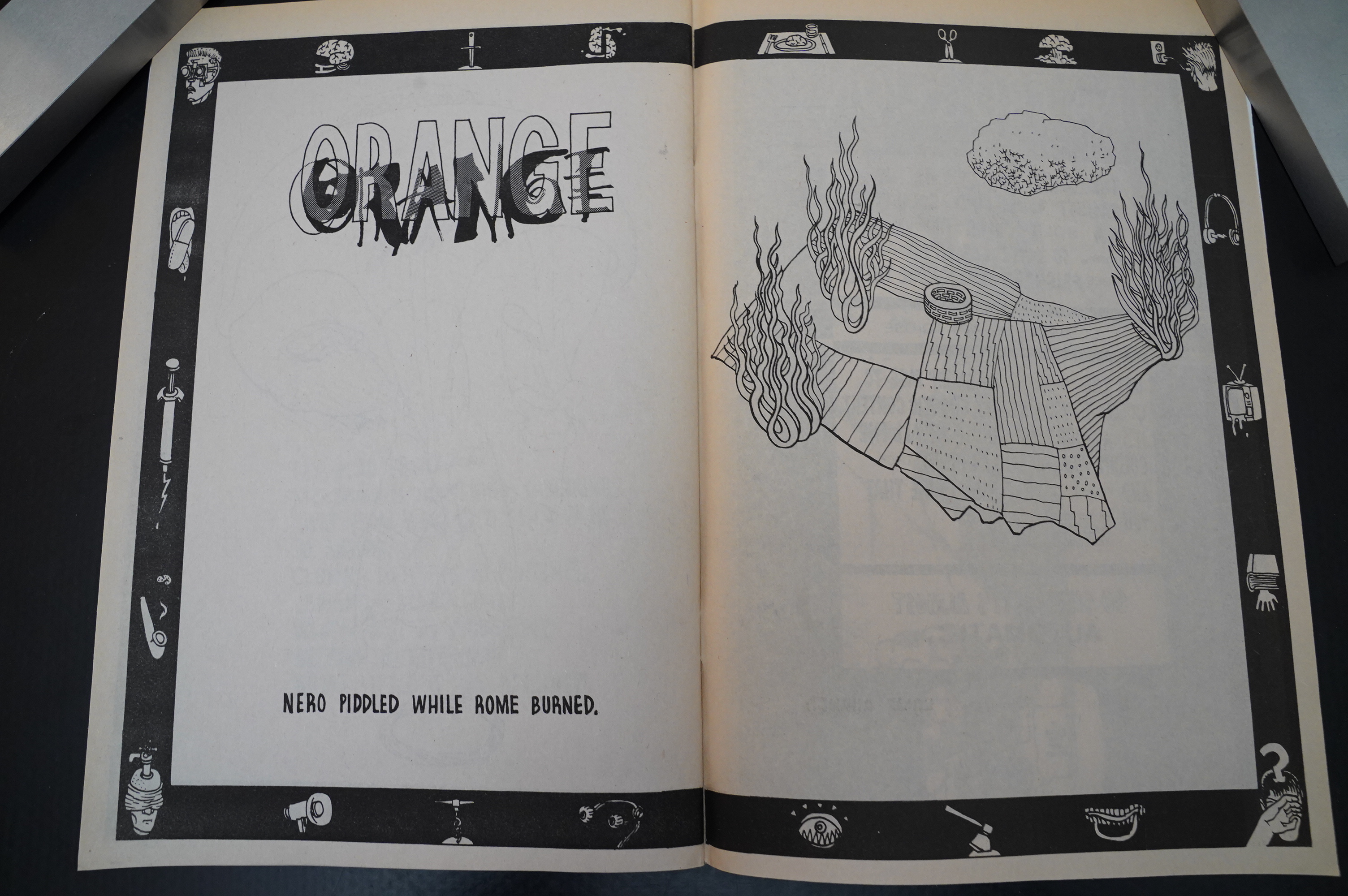
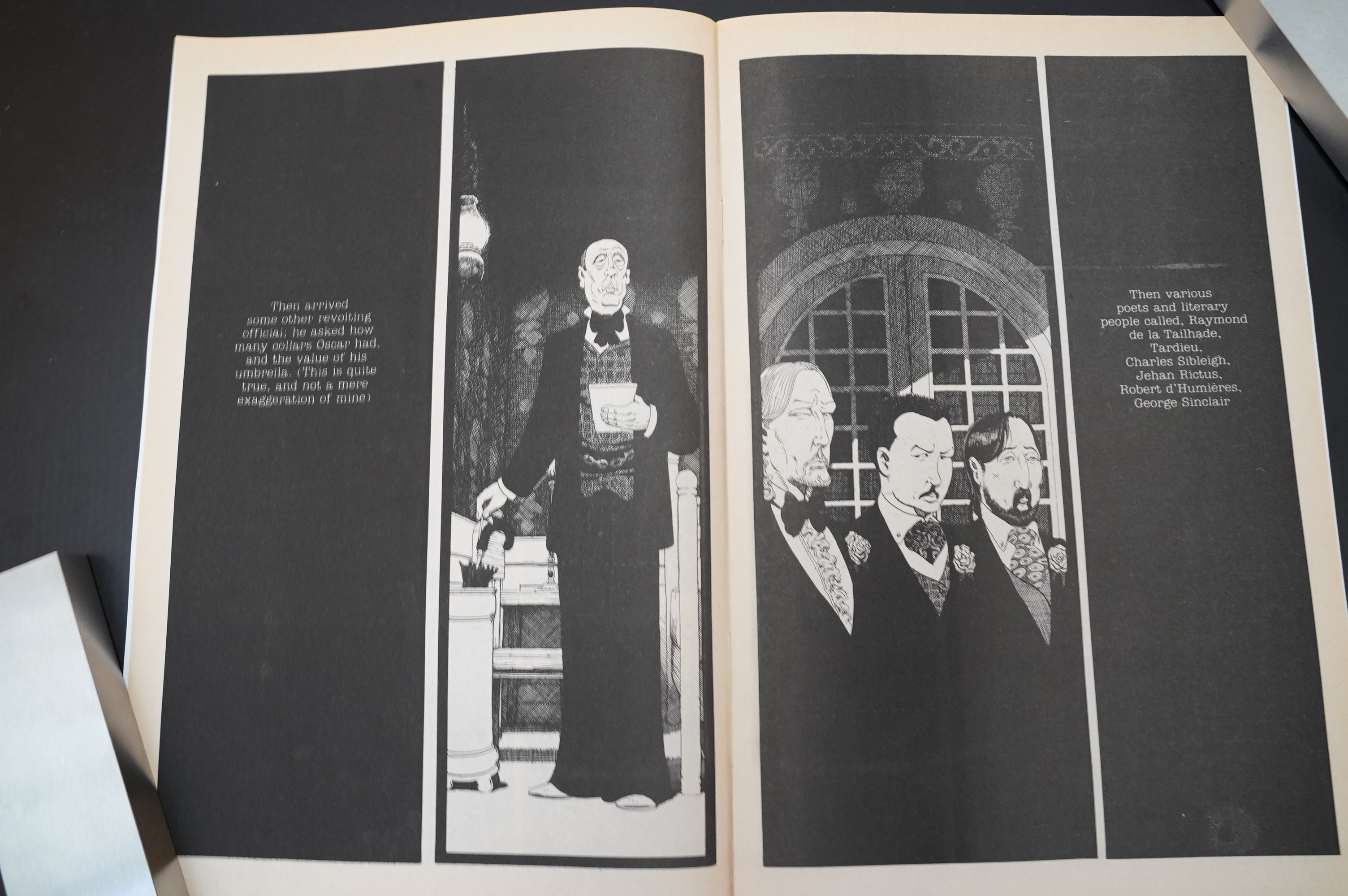
Let’s read the first three pages together.

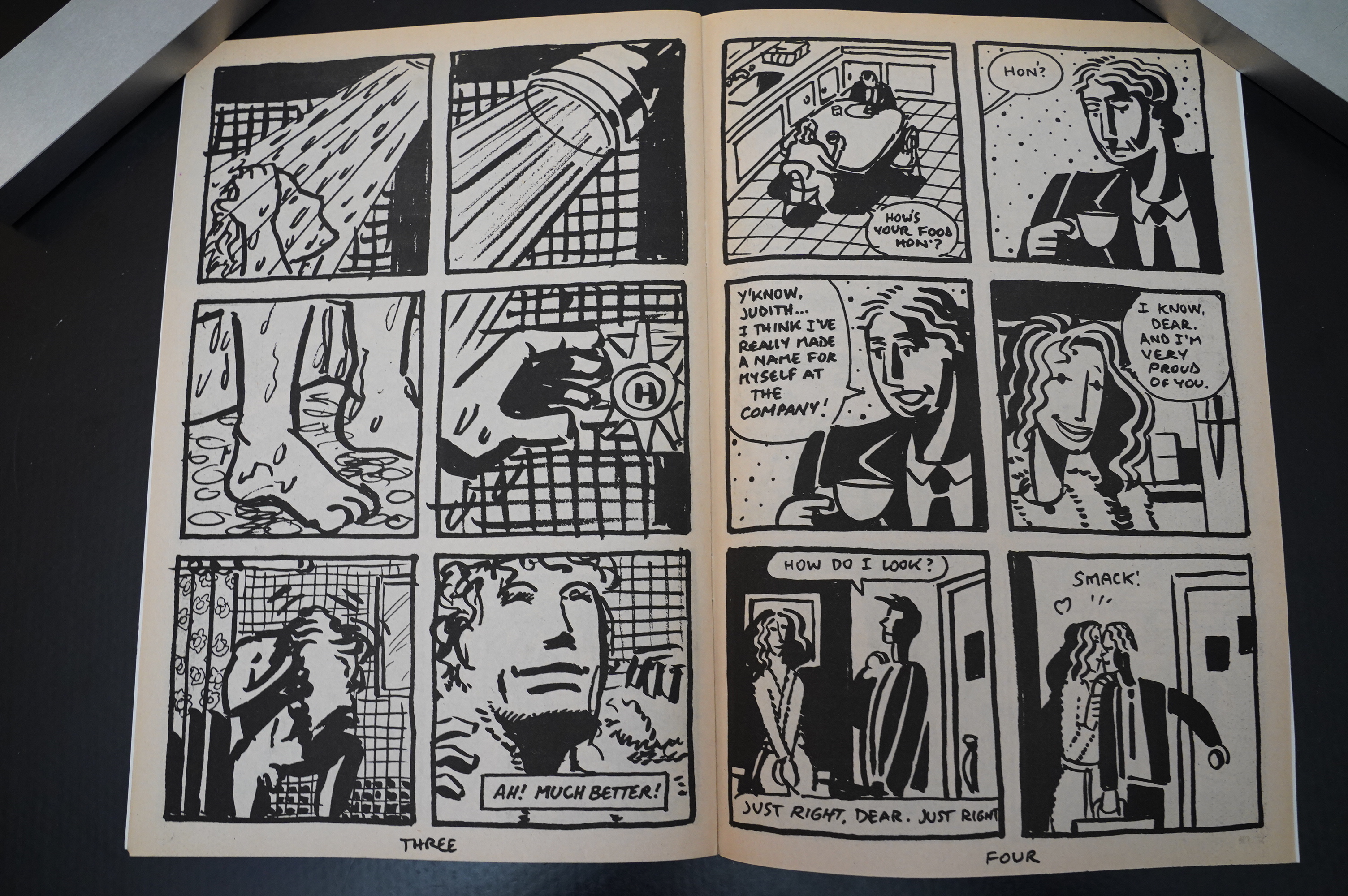
Well, that’s kinda stylish? It’s very stark: No cross-hatching or tone or anything, but a pleasing variation in line weights and black spotting.

It’s also a bit difficult to actually read — my eyes are skidding all around these pages without finding any purchase whatsoever.

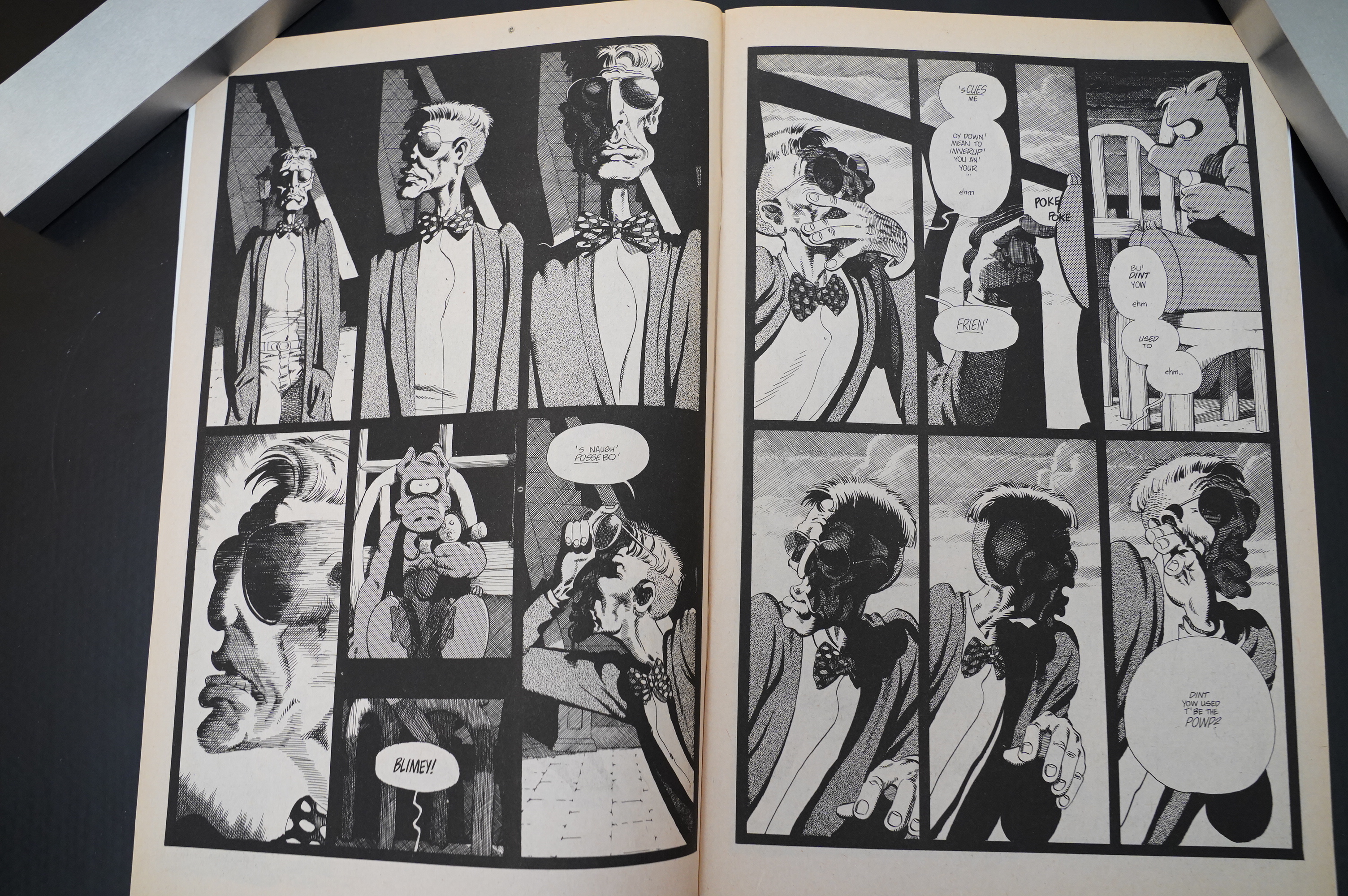
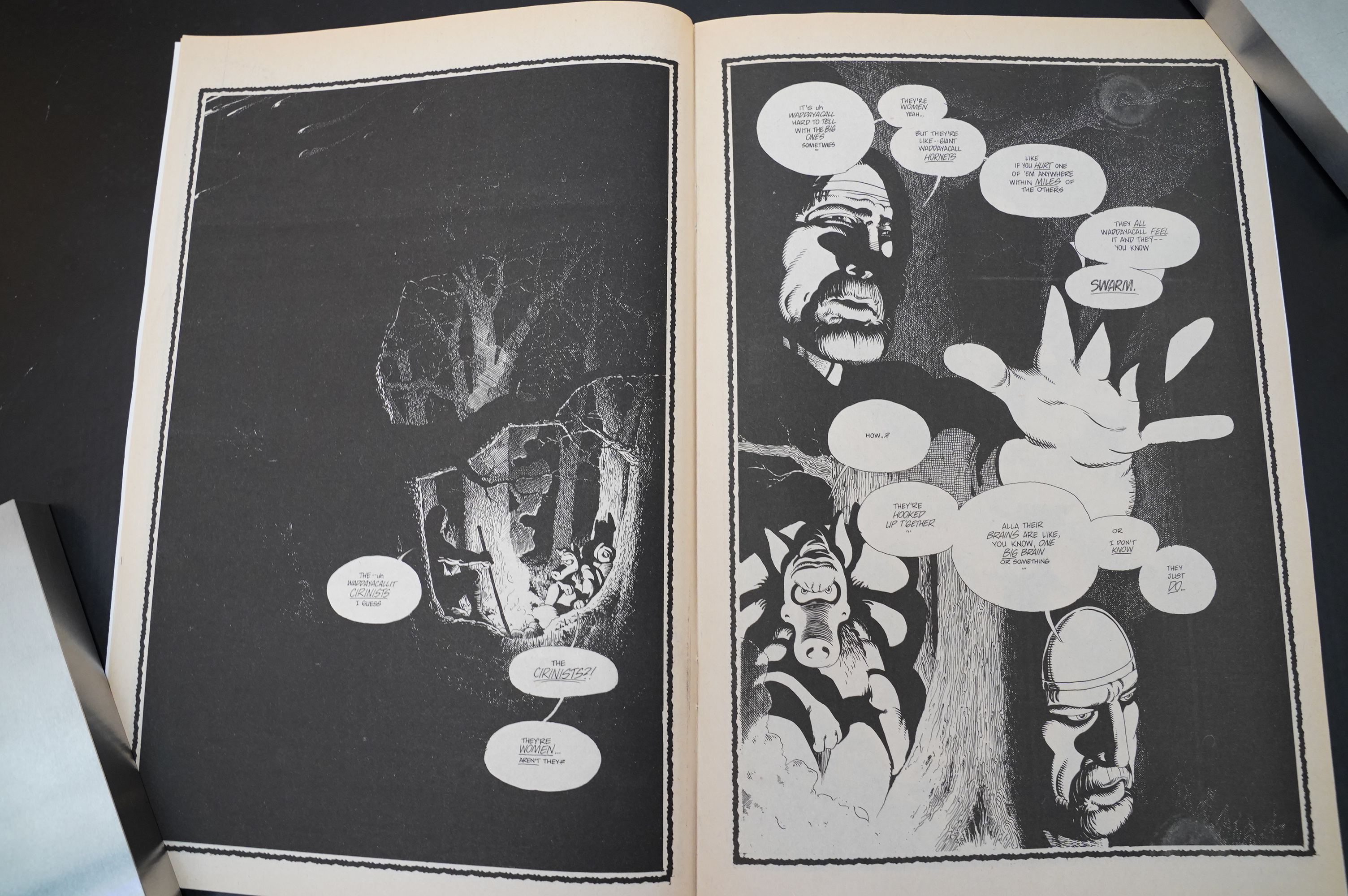
And that’s even before we get to the other worlds, where the design of the world and the characters makes things even more difficult to grasp.

Like… what… what’s going on? If you sit down and concentrate and interpret each panel, character by character, it’s not impossible to make out what’s happening here, but it’s just migraine on paper.

I know nothing about the creators, but I’m going to go ahead and guess that the penciller (at least) is quite young, and has an idea about making chaotic, fun comics, but the chops just aren’t there. Instead of being over-the-top weird action, it’s just a bunch of noise.

That the story doesn’t make much sense (I think? it’s hard to tell) either doesn’t help.

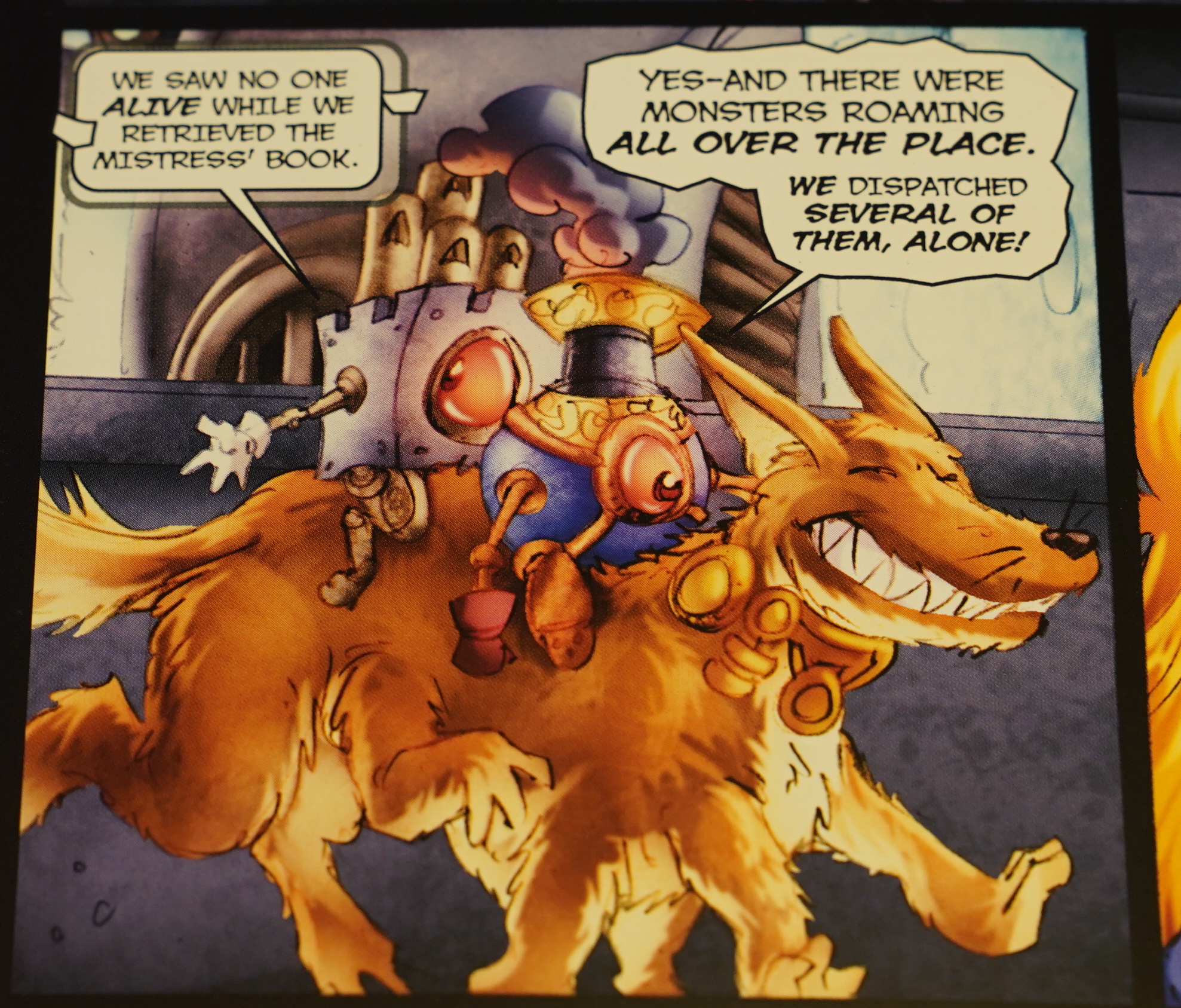
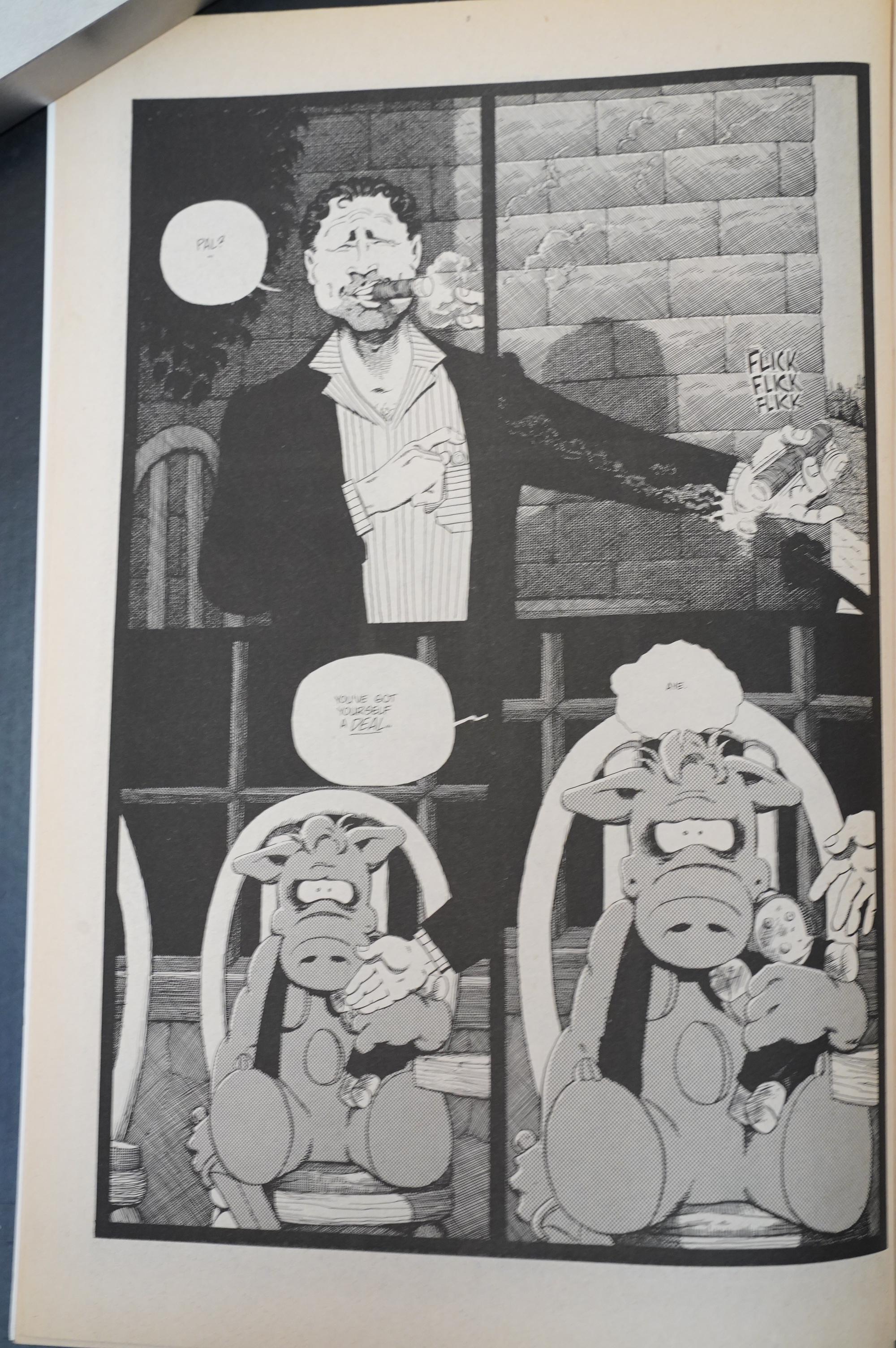
And it turns out that we’re on… Discworld? I mean Strata.

That age-old question: “What does a graphic designer do?” The answer is “Not work at Renegade”.

… Oh! I didn’t get that it was a swastika! I just thought it was a very odd collection of panels oddly cropped.

So perhaps they had a graphic designer anyway.

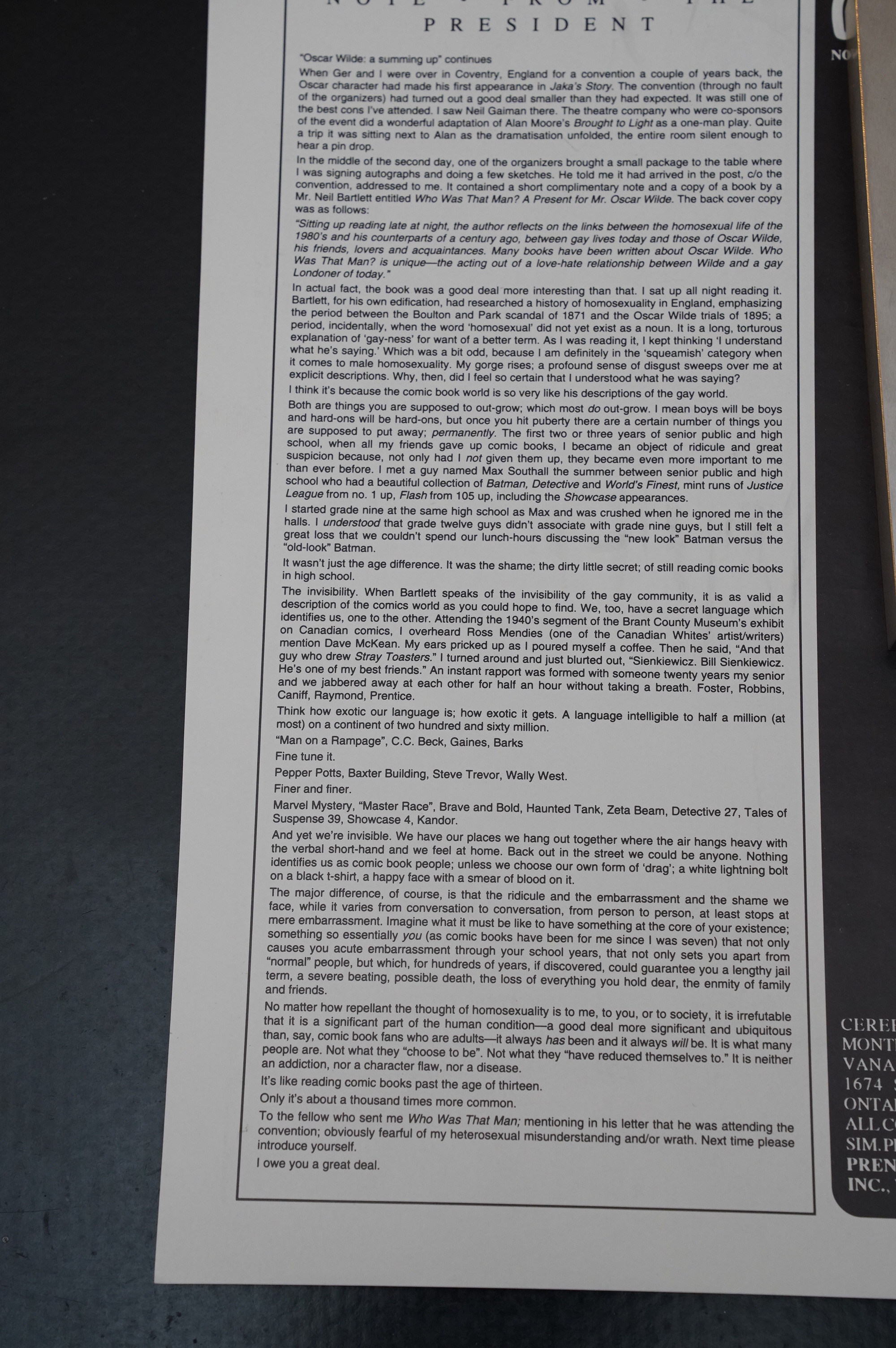
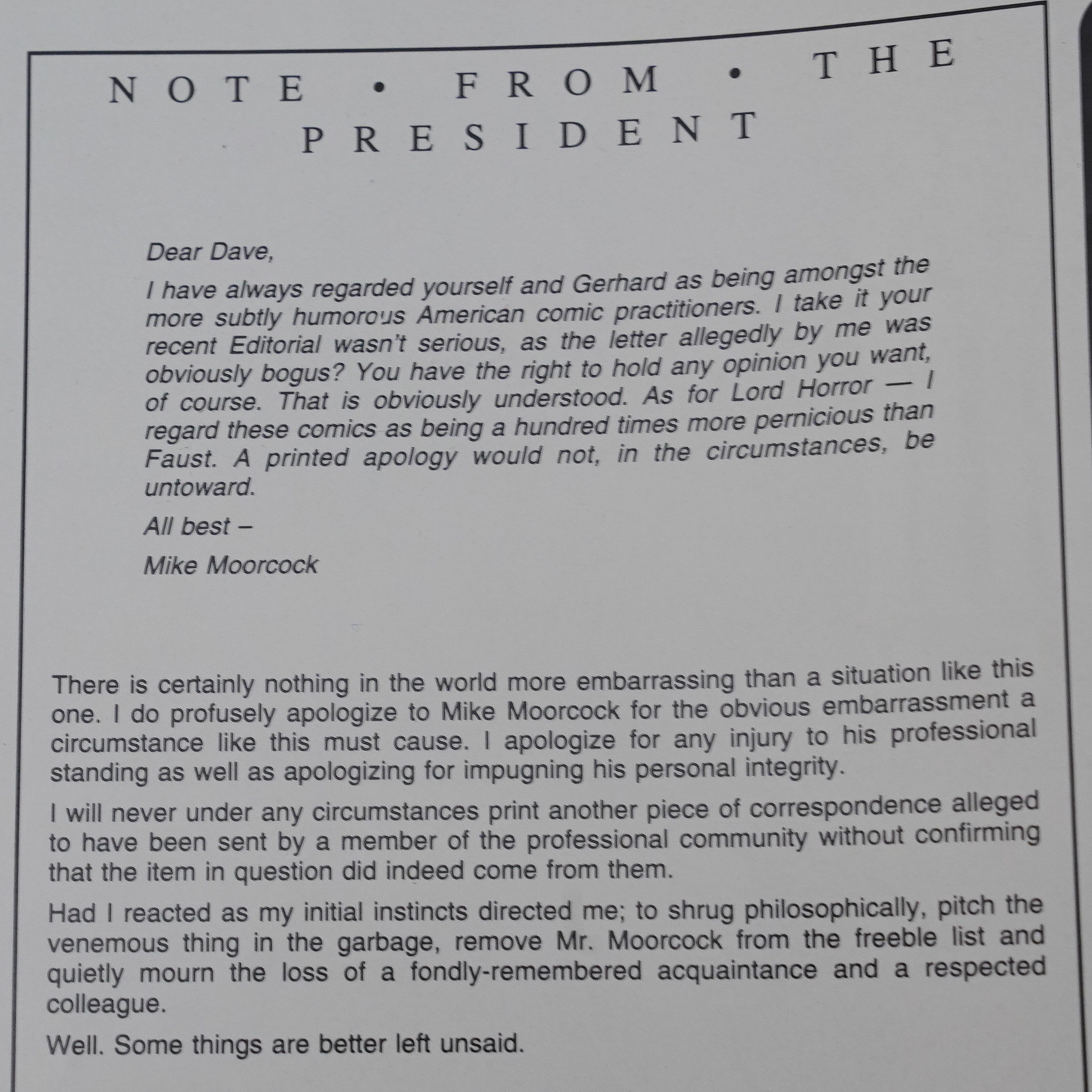
In the first year or so, Deni Loubert had written introductions to all the comics. But by now she’s just running the same one in all the comics (per month). Makes sense.

I wondered whether there was going to be rapid artistic development on display here, but nope.

So risque.

Inker Brozman does the all the artwork on this amusing back-up story written by Jack Herman. It’s about Picasso being hired as a police sketch artist.

Yup.

In the third issue, somebody has finally tipped the artists about something called “tone”, and the pages suddenly become legible. But at the same time, they also lose the stark attractive qualities the artwork had.

Panel-popping sword work.

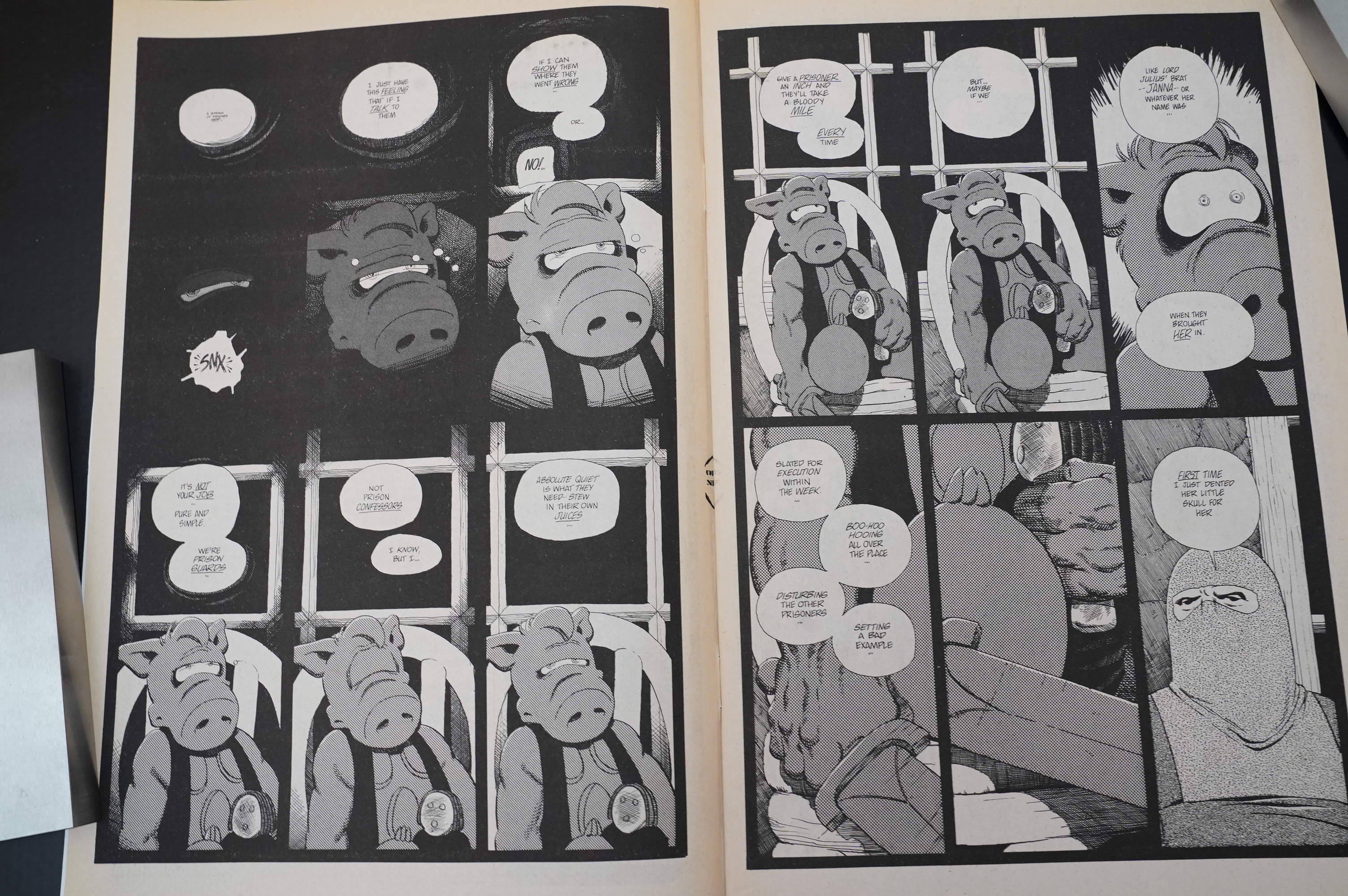
I guess if you’re charitable, you could say that the storytelling and the artwork reflects the state of the protagonist pretty well. He’s confused about the world he’s in, so the reader should be confused, too?

But…

And then… they didn’t really ignore the giant otters in the next issue?

“The ring!”? What? I guess my eyes had glazed over at this point that I even missed there being a ring in here?

Or is it a reference to Tolkien? I mean, just because this comic isn’t funny doesn’t mean that it wasn’t meant to be funny; perhaps I just missed it.

And then the series ends like this.

A perfect mess, I guess.

The series wasn’t picked up by a different comics company, so I guess it was just abandoned. It hasn’t been reprinted, either.
Somebody writes in Amazing Heroes #92, page 58:

Strata presents a competently writ-
ten fantasy adventure. Too little time
is spent developing the character of
Flambeau, and too much is devoted
to the slash and stab antics of the
otters. One Bould expect them to be
played as humorous foils to the
human, but there is nothing about
them which is in the slightest bit
amusing. They are simply two talk-
ing animals that don’t have a lick of
sense.
The plot involved—a man is mys-
teriously transported to another
world to which he must tty to adjust
or from which he must try to escape
—is at least as old as the early pulps
(and indeed has antecedents in an-
cient mythology). Still, it is one that
has not been milked completely dry,
and can still be presented effective-
ly. Scripter Joe Judt has done a reas-
onably good job in that department,
though certainly not delivering any-
thing particularly noteworthy or
memorable.
His yeoman-like efforts are com-‘
pletely undermined by the poor
visuals to be found in this issue. It
is a veritable cornucopia of rotten
fruit. The art looks like the work of
a man who learned to draw from
reading old Harvy comics while
dropping acid.
Penciller Ray Murtaugh’s panels
vseren’t laid out on the page so much
as spilled. Each page is a cluttered
jumble of images fighting for atten-
tion but succeeding only in obscur-
ing those around, above and beneath
them. The only uniformity they pre-
sent is in their unattractiveness. The
almost total lack of line work leaves
nothing but sparse black-and-white
illustrations that blend one into the
other.

Harsh! I have no idea what “almost total lack of line work” means. It’s nothing but line work. Oh, they mean cross-hatching? Sure.

Russell Freund writes in The Comics Journal #109, page 53:

Strata could become delightfully Car-
rotoid with only a slight push. It’s a serio•
comic space opera, less richly detåiled than
Nexus, but in that same zany vein. The art
is almost there. Ray Murtaugh’s engaging
pencils have a nearly Burdenesque loopi-
ness; I liked his wild biplanes and his
spaceships that look like, well, watermelons
being gang-banged (you have to see these
things to believe ’em), and his Commander
D’art could be Lady Luck’s Peecolo caught
in a time warp. I wish his hero didn’t 100k
so much like something out of Mike Ploog,
but that’s a quibble. This is good, fresh
work.
I would prescribe a dose of Burden for Joe
Judt, the’ writer, however. There’s a scene
where the lovely lady space ranger throws
herself at the hero and he demurs, saying,
“l don’t love you,” and goes into a song and
dance about having to feel “something
magical.” This bit just begs to be played as
an absurd, Burdenesque vaudeville duet for
skewed egos. Instead, Judt treats his char-
acterS as rational beings, albeit With a touch
of humor. Strata is fun, but it isn’t as inven-
tive as the best books in its field. A judicious
dose of brain dama#, evenly applied, would
help.

Heidi MacDonals writes in Amazing Heroes Preview Special #2, page 117:

Flambeau also finds that having
ones dreams come true isn’t all beer
and skitties. “He’s a very ethical and
morat guy.” says Judt, “and he’s sud-
denly tossed into a world where every-
thing he beiieves and thinks is no longer
true. Nothing is realty as it seems in this
world: nothing is as it seems in this
book. Even it you think you know what
it’s really about. that maynot be true
“There”lbe a iot of swashbuckling.
and a lot of bad jokes. I try to keep
ttyngs as insane as I possibly can!’

Well, that bit was achieved…

I’m unable to find anybody discussing Strata on the interwebs. Joe Judt doesn’t seem to have done anything in comics after this, but Murtaugh seems to be working in comics still, and so is Brozman.

This blog post is part of the Renegades and Aardvarks series.

A&R1986: Manimal

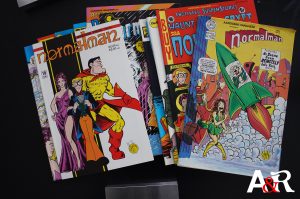
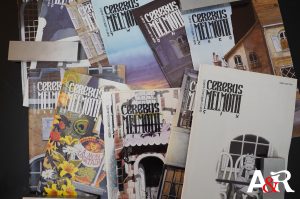
Manimal (1986) #1 by Ernie Colón

Renegade was a very hands-off company, editorially… but for such a creator-friendly publisher, they sure were vague about credits. Nowhere in this comic does it say explicitly who created it. Even the indicia is vague: It’s “© 1985”, but by whom? (Who? Hoo?) It was “designed & produced” by Robin Snyder… but does that mean that he wrote it? It’s not an unreasonable guess, because he did write some of the stuff in the Revolver anthology.

But let’s read the first three pages of Manimal.

So this is quite grisly, and apparently a comic about a man/monster who kills scientists.

I like Colón’s artwork (and it’s presumably by him, because the back cover is signed by him, and besides — it looks quite like Colón artwork). There’s some nice storytelling touches: The final panel of the left-hand page is of a foot print (“… and feet like a man”), and the first panel on the next page is of a man who’s walking, with feet saying “tap tap tap tap”.

Clvr aspect-to-aspect scene change, right?

I mean, it’s just a little thing, but it’s fun.

Then it turns out that the scientist (who was killed) was totally evil!

The panel transition I nattered on about up there made me really wonder about transitions like this. There’s a hand very prominently displayed in three of these panels — does that have a meaning?

… probably not.

Then it turns out that the doctor was a real, actual Dachau killing Nazi, and the Manimal guy was the result of Nazi experiments on Jews. (And now Manimal is killing Nazis, of course.)

Is this really crass? Or, like Inglorious Basterds, an apt revenge fantasy? Or both?

That’s a very odd pose, even for a corpse. (Manimal’s girlfriend here gets fridged by some Nazis, because having his parents in Dachau wasn’t… sufficient?)

I should have known it! Manimal wasn’t made for this comic — it’s a serial, probably meant for some anthology. It’s not in magazine aspect ratio, so probably not for a Warren anthology?

The Revolver anthology was a collection of junk Snyder had apparently not been able to sell anywhere else (plus some Ditko stuff), so perhaps this is just more of that?

The traditional jailhouse greeting.

Super-attractive artwork, though.

We get three of these eight page stories, but there’s really no resolution. It feels like it was designed as a serial where Manimal would go around killing Nazis every episode, but the final page seems to have been reworked as an ending of sorts. It’s a complete non sequitur, though — we’re not even given a hint as to how he got out of jail.

Somebody (possibly Colón? According to Gary Usher’s Robin Snyder’s Comic Book List) writes about how victims deserve “more than Manimal”.

And then there’s a back-up story (presumably by the same creators? It still looks like Colón?) called Tender Machine 10061. It’s interesting graphically: Note very 60s Spanish comic like psychedelia and pictures integrated.

The story is O. Henryish.

These stories apparently originally were printed in Hot Stuf’, a 70s anthology I’ve never heard about before.

Bill Sherman reviews Hot Stuf’ in The Comics Journal #51, page 70:

What differentiates “Manimal” from
similar current company comic pulp
is its level of action—paperback
violence reminiscent of Gil Kane’s
undeservedly forgotten His Name Is
Savage—and Colön’s willingness ,
however tangentially , to delve into
the morally murky areas his
subject brings forth. Black’s anger,
responsible for his transformation,
never fully abates as it does with
Bruce Banner’s Hulkishness, and
this makes him a discomforting type
of hero. Instead of overexposing his
lead in the Marvel manner, ColÖn
focuses on others’ responses to
him; the approach reduces easy
sentimentality at the same time as
it builds Black’s “reailty.”

“Manirnal”‘s opening chapter, in
fact, seems the weakest for its
greater focus on Black: an intmduc—
tory confrontation with the detective
who will dog the Manimal is especially
clumsy and awkwardly set up. But
as the series progressed and context
for Black’s actions filled in, such
moments vanished. Black becomes
increasingly taciturn , as if his
vendetta has begun to blunt his
fragile humanity even further, and
his only spoken moment of self-
defense by the third chapter is a
brief diatribe against court protection
Of war criminals. C016n’s art, too,
which in the opening relies a bit too
much on the kind of medium shot
comic strip composition Art Spiegelman
satirized in “Malpractice Suite,”
grows more varied as the series
progresses. I’m not sure where he
intended taking the strip: as the
uncompleted series now stands
(three chapters in) it has potential
for moving in several thematic
directions—including a retreat into
pat superheroics. I’d have liked to
see Black’s moral certainty shaken
a bit.

Well… He’s killing Nazis… What’s to shake?

R A Jones writes in Amazing Heroes #94, page 54:

FINAL SOLUTIONS

[…]

Tho story presented in Manimal is
composed of three separate install-
ments which veteran writer/artist Er-
nie had originally crafted for
another publication in the 1970s. I
have long enjoyed Colon’s artM)rk,
and this presents some of his finest.
The richness in texture and tone
gives it the appearance of having
been reproduced directly from his
pencils. It has a realistic flavor to it
often missing from his inked work;
not the slightest trace of his cartoon
influences leaks through here. The
images are not pretty, for this is not
a pretty tale, but deliver the graphic
irnpact of Colon’s message with full
force.
My opinion of his script is not
quite so favorable. Current patterns
in comics lead many to believe that
the fans will not sample your work
unless it wears at least the trappings
of fantasy. Unfortunately, I suspect
this assertion may well be true. In this
instance, it serves to over-
ly dilute the issue at hand.

[…]

Displaying it in the context of
a comic book superhero/fantasy/hor-
ror story often adds to the problem.
So it is here. Colon’s depictions of
the atrocities committed by the Nazis
are relatively mild—incredibly tame
when compared to the graphic dis-
embowelling and dismemberment
inflicted by the “good guy.” The
manimal comes off as little more
than a more vicious version of the
Hulk, while the ex-Nazis are pre-
sented in such a way that they resem-
ble a Mafia clan.

MW writes in Amazing Heroes Preview Special #2, page 72:

This January, Renegade Press plans to
release Ernie Colon’s Manimal, a strip
that originally appeared in the black-
and-white magazine Hot Stuf.’ Explains
Colon, “It’s very incomplete; it was
meant to be an ongoing thing. It looks
like a one-note deal—here’s a guy go-
ing around blowing ex-Nazis’ heads
off—but it was meant to take off from
there, and never got a chance to
because Hot Stuf’ was cancelled.
Since then, I’ve just been sitting on the
pages.
“Manimal is the story of a young man
whose parents were killed in a concen-
tration camp as part of a ‘medical’
experiment—they were injected with
rabies. He was born in the camp, and
became the recipient of mutated genes,
which turn him into a beast when he
gets angry.” Publisher Deni Loubert
wishes to warn readers that the story
content is rather intense, and not for
everyone.

Bhob Stewart writes in The Comics Journal #86, page 15:

Artist Ernie Colon and Hot
Stuf’ editor Sal Quartuccio have
taken legal action against NBC-
TV, 20th Century-Fox, and
Glen A. Larson productions,
charging that the new NBC
science fantasy series Manimal
features a character used
without permission from Hot
Colon and Quartuccio
sought a temporary restraining
order to halt the debut of
Mammal. This was denied by a
New York Federal judge, and
the series premiered on
September 30 as scheduled.

Manimal hasn’t been continued or reprinted since this edition.

There’s not much about it on the interwebs, but there’s this.

This blog post is part of the Renegades and Aardvarks series.

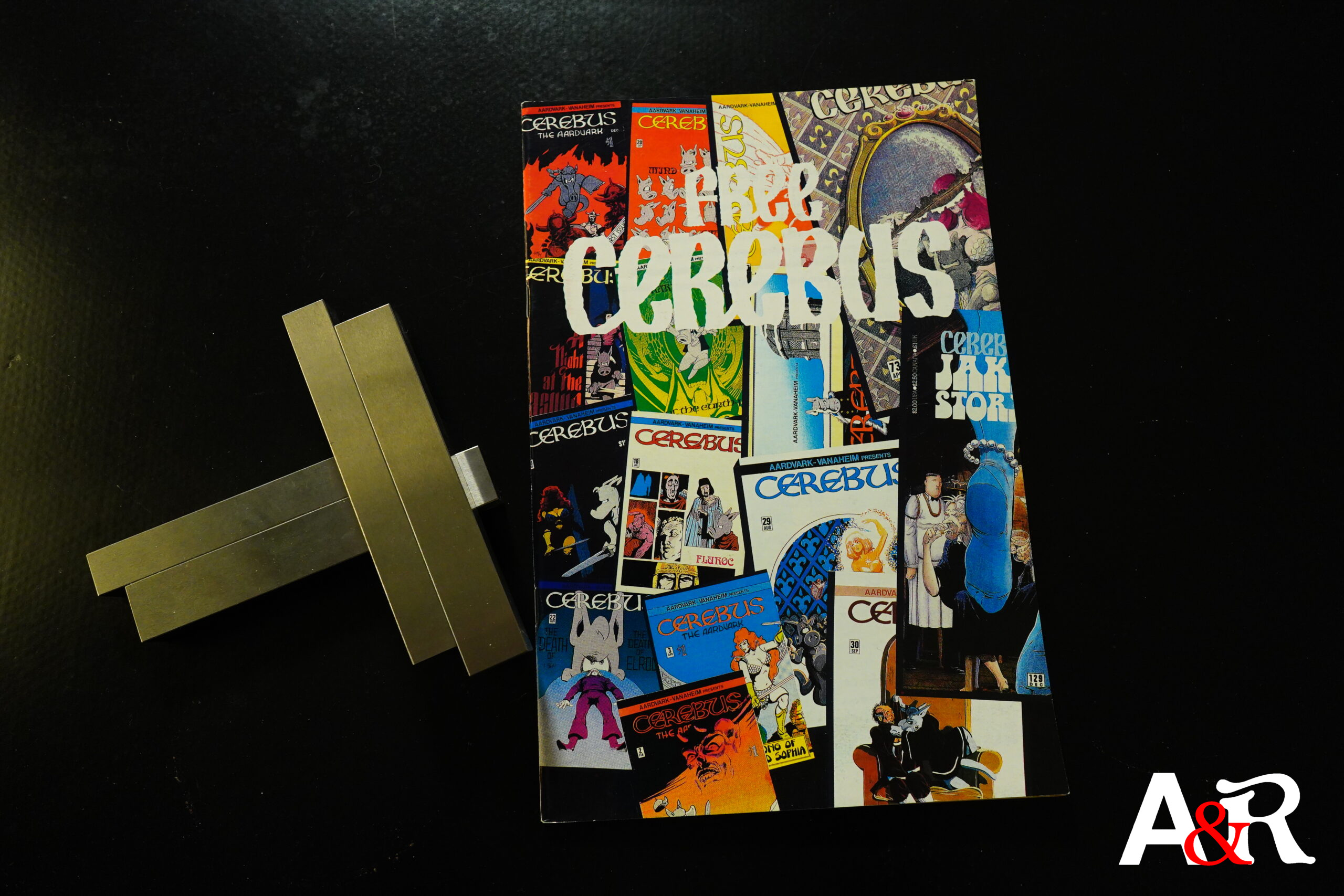
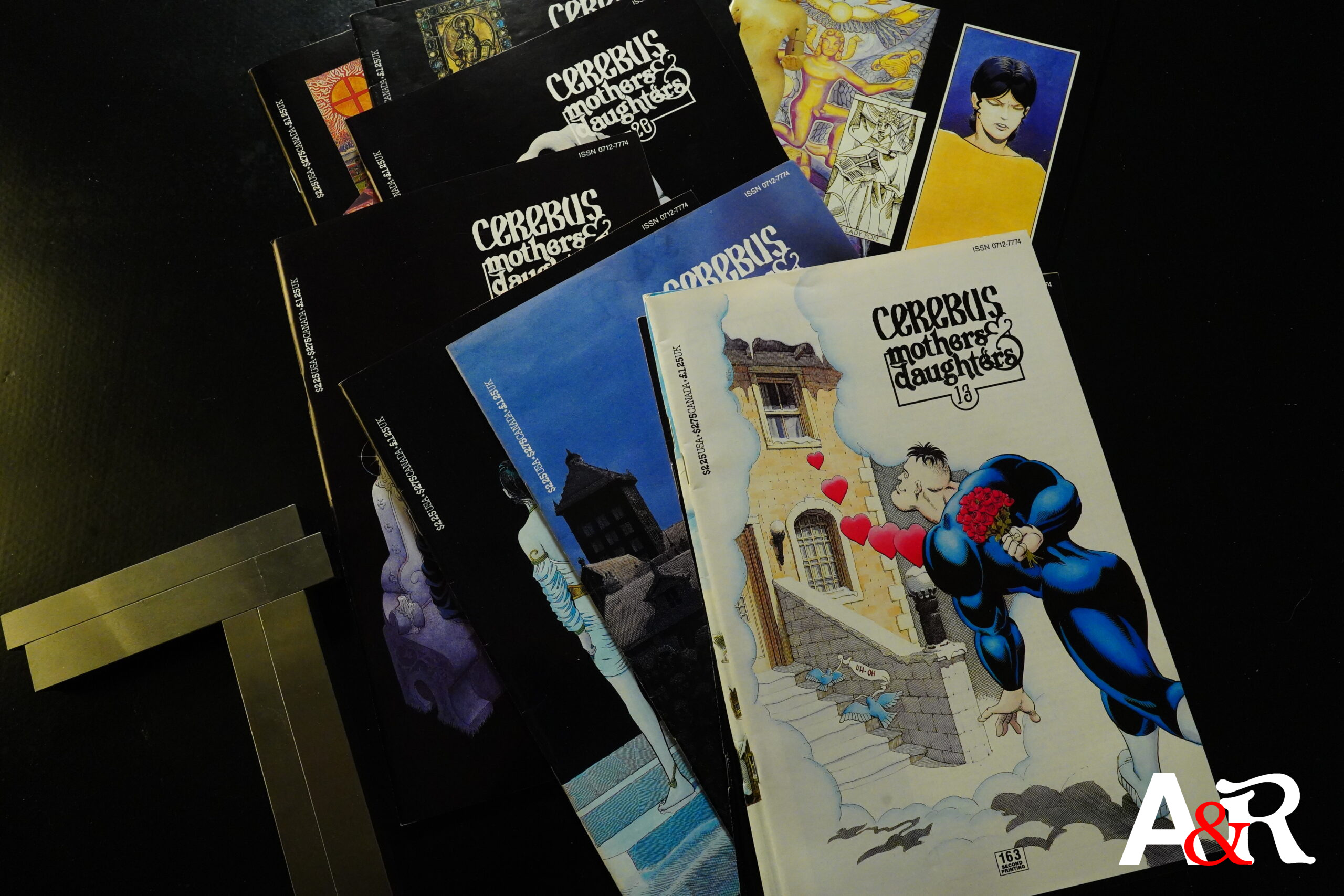
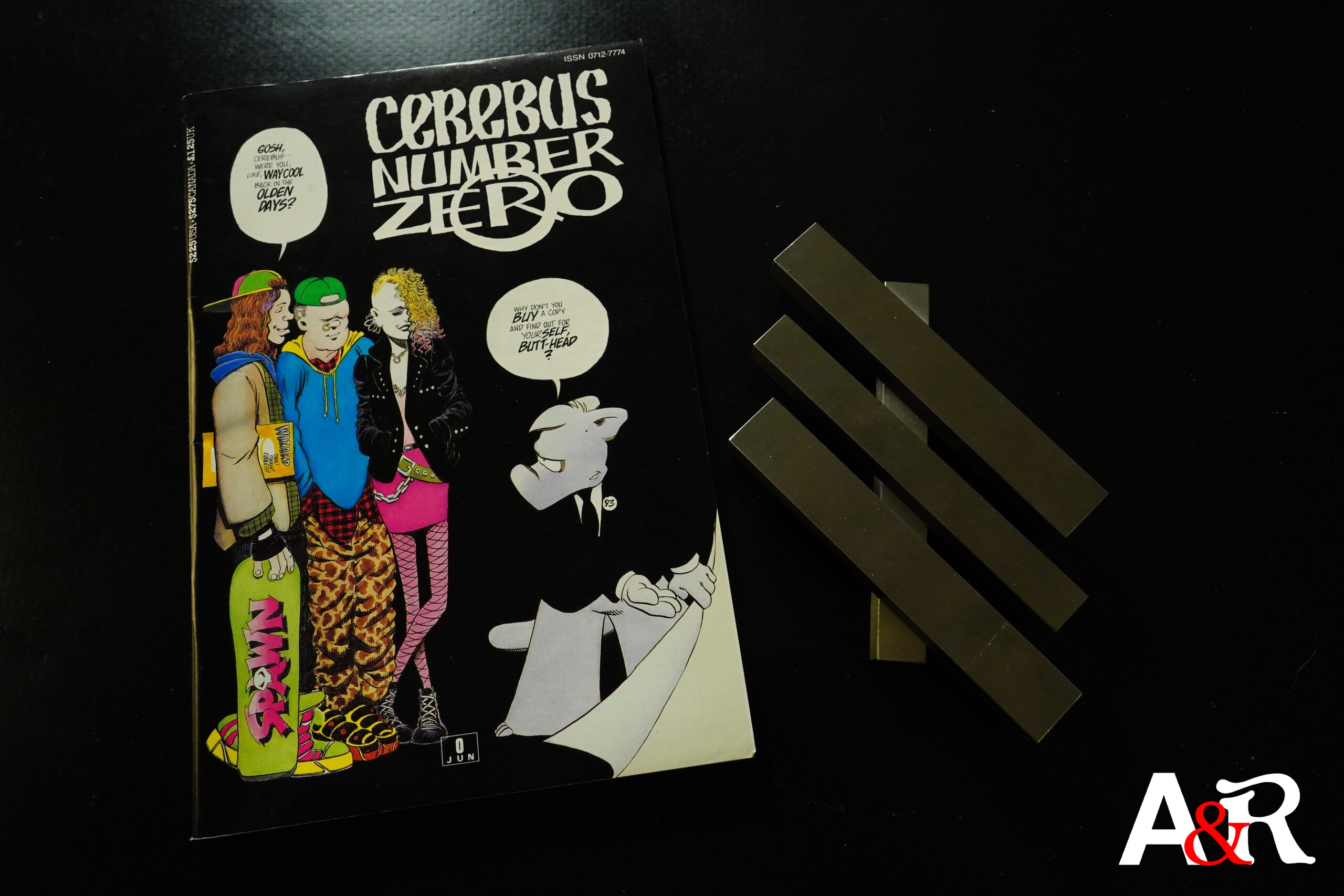
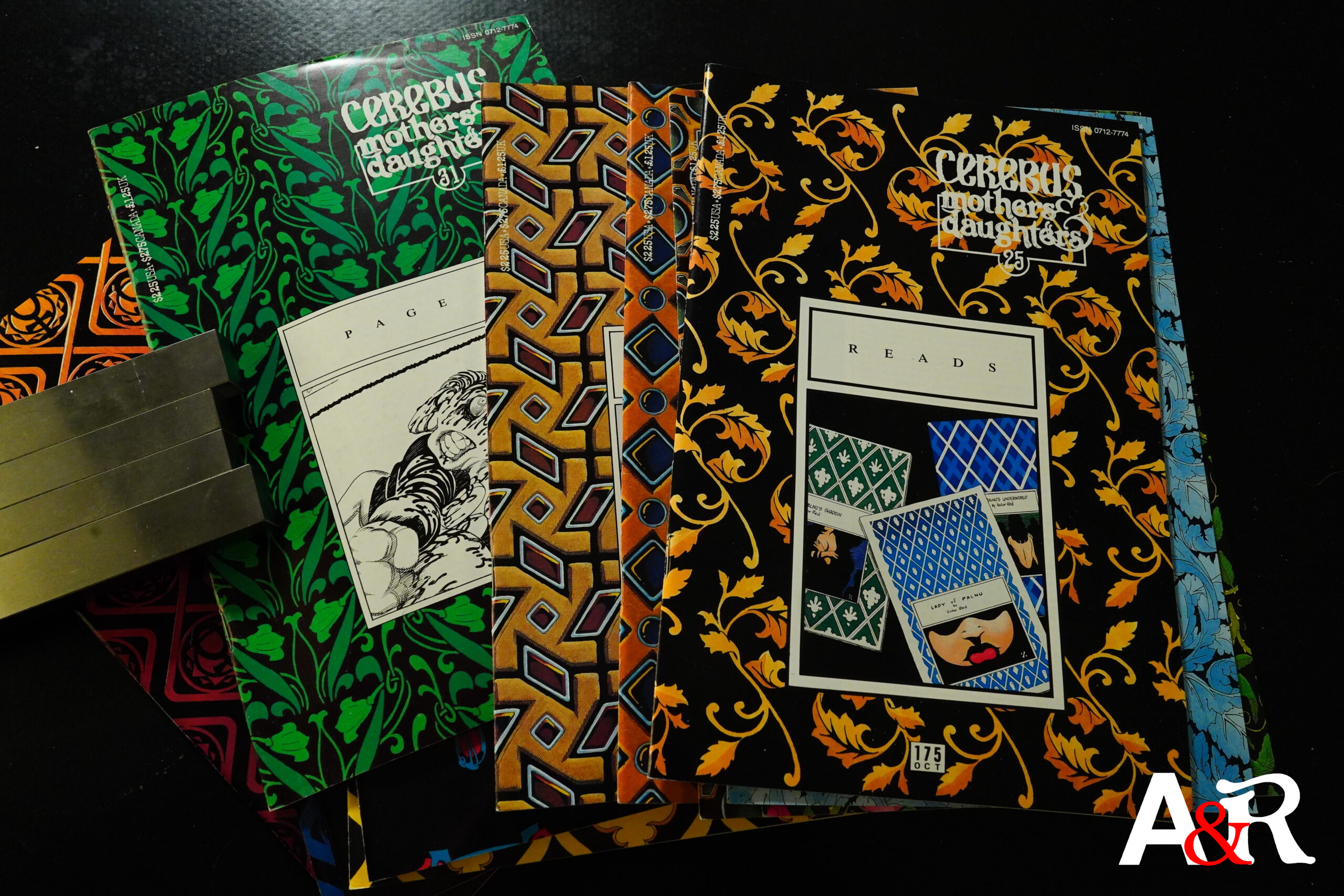
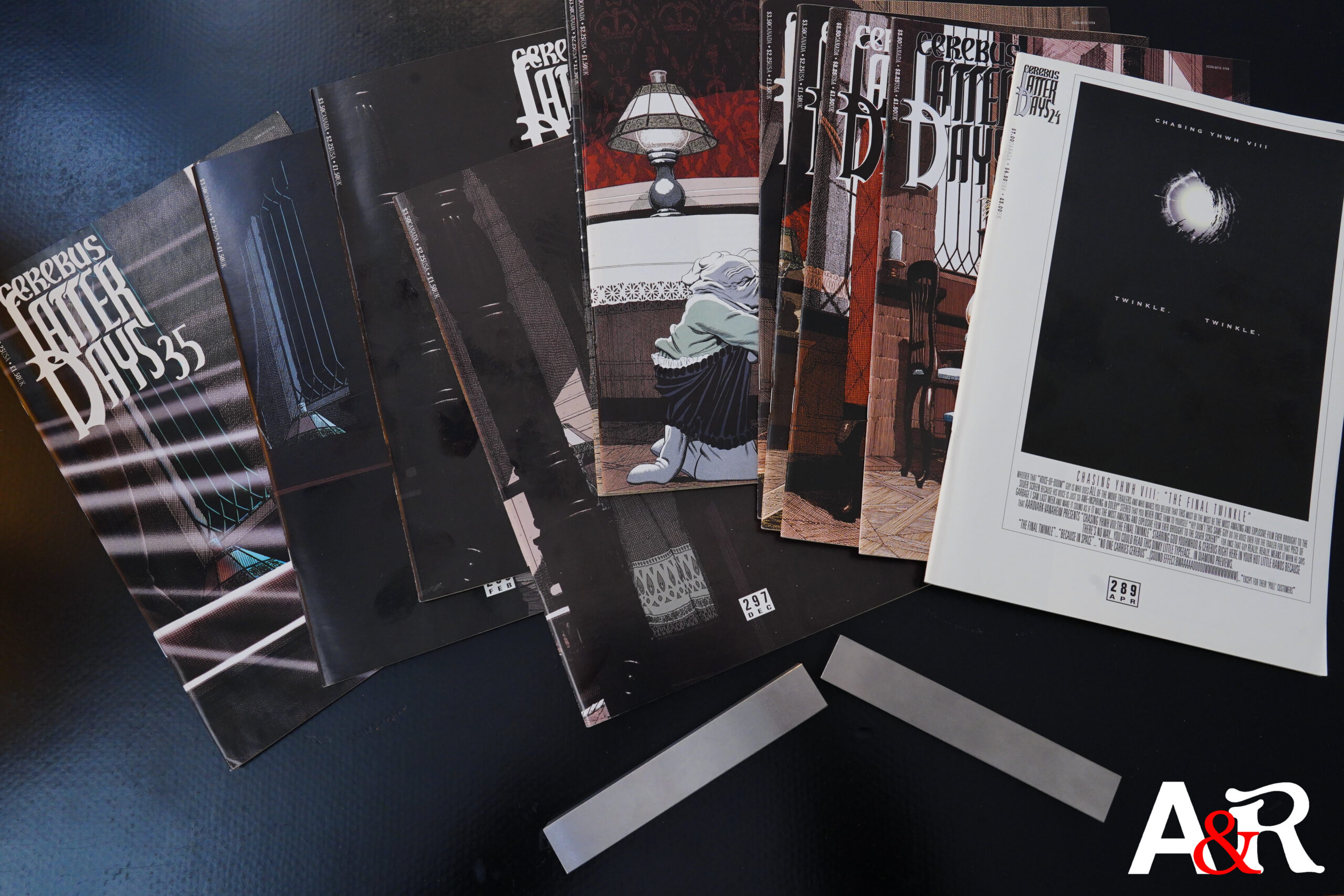
A&R1985: Cerebus #81-111

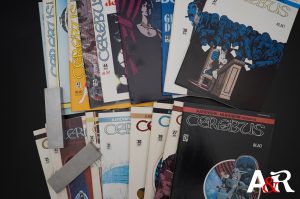
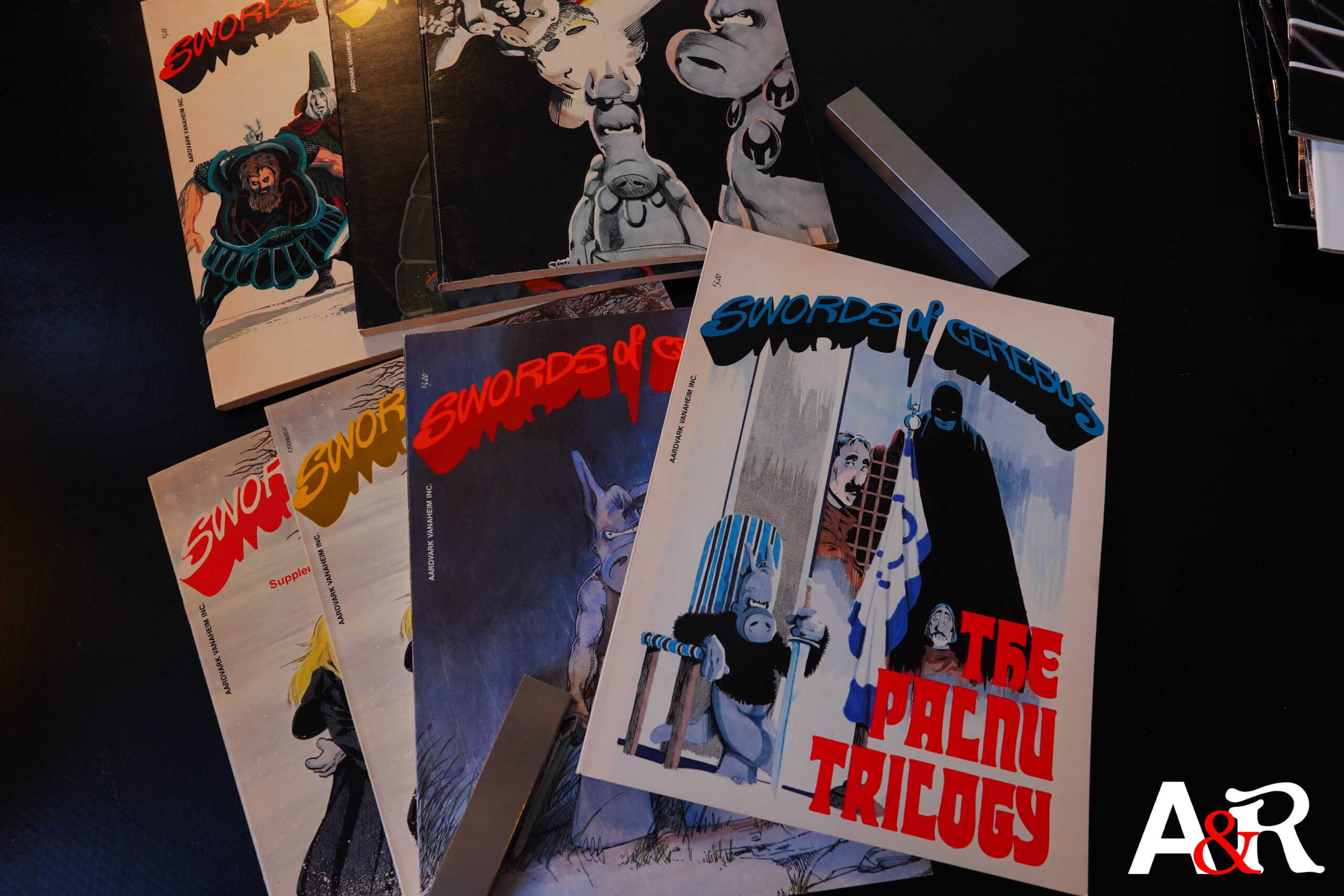
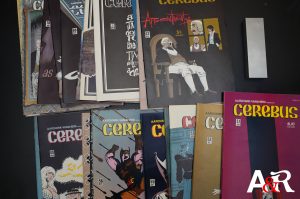
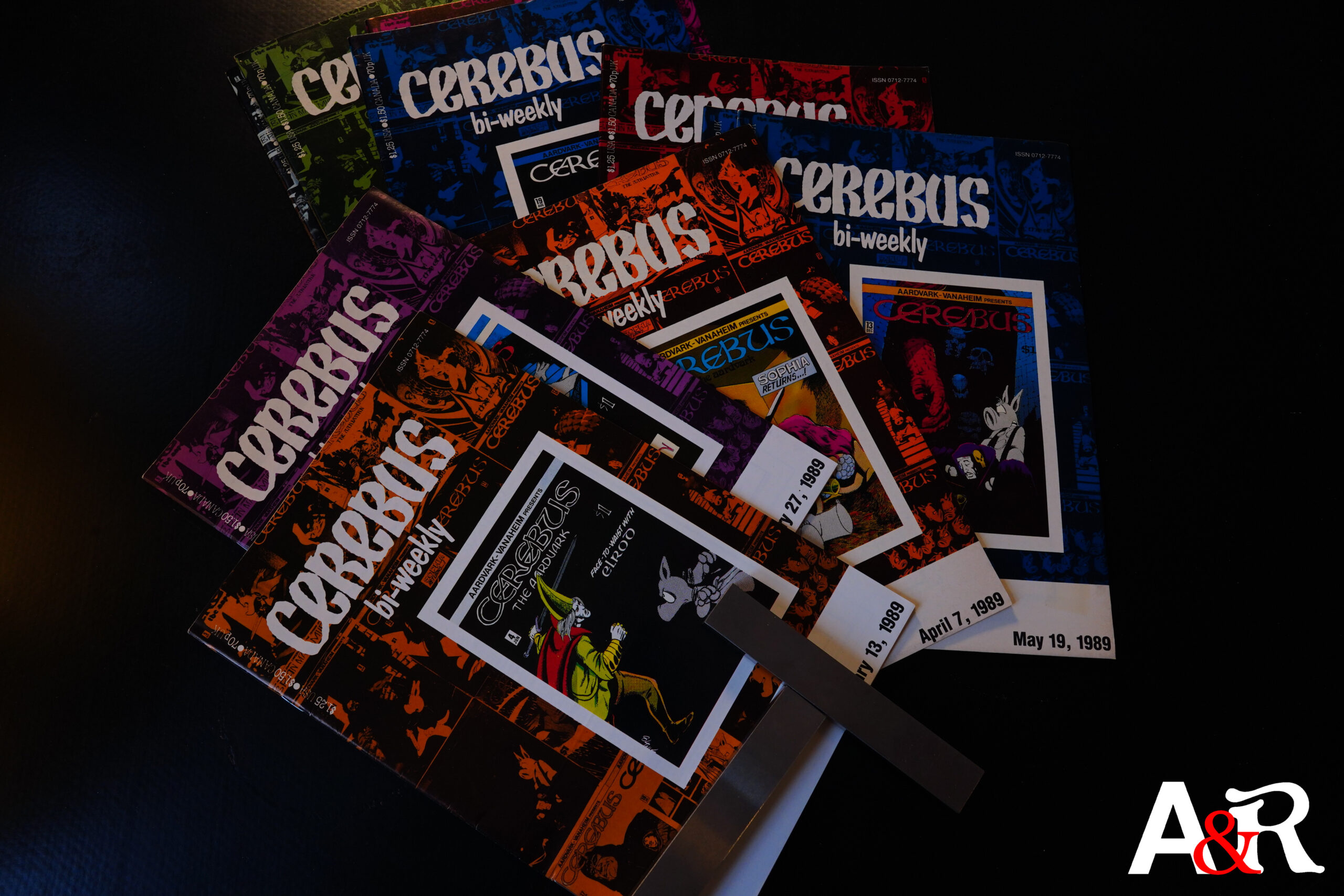
Cerebus (1985) #81-111 by Dave Sim & Gerhard

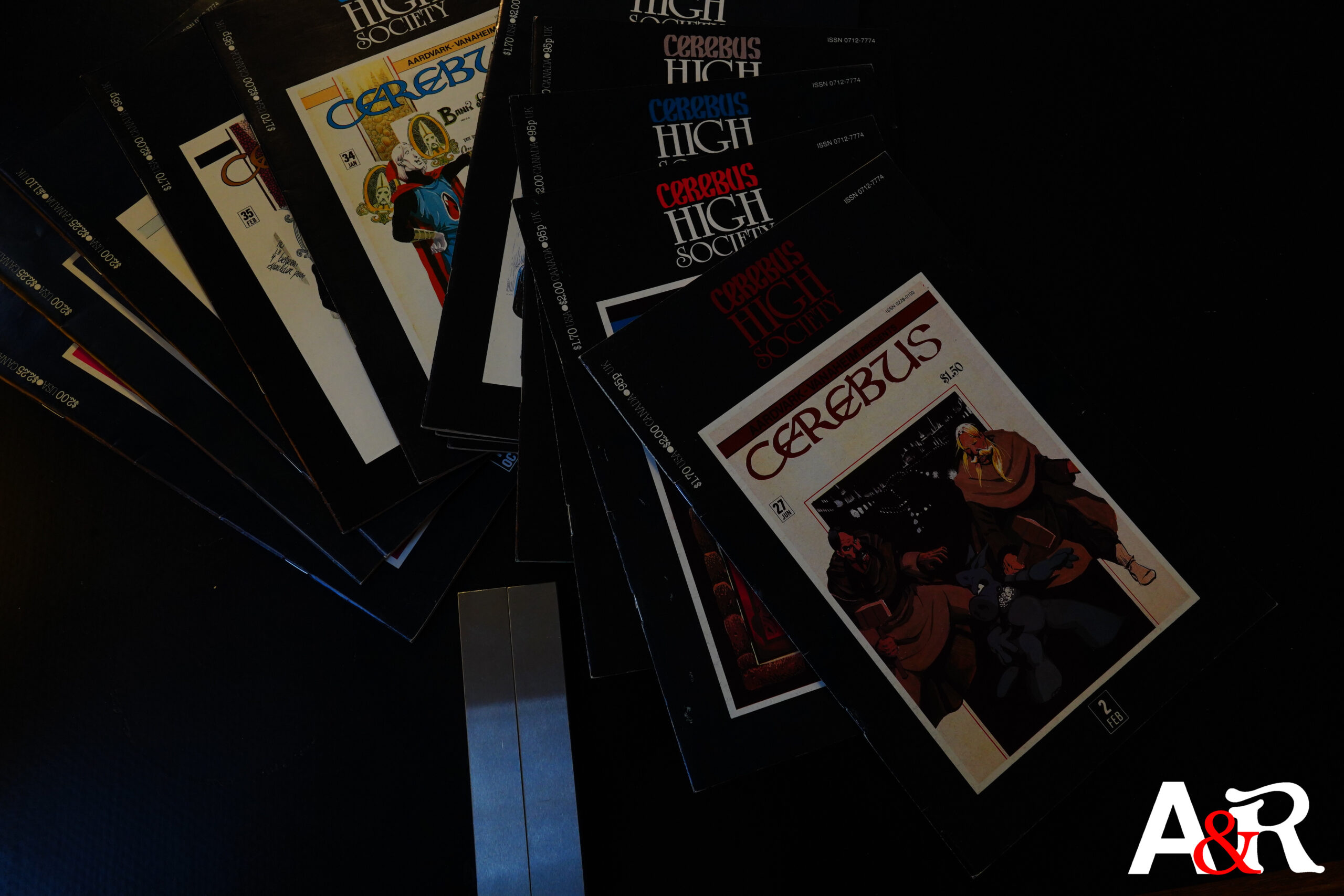
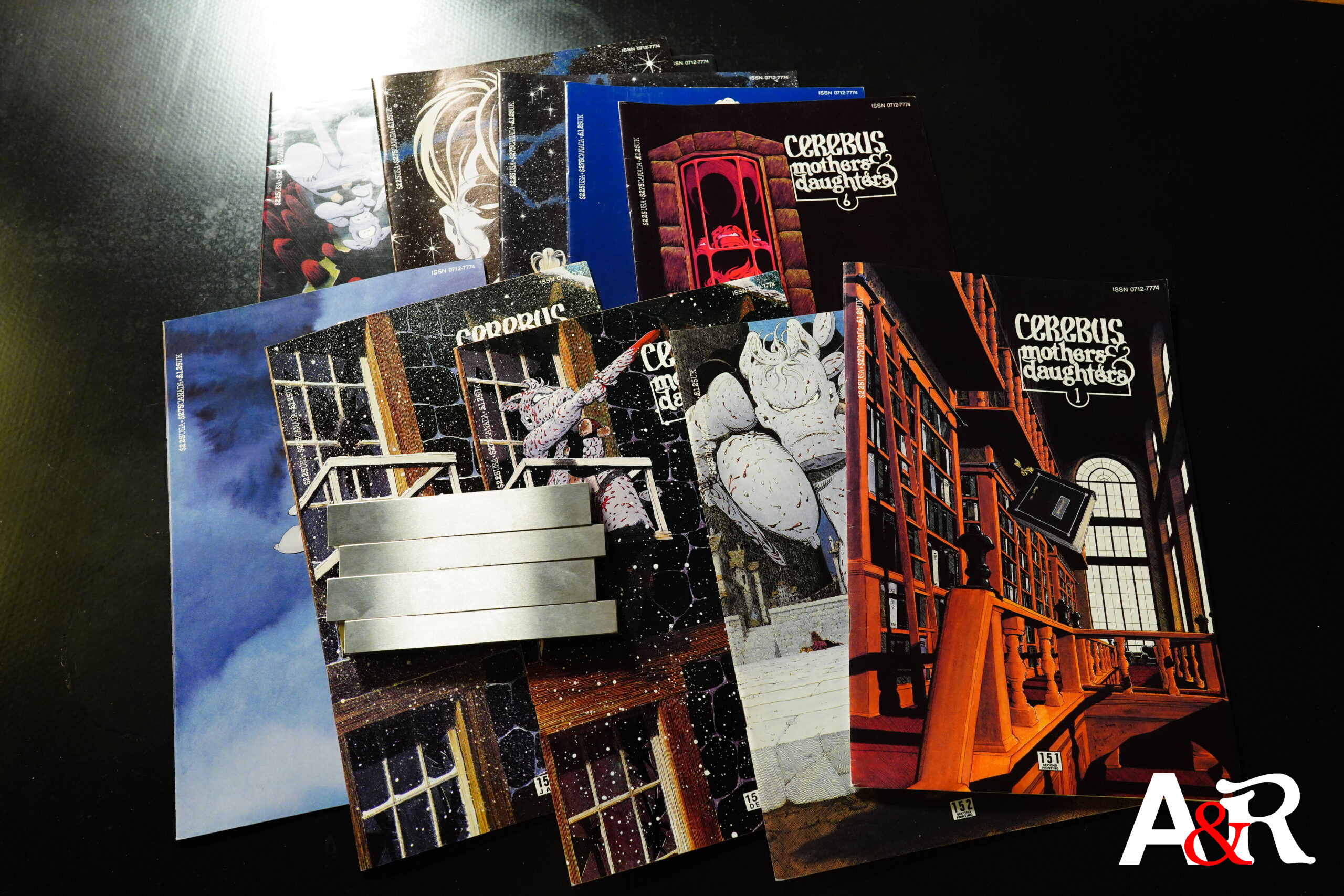
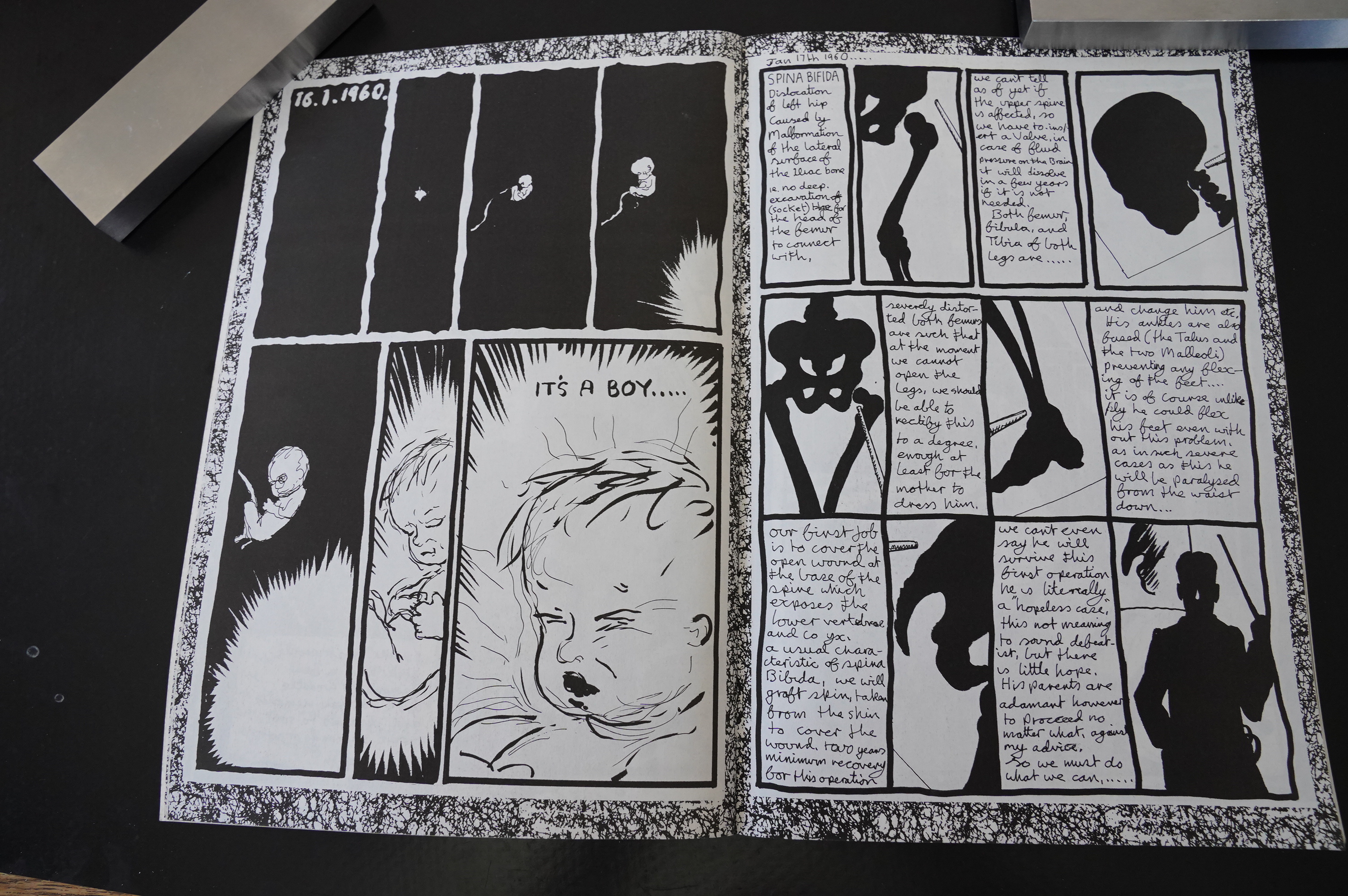
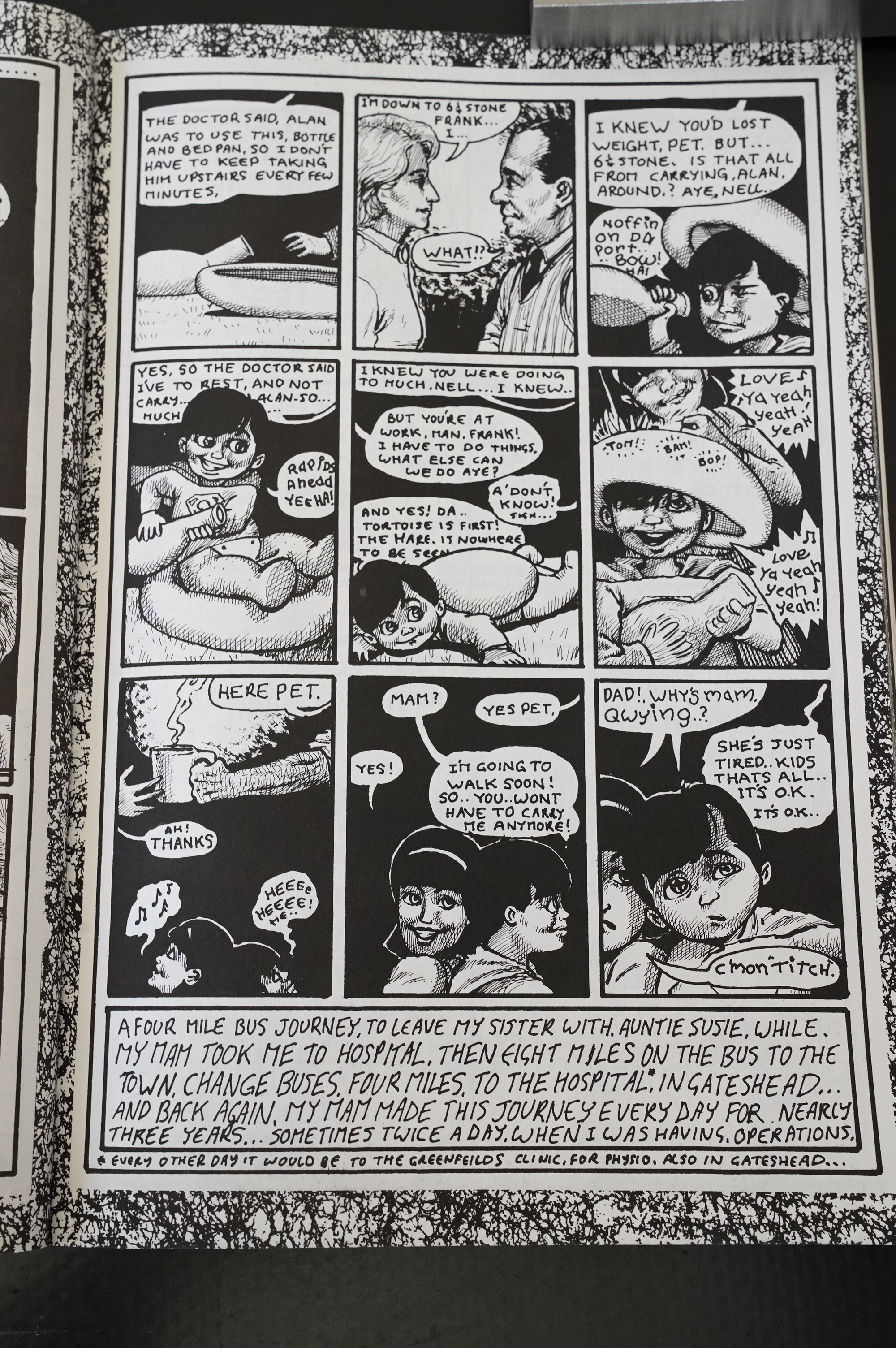
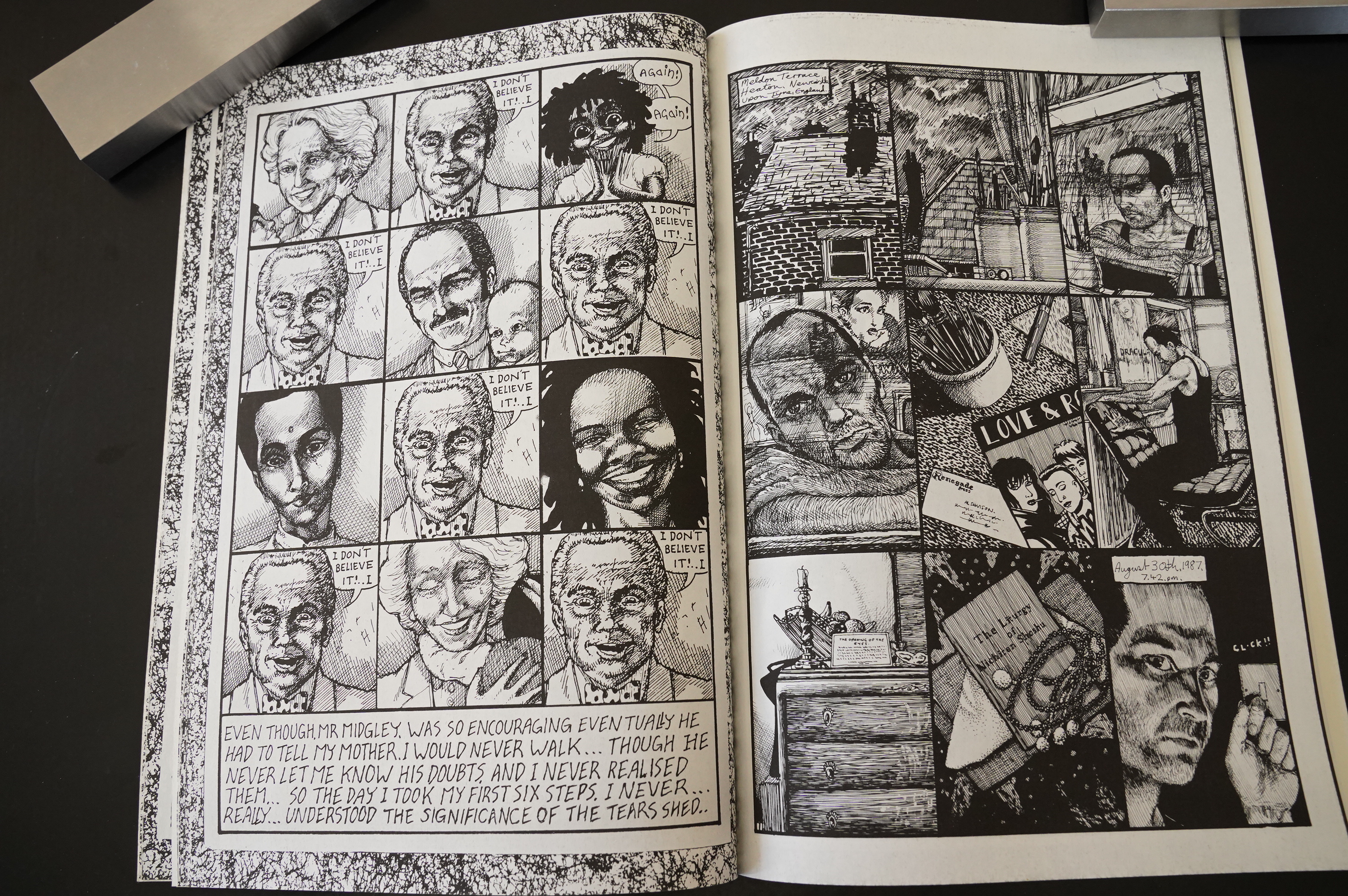
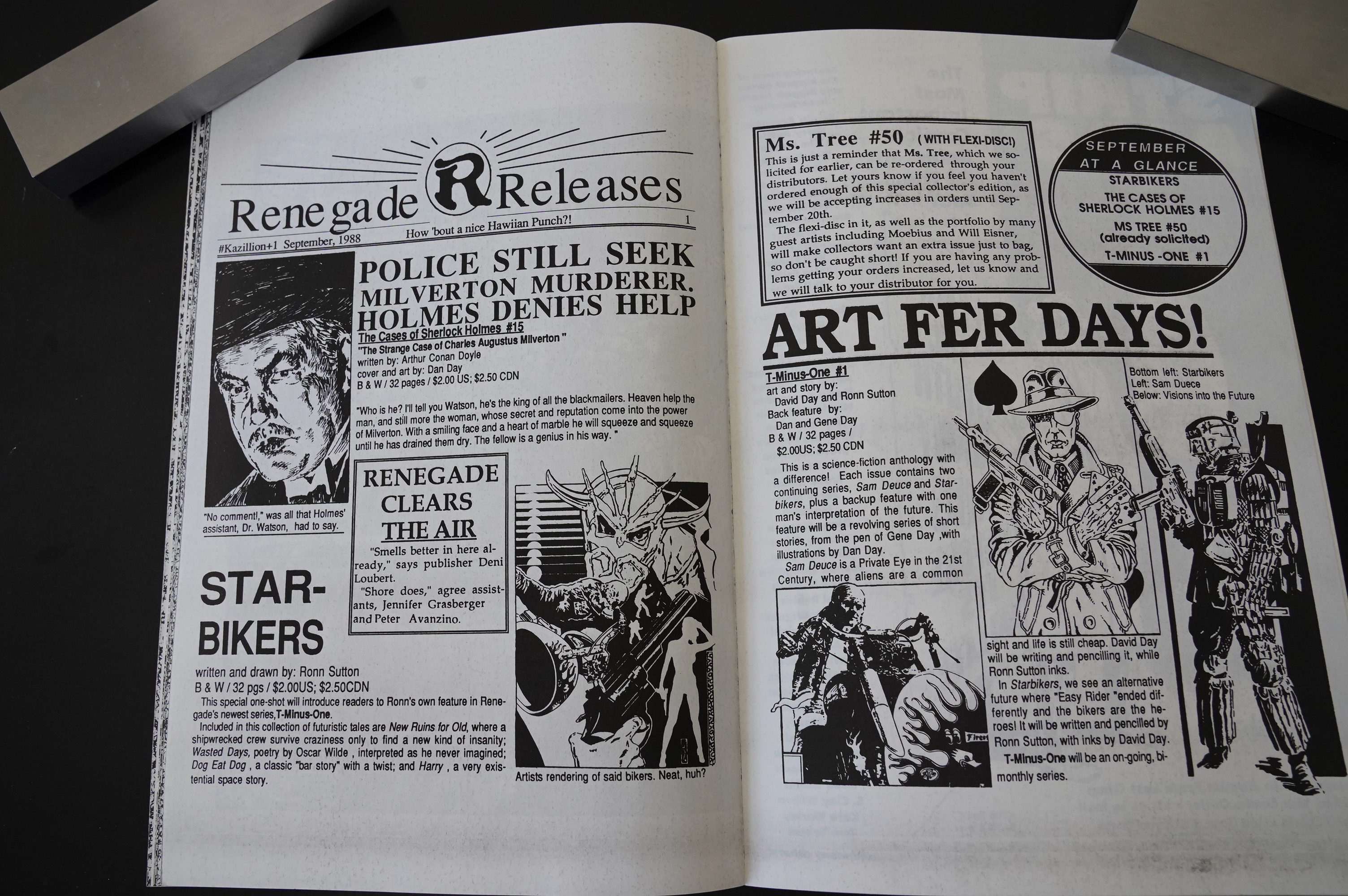
This batch of Cerebus comics are the issues collected as Church & State II; December 1985 to June 1988. Let’s see how it starts:

Ah, yeah: Cerebus is the Eastern Pope, but had been thrown into the Lower City (of Iest) by a Thrunk, a very big stone monster. And then meets up with the Roach, of course, while having a bad cold. You with me? Sure!

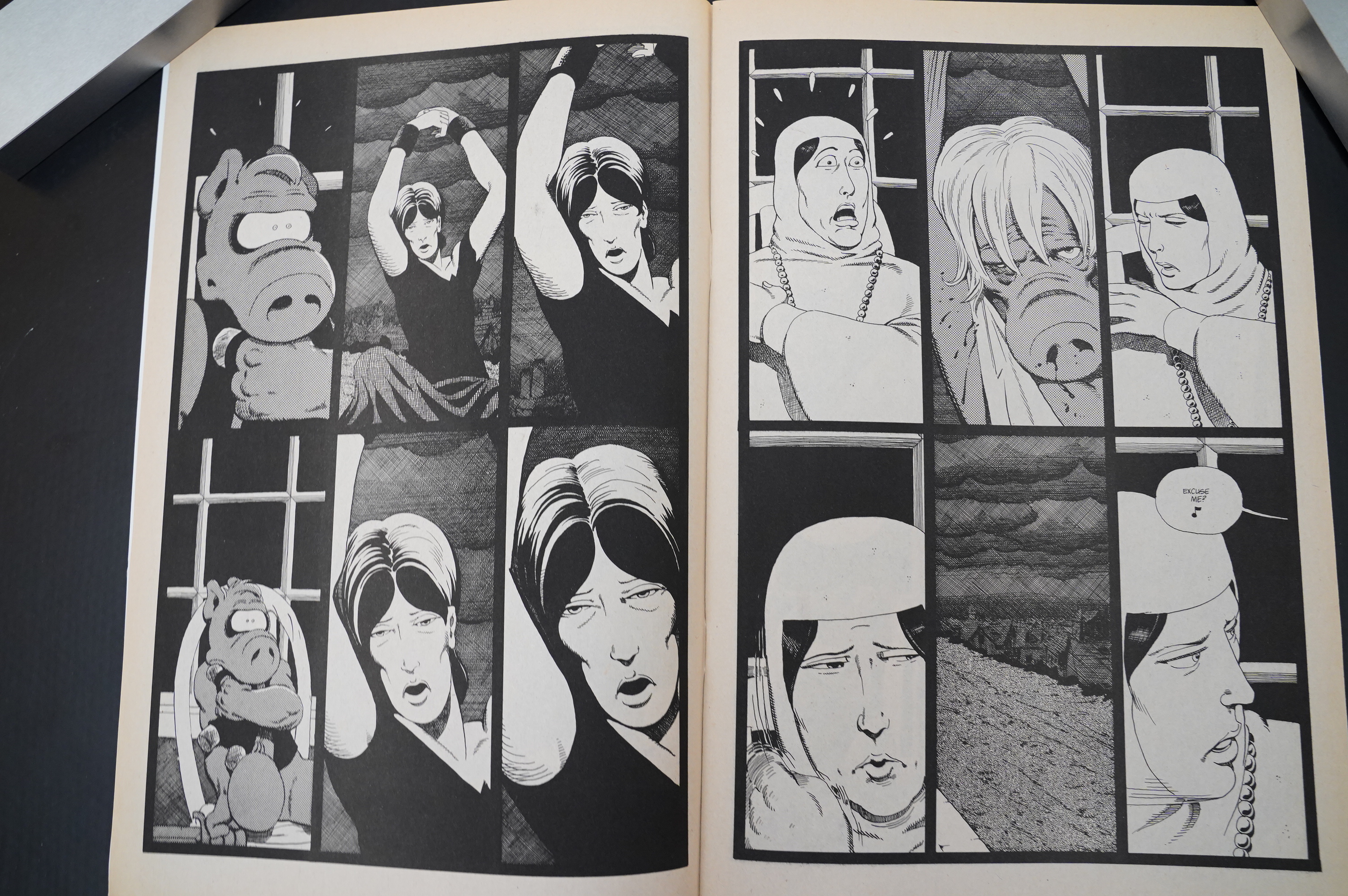
Also: Sim and Gerhard’s artwork is still reaching new heights.

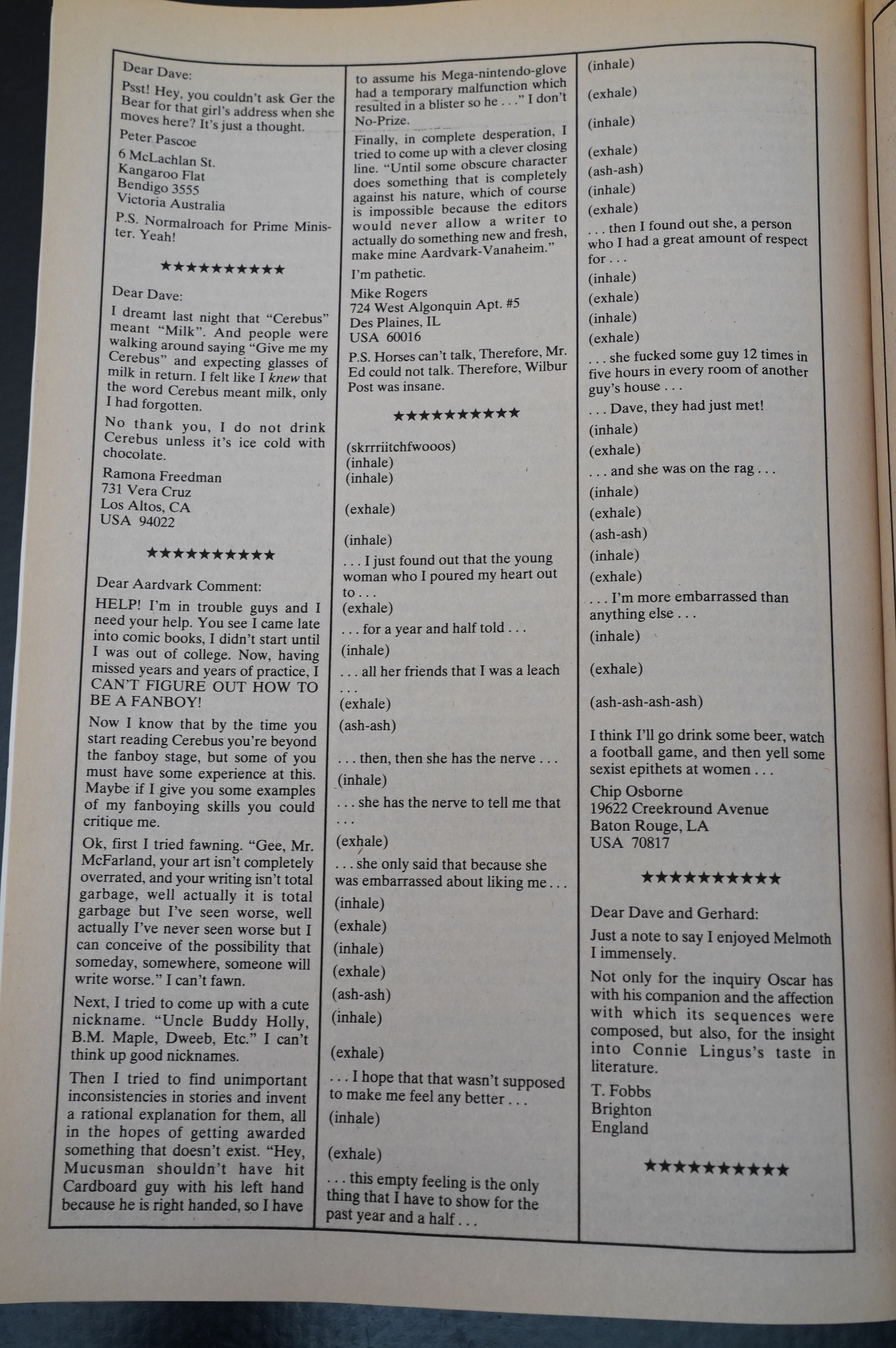
I may be in the minority here, but I think there’s a kind of diminishing return on these Marvel parodies. This is about the verbiage of Secret Wars, and the blocks of recapping the Fleagle Bros are engaging in here is pretty much spot on, but… is it hilarious? Is it? Or is it just kinda slightly amusing?

It doesn’t help that everybody speaks in funny voices at the same time. And the Cebebud god a cod thing gets really annoying after a while.

Fan service.

In case anybody wonders:

Mardas lived in Athens until his death on 13 January 2017 at age 74 from pneumonia

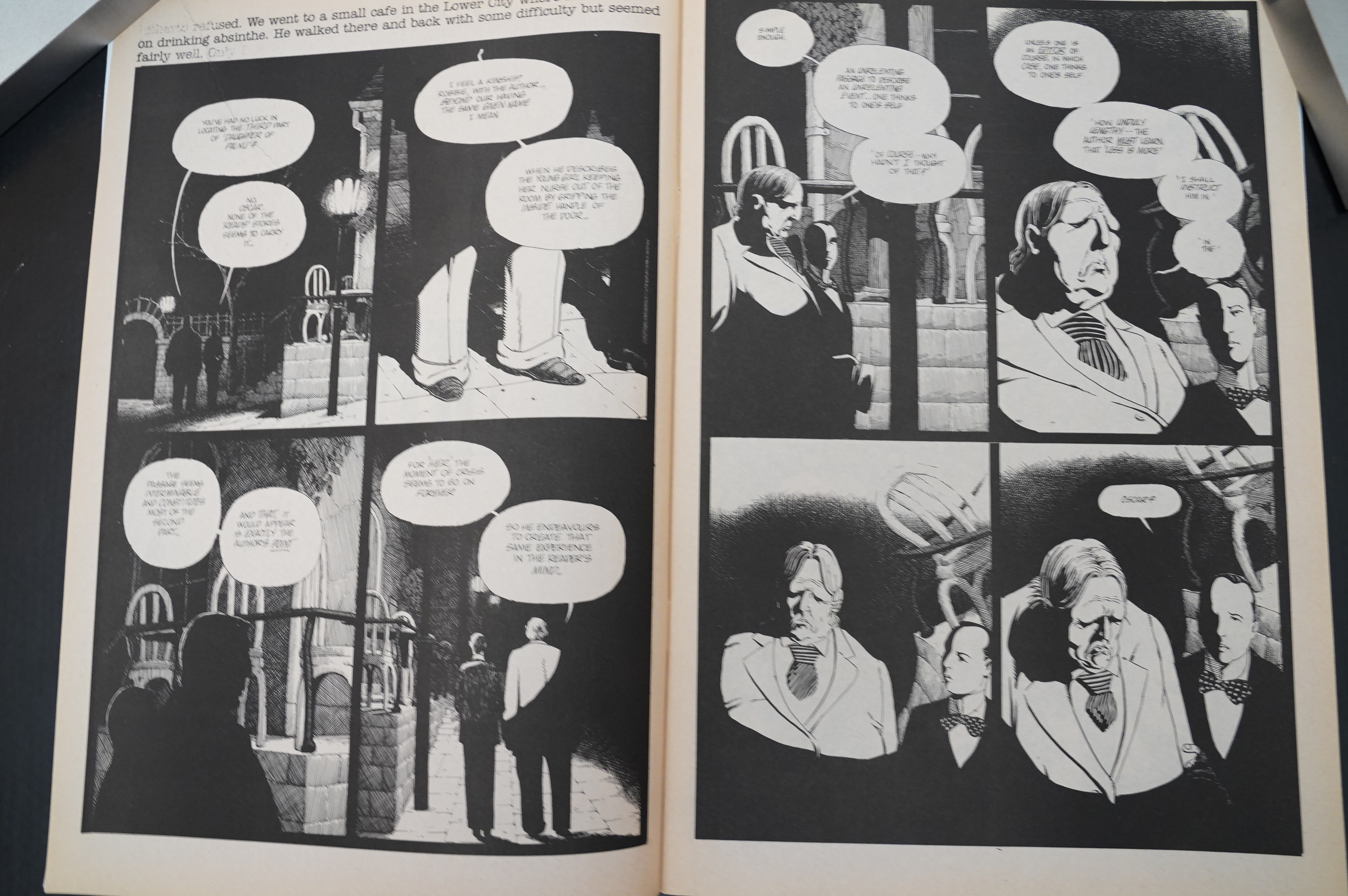
I think Sim is hinting at these hangers-on being leeches on the creative lights, and I think he’s probably talking about himself being Lennon.

Finally Astoria sums up the central tenets of Kevillism!

I interpreted this as Michelle saying she was going to tell Cerebus all about the truth of things in the next issue… but that doesn’t happen, so she said all the had to say in this issue, I guess? It wasn’t particularly illuminating. Except showing Weisshaupt to be even less of a political genius than we had reason to believe. (But at this point, it had been shown pretty conclusively that he wasn’t that smart anyway, so…)

But Sim is so good at this! Reading these scenes, it’s really effective: You really feel like you’re getting vitally interesting information conveyed (and in an amusing way, too), but then you start to think about it, and…

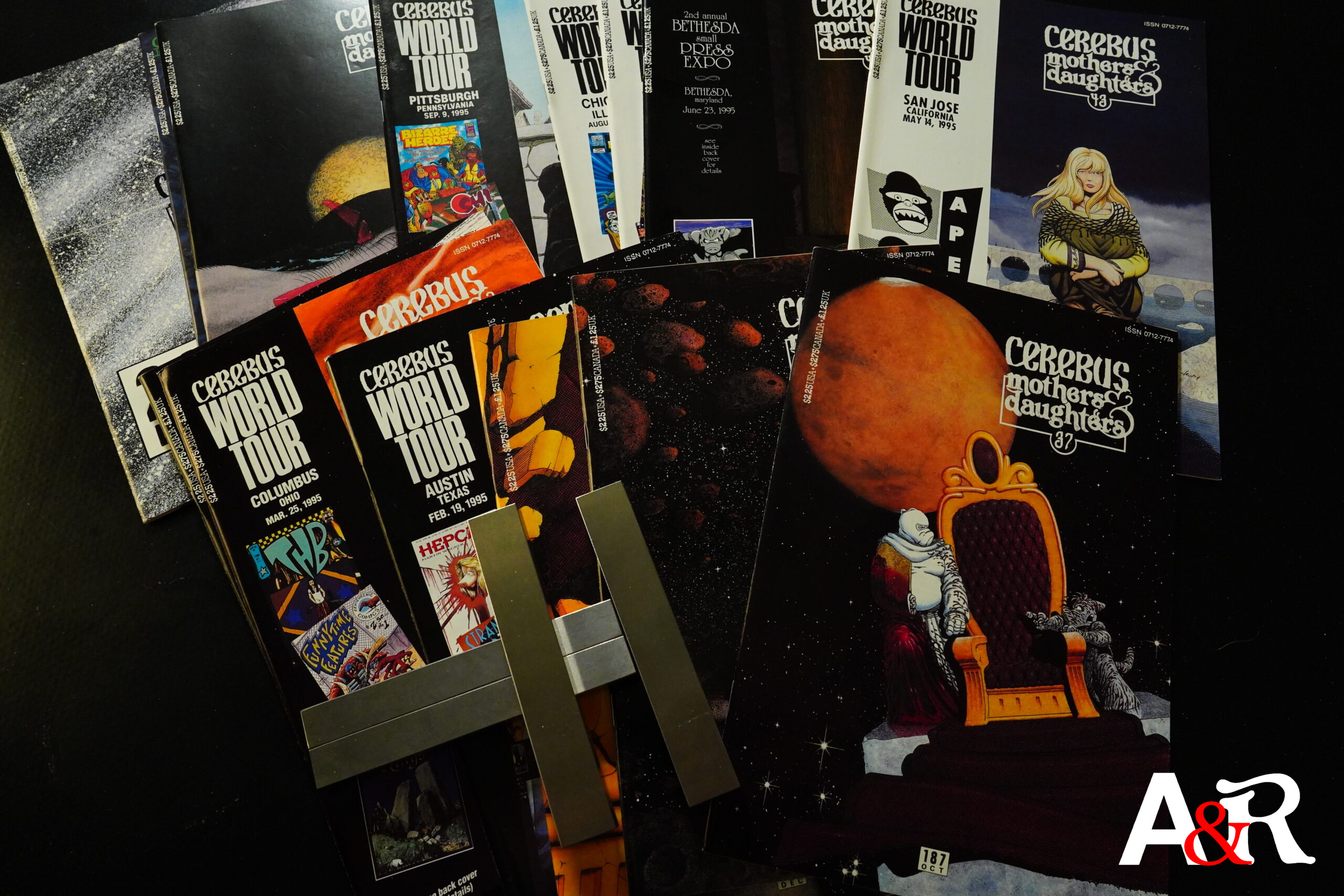
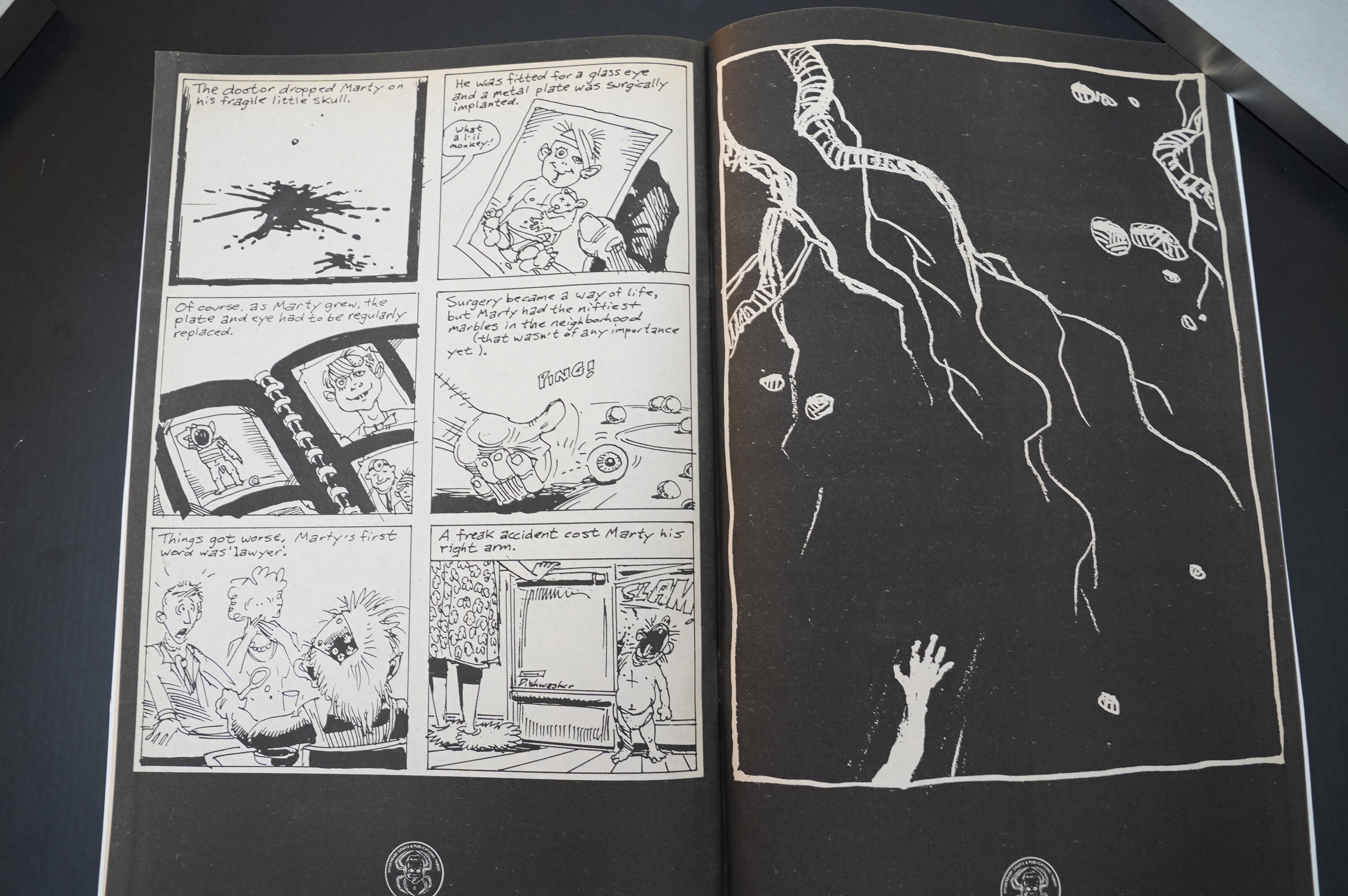
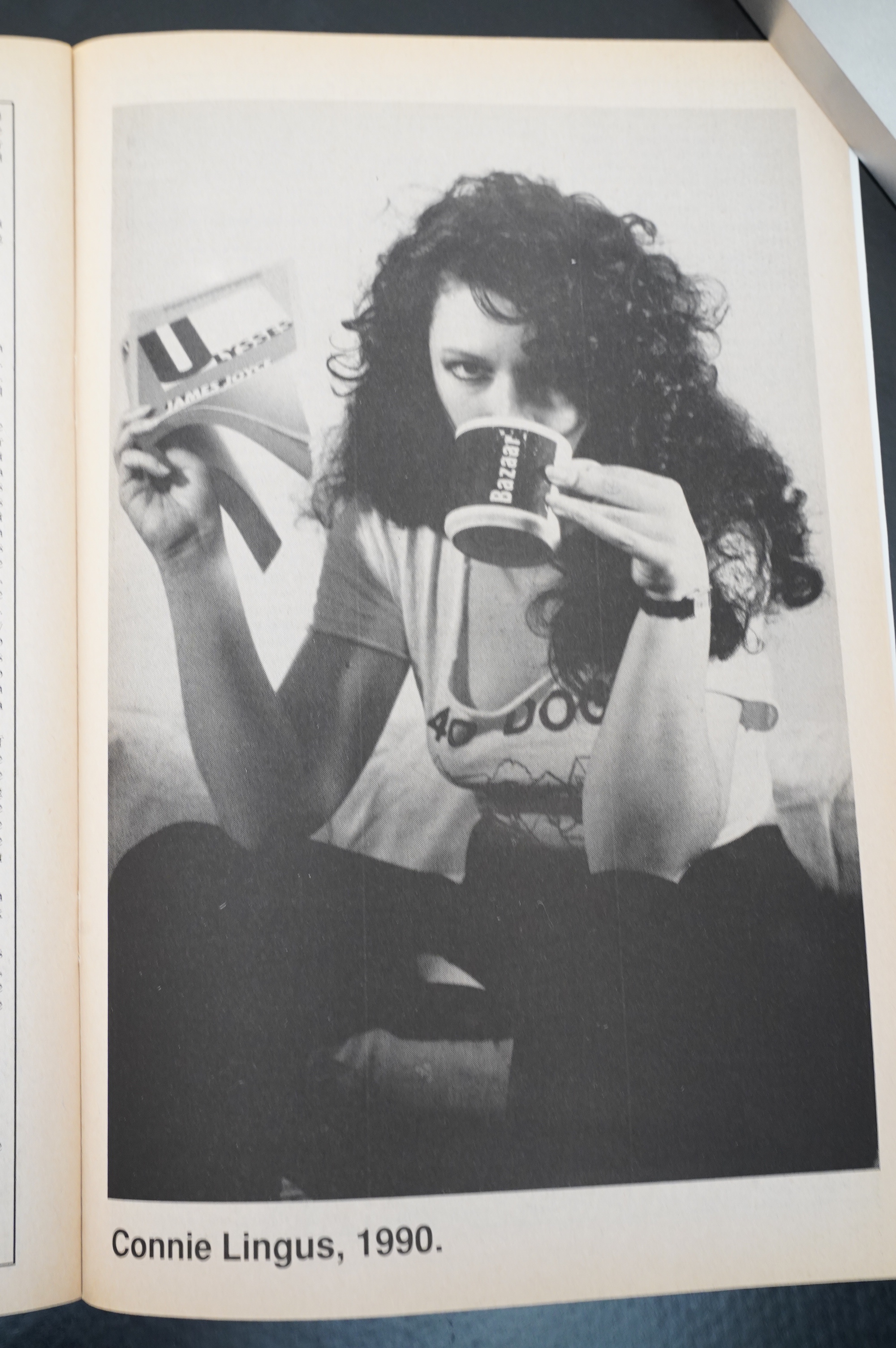
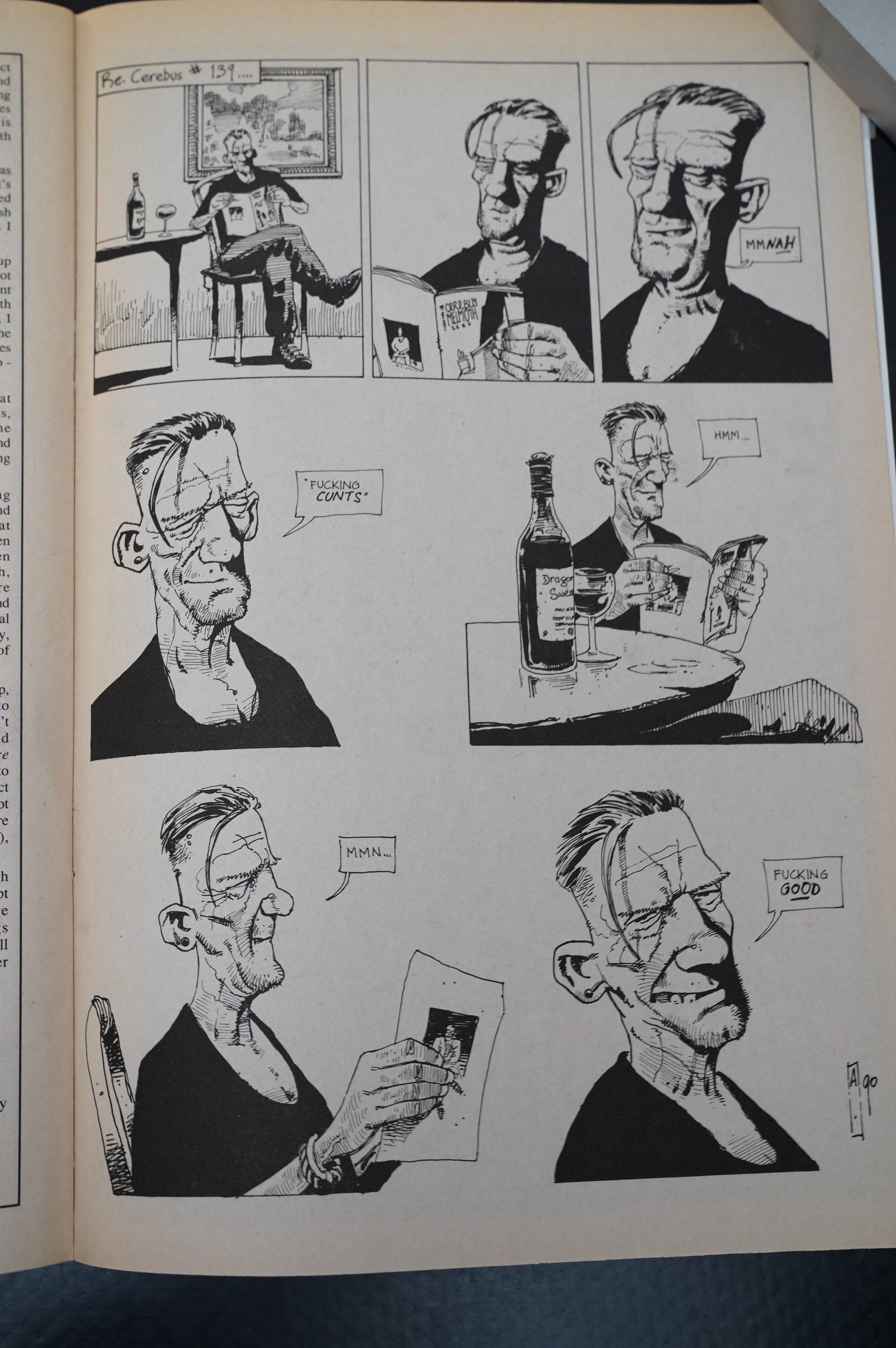
The pics on the back covers are uniformly horrible, and I wonder why. I mean, snapping shots isn’t that difficult.

We’re getting a foreshadowing of the High Society paperback: Sim really wants more money, but isn’t quite sure about how to make that happen. DC had (at this time) allegedly offered Sim a lot of money to buy Cerebus, and that had apparently started Sim thinking…

Oh, yeah, I had forgotten that Church & State was divided into “books” (of uncertain lengths). Sim had planned out the entire storyline at this point, but not how many issues this would result in.

I think this is a parody of Dark Knight Returns? And also… even having read this a bunch of times, I’m not sure why Cerebus starts running after the Roach?

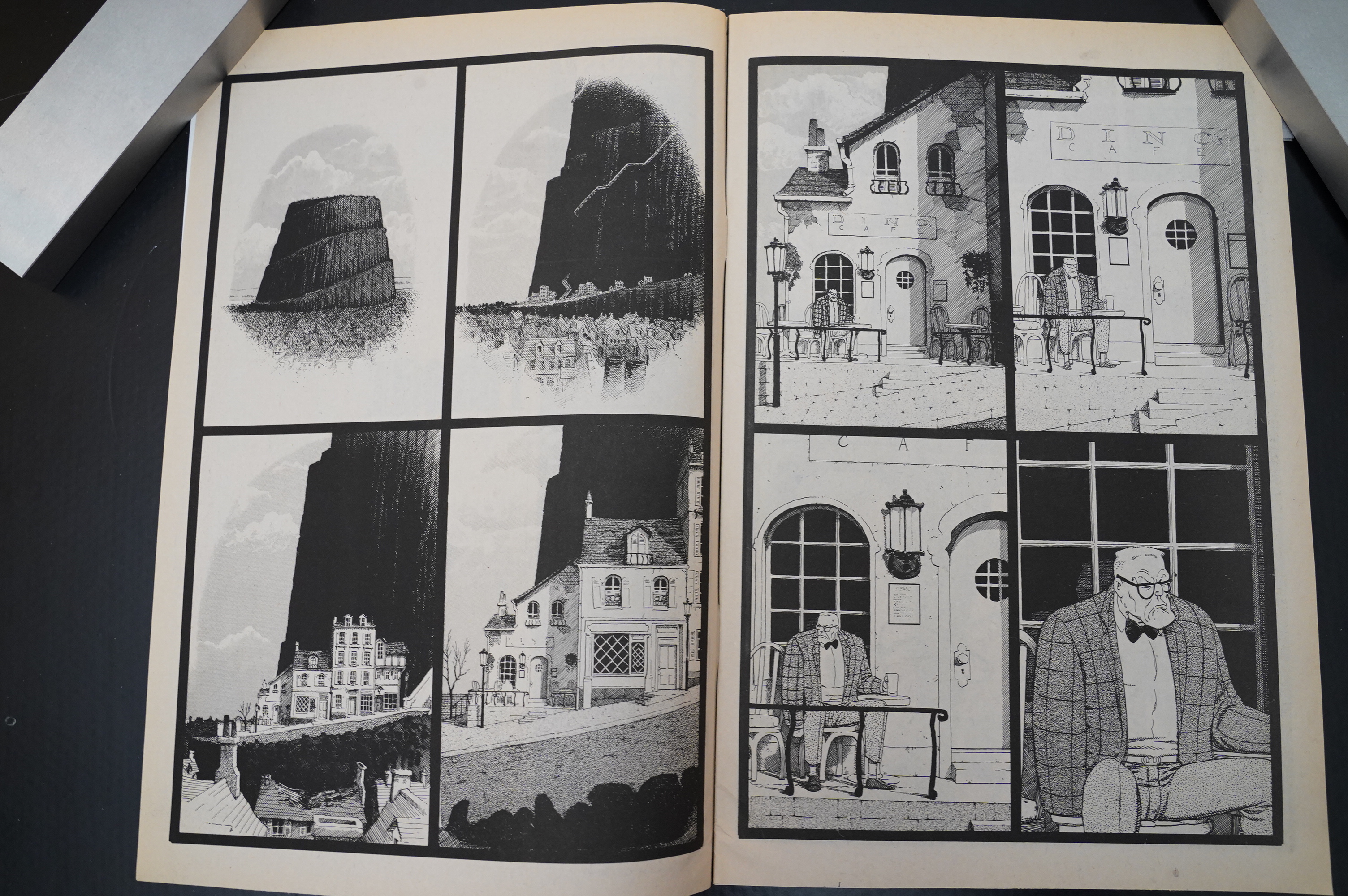
And also: I remember being really frustrated (as a teenager, reading this for the first time) with the lack of details about what the layout of Iest was. I mean, there’s the Lower City (seen here) and the Upper City (which is growing into a tower), or is it?

The confusion stems from pages like this, where Cerebus is crawling up to the Upper City (probably), but we see panels like this where there’s apparently a Black Tower behind him? But that is supposed to be Cerebus thinking about the Tower, I guess.

On the one hand, this confusion fits the frantic action of these scenes. On the other hand, I think… it’s perhaps not a confusion that was intended? It’s a thing in Cerebus generally: It’s seldom conveyed where things are in relation to each other.

Sim says that he’s fed up with letter writers and nasty people having opinions about Cerebus.

But he produces these awesome promotional posters. I mean, what comic shop wouldn’t want to put these on the walls and watch the issues of Cerebus fly off the shelves?

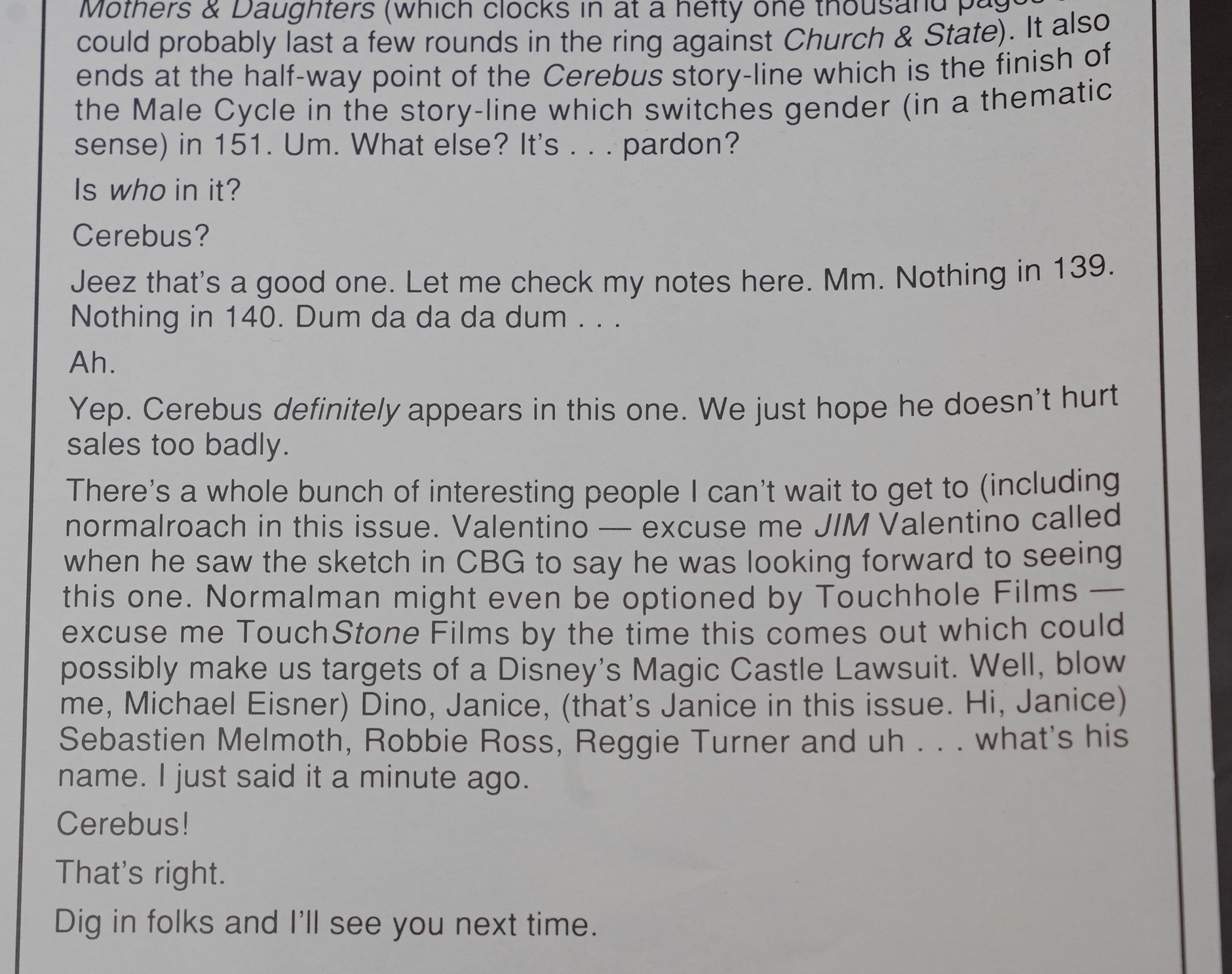
I kinda think these years are the Imperial Phase of Cerebus. Gerhard had come aboard, so Sim didn’t have to draw so much stuff, and every issue of Cerebus seemed to sell more than the previous one (peaking at 33K, though), and Cerebus was critically well-regarded and Sim was doing all the drugs and having fun (I’m just going off the pics here), and Sim was starting to head an entire movement of self publishers…

However, 86-87 was the black and white boom (and bust), so all black and white comics were increasing in sale at this point. And Sim’s deranged politics hadn’t really been made manifest yet, and both the imploding sales and growing unease (and disinterest) in Cerebus happens about… four years from now? I think? We’ll see later in this blog series, I guess.

So: The Imperial Phase.

Because Cerebus is really cooking in these sequences. It seems like everything is finally happening, and everything is going to connect and make some kind of deep, satisfying sense. In addition to being exciting on a scene to scene basis, of course.

Sim expresses appreciation for the work editors do.

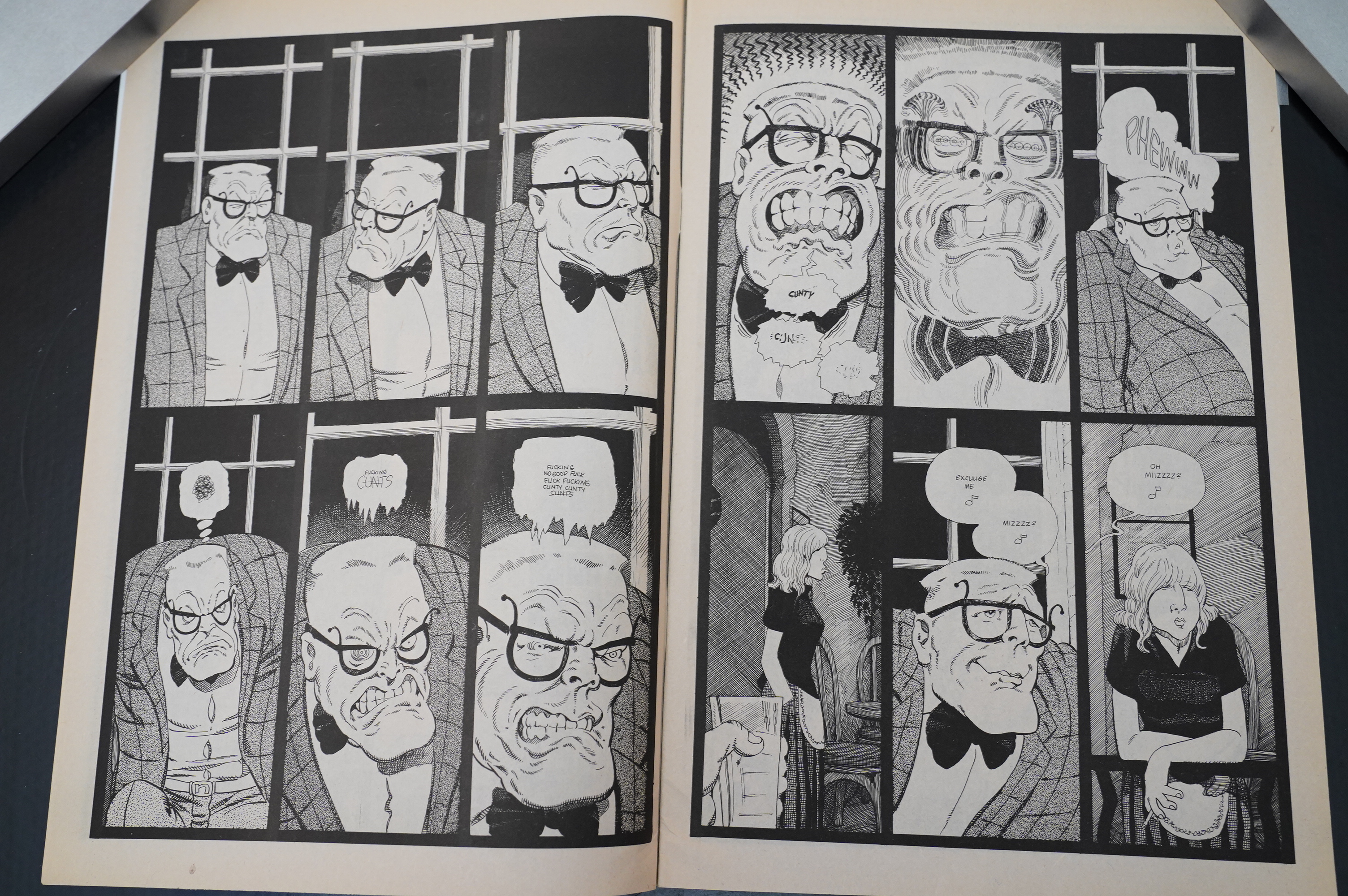
Sim’s Marxian dialogue is so effortlessly hilarious.

Sim had found out how to get rich quick: He printed up 6K copies of High Society, and sold them via mail order at $20 a pop, giving him a cool $100K in profits (apparently). Good for him. The problem was, though, that this pissed off comics retailers and distributors, because he didn’t offer the books to them. Sim here tells them to go fuck themselves. (I’m paraphrasing loosely.)

The reasoning here is… it’s… he spends a lot of time speculating that a large part of his readership is people working in comics shops, so they’d been getting Cerebus at a discount anyway, so… er… something.

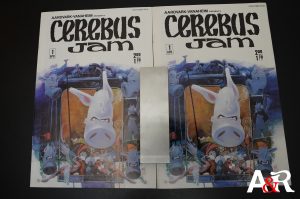
Cerebus Jam was planned as a bi-monthly companion series, but it took more than a year to get the first issue done, so Sim here says he’s just going to run the pieces planned for #2 in Cerebus. This seems to be the only piece though, and I guess it’s about DC editor Julie Schwartz, who was notorious for sexually harassing any women in his path?

Anyway, Sim warns off all women in the comics industry that harassment is endemic, especially at conventions and the like. I don’t think that was talked about a lot at the time… it just took (counts on fingers) 30 more years for that to get some general attention.

The four page story (which melds Doran’s and Sim’s (and Gerhard’s I guess) artwork pretty flawlessly) is a even more vague on particulars than the introduction.

Cerebus shows consideration.

I talked about this issue in the blog post about Mister X, but it’s a pretty major plot element here. I mean, Cerebus has gotten an apparently mystical, possibly holy golden sphere, but Seth and Bill Marks inadvertently distract him so much that the sphere turns into gold coins again. It’s brilliant storytelling, because it’s so… so… annoying!

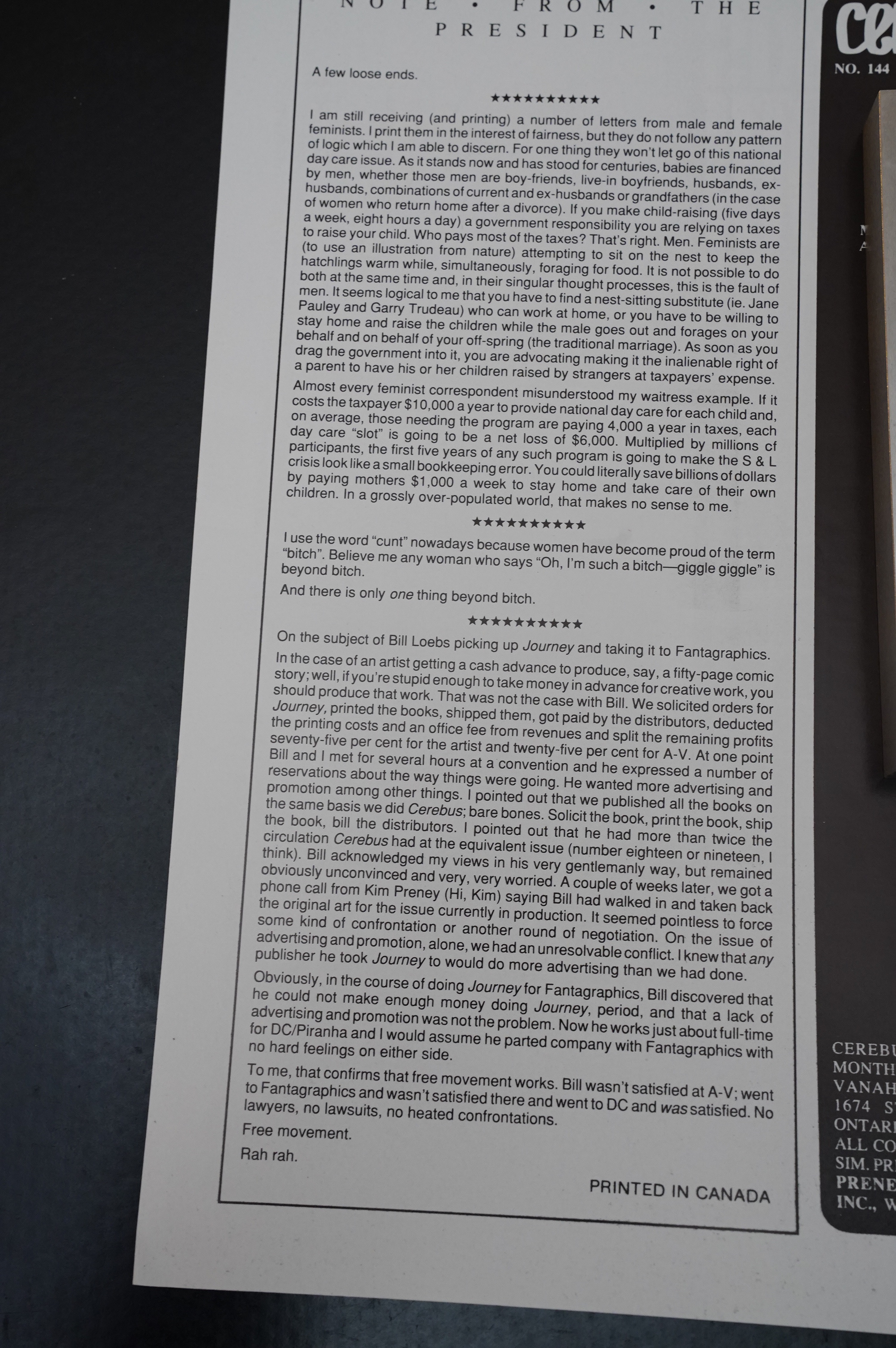
Comics shops have been buying copies anyway, and are selling them at the proper mark-up… which makes me wonder whether Sim could just have framed this differently and avoided the controversy. I mean: Sell the book both through the distributors and also directly to people. And taking $20 in either case? (I.e., not giving volume discounts to anybody.) Comics publishers rarely do that, though, and it might have pissed off as many retailers, anyway.

cat yronwode, the Eclipse editor, writes in to say that she pissed off at Sim’s anti-editor stance.

And then Cerebus rapes Astoria.

Now, Cerebus had been killing babies and old people en masse in previous issues, but the framing had been comedic. This is something qualitatively different, and I wonder whether this was what started souring people to Cerebus. I mean, it’s one thing to read a series about a not-very-smart, selfish, somewhat murderous barbarian trying to conquer most of the world… all fun stuff!… but having the protagonist be a rapist, too, makes it more “hm”.

Sim regales us with stories about how hot he is, seemingly without any sense of this being ridiculous.

Cerebus explains.

Sim announces that he’ll allow distributors to buy the collections if they place sufficiently high orders. Perhaps.

I’ve kvetched in previous blog posts about how unconvincing some of the machinations in Cerebus are. I mean, here we have Astoria, who’s supposed to be very smart indeed, ascribing Cerebus’ actions as having some kind of deeper meanings. But she knows better than anybody else that he’s about as smart as lichen. So why?

Because Sim couldn’t come up with anything smarter himself.

Sim announces that he’s going to stop smoking pot every day, all day long.

I think the trial scene is masterful. It seems like as if everything is coming together! It all fits! It all connects! It’s wonderful.

I want to go to Hawaii, too!

Apparently some (?) readers didn’t think that Cerebus raped Astoria, but Sim is pretty adamant.

An editor explains to Colleen Doran about human anatomy.

The thing about that masterful revelation in the trial scene, though… is that it all hinges on Weisshaupt being totally prescient. I mean, first he arranged for the Countess to give Cerebus the means to blow up Thrunk. Then he somehow arranged for a golden sphere to appear during the trial to allow Cerebus to ascend (and become Tarim, Weisshaupt assumed). It’s super lazy plotting, having Weisshaupt being the not-quite-deus in the machina, and it doesn’t really make that much sense if you stop to think about it.

If you don’t, though, these are super thrilling issues, and re-reading them now was pure delight: They’re propulsive and exciting.

Trina Robbins (and others) take up the invitation from Sim to write in and express their opinions on Astoria’s rape.

If you wondered what kinds of things Sim was thinking about now that he’s stopped being stoned all day…

Perhaps he should have gone back to smoking?

Just when things were barrelling along most wonderfully, we get a cross-over issue with Bob Burden’s Flaming Carrot. It feels pretty irrelevant.

A very strange person writes in with an apparent death threat (he probably thought he was being kinda funny?) because Sim hadn’t signed several cases of Cerebus comics at a convention.

He writes in back again and justifies his original letter… because he was… angry.

If Sim was dealing with this kind of shit on a daily basis it clarifies his anger directed at fans.

Sim decided against offering the reprint collections to the distributors, and Diamond retaliates with an extraordinary letter of extortion: If Sim doesn’t change his mind, Diamond is going to tank Puma Blues (also published by Sim). It’s pretty despicable.

Meanwhile, Cerebus really did ascend, but instead of becoming Tarim, he meets a guy on the moon who apparently explains everything… but with a kinda anti-Tarim slant. It turns out (ten years later in Cerebus) that most of what he’s saying are lies, but it’s not clear whether Sim meant for this to be the truth at the time. My guess is that Sim changed his mind after going off all the drugs and finding religion. (I guess he didn’t check the look on his junkie face (see editorial up there).)

Meanwhile, all the text pages in these issues are taken up with the battle between Sim and the distributors.

Sim says he will never back down. (Spoilers: He backs down a few months later.)

Of course, Cerebus is so dim that he just wanders off in the middle of that guy explaining the secrets to how Suentus Po conquered … er… stuff. (It didn’t seem very interesting to me, either, so I sympathise with Cerebus.)

The guy on the moon explains that The Big Bang was Tarim (the void) raping Terim (the light). (I think.)

And also that there’s something mysterious meaning involved in going to the moon. But we didn’t take the hint the universe was trying to send us!

I think you can see Sim’s later “there are signs everywhere” weirdness already at this point.

And then this sixtyish issue sequence ends… pretty much like Sim had ended all the stories: Cerebus is off somewhere where the action isn’t. The end! (The invasion in issue #19, the ending to High Society, many of the earlier one-issue stories.)

Since Sim uses this ending so often, it’s either because he’s really fond of it… or because he writes himself into corners and has to hit the reset button.

I think it works OK here, but it is a bit of a disappointment.

And of course: Pages and pages of distributors writing about what a meanie Sim is.

I think the second part of Church and State is probably the most accomplished Cerebus sequence, but it’s hard to love. It doesn’t have a lot of structure, and part one is even messier.

TP writes in The Comics Journal #120, page 9:

Diamond Comics Distributors, one of
the nation’s largest comics distributors,
has notified Aardvark One Interna-
tional publisher Dave Sim that it will
no longer distribute the comic Puma
Blues as a response to Sim’s decision
to not offer his graphic novel High
Society to distributors. In a letter to
Sim, Diamond’s National Account
Represenative Bill Schanes said Dia-
mond felt “betrayed” and “penalized
for the unbusinesslike behavior and
practices of others” in not being able
to carry the second printing of High
Society. “If it is your intention to pick
and choose which products you want
distributors to carry, it should be our
privilege to choose what we wish to
distribute. Therefore, it is our feeling
we should no longer carry and promote
puma Blues.”
Sim told the Journal, he believes that
Diamond’s dropping of puma Blues is
an act of “blackmail” indicative of
what he sees as a larger “anti-creators
stance” on the part of comic
distributors.
When High Society. a $25.00 collec-
tion of the popular black-and-white
comic Cerebus, was first printed in
mid-1986 Sim sold it exclusively by
mail order Circumventing the usual
distribution channels enabled him to
retain an additional 504) % of the pm-
fits that the normal,distributors• and
retailers’ discount usually consumes.
That added income, Sim wrote in
CerebLS #87, ensures ‘the survival and
success of creative liberty” by giving
him a stable capital base. Sim has
subsequently published Other
graphic novels, Cerebus ($22) and
Church and State (S25) and sold both
exclusively by mail order. A 25% dis-
count is offered for orders in quantity:
for 18 copies of Cerebus or 16
THE COMICS JOURNAL #120, March 1988
copies Of Church and State or High
Society.
Schanes contends, however, that dis-
tributors are being treated unfairly. He
asserted that after years of supporting
the low profit products Of
Aardvark One International and its
sister company Aardvark-Vanaheim,
distributors and retailers deserve to
also get a percentage of the larger pro-
fits that High Society will make.
Schanes also quoted in his letter the
praise of Aardvark-Vanaheim’s Ad-
ministrator Karen McKiel who told
him Diamond “was one of your ‘best
distributors and the most financially
Strong based On years of prompt
payments.”‘
When High Society went into a se-
cond printing in the late summer of
1987 Sim agreed to let distributors
carry it on the condition that they could
solicit high orders. The nation’s largest
distributor, Capital City, neglected to
solicit for the book, however, because
they believed, due to a miscommunica-
tion, it wouldn’t be available to them.
Without an order from Capital City
Aardvark-Vanaheim still received
orders for 4 copies. However, on
October 9 Sim sent a letter to
distributors canceling High Society’s
direct distribution “Because of [low]
advance orders.”

Gary Groth writes in The Comics Journal #121, page 5:

Cerebus’s Dave Sim has declared war on two
direct-sales distributors, Bud Plant and
Diamond. As usual, it’s being played out as a
Creators vs. The Oppressors drama, which is
not a little misleading. But when Sim puts Bud
Plant On an ‘ ‘anti-c•reator” blacklist, he’s for-
saking any claim to being just or even
reasonable, and his use of the tactics and ter-
minology of McCarthyism is disconcerting to
say the least.

[…]

But, in what I can only see as an attempt to
punish Plant for returning the books in the first
place, Sim now refuses to ship Aardvark-
Vanaheim books to Plant’s Denver warehouse,
shipping them instead to Grass Valley, Cali-
fornia, whence they have to be shipped by Plant
to Denver and even further to St. Louis. This
smacks Of pure vindictiveness since it helps no
one, hurts both Sim and Plant (not to mention
the creators of the books), Costs money, and
serves no useful purpose.

Next, Sim is putting Plant on an anti-creator
list to be published in Cerebus. This is not
merely vindictive but downright unjust. Of all
the distributors in the direct-sales market, Bud
Plant has probably been the most resolute in his
support for creators whose work he admires. He
is probably the distributor most knowledgeable
about comics and most respectful of the good
work being done in the medium.

Somebody writes in The Comics Journal #124, page 18:

Dave Sim hosted a “summit con-
ference” with six other comics profes-
sionals who self-publish or are con-
sidering self-publishing their ‘*Ork,
from June 28 to June 30 at L’Hotel in
Toronto, Canada.
Attending the conference were Sim,
the creator of Cerebus and publisher
of Aardvark-Vanaheim and Aardvark
One International; Taboo editors
Stephen Bissette and John Totleben;
Puma Blues creators Stephen Murphy
and Michael Zulli; and Teenage Mu-
rant Ninja Turtles creators and Mirage
Studios publishers Kevin Eastman and
Peter Laird. Previously announced
guests who did not attend included
Frank Miller, Bill Sienkiewicz, Alan
Moore, Dave Gibbons, Gerhard, and
Bob Burden.
The meeting originated as an
outgrowth of Sim’s dispute with Dia-
mond Distributors over Sim’s refusal
to sell the Cerebus High Society
graphic novel and Diamond’s threat-
ened retaliation of refusing to carry
Puma Blues. Sim announced the
meeting at the Capital City Sales con-
ference in May [See ‘ ‘Newswatch,’•
Journal #120-123].
According to a Mirage Studios press
release, much of the discussion at the
meeting revolved around the drafting
of a promised ‘ ‘Creative Manifesto” for
self-publishing comics creators. The
first draft of this document is to be
released in late July.

Somebody writes in The Comics Journal #118, page 53:

There’s still a zany pinball sensibil-
ity to Sim’s work; he’ll give you taut,
exquisitely-written exchanges between
his power brokers, and then, when the
tension is at its zenith, when an arch
of an eyebrow is like a baseball bat (to
the skull, he’ll open the floodgate for
his parodi characters, and bury you in
the broadest farce possible.

Kim Thompson interviews Sim in The Comics Journal #184, page 92:
SPURGEON: I get a sense you weren’t as interested in the
inner workings of the Church as you were in the nuts and
bolts offhe politics. Except maybefor Bishop Powers, you
don ‘t get a notion Of any of the players there.
SIM: My observations lead me to the conclusion that the
nature of faith is based, usually, on 25th generation stories,
car,’ed in stone, and the nature of the give-and-take of
politics like the two opposition parties. You’ ve got God and
the Devil when you move over into what really constitutes
the bedrock of faith. The adversarial idea behind faith — is
that necessary? In Cerebus I tried to get across that the
religion that I was dealing with , the primary religion, was not
so much concerned with the idea of God and the Devil. There
really is no Satan in the context of any of the writings that
I’ve done, apart from the peculiar splinter faction that
Cerebus was a part of when he was growing up which I threw
into the Jupiter sequence at the beginning of Minds. That in
place ofa God vs. Devil, it was more of a “Who’s going to
win, the men or the women?” Extrapolating Goddess wor-
ship and the primarily B)litical, far less religious Kevillism
as opposition to that, satisfied me that I had enough large
scale tension that was interesti ng to address to me. Certainly
far more interesting than trying to bring my own interpreta-
tion of “Is there a devil? Do we wrestle God and the devil
inside of us?” which is the sort of thing that has informed
Norman Mailer’s work from way back when. That just
became interesting as another dichotomy. I did want to
make up a civilization. As much as I wanted to talk about,
“Well, here’s North America. Here who’s I am. Here’s the
context in which I find myself,” I did also want to create a
world and make it plausible.

This blog post is part of the Renegades and Aardvarks series.

Oddball Raspberry Pi Screen Resolutions

A couple years back I bought a Dasung Paperline HD to use as an alarm clock, and it’s worked perfectly. However, the little FitPC computer I was using died today.

I was looking through the Cupboards of Mystery to see if I had anything here that I could replace it with, and I found a Raspberry Pi 3B. I assume everybody’s got a Raspberry Pi or two that they haven’t used for anything…

Setting up the Pi was fairly straightforward: The only problem was the power. The Paperlike HD is an HDMI monitor, but it’s USB powered, and the Pi doesn’t deliver enough power to drive it. Fair enough. More strange was that the Pi power source (bought with the Pi as a set) didn’t deliver enough power to even drive the ethernet port — that just seems weird.

I’m not a huge fan of Raspberry Pi — they seem to always be teetering on the edge of not working… and it’s often to do with the power supplies.

Anyway, I plugged into a powered USB hub instead, and that makes the ethernet port work.

Now the real problem, and why I’m writing this blog post: Getting the Pi to work with non-standard HDMI resolutions is kinda under-documented? I spent several hours googling and trying out weird stuff until I found a page with a hint. So I thought I’d sum it up here, in case somebody is googling the same stuff. Here’s some keywords: Raspberry Pi, RPi, 3B, HDMI, odd resolution, that should be enough:

framebuffer_width=2200
framebuffer_height=1650
max_framebuffer_width=2200
max_framebuffer_height=1650
hdmi_group=2
hdmi_mode=87
hdmi_cvt=2200 1650 30 0 0 0 0

The Dasung screen is a 2200×1650 HDMI device, apparently all these lines are needed. At least, if I remove any of them, the screen is displayed wrong in one dimension or another. The most important thing here is “hdmi_cvt”, which has a format of width/height/refresh per seconds.

This goes into /boot/config.txt.

And now:

Presto! The alarm clock is working.

Now I just have to stuff all the cables back into the box again.