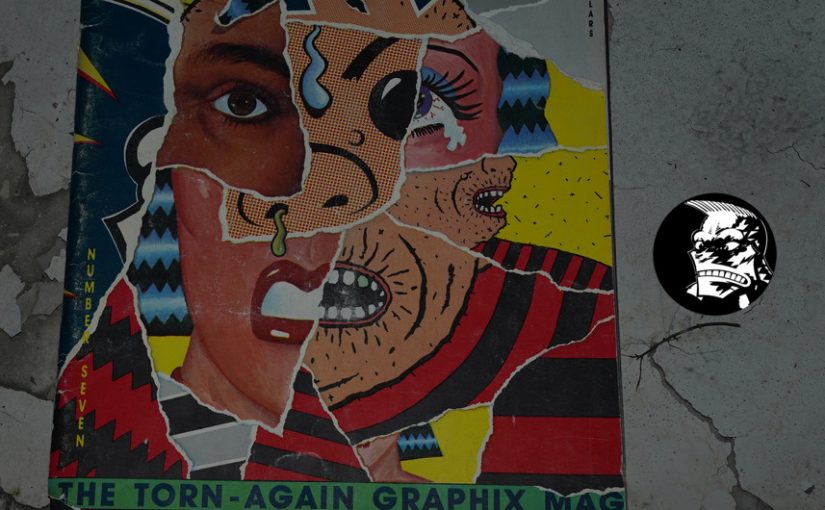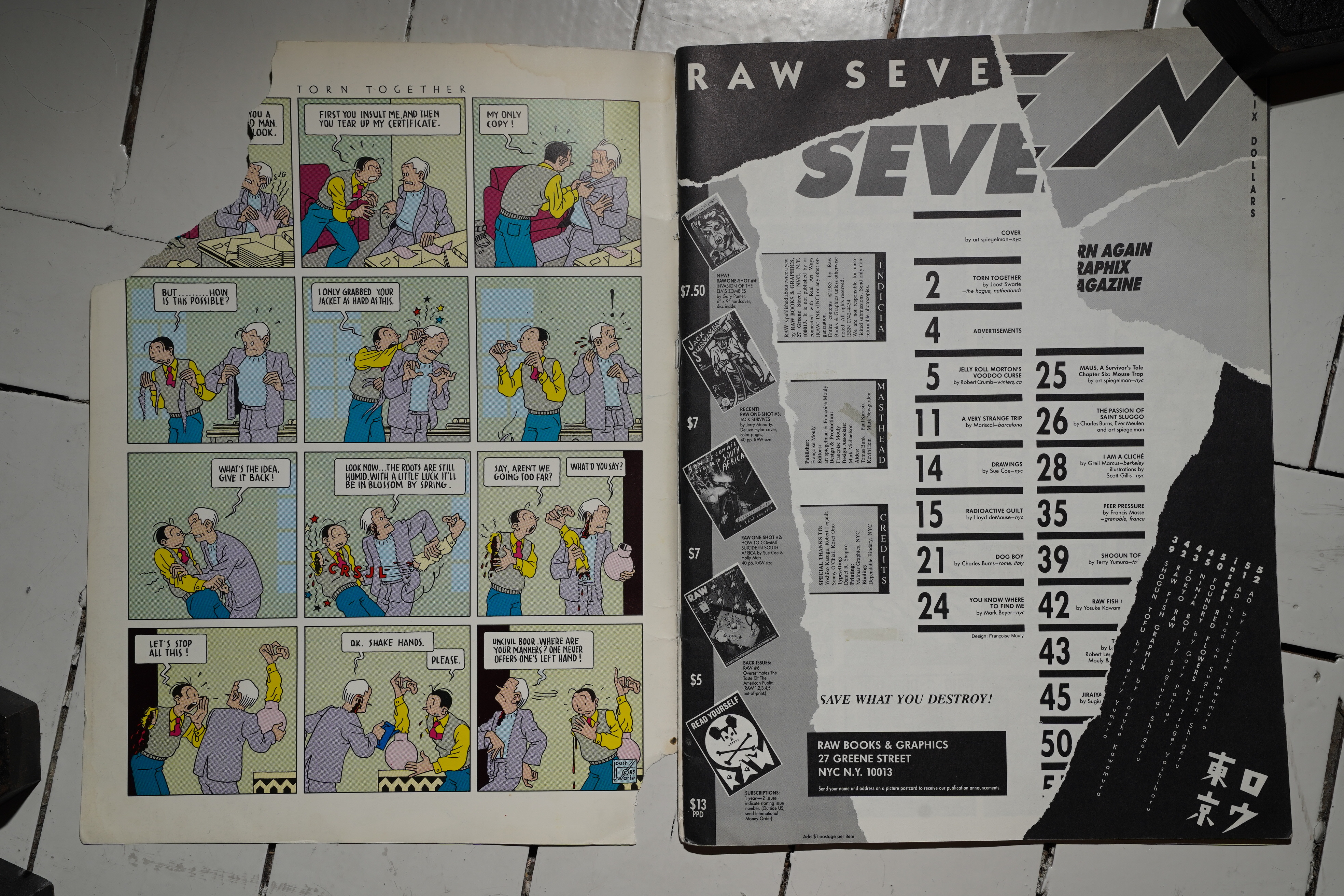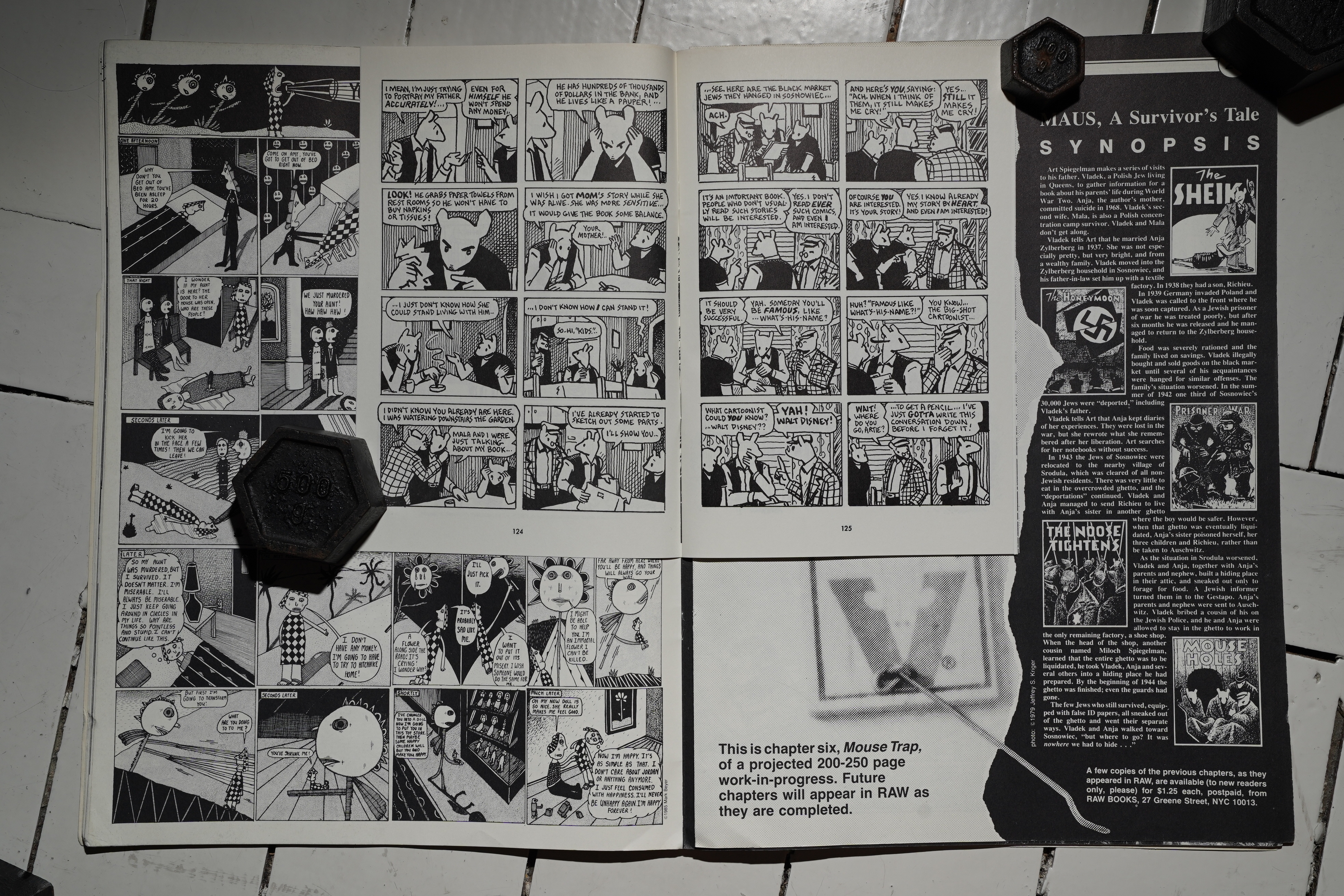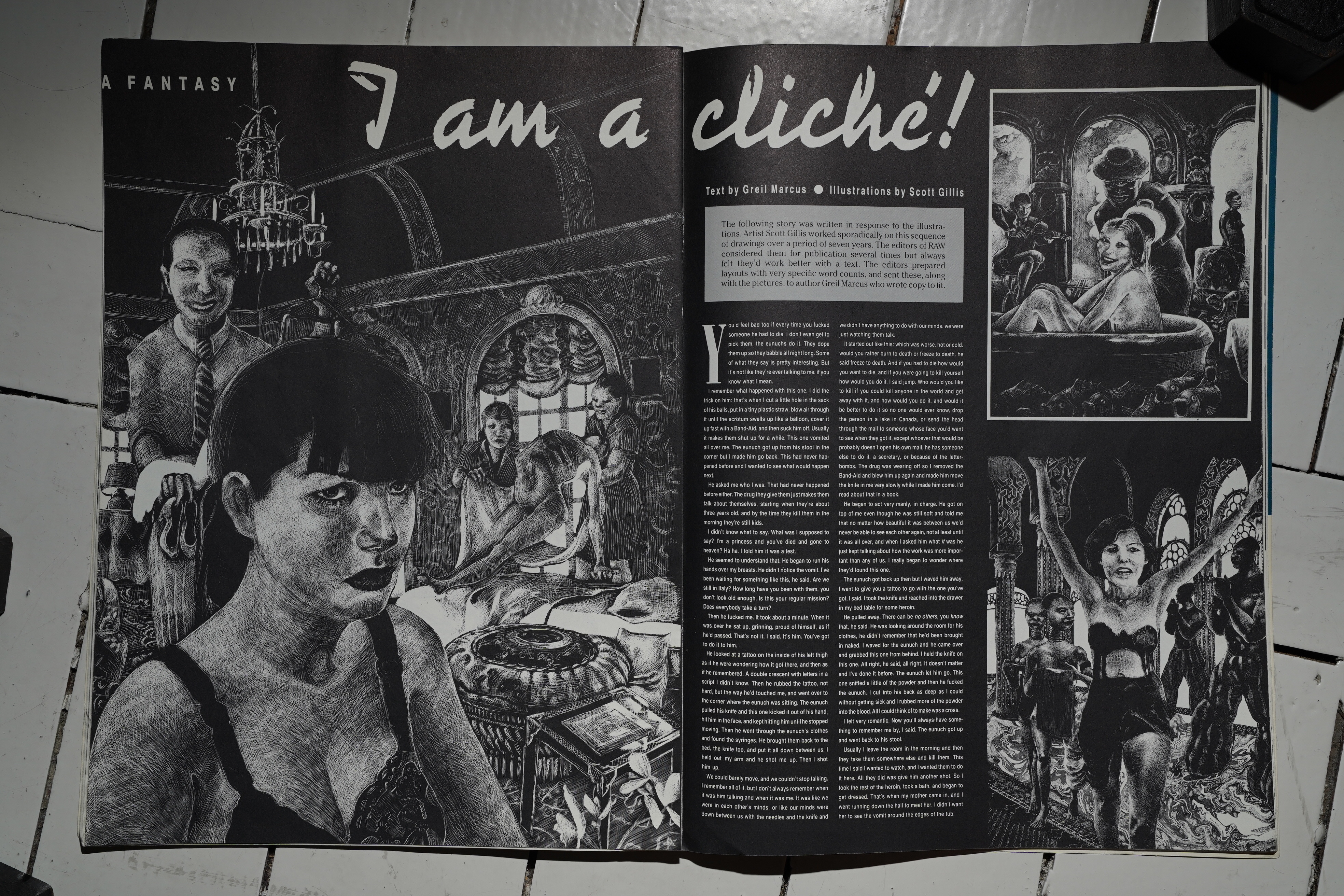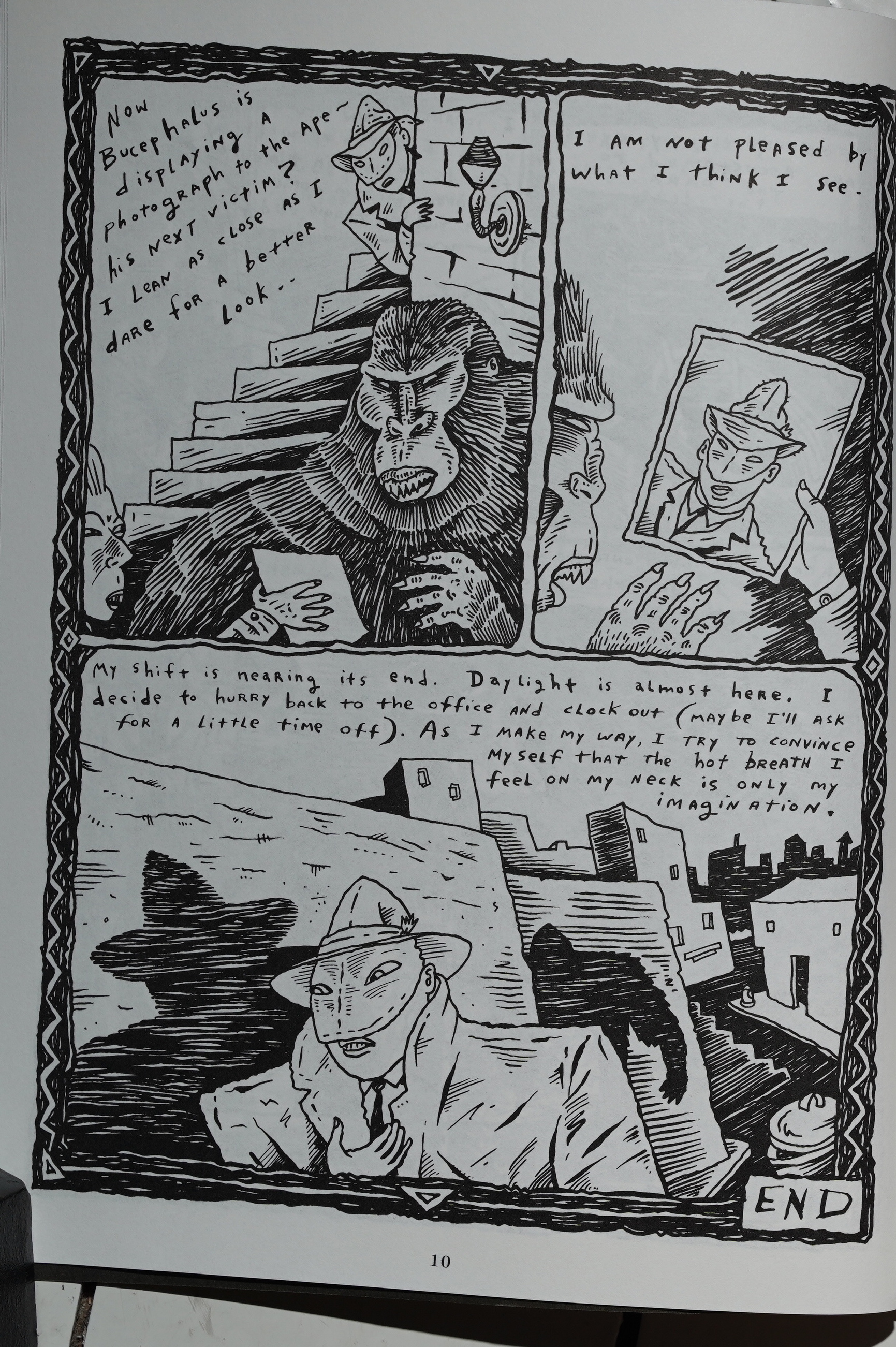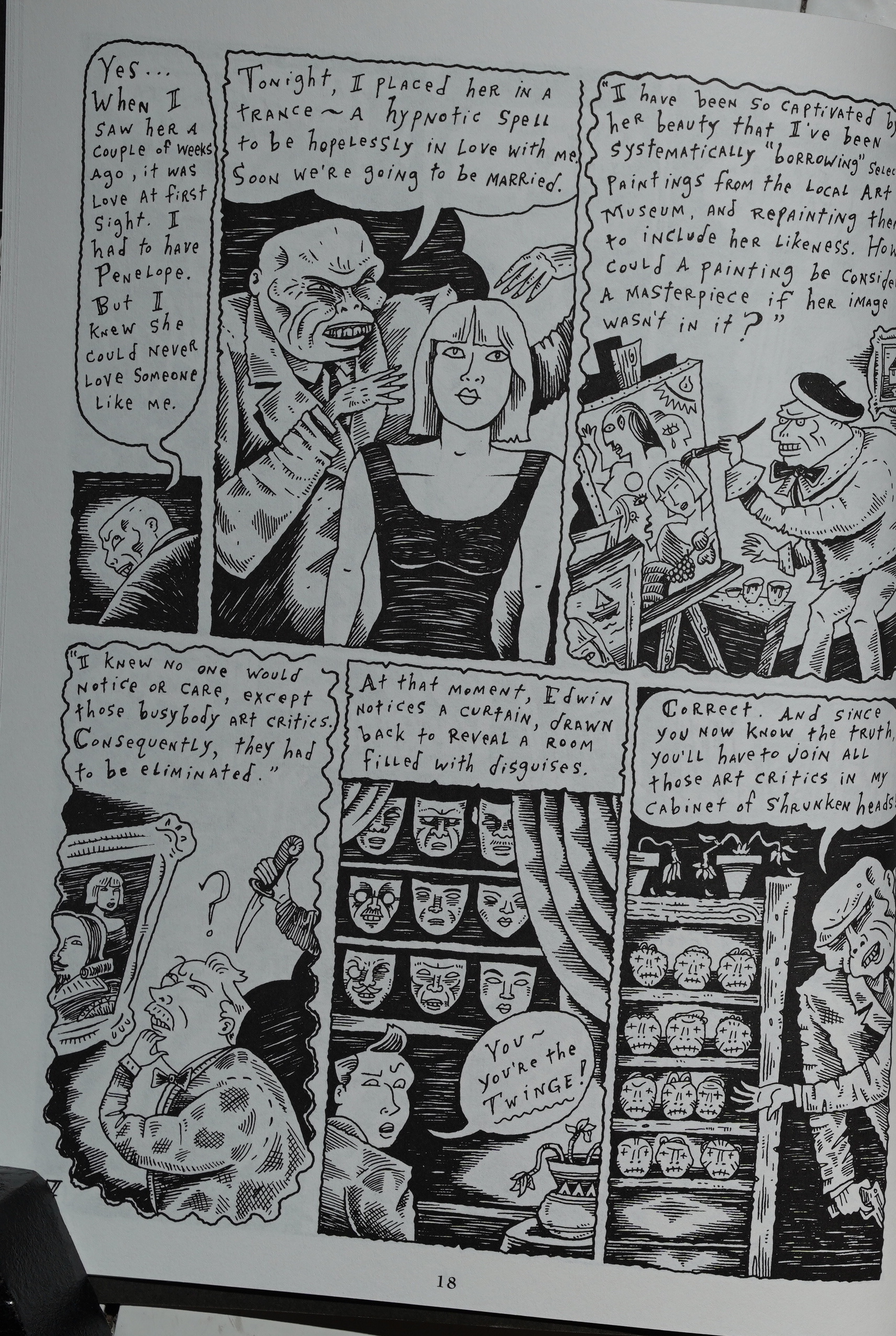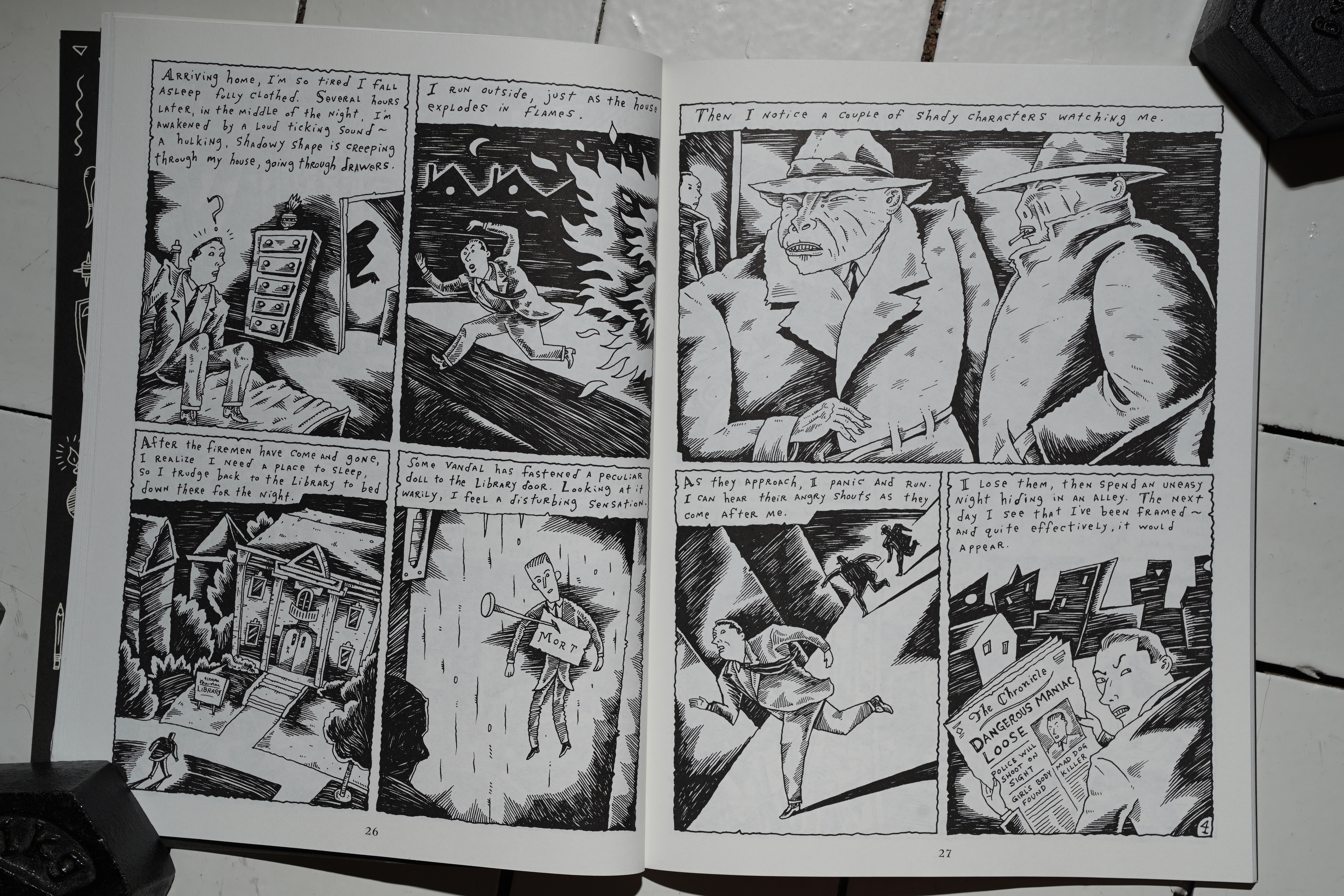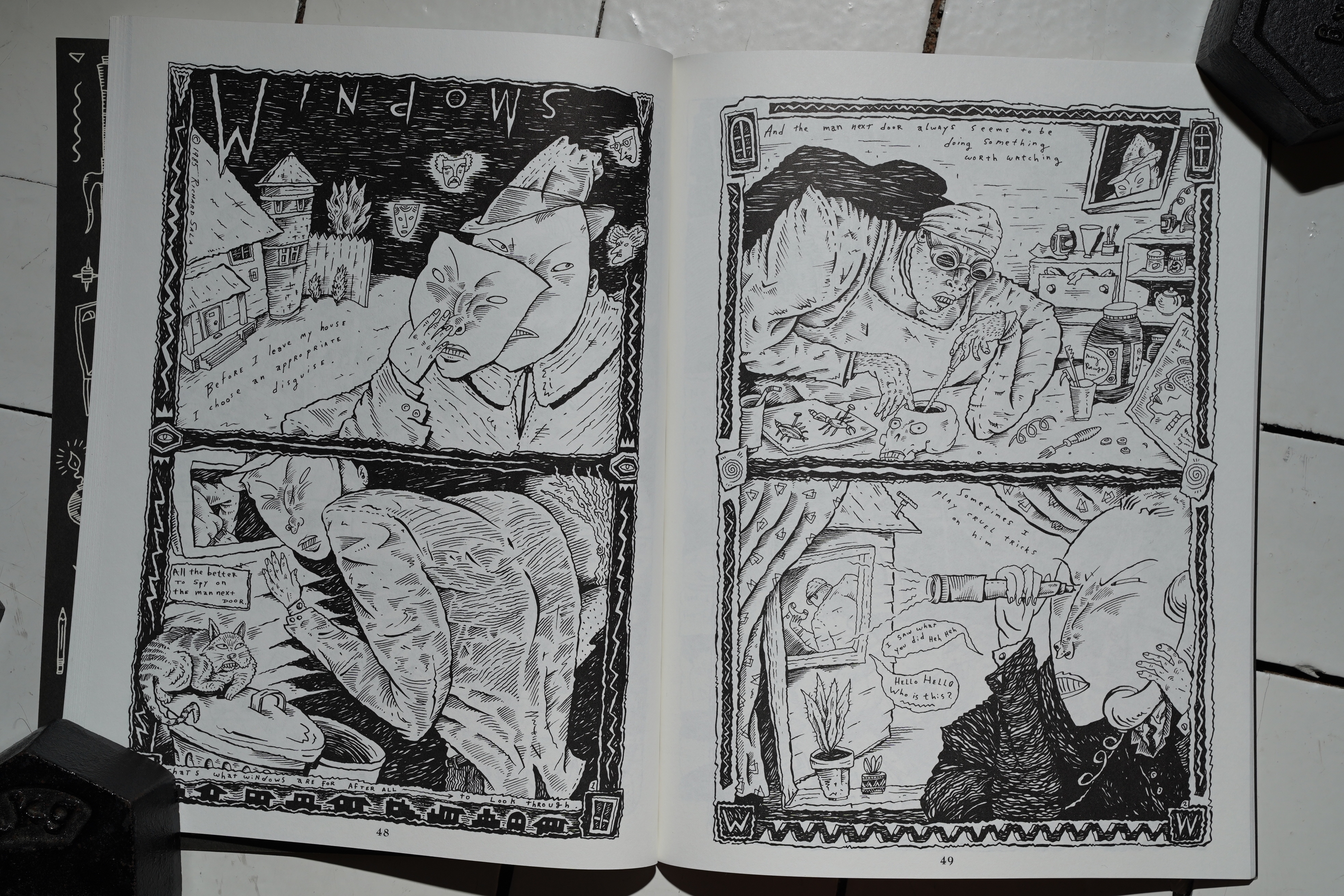
PX83: Bad News #1: World Ends

Bad News #1: World Ends possibly edited by Paul Karasik (210x260mm)

According to comics.org, Bad News was:

Started as a SVA class project assigned by Art Spiegelman in order to give his students some practical experience.

Mark Newgarden confirms in The Comics Journal #161, page 84:

KELLY; You used to edit a comic anthology, Bad News.
How did that come about?
NEWGARDEN: It started in Spiegelman’s class. It was after
I had graduated and he had a bunch of students doing this
magazine project which he asked me to get involved in.
The first issue I wasn’t too involved in. All I really
contributed was the Pud and Spud strip and I think I helped
put together the contents page. I didn’t edit it. On the
second one, Paul Karasik and I independently did it. We
published it, edited it, went out and got ads for it, got it
printed, the whole thing. A painful experience. We leamed
a lot, but I’d never want to go through it again.
The third issue happened years later when Paul and I
were teaching experimental comics at SVA We had some
good students’ work and we had been kind of collecting
some strips we liked and somehow we wound up with
enough material for a third issue and we did that through
Fantagraphics, which was a lot less painful.
KELLY: It seems like Bad News somehow evolved into
Snake Eyes.
NEWGARDEN: Yeah. I think at a certain point Glenn Head
was lobbying for another Bad News and I said, “I don’t
want to have anything to do with it. Why don’t you be
editor?” And ultimately it was renamed Snake Eyes and he
and Kaz took over as editors, They’ve done a great job.
Also RAW was kind of instrumental in killing Bad
News. When we were doing the second one, about to go
into a third one, suddenly Spiegelman got all paranoid
about our little comic book. Like we were muscling in on
his turf. I got into this big fight with him. At a certain point
he said, “I’m gonna bury you.” Just like Kruschev! And a
lot of stuffthat ended up in the very next RA Wwas actually
intended for a third issue of Bad News. My Nancy strip,
“Love’ s Savage Fury” was done for Bad News and Drew ‘ s
great illustrated piece using Leo Gorcey’ s poetry and that
strip that Richard McGuire did, “Here,” were all projects
initially done for Bad News. We kind of got muscled out
of business for a while. Eventually [Spiegelmanl I guess
got over it, but he saw it as some kind of threat to RA W’,
which was pretty ridiculous.

!!!

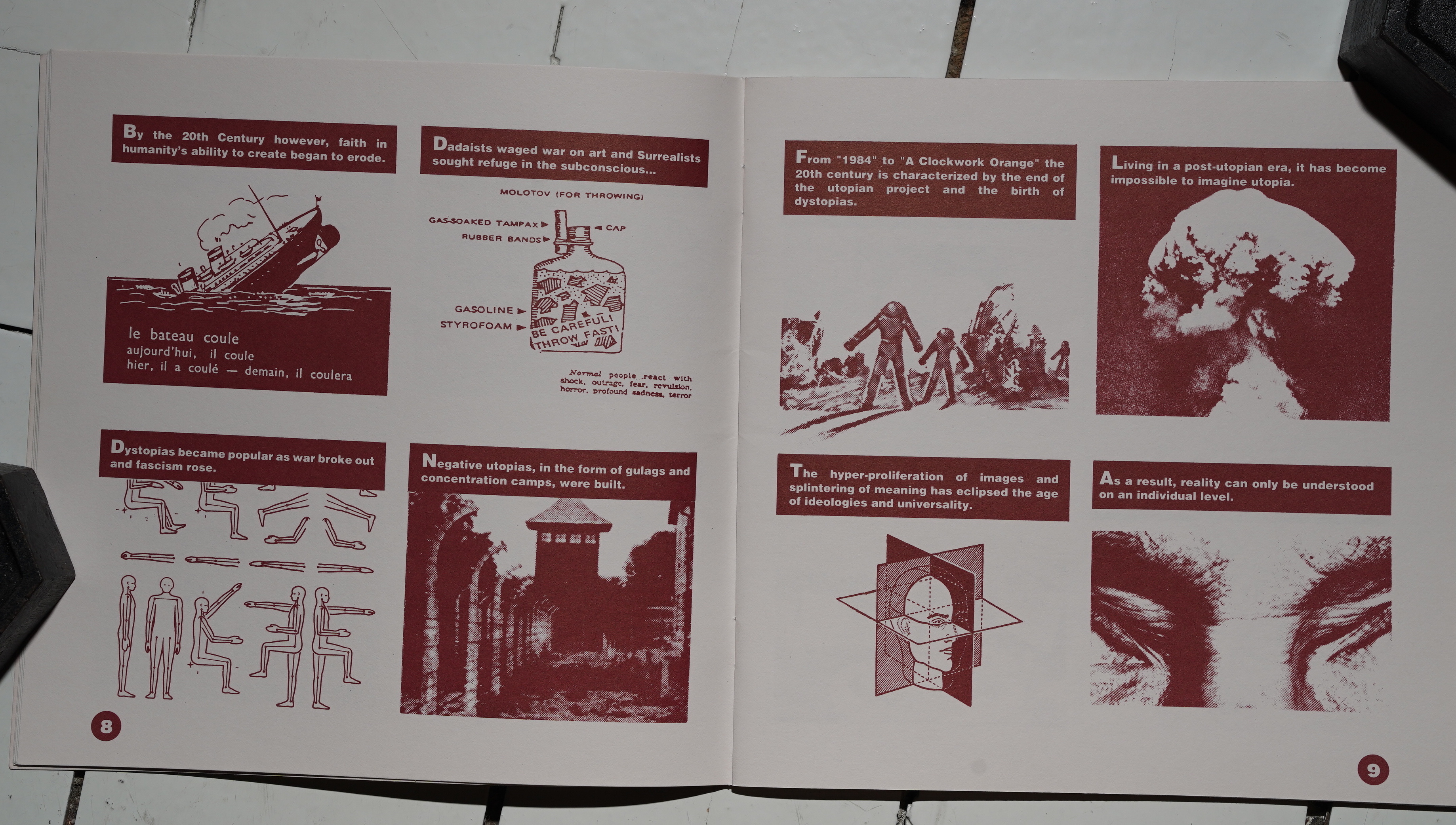
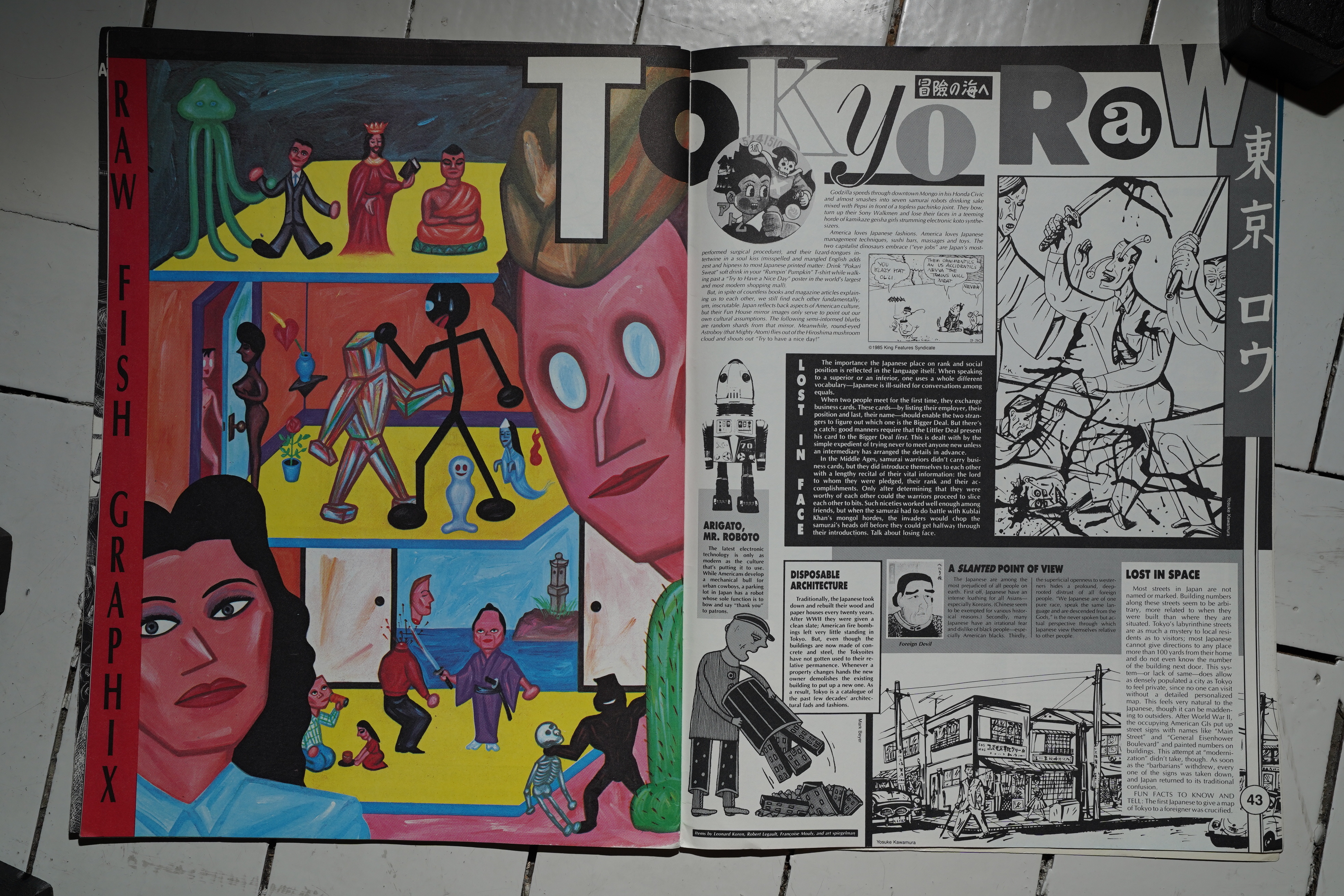
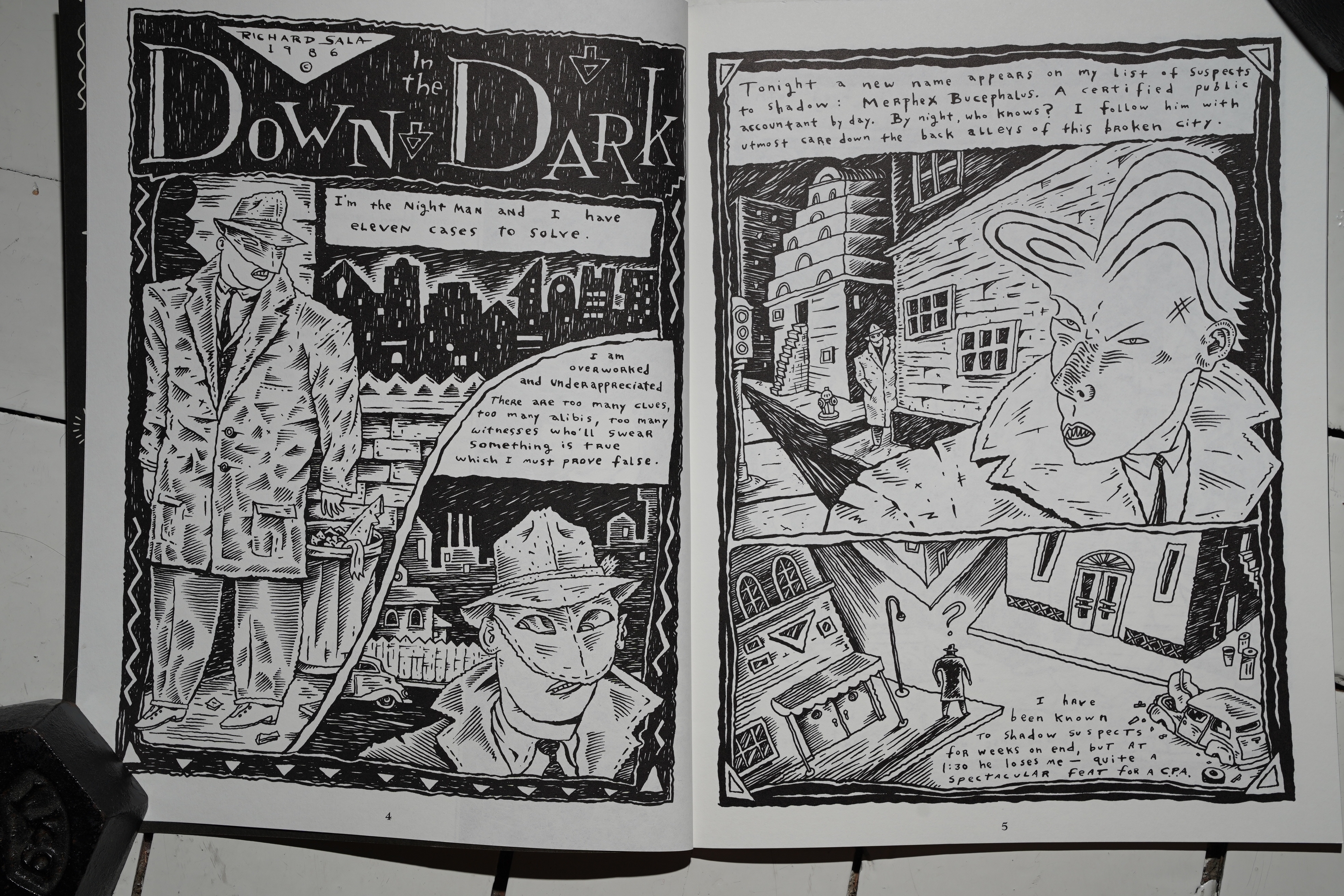
Anyway, that’s later, and what we have here is the first issue, which was published by the School of Visual Arts.

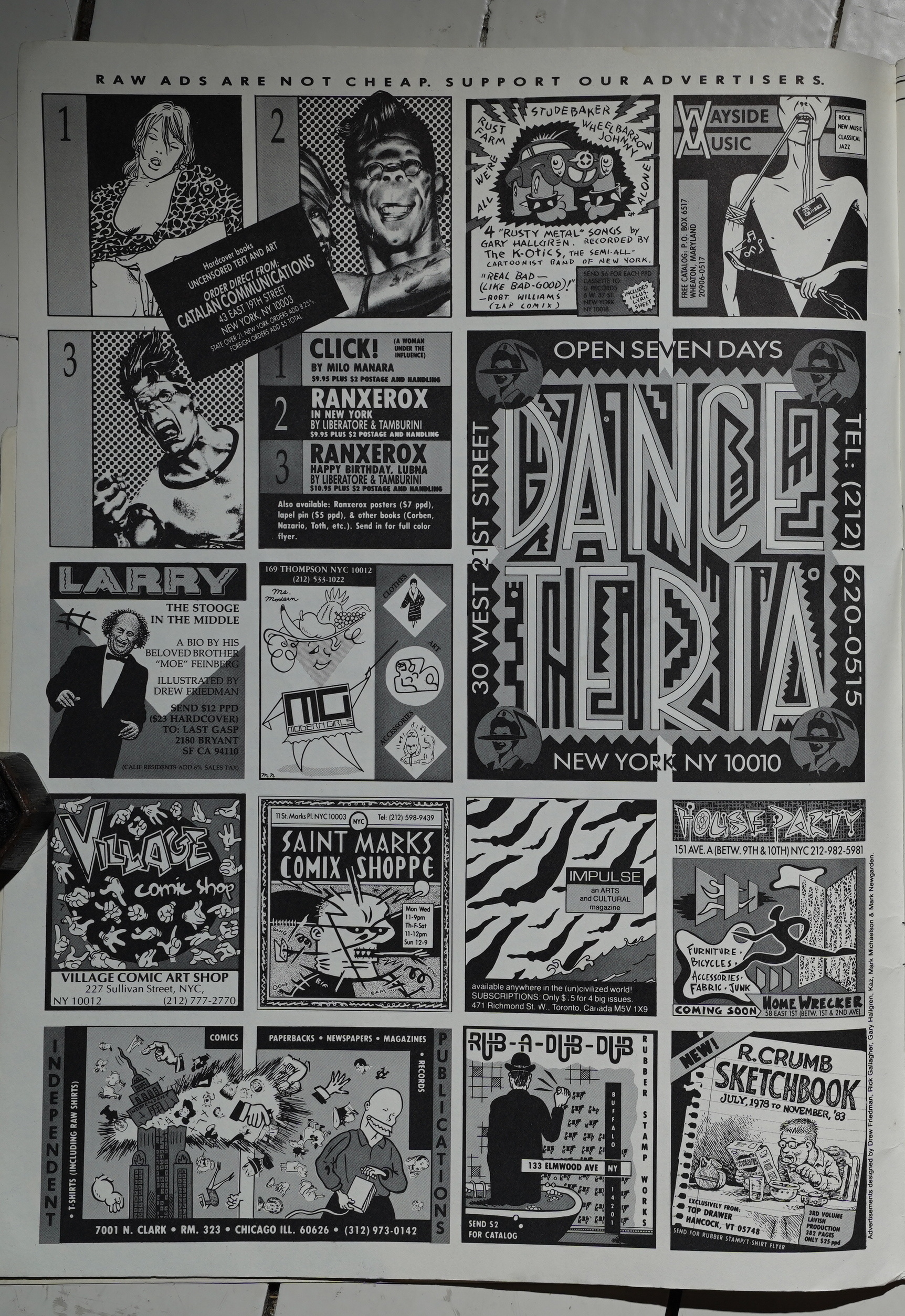
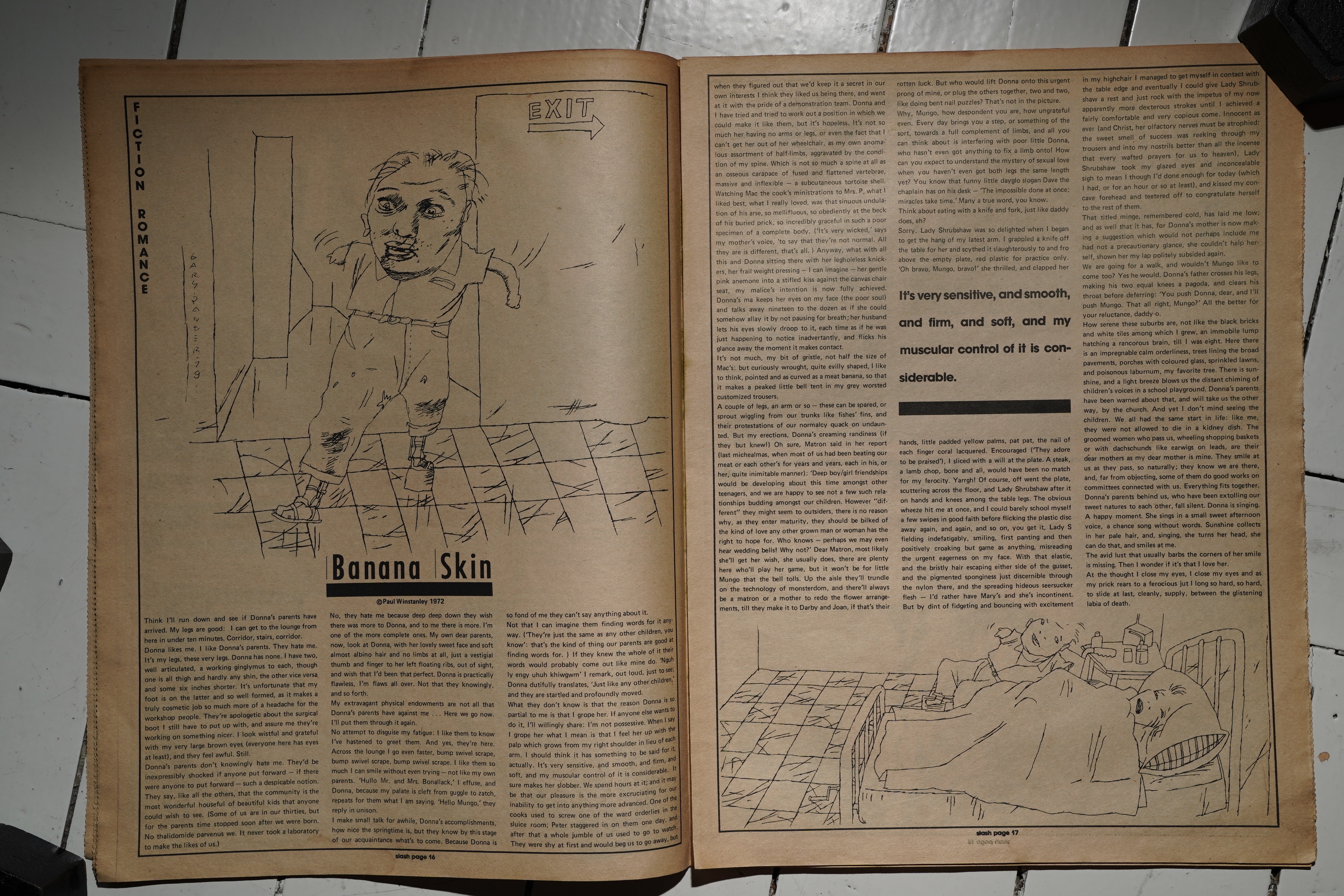
Heh. An ad for Danceteria?

Instead of an introduction to the creators featured, we get their obituaries. I’m surprised that there’s only eight contributors — it means that they get about eight pages each, which is more than I’d expect of a classroom project like this.

And it’s… it’s not very accomplished work. Bob Guglielmo’s work is pretty typical: The plot’s vaguely “political”, and the artwork seems to crib styles, sometimes several styles at once, from more established artists. I mean, it’s student work, so that’s what you’d expect.

Jayr Pulga’s line is good — perhaps a bit overly influenced by Jerry Moriarty?

There doesn’t seem to be much inspiration behind many of these comics — they’re just kinda… there…

Perhaps predictably, the only thing in here that’s interesting is Newgarden’s Pud + Spud two pager. It’s not as good as the later Pud + Spud thing he did (which works along the same lines, but had more resonance), but it’s still something.

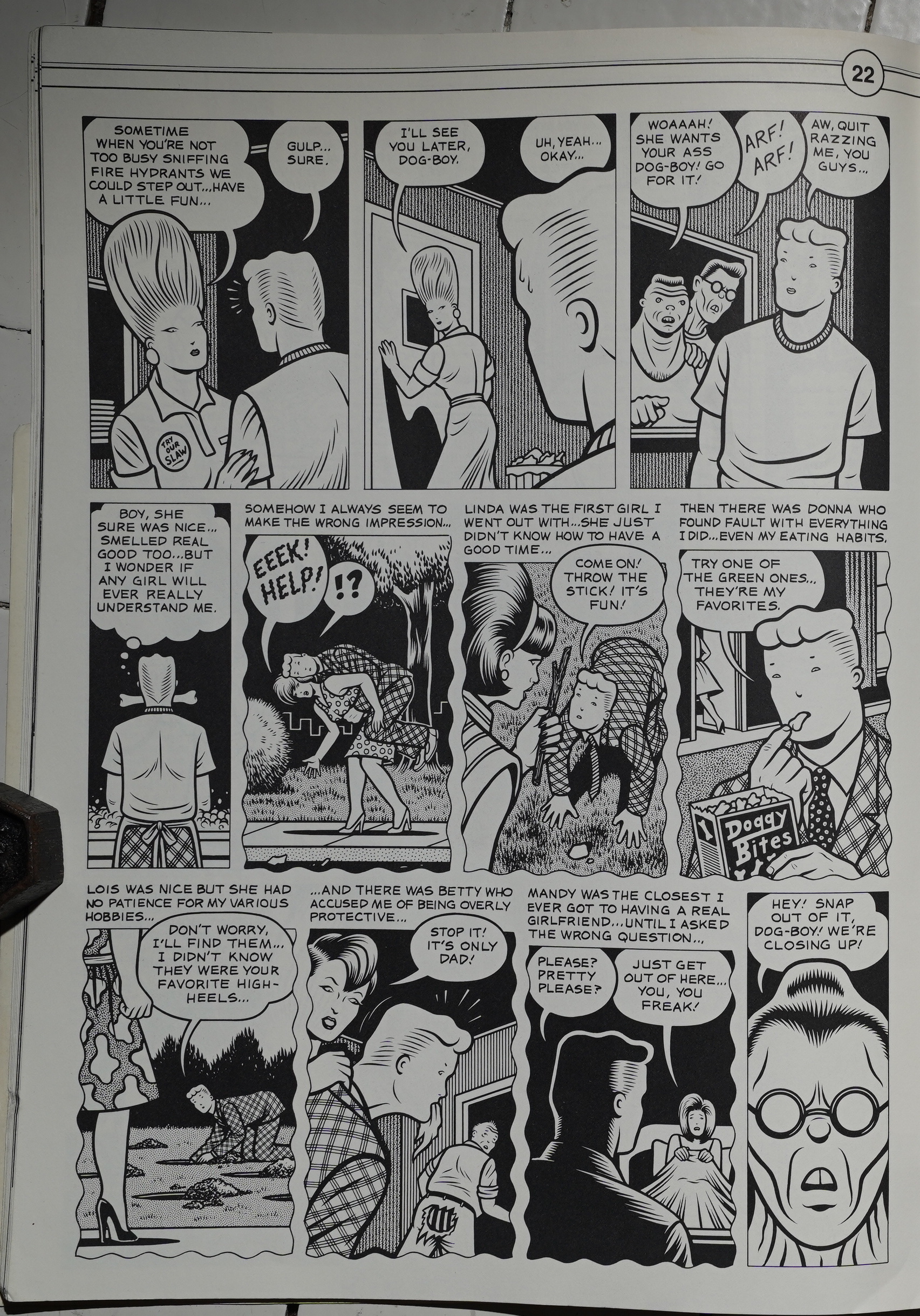
Glenn Head does a couple of autobio things (I assume), and as usual it’s about what a tough and hard life he’s living. But… “Jewish lightning”? Dude! I guess this just reminds me of sloppily anti-Semitic mid-70s undergrounds more than anything: It’s not really graphically interesting, and uses very traditional storytelling.

I guess Paul Karasik is more known as a writer and editor than an artist, but this story about a slavery uprising on St. John has some graphic interest. But it’s pretty sloppy.

Finally, we have a an insert by Etyan Wronker…

It’s totally unreadable, but it does have this one gag.

Targeted advertising!

So… that was… pretty awful? And I’m also wondering whether there were no women at the SVA?

Bill Sherman writes in The Comics Journal #99, page 95:

Born Of Raw and the urban
art school experience, Bad
Neu’S is the 1980s’ answer to
such apocalyptic-themed
undergrounds as Hydrogen
Funnies Of 1970. Printed
on the heavy stock paper Of
today’s Seriously Artistic
Comix Book, Bad News offers
a sardonic series of takes on
Reagan’s America, much the
same as early undergrounders
like Shelton and Irons took
on the Nixon gang. That
there is a discernible dif-
ference, both in tone and
style, between these two
period titles says much about
the state of alternative comix
today and the way they differ
from their forebears.
[…]

Harvey Pekar and his
cohorts may look at the
streets of Cleveland and see
Americap splendor, but to
the artists of Bad News the
Vista is nightmarish.
The Pekar comparison -is
apt, for most of News’s con-
tributors owe a debt to his
comix-scripted naturalism.
Jayr pulga’s “Teenage Zom-
bies on Party Beach” and
Glenn Head’s Avenue B
strips in particular follow the
Pekar mode: small vignettes
of life in the ‘burbs and East
Village respectively, with
lifelike dialogue and open-
ended structures. In Pulga’s
autobiographical strip, two
solemn suburban teenagers
drive to the beach to drink
and ineffectively comfort
(Shelton, Jaxon, Sturgeon, et al.).

[…]

Bad News is paaaged like a small-scale
Raw, down to the inclusion Of an insert
comic, and opens with its own self-
characterizing epigram: ‘ ‘He who is still
laughing has hot yet heard the bad news.”
But where Raw’s contents reflect the rather
broadly inclusive vision Of editors Mouly
and Spiegelman, Bad News’s material is
more self-consciously restric-
tive. Darkly urban and fre-
quently just plain depressing,
the title reflects both the grim
relities of life in the new
Depression and on the city
streets. Harvey Pekar and his
cohorts may look at the
streets of Cleveland and see
Americap splendor, but to
the artists of Bad News the
Vista is nightmarish.

[…]

Of all the Bad Netes artists, Karasik
immediately strikes the reader as the most
visually smooth.

I… guess…

This blog post is part of the Punk Comix series.
PX Stuff

Painting on glass by Mark Beyer.

Beyer’s done a bunch of paintings onto acrylics (“plexiglass”) and other kinds of transparent plastics, but this is the only one I’ve seen that’s painted onto real glass. I had this one mounted to that you could see the back, too:

Neat, eh? The framer said she never wanted to do something that challenging again: She basically stapled two narrow frames together.

This blog post is part of the Punk Comix series.
PX79: Work and Turn

Work and Turn by Art Spiegelman (75x82mm)

This curious little book (and it’s very small — 7.5x8cm) was presumably printed by Mouly and Spiegelman on their own press?

It’s got one panel per page, but only on the right-hand page…

I think it’s about sex and dancing? Some of the pages repeat…

… like this one…

… and then repeat again, but in this blurred way, with apparently a second off-register-on-purpose grey ink?

It’s puzzling, but it’s enjoyable.

The back cover … explains…

Oh! Was the innards of this entire book printed on a single sheet of paper, perhaps? On both sides? Carefully arranged to end up with an every-other-page little booklet?

This excerpt from Art Spiegelman: Conversations confirms that they printed this themselves on their press.

That’s the only mention I can find of the book, though, except things like this:

Work and Turn is a Tijuana bible as rendered by Picasso, all tumbling cubist shapes.

This blog post is part of the Punk Comix series.

The Twits

Over on the movie blog, I’m been amusing myself by formatting the director name(s) in the first image of each post in a way that’ll look consistent on Twitter — taking Twitter’s cropping/fixed-width thing in account.

I know! So vital.

Example:

See how the text is the same size, visually, in every image? Which is slightly harder than you’d think, because the images have wildly varying form factors, and I don’t make the images fixed width.

So the font is really way bigger on that first image than on the second, but since the image is much wider, it’s shrunken an equivalent amount by Twitter.

*phew*

Math! It’s hard!

So what has Twitter now gone and done in the Tweet app?

Yes! Instead of cropping for height, they’ve started cropping for width instead! So now all the wide images have the left and right chopped off, but they aren’t shrunken! So the text sizes are wildly different!

*pout*

This is the biggest outrage in the history of outrages. The fact that that account has no followers just contributes to the outrage!

OUTRAGE!

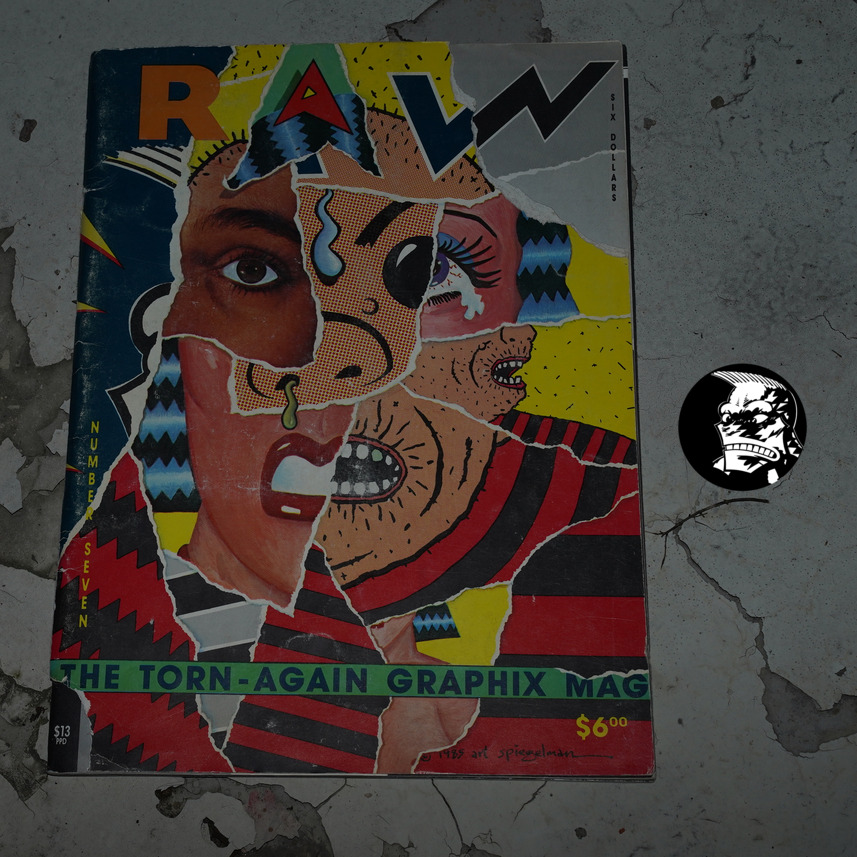
PX80: Raw #1: The Graphix Magazine of Postponed Suicides

Raw #1 edited by Françoise Mouly and Art Spiegelman (268x370mm)

The immediately striking thing about Raw is its size: 27x36cm (or 10.5″ x 14.12″). It’s not quite tabloid size, which would be 11 x 17 inches, so quite a lot higher — the form factor is slightly taller than a European album, but larger.

I think it’s kinda fascinating how this format became a signifier for a genre: Quite a few of the comics I’ll be covering in this blog series is in a format similar to Raw: The same size; good paper with good printing; a thicker cardboard cover; stapled. There’s something about this format that was perfect for this material: It’s strikingly big and handsome (so it’s says “this is art”), but it’s a stapled pamphlet (so it also says “but this is an unassuming, unpretentious object”).

It’s a format that’s virtually not used any more for comics. Things like Paper Rodeo go to full tabloid size, and is typically printed cheaply on newsprint, which says something very different. On the other hand, you have things that go after the bookstore market in the same size, but they’ll be hardbound things, often with embossed covers with metal inks or other signifiers of luxury.

Format creates its own product category (if successful). I think it’s likely that if somebody were to release something in this format today, the no. 1 question they’ll be asked “so is it like Raw?”

Anyway! Raw #1! Let’s read it.

“Apparently on a non-profit basis”. Heh heh. I do find it quite interesting that “All payment is in contributor copies”. I’d guess that that would change after a while? Mouly and Spiegelman had their own little press in their loft, but I’m guessing Raw #1 was printed professionally, but perhaps assembled manually.

Oh, yeah — I forgot to mention that even the cover is printed in black and white. The window view inset (in colour) is glued onto the cover. I seem to remember reading that they used to throw parties where people would help assembling these Raw issues (some of which required more work than others).

We start off with an editorial that consists of quotations from other editorials. I suspect that some of these may be imaginary? But… even The Razor’s Edge seems to be real, and:

It’s a pretty fun way to start off a magazine like this, eh? Doing this sort of thing for an editorial is bratty, but also seems to be poignant somehow. Which is, I guess, the entire Raw reading experience.

I also love how they list where all the artists are from. It’s basically New York City and various European cities, and this feels like more of a mission statement than any editorial would have been.

We then launch straight into a defence of having sex with corpses (by Alfred Jarry). It’s funny, but moreso further sets up the idea what this magazine is going to be like.

But the bulk of the magazine is actual comics. Here we have a page by Kaz that’s both a joke and plays around with formal comics stuff — something that would be a Raw staple.

I also love the design here. Sure, the thin horizontal lines at the top of the pages are very 1980, but giving the artist’s name explicitly like this feels… generous. That is, there’s a ton of anthology editors that seem to wilfully obscure who the artists are, perhaps with an idea of “seamless unity” or something, but it really gets on my tits.

The longest piece, by far, is this eight page story by Tardi. It’s a wonderful, powerful story, but it’s easy to see why it’s been chosen beyond that — it’s a French artist doing a story about Manhattan. It’s perfect for a magazine that’s emphasising this NYC/Europe thing.

And so we have a Joost Swarte page about singing the blues, which is another example of the same.

But it’s not all Europe/NYC crossovers. We also get a page by Jerry Moriarty, for instance. And I have no idea how he does it — I remember being so fascinated by these pages of his as a teenager, and I’m still fascinated by them now. The stillness seems to imply something… they’re somehow moving, but in a kinda abstract way?

They give me all kinds of feelings, is what I’m saying.

Mark Newgarden’s in the house with a Mutt & Jeff homage/parody thing. (It gets more depressing every strip. But in a funny way!)

The magazine famously had a bunch of inserts, and this time it’s Two-Fisted Painters by Spiegelman.

It’s a funny, very meta romp. It’s probably the slightest thing in the issue, but it’s still fun.

I didn’t remember the first issue of Raw being this complete, but basically most of the artists who you think of when you think of Raw are present here. So here’s a somewhat untypical Amy & Jordan thing by Mark Beyer. (It’s untypical in that Jordan becomes a business executive, but Amy dies, as she is wont to do.)

Josh and Drew Friedman contribute the piece that feels most like an underground comix thing — it references the Andy Griffith show, and the rest of the issue mostly steers clear of the “let’s parody a sitcom” underground staple.

Some of these things are so bizarre that they create their own reality, like this David Marc two-pager about supermarkets in Iowa.

Mouly does a one-pager about trying to be an “artist” for once, and feeling ambivalent about it.

And then we round out the issue by reprinting a Windsor McKay Rarebit Fiend page.

So!

Reading this is such an immersive experience — it feels like opening up a cornucopia of wonderful, unexpected things. But it’s not just random pieces: It feels like a unified vision, somehow — that the artists are somehow in communication with each other and are being inspired by each other. Which may be accurate, as the NYC contingent were mostly from the School of Visual Arts, I think? But the European artists also seem to share the same vibe… which means that we have a generation-defining anthology on our hands.

Bill Sherman writes in The Comics Journal #60, page 40:

This curious publication—it refuses
to let itself be called an “under—
ground” — could be the first eon—
vincing argument that literary
intelligence is essential to good comics
art. Subtitled “The Graphix Magazine
of Postponed Suicides” (“A book,
our ever—scrupulous editors quote
from E.M. Cioran, “is a postponed
suicide.” ) , Mouly and Spiegelman’s
Raw is a fascinatingly complementary
package of prose , art , and experi—
mental comics stripwork. It is Raymond
Chandler to Epic’s’ Erle Stanley
Gardner, art to competently presented
divertissement.

[…]

But the magazine is still mainly
Spiegelman’s show, more so than the
earlier A reade (the 70s anthology
magazme co—edited by Spiegelman and
Bill Griffith) could ever be. Arcade
by and large seemed hemmed in by
the obvious disenchantment many of
its artists were feeling at the time,
restricted by its heavy reliance on all
the California underground standbys.
Raw basically takes from a whole
different crew of artists: East Coast
and European upstarts, peranoid poets
who have nothing to say about the
lost ideals of a different decade.
Almost inevitably , Raw has a darkly
urban tone (emphasized by Spiegel-
man’s stark city suicide cover) that
Arcade’s media hippies never showed
themselves capable Of reaching.
But then few of Arcade’s contrib—
utors could be as effortlessly academic
as Spiegelman and co. Or as entertain—
ing about it , either. Part of Raw’s
appeal lies in the way its editors
juxtapose the solemn and the absurd
as a brace against pretension.

[…]

Especially intriguing
is co-editor Mouly’s one—page “Indus—
try News and Review NO. 6,” a strip
composed of 16 panel images that have
all been cropped from the same
industrial illustration. Pasting word
balloons over the succession of images,
Mouly makes the best case yet for the
interdependence of words and image
in cartoon art. (And yet what are we
to make Of Barcelona artist Mariscal’s
two “Piquer, Lucas, and Fermin”
strips—where two very simple gags
are effectively communicated with
barely a word of English? That litera—
ry intelligence is not essential to good
comics art ?)
Raw #1 is the first clear sign that
comics art can catch up to the ’80s. •

Mouly and Spiegelman were interview in The Comics Journal #65, page 120:

CAVALIERI : Why was Raw “The Graphix Magazine
of Postponed Suicides “.9 A postponed suicide is just a
stall till suicide, isn’t it? That doesn’t sound very
hopeful at all.
SPIEGELMAN: Let me answer that with a quote from
Nietzsche; “The thought of suicide is a great consolation:
with the help of it one has got through many a bad night .
To think about suicide isn’t necessarily to commit suicide .
It’s to acknowledge the possibility and to acknowledge the
precariousness of being alive and to affirm it . Every
moment that you don’t commit suicide is an affirmation .
It’s deciding to live some more. The reason I think it’s
actually an optimistic notion is the fact that… well, that
quote that’s in the inside front cover by Cioran, book
is a postponed suicide,” to me implies an act Of faith has
been committed. Which is, to create a work of art, a
book, a painting, a poem, a magazine, a comic strip ,
whatever, and that the work is in itself a justification
for remaining alive. In that sense , at least, I felt it was
provisionally optimistic .
One thing that bears mentioning is that neither Fran-
coise nor I were aware when we were collecting material
for the magazine that it was all going to be so downbeat.
We were just looking for strong comics. And we found
that looking for strong comics ended up meaning finding
comics that were personal in some sense, and were filled
with anxiety , since most of the artists, for one reason
or another, tended to be filled with anxiety and were
able to express it. As a result , it creates an interesting
tension in the work, because what one usually associ-
ates with comics is anything but existential despair.
Maybe Raw is really Despair Comics
In any case it was a posteriori—after the fact—that
we discovered that all of this work had a common
denominator. We had come up with this catchy subtitle
without realizing that the material inside tended to rally
around these themes. urban madness and suicide.
MOULY: And again, it was not to make a statement
about suicide—not to either advocate it or provide a
solution or pretend we had one, in any way. Simply,
when we looked at the work, we had a strong response
to pieces that had this element in it.

[…]

The magazine is an affirmation. The magazine was not
produced cynically to make money . The magazine is
produced…
MOULY .
.with a certain belief in what we do.
SPIEGELMAN: With a certain belief in what we’re doing.
With a commitment to the medium. With a commitment to
the art and to the works within. All of which We see as—
to one degree or another—affirmations.
CAVALIERI : With a commitment to change the Way comics
are perceived?
MOULY: Maybe, maybe not. It’s not—
SPIECELMAN: I would’ve said “Yes” to that. If you
want to expand on it…
MOULY: Well, it seems to me that comics provide a
certain function: entertainment. Comics are a pleasurable
thing to read—in some ways easier or more enjoyable to
read than a piece of text. And this is never going to be
changed. There’s no reason to change it. It’s one way
comics are perceived, one way they perform. It would be
pointless for us to try to say, “We don’t want this to
happen any more—this is forbidden . It would also be
very presumptuous, and unrealistic. We’re not trying to
change that .
We’re trying to widen the perception of comics, in that
its only specific is that it combines words and pictures.
But it doesn’t have to be one page and it doesn’t have to
be 20 pages. Or 250 pages. It doesn’t have to be well-
drawn or badly drawn. It doesn’t have to be a humor
or an adventure strip. It _doesn’t even necessarily have
to have words in it. These are not the things that define
comics. What defines cornies is more an element of time,
of placing things in a certain order on a page which
indicate a certain temporal relationship , or a spatial
relationship. In his strip , Kaz plays with both time and
space .
SPIEGELNIAN: Which is not to say there isn’t room for
entertainment in Raw. I think there are some strips that
qualify .
MOULY: Yeah. “Manhattan” is very entertaining.
SPIEGELMAN : In a sense it is: Hey , entertainment
doesn ‘t mean happy endings. And certainly Gerry
Capelle’s “Canal Street” is an entertaining bit Of
business. I think essentially “Two-Fisted Painters” is
an entertainment. It’s just that we’d like to entertain
a more literate audience than comics usually reaches for.
MOULY: But this point is very important to me: we’re
not trying to get people who are now reading Marvel to
stop reading Marvel and start reading Raw. We ‘re just
trying to get people who might have similar interests to
ours, who right now do not look at comics because of
whatever negative connotations it has, to start looking at
it and hopefully finding something of interest to them in
Part Of the way to do this was to use a totally different
format than comics have been printed in up to now. To
combine comics, text, and graphics without any emphasis
on any one. The main denominator Of all the pieces is
that they should be paid attention to. The artists have
worked on them and have tried to express ideas and
visual concepts in them and it’s up to the reader to pick
it out. It’s not to spend five minutes with it in the
bathroom.
CAVALIERI : So that’s why it’s “the graphix magazine”
as opposed to “the comix magazine”?
MOULY: Yes. We were afraid that if we had put “the
eomix magazine , that would have kept away everybody
that did not read comics.
SPIEGELMAN: To whom comics has bad connotations.
MOULY: So we tried to fool those poeple.
SPI ECELMAN: In a sense, the packaging Of Raw is a
deceit. This is essentially comics. There are texts in it,
there are graphics in it, they’re all integrated in the
maga zine.
MOULY: By putting it out of its usual context, we
tried to get people to pick it up without the a priori
ideas they might have about comics. And maybe after
they read it, they would figure out, “Oh, this is comics!
I should have known!
SPI ECELMAN: And what’s wrong with that? But the big
size does perform a very specific set Of functions for us .
For one thing , there are at this point a handful of large-
size magazines. Wet Magazine. Skyline, which is an archi-
tectural magazine, Picture, a photo magazine, Fetish, which
is I don’t know what kind of a magazine.
MOULY : A consumer magazine,
SPI ECELMAN: A consumer magazine? A bunch of
these advertising magazines. All of which come under the
banner of new wave or whatever, and are sort Of put in
their own section on the newsstands that carry them, and
tend to be carried in large newsstands, urban newsstands,
“hip” newsstands.
MO ULY : This was to overcome the distribution problems
that Art had when he did Arcade. Even if some newsstand
wanted to take Arcade it didn’t know where to put it. At
best, they’d put it with National Lampoon. There was no
slot for it. By doing Raw large-size, it gives it an
automatic slot. It goes with the other large-size magazines.
The other reason—which is harder to explain—•is that ,
by having a, very luxurious format it somehow gives the
feeling when you pick up the magazine Of a very elaborate
display of the piece of work. I think that you 100k at
work differently if it’s printed on newsprint in 84 by II,
or if it’s printed on very good paper in a larger format.
Your attitude toward it has changed. For one thing ,
this is not a magazine you will throw away after you have
read it.
SPIEGELMAN: Not at $4.00 a shot.
MOULY : So it creates this almost automatic respect
for the work.
SPIEGELMAN: Which isn’t to say that it’s an excuse
to print empty work, and get the respect that way , just
by fooling people with the format. It’s a way to make
people accept our attitude toward comics by presenting
it in a format that deserves that respect.
MOULY: For those reasons we did Raw this size, we
did the insert inside. we did this elaborate work Of
tipping-in the color picture onto the black-and-white
cover of the first issue. And we’ve had thinking
—quite a few, actually—that the tip-ins on the cover
came from a mistake. That we made a mistake on the
black-and-white, or it was supposed to be printed in
color and we couldn’t afford it, and therefore, we tried
to cover up our mistake by gluing this other piece of
paper on top.
CAVALIERI : Had they peeled it away?
MOULY: Yeah.
SPIECELVIAN: We’re one step ahead of them. There’s
another image underneath. But this thing with the large
size: it’s a mistake to leave it at this on the record,
because it does allow for the pictures to be seen. One
doesn’t have to squint and find one’s Way through tiny
little boxes. There’s something very pleasant to me about
reading things in this format. It also just happens that
pragmatically, it’s useful to us to find a new audience.
CAVALIERI : What struck me about the magazine as
soon as I saw it was, that it wasn’t so much a magazine
as a printing orgy.
SPIEGEL-MAN: well, we both like objects.
MOULY : We could have rationalizations for why we did
that , but the main reason, I guess, is the fact that we do
like it. We enjoy doing this.
SPIEGELMAN: It’s nice to get a well-made book. Inde-
pendent of what’s in it, even. It’s just a wonderful thing.
MOULY: That’s something that we want to keep.
SPIEGELMAN: That’s important to us.

[…]

Though we are doing a printed magazine, we’re not
doing a mass media magazine. We are trying to fall some-
where inbetween. A unique Object, yet not a unique
object. There’s 5,000 of them. It’s available to most
people that want it. At this point, to us, that’s a pretty
satisfactory solution. We feel more fortunate than our
commercial artist friends or fine artist friends , each in
their ghetto.
SPIEGEUÆAN: I’m afraid that Our comments make it
sound very pretentious, and yet, there’s something that
I like about the fact that comics are such a gritty
medium. That they’re so ignored. There’s something to
be said for that. And I don’t think we’re necessarily
losing that grittiness in Raw. Some pieces in Raw express
that element in comics more than Others. I think that in
my own work, in wo-Fisted Painters, for example,
there’s a lot Of respect for what’s gone down before,
for the kind of comics that have been coming out—an
attempt to play with all those things. We’re not
necessarily rejecting them.

[…]

MOULY: This is not a direct answer to your question ,
but we have a different relationship in a sense with the
artists in Europe and the artists in America. Part of the
reason is that the guys in Europe have been working for
a while. It’s easier for us to look at their work because
it’s finished work and if we’re interested in it at all We
have to do is contact them, see if they like the magazine ,
want to be printed in the magazine. We know exactly
what we’re getting.
In America, it’s much harder for us in a sense to
solicit work because since there hasn’t been any maga-
zine like Raw and there hasn’t been that approach to
very good quality comics being printed, it’s very hard to
get in touch with people who have already done work.
Most of the people we know are people who have the
potential and the interest in doing great work and see
the magazine, get interested in doing something for it ,
and we end up with a situation like, “GO ahead” or “Wait
a while” and then Seeing something.

Sorry! I didn’t mean to quote so much from that interview, but I just found it all kinda interesting. It doesn’t come as a surprise that Mouly and Spiegelman have really thought all the things about Raw out: The format isn’t an accident, but is that way for a reason, etc.

Dale Luciano writes in The Comics Journal #64, page 36:

A word of caution about Raw at the
outset. Many will find the magazine
“arty” and impossibly pretentious ,
while others will find it coldly abstract
and cerebral. (They’re not necessar-
ily wrong , either.) To someone willing
to enter into the spirit of the magazine
sympathetically, however , Raw offers
an engrossing and sometimes eye-open-
ing array of possibilities for use of
the comics medium. Many of the pieces
in Raw can be enjoyed for their own
sake, of course, and they probably
should be; it is possible, however, to
view certain pieces as preludes to oth-
er , more “practical” applications Of
experimental techniques.

[…]

All of this may or may not help
clarify the historical and cultural
context in which Raw bears looking
at. Certainly Spiegelman is fond of
the Dada send-up, represented in
Raw by the “Editorial,” which
implicitly caricatures the traditional
uses of the ‘First Issue’ editorial
and thus announces its own Liberation
from the absurdity Of such conven-
tions. I am reminded that the
impulse behind the Dadaists
involved not the attempt to consigm
art and literature to the trash pile
of civilization’s failed ideas (as some
have contended) , but rather the
attempt to explode the extremely
limited notion most people have
about their nature and function.
In this regard, Raw can be
approached more as magazine-as-art-
object than a magazine of art (though
it is that, too), and thereby attempts
to elevate our notion of what such
an object can be and how it can
function. Even the nonsense-ad Of
unidentified origin on the inside-
front cover contributes to the effect.
It’s a whimsical, gratuitous expres-
Sion of wonder at the silliness of
advertising and the comic absurdity
of certain human activities. Though

it has its serious side, Raw is
edited with some of the same ‘pata-
physic spirit of prodigal schoolboy
inventiveness with which Jarry’s
Faustroll is written. (Also, the
inclusion of the McCay strip , “Dream
of the Rarebit Fiend.” is an homage
to the Surrealist dream-tradition in
art.) Raw is “experimental” only in
the sense that it functions on a
rather ‘pataphysical plane of pure,
“raw” imagination. Spiegelman’s
intent is to shake things up , to move
beyond accepted conventions into
new areas of expressiveness and
idiosyncrasy, at the risk of obscurism
and preciousness. It’s reassuring ,
though, that Raw can accommodate
work ranging from the unsettling
grimness of Tardi’s “Manhattan” to
the energetic, childlike absurdism Of
the Mariscal and Kaz strips. It’s
difficult to argue that such a wide—
ranging, experimental forum has no
place in the contemporary scheme of
things. Raw is R Jarryesque toying
with the arrangement Of things and
their significance, and it’s a cele-
bration of the cartoonist’s mode of
imagining.

Carter Scholz writes in The Comics Journal #64, page 34:

Raw magazine is the creation of Art
Spiegelman and Francoise Mouly, and
is as far removed from conventional
comics (or comix) as Duchamp is from
Renoir. Like witzend it is a folio of
jeux d ‘esprits, except that its artists
come mainly from the European
undergrounds. or File or Wet maga-
zines , rather than American
commercial comics. Spiegelman’s
guiding intelligence is acute, eclectic,
and well- grounded in the history of
art as well as the history Of comics.
He understands his roots as well as
the Art Ensemble of Chicago under-
stands jazz and he uses the materials
of the tradition in a similar way. I
have never read a eomies artist with
such informative and, on the whole,
right things to say about his art. TO
work in this somewhat despised
medium, and to neither overvalue nor
undervalue it, is rare; more usually
comics artists lose all touch with their
tradition , descending to repetition and
hackwork, or rising to the intolerable
pretension Of issuing bloated overpriced
portfolios with all the charm and
strength of a Leroy Neiman print.

[…]

The only evident weakness of the
books is A lack of sustained effort.
Except for the three long strips de-
scribed , and one 3-page strip by
Swarte, and a 4-page strip by Kaz,
the works are all one or two pages.
Of course the pages are big, and one
or two are adequate to most all the
strips, but there is an overall im-
pression of jumpiness. It’s support-

able to want a variety of work, and
it is hard to expect an artist to work
for free at an extended length, and
printing is expensive, and the insert
books are a fine compromise… but I
would still prefer six or seven strips
of moderate length to fifteen short ones.
Since Spiegelman teaches at the
School Of Visual Arts, it is natural he
should use some student work. Only a
little of this is not so good. I think
Drew Friedman is mainly an illustrator ,
and does not yet understand comics nar-
ration very well. The page by Patricia
Caire has the look of an “illustrate-
this-text” assignment. I hope that Raw’s
partial subsidy from SVA will not turn
it into a kind of student portfolio from
the school’s illustration department .
(My experience has been that illustra-
tors tend erroneously to regard comics
as a minor, undemanding form of illus-
tration. )
Oh, was Raw financed by the School of Visual Arts? Scholtz seems to say so…

Anyway — three reviews in The Comics Journal for Raw #1: People took notice.

This blog post is part of the Punk Comix series.