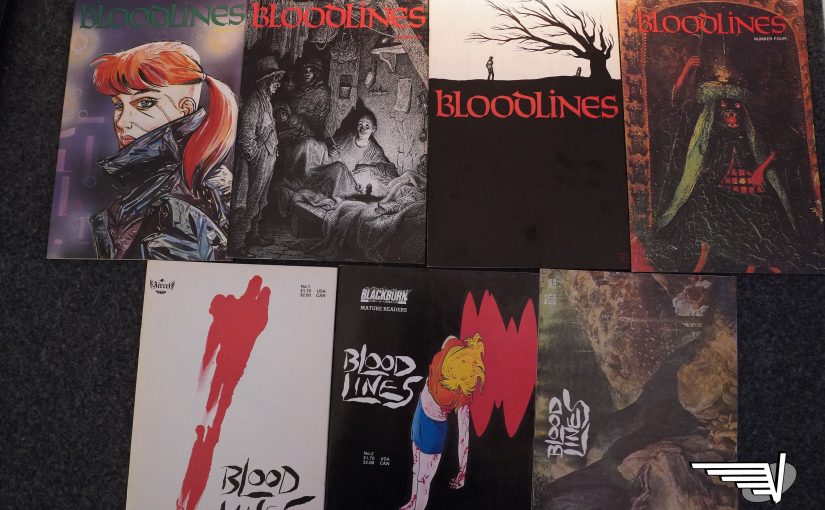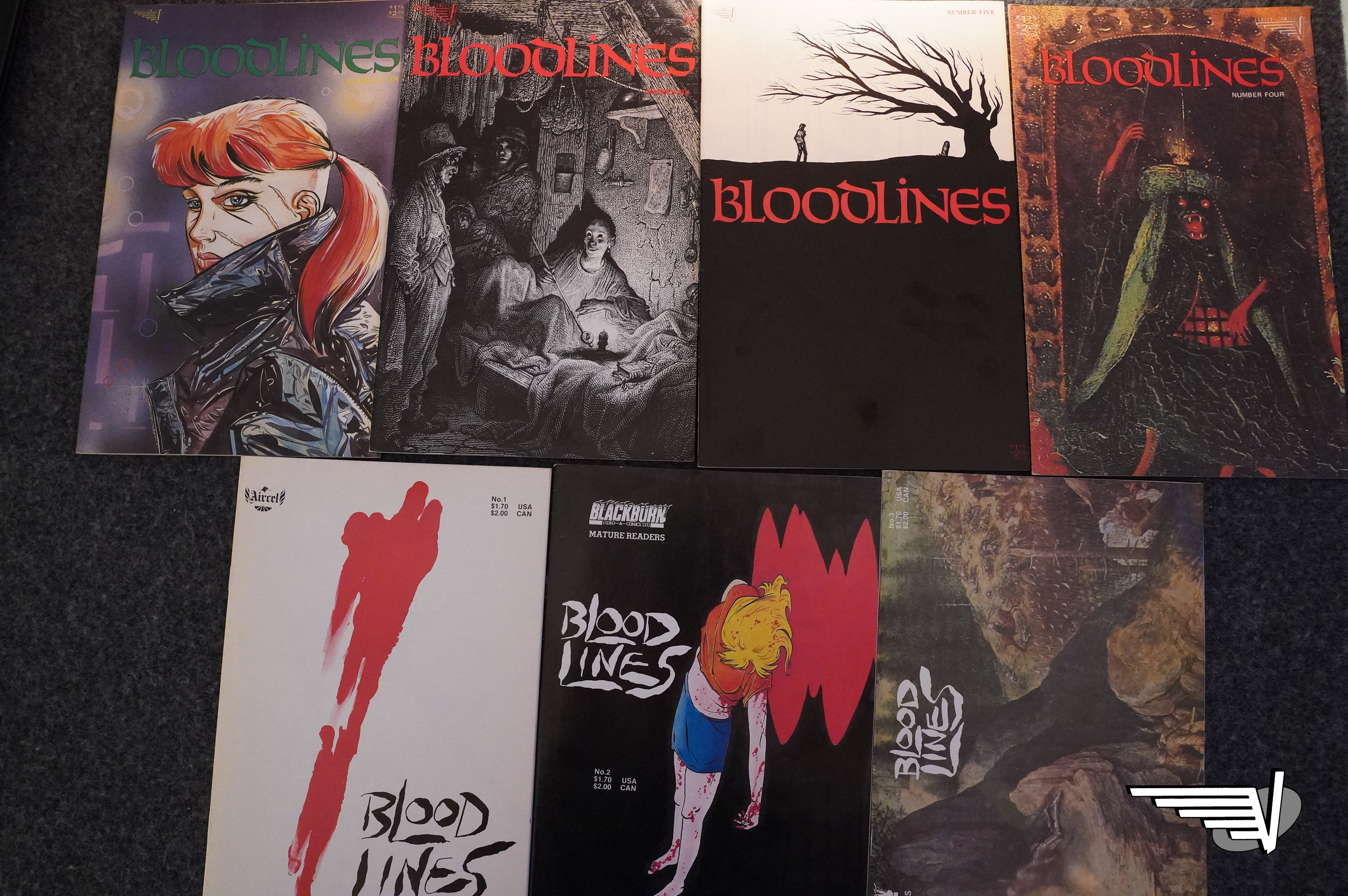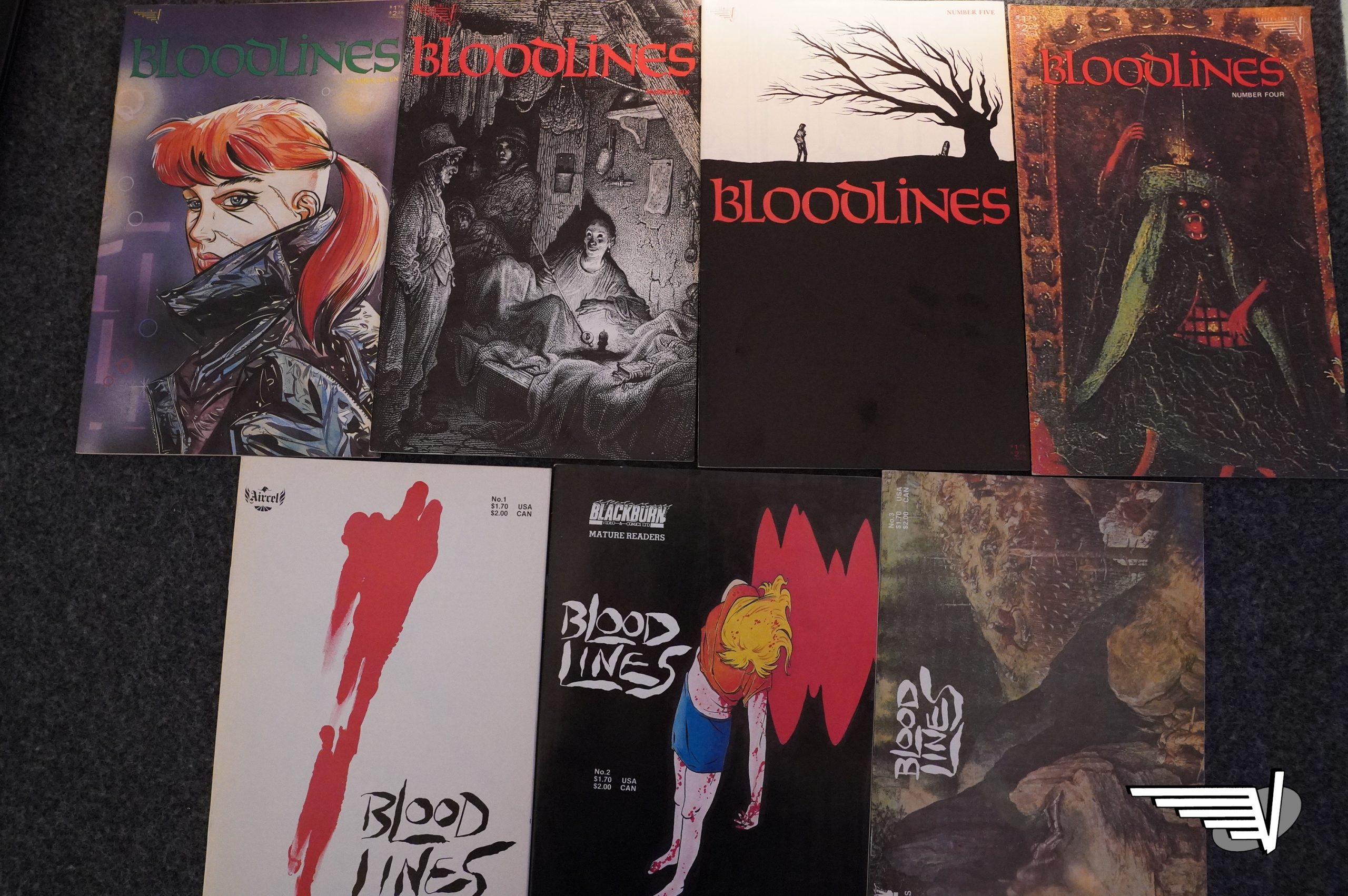
Bloodlines (1987) #1-4
by Rob Walton
I know, this is a blog series about Vortex, but this series started at Aircel, before moving to… Blackburn Videos + Comics (!!!)… before moving to Vortex. 1 issue at Aircel, 2 issues at the video store, and 4 issues at Vortex, so you’d expect 8 issues at the next company, but that didn’t happen.
So let’s just read the first four pages of the first issue.
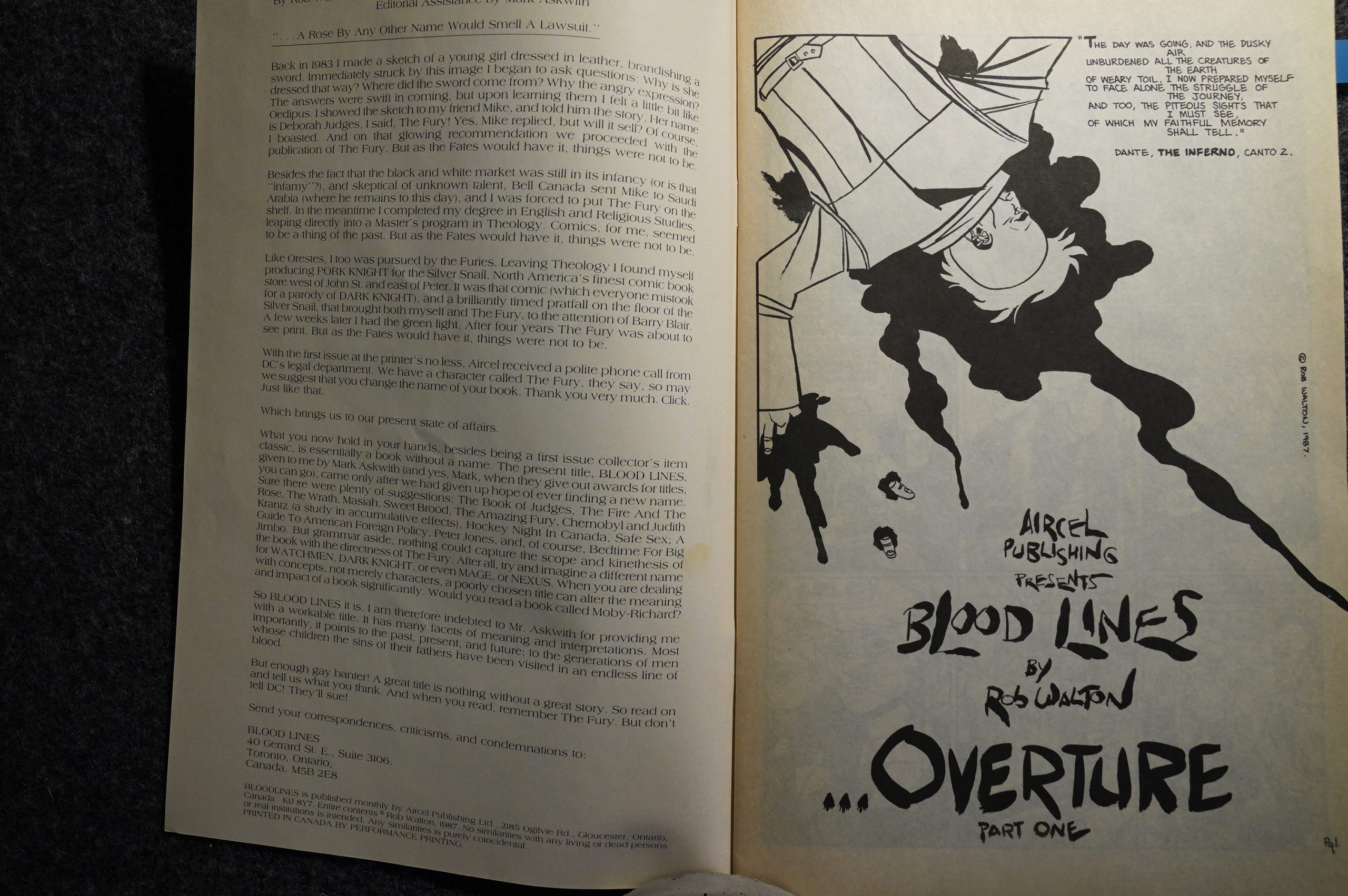
So this is a comic that has been a long time coming — Walton started working on it four years before Aircel picked it up. Presumably because the Black & White Boom “collectors'” craze was in full swing, and Aircel was one of the main perpetrators, pumping out all the amateurish crap they could manage to produce.
But this is a pretty strange thing for them to be pushing… it seems… er… to be about… well, I’m not sure what it seems to be about, but it’s not about Elves or Lords or Elflords, so it’s an odd fit. I’m no Aircel scholar, though.
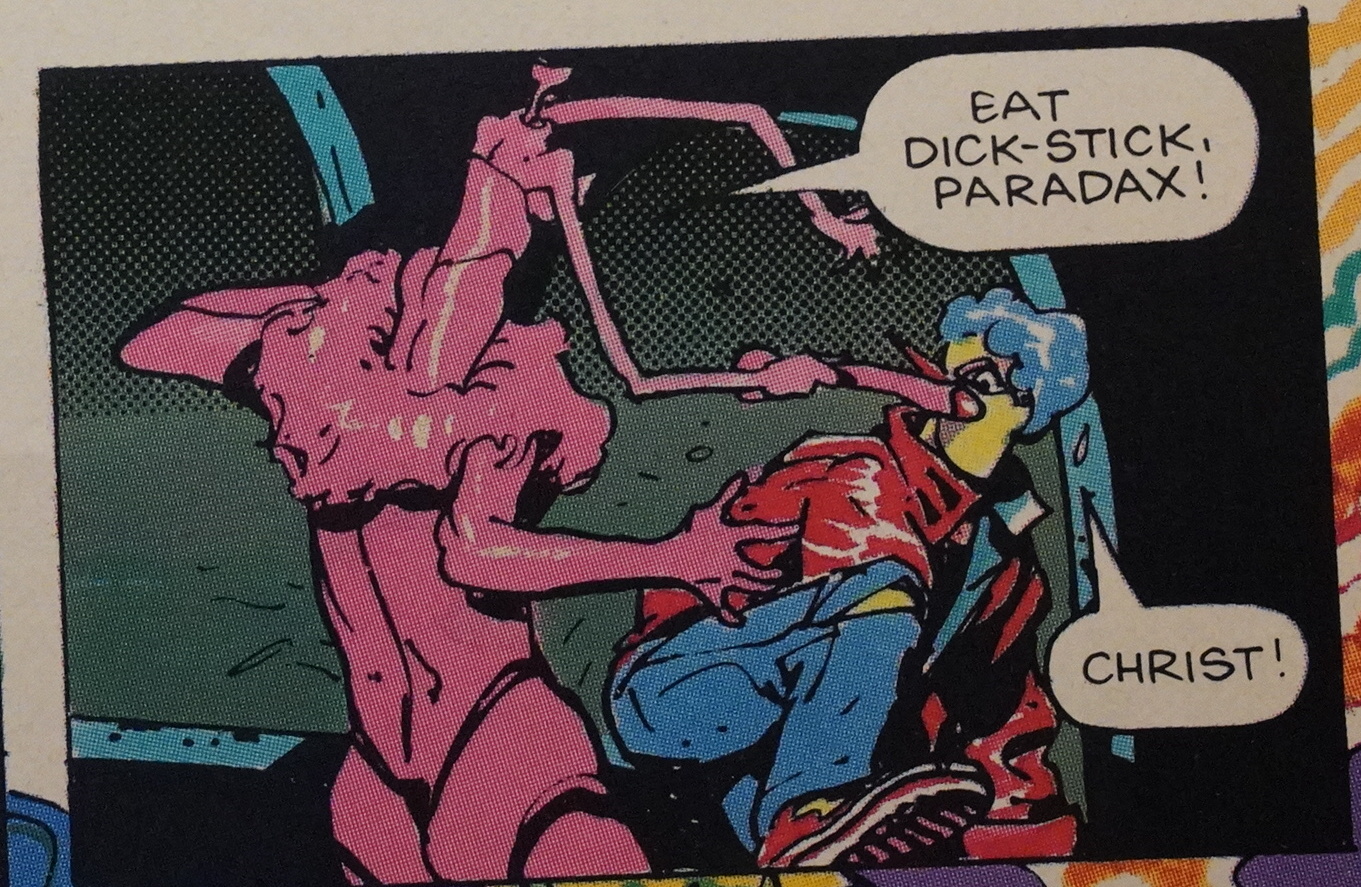
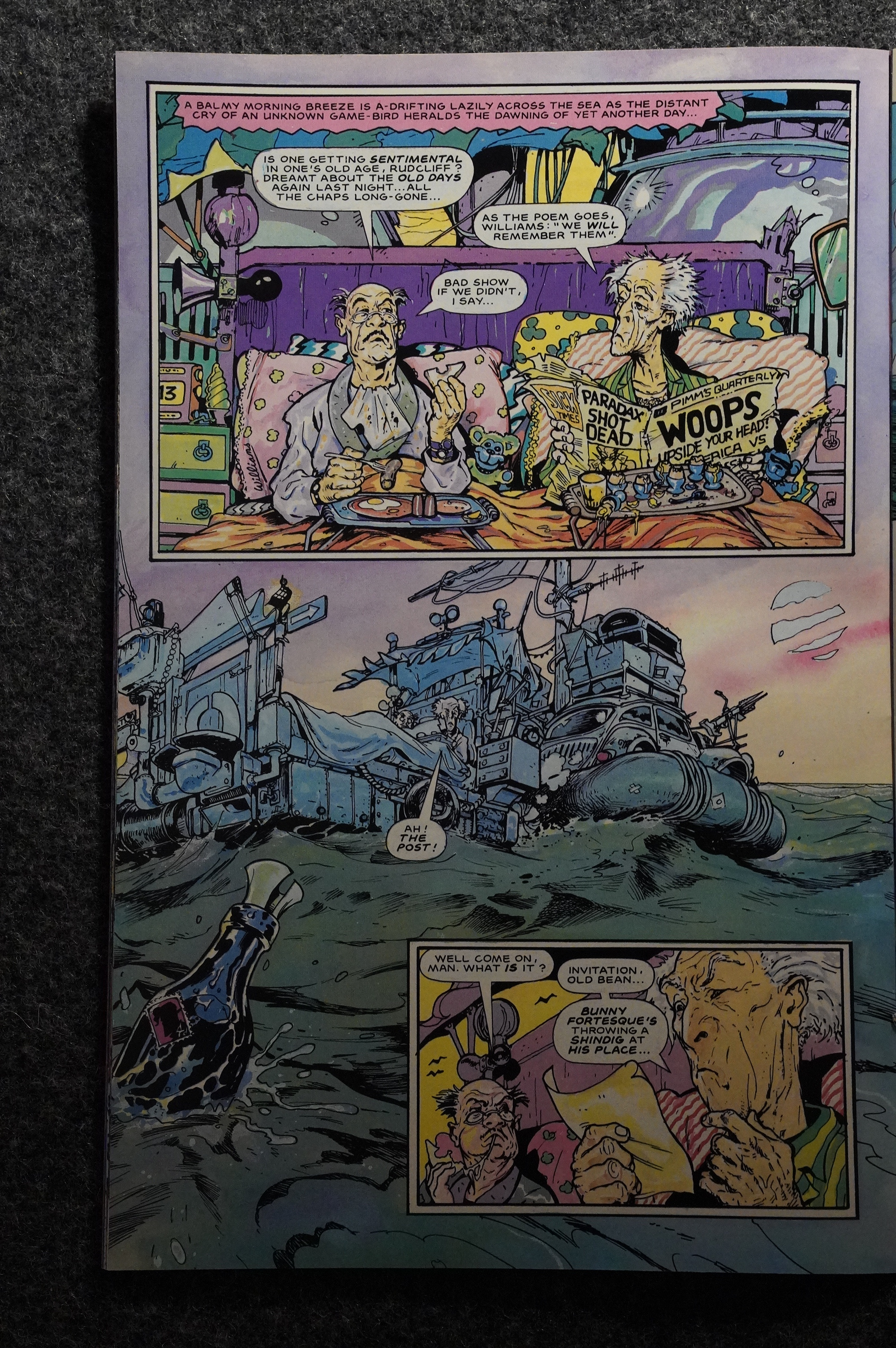
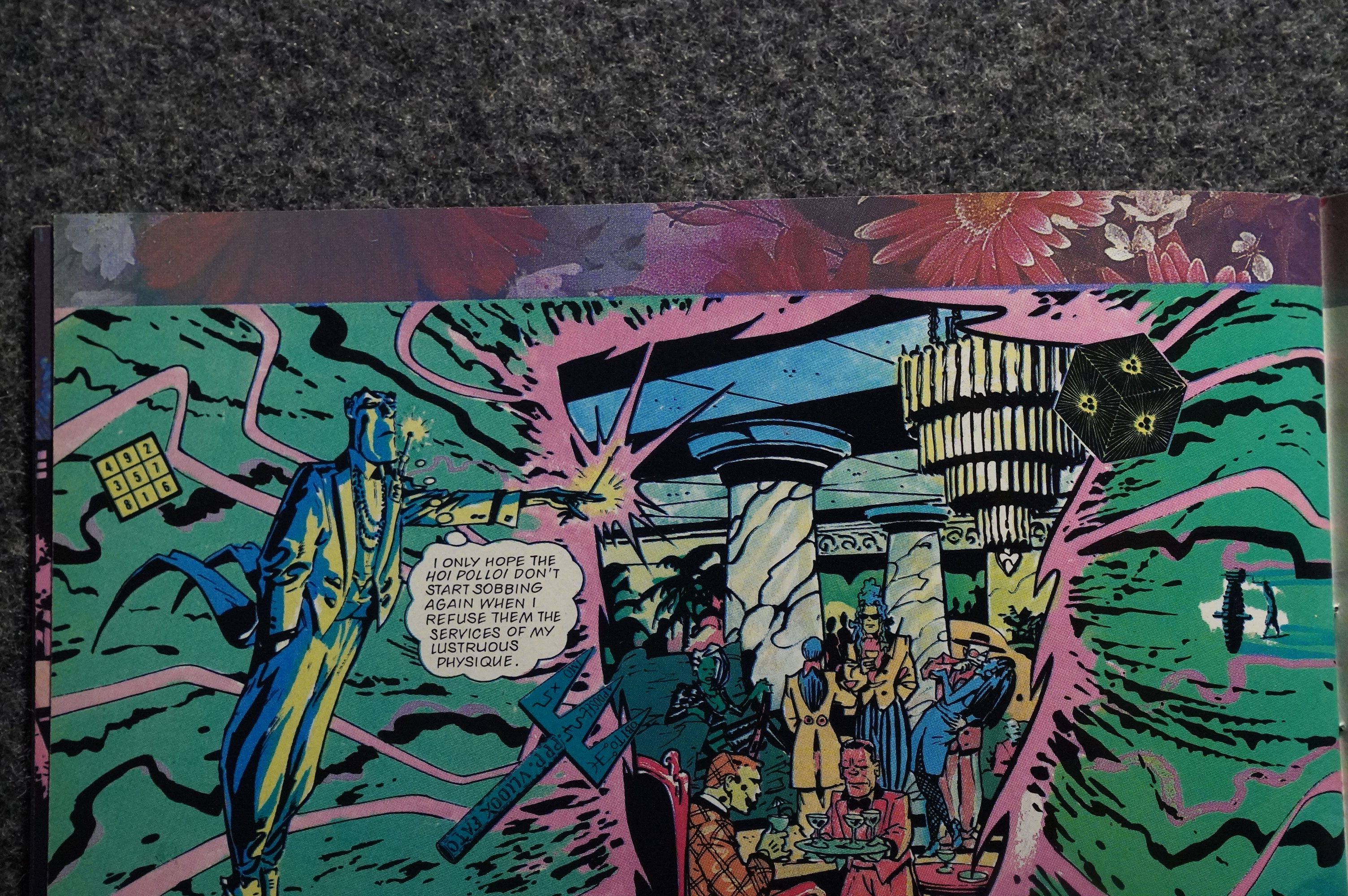
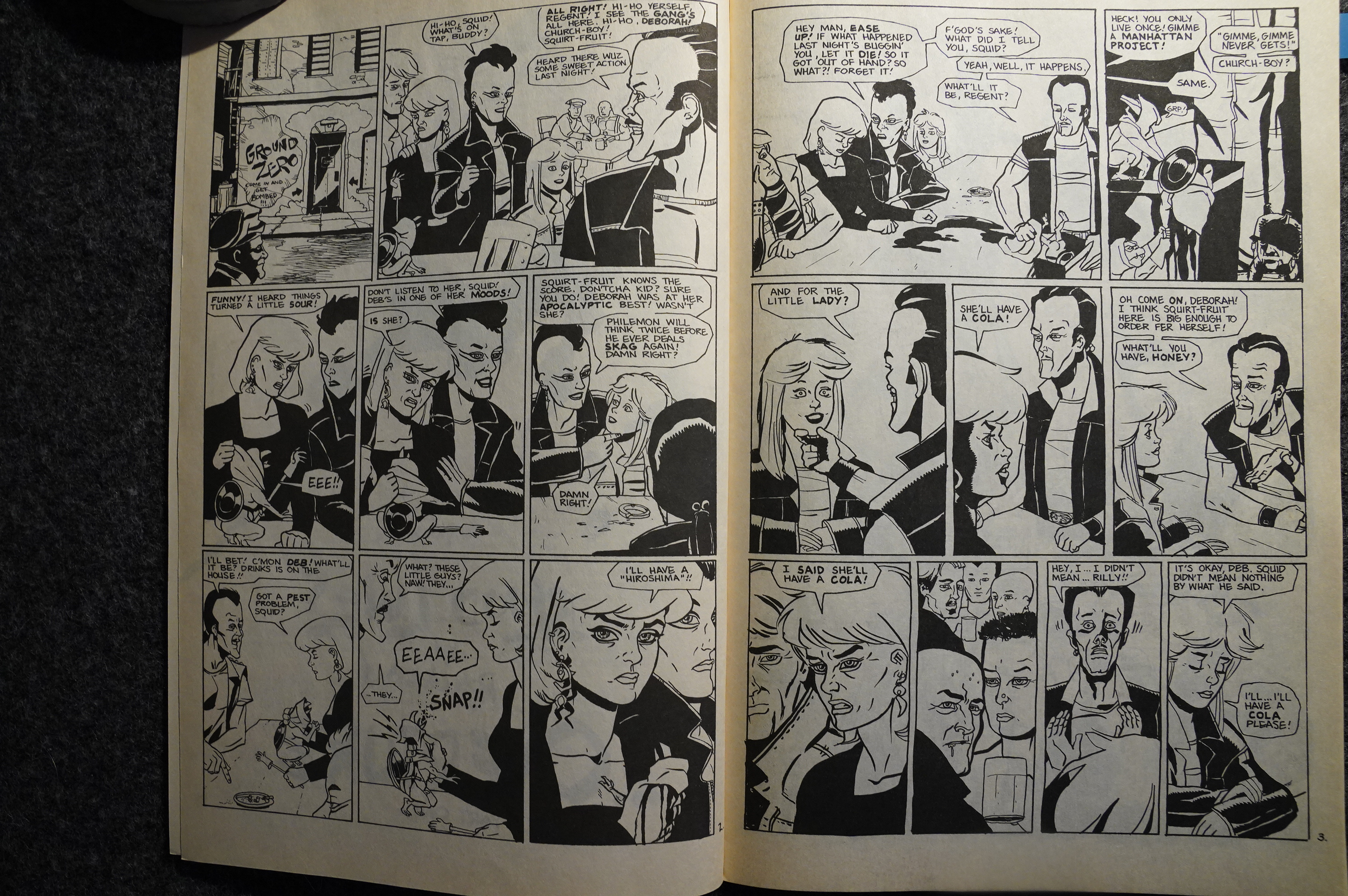
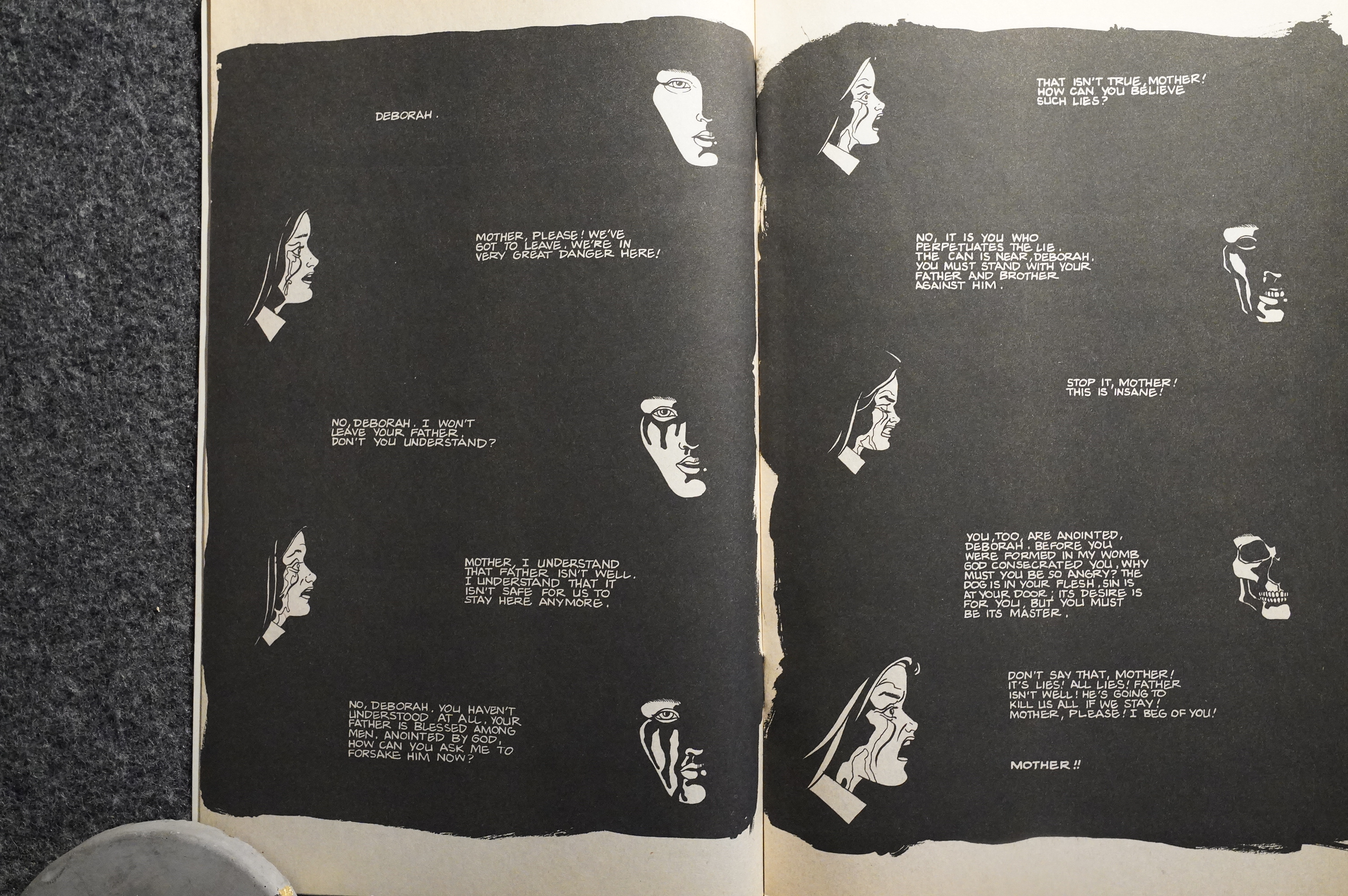
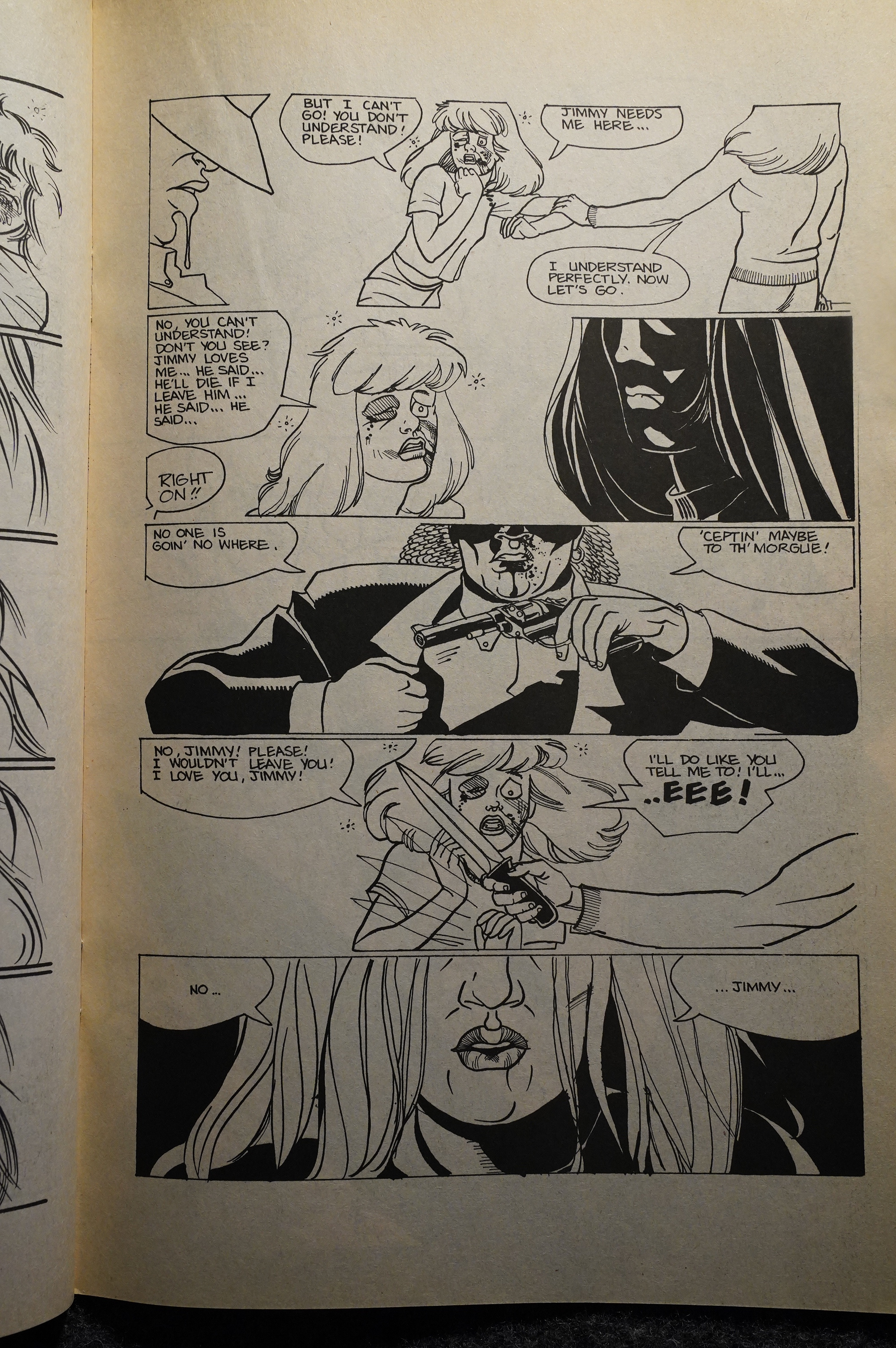
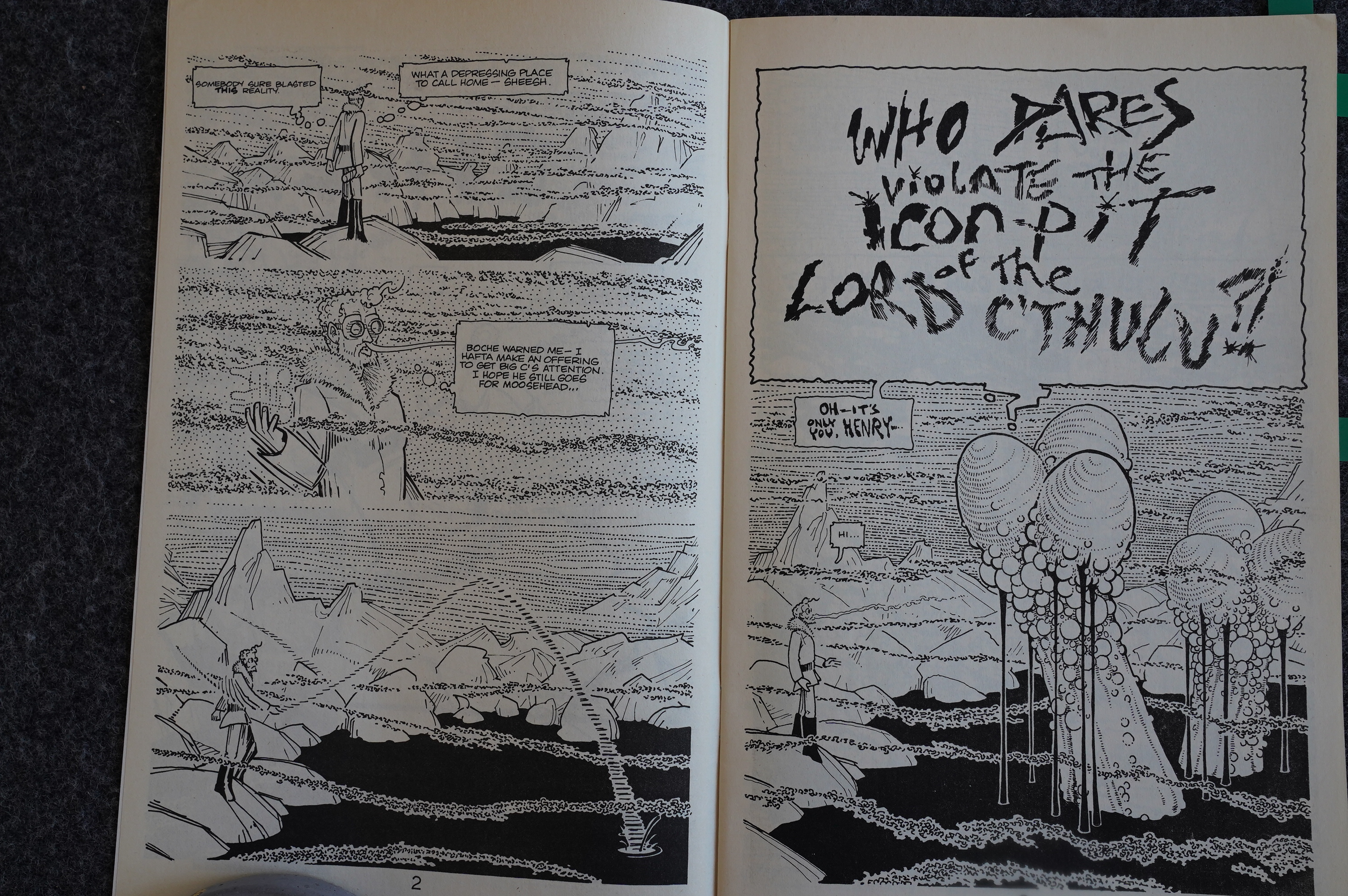
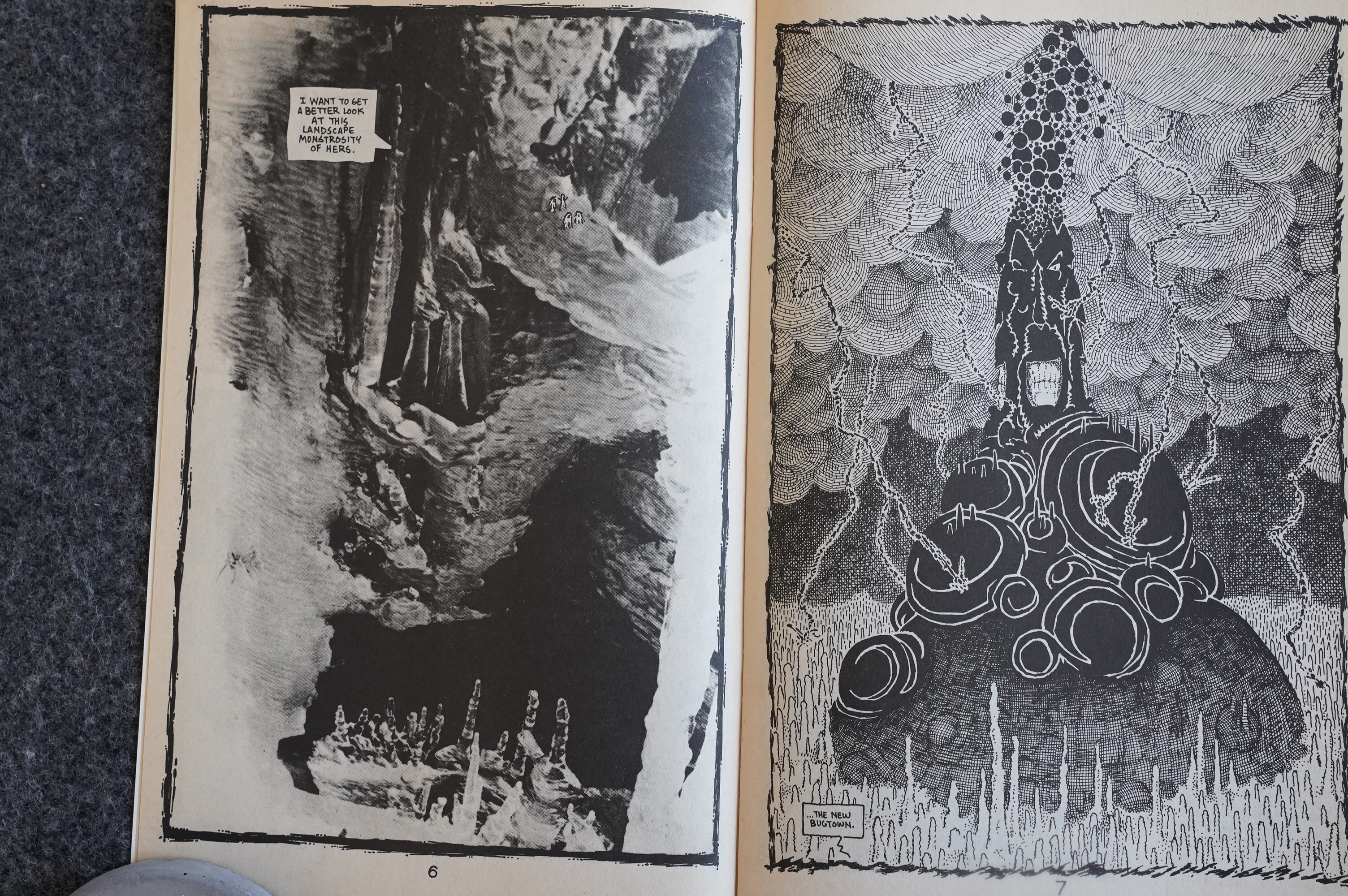
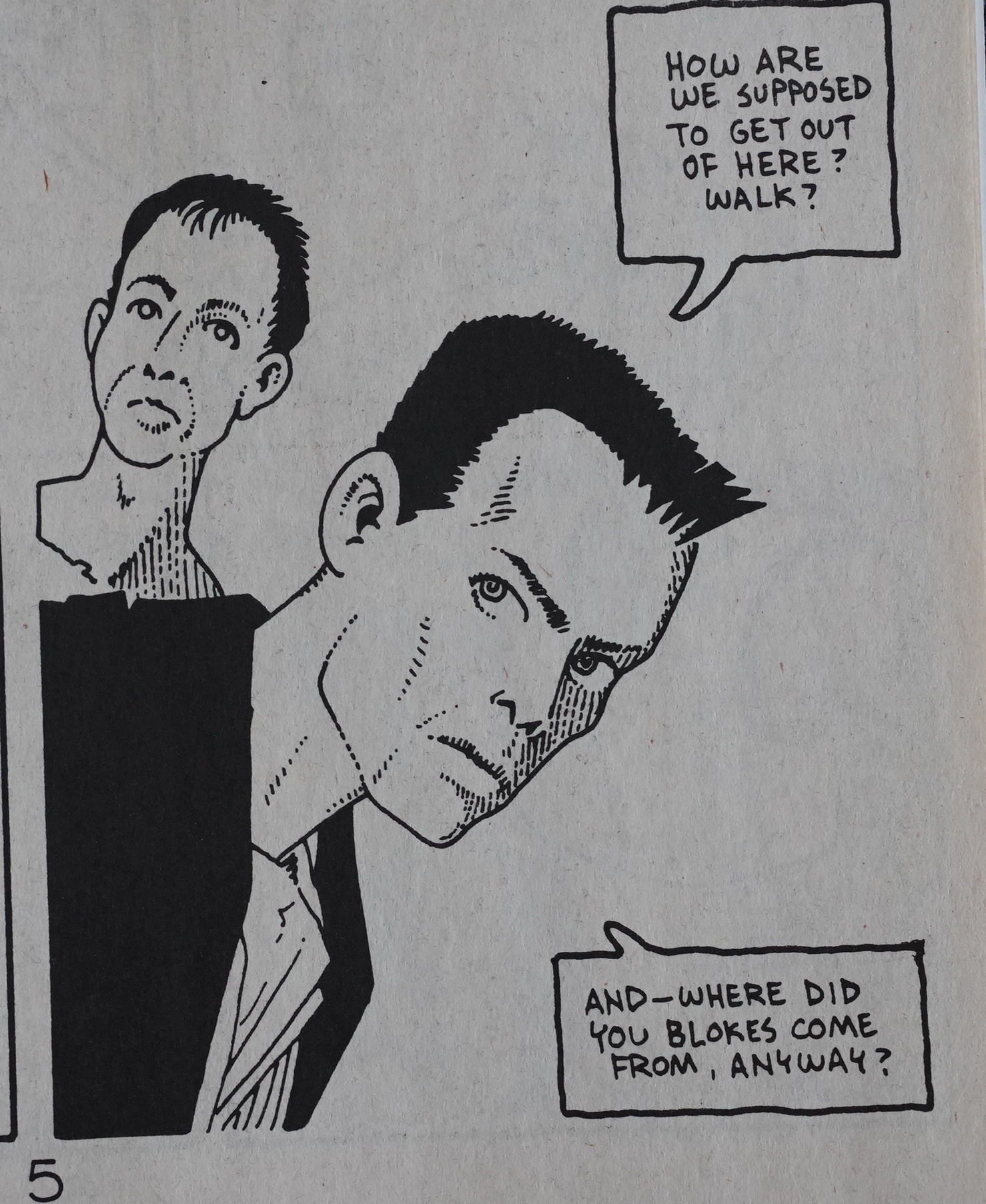
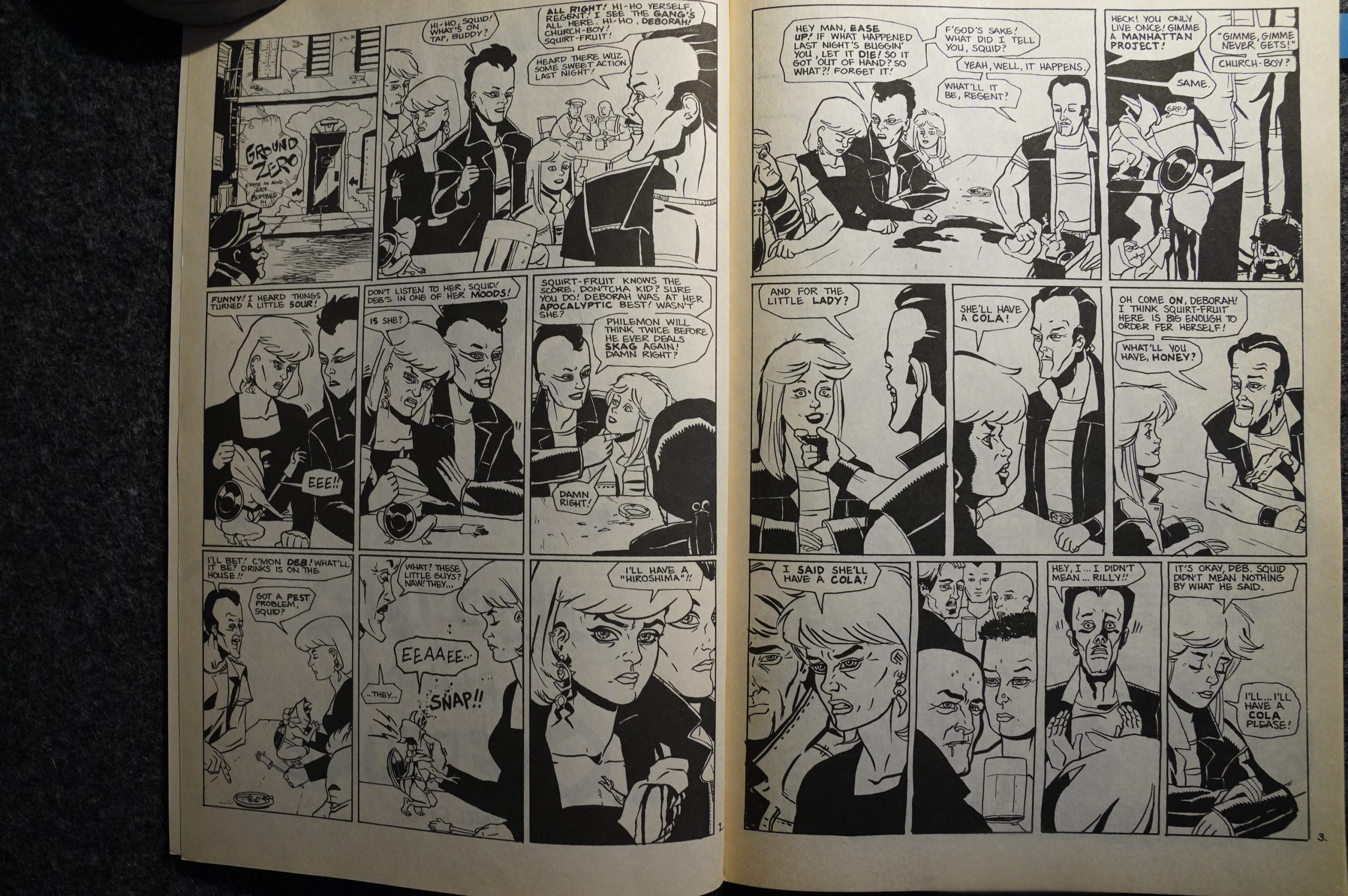
There’s a couple of striking things about these first pages. First of all, the black spotting seems so precise and appealing that you think Walton must be a seasoned professional. The other is that the heads and faces on these characters look like Walton has never seen an actual human being. Those incessantly staring eyes, that seem to be looking at… something, never quite clear what it is… are unnerving, but probably aren’t meant to be?
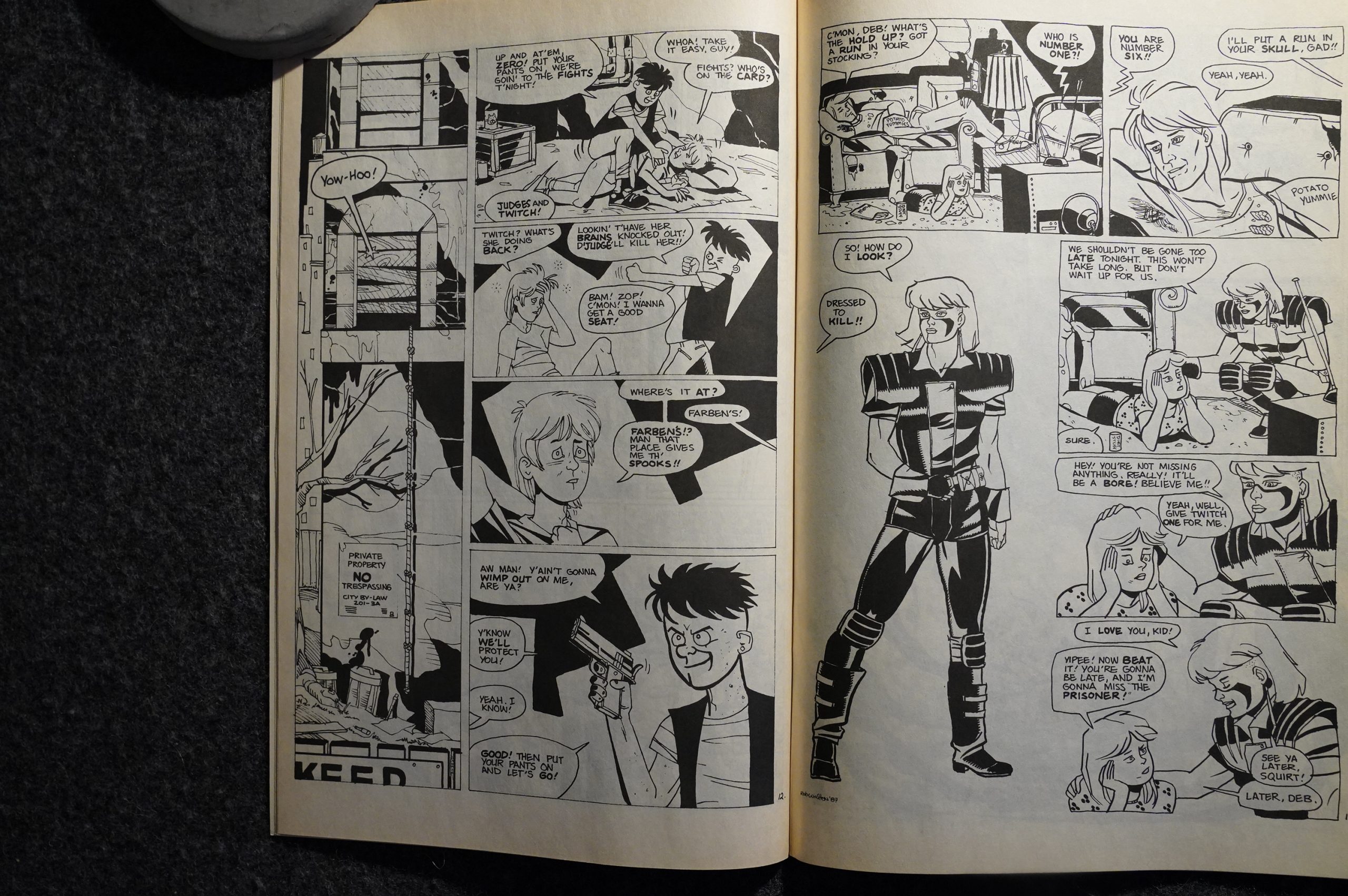
And another thing: When drawing children, Walton seems to drop into a very cartoonish mode. Was he an animator, by any chance? That face from the lower right panel on the left-hand page seems to come straight from some cartoon. Some limited-animation cartoon.
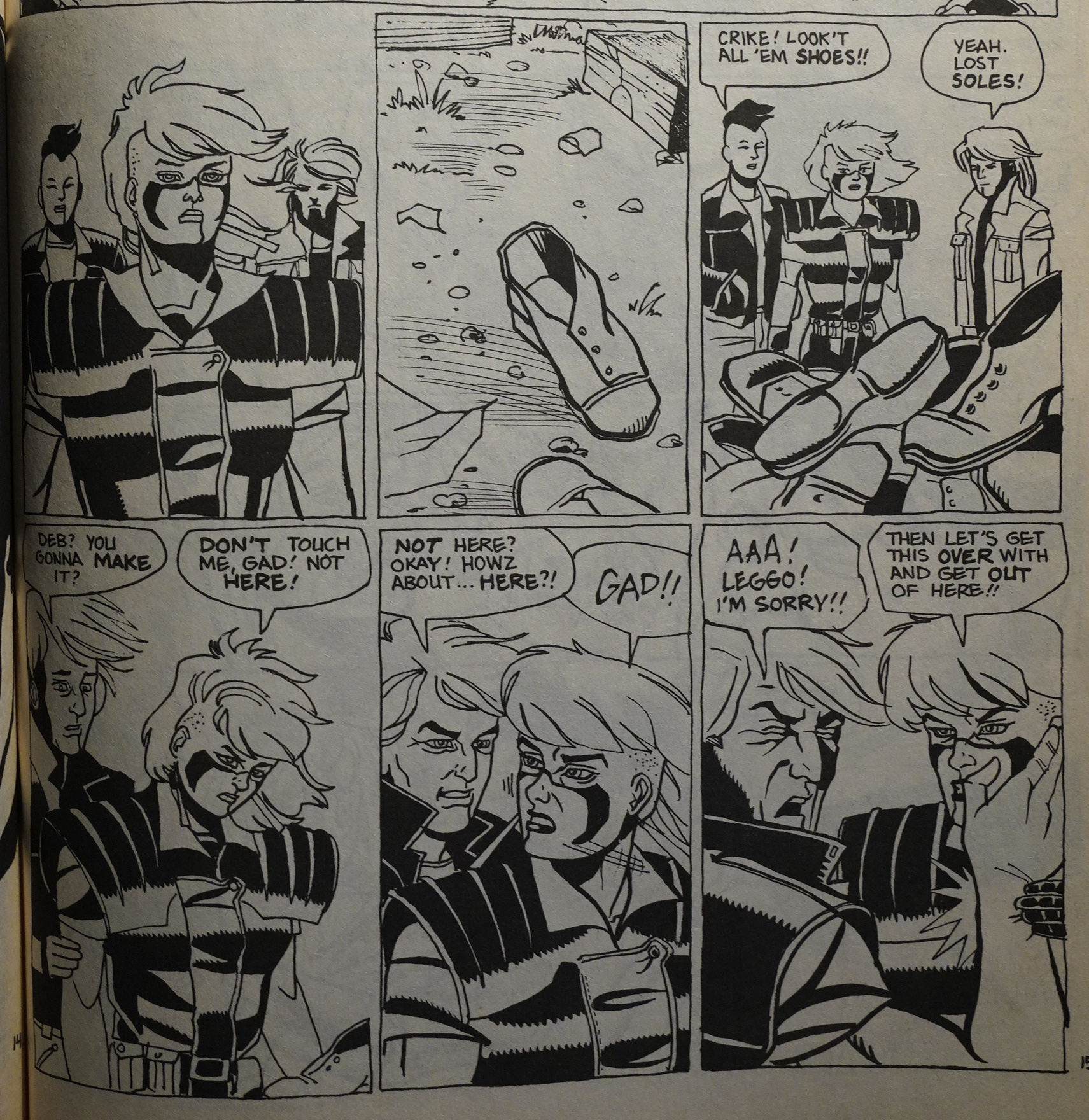
I like comics that don’t explain what they’re about, but Walton pushes the reader pretty far here. We’re dropped in the middle of a bewildering number of characters, and what seems like a half-dozen intersecting plot lines, and nothing is explained — not even who these characters are. That several seem to have multiple names doesn’t help with comprehension. (Or perhaps it’s different characters drawn the same; the main way to tell characters apart is remembering who has what hairdo.)
It’s not even clear if “lost soles” is a joke or has some deeper meaning.
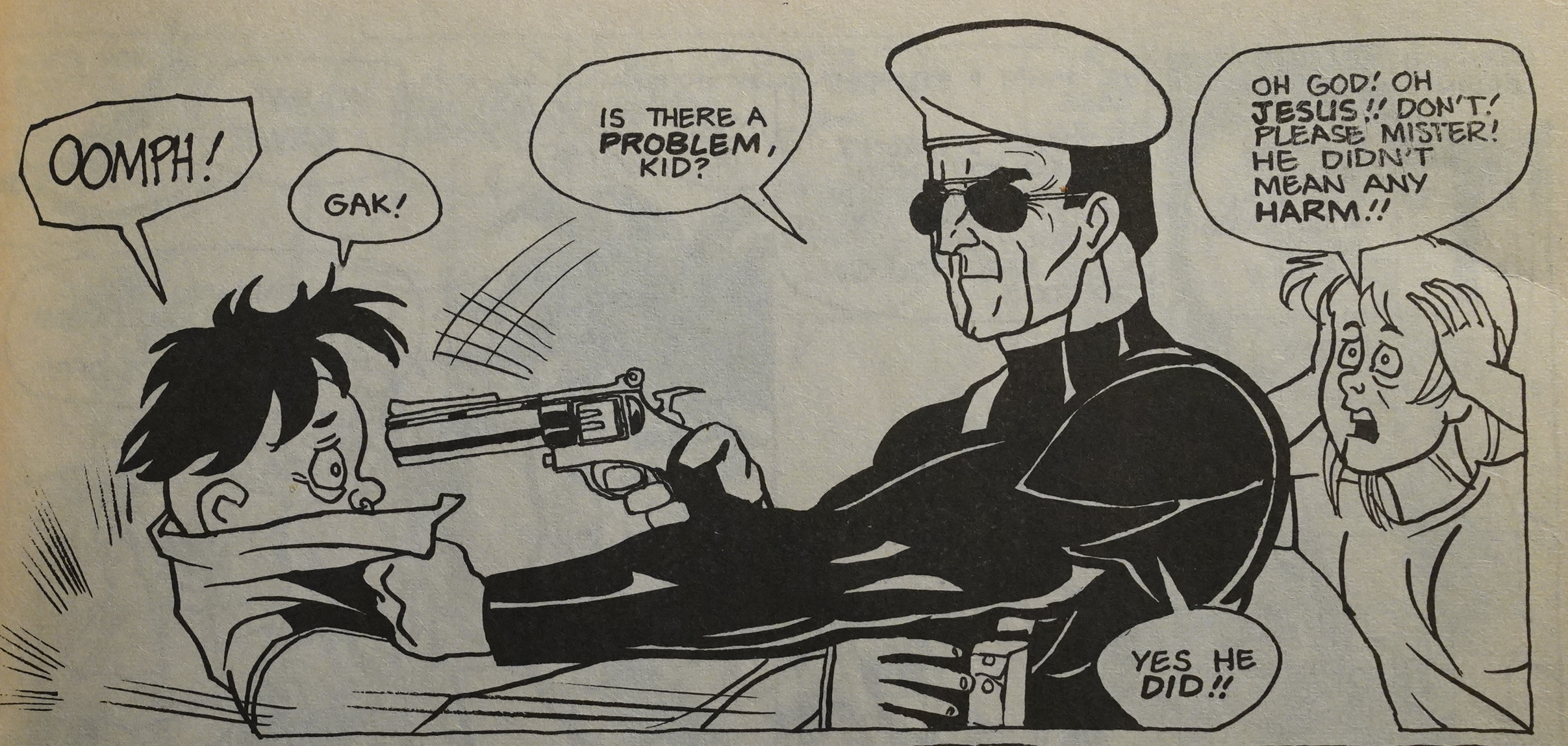
Super-deformed mode, I guess.
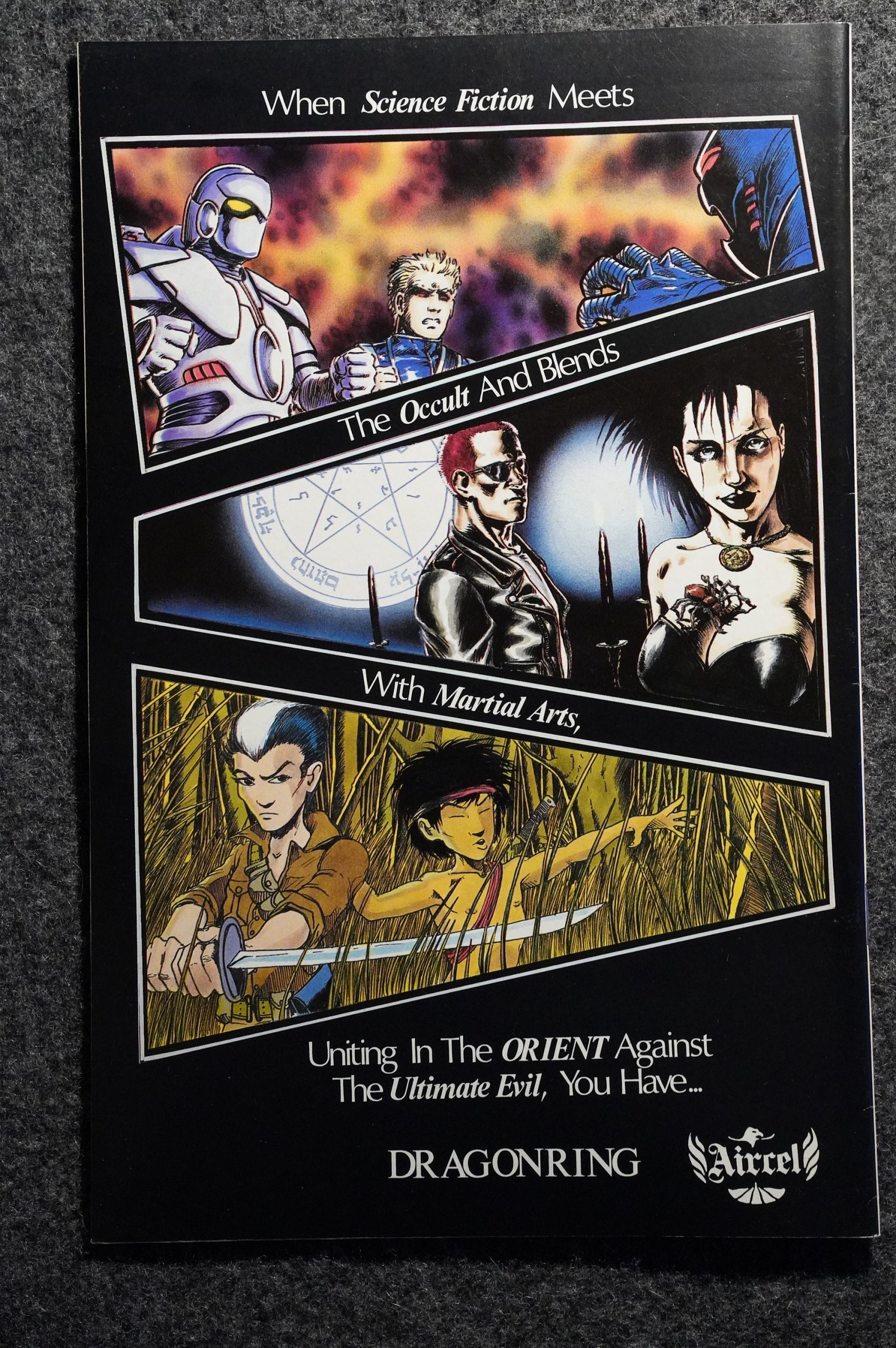
Oh, not just elves. Dragons, too.
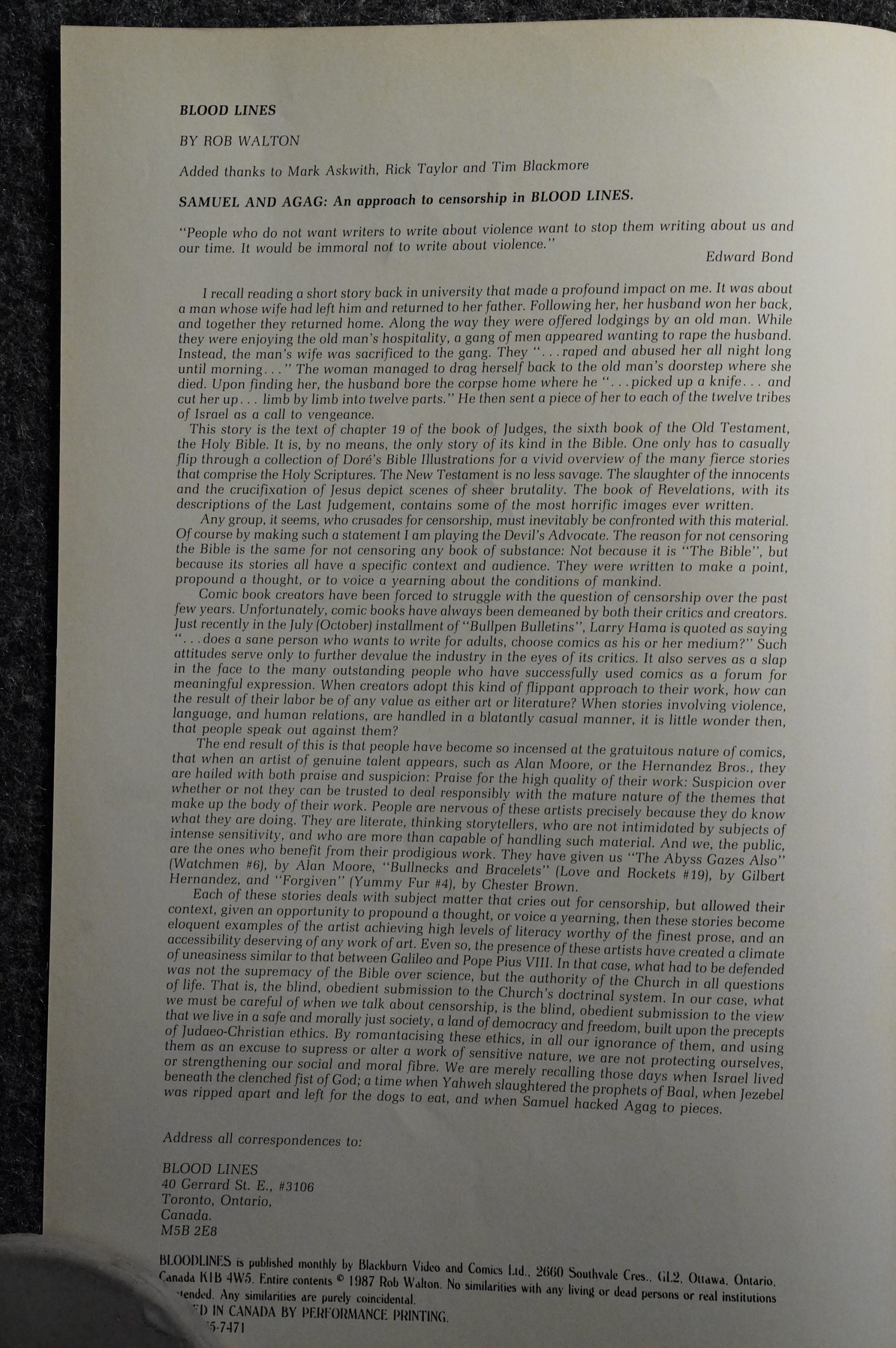
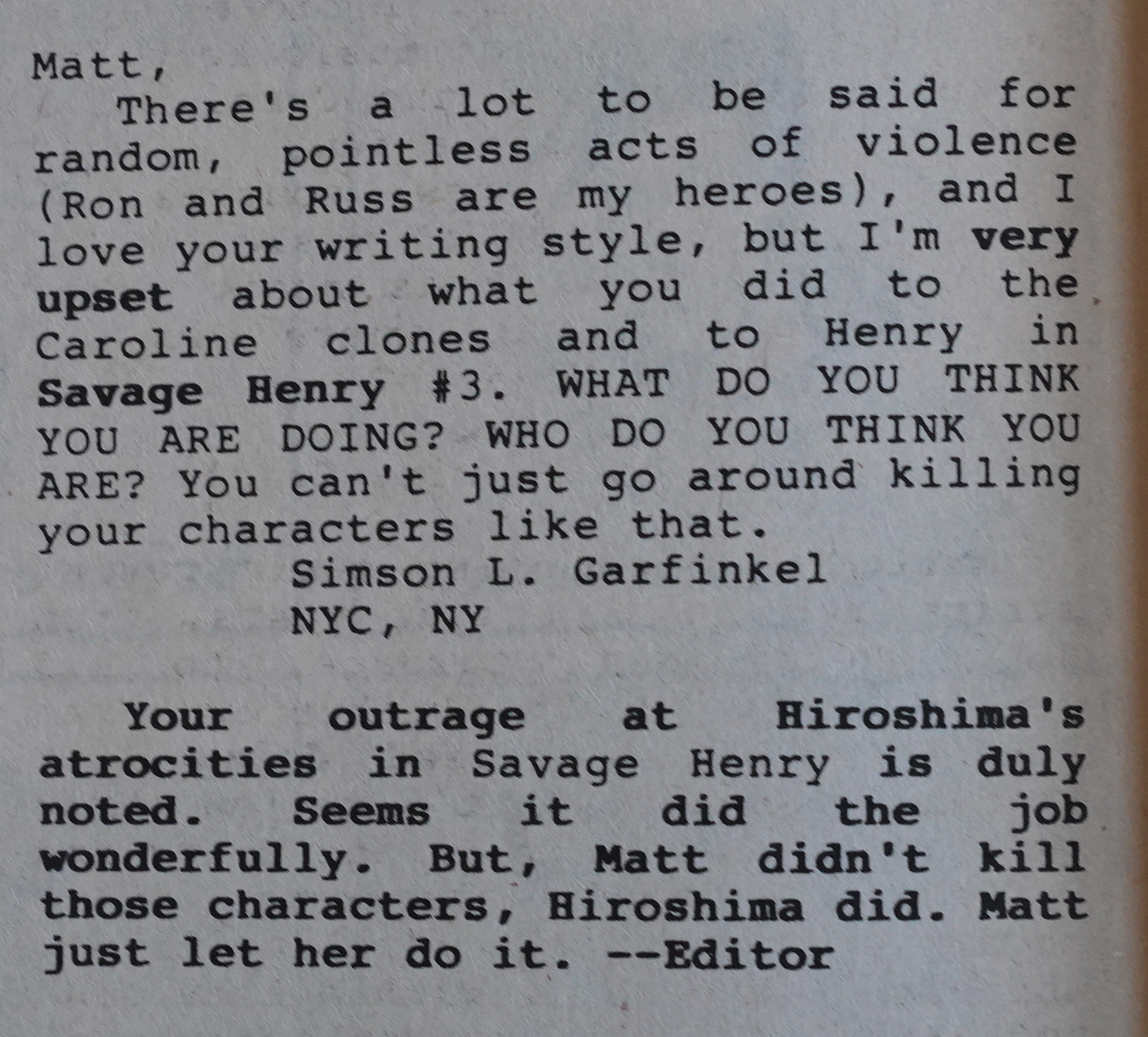
The editorial in the second issue (published by Blackburn Video + Comics (!) (allegedly)) is all about how censorship (of violence?) is wrong, because there’s a lot of gnarly stuff in the bible. Which begs the question.
Walton is a has a religious education (a master’s in voodoo or whatever he was saying in the first editorial; you should look it up — I may be misremembering, perhaps it was hoodoo), and it’s obvious he’s got religious damage. So there’s a ton of religious references in Bloodlines that… I just don’t get, or even care to get, because it sounds really boring.
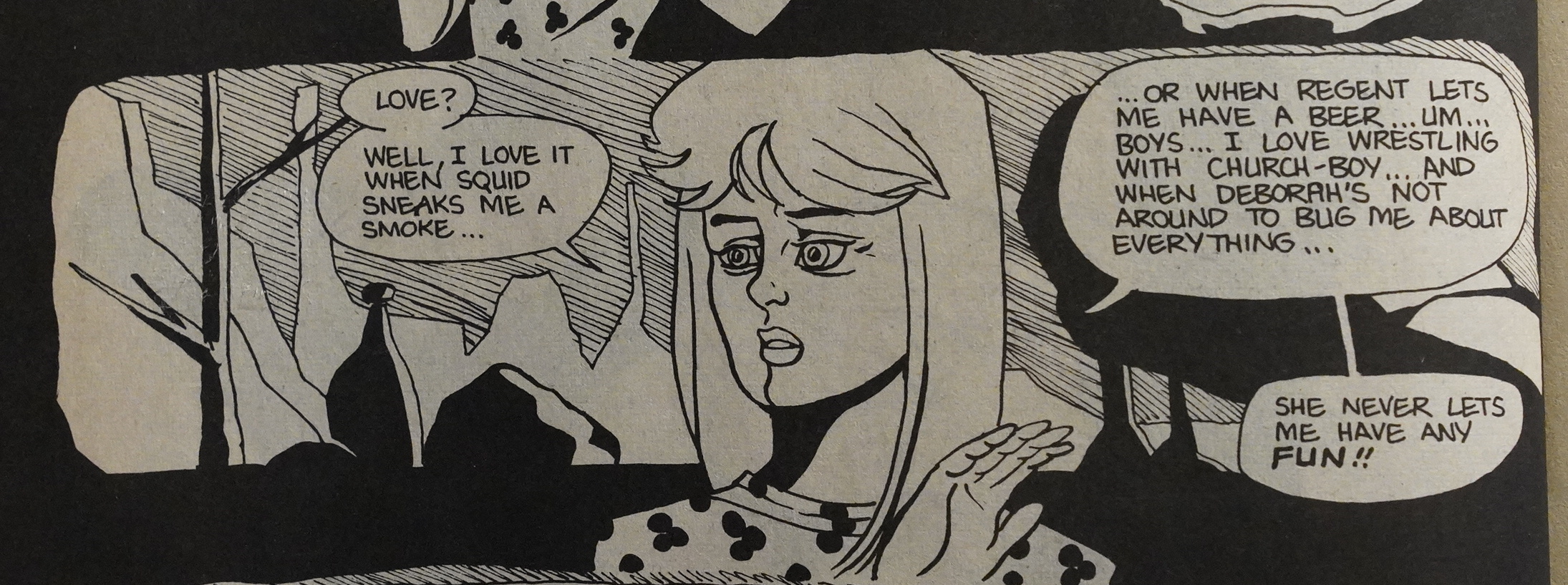
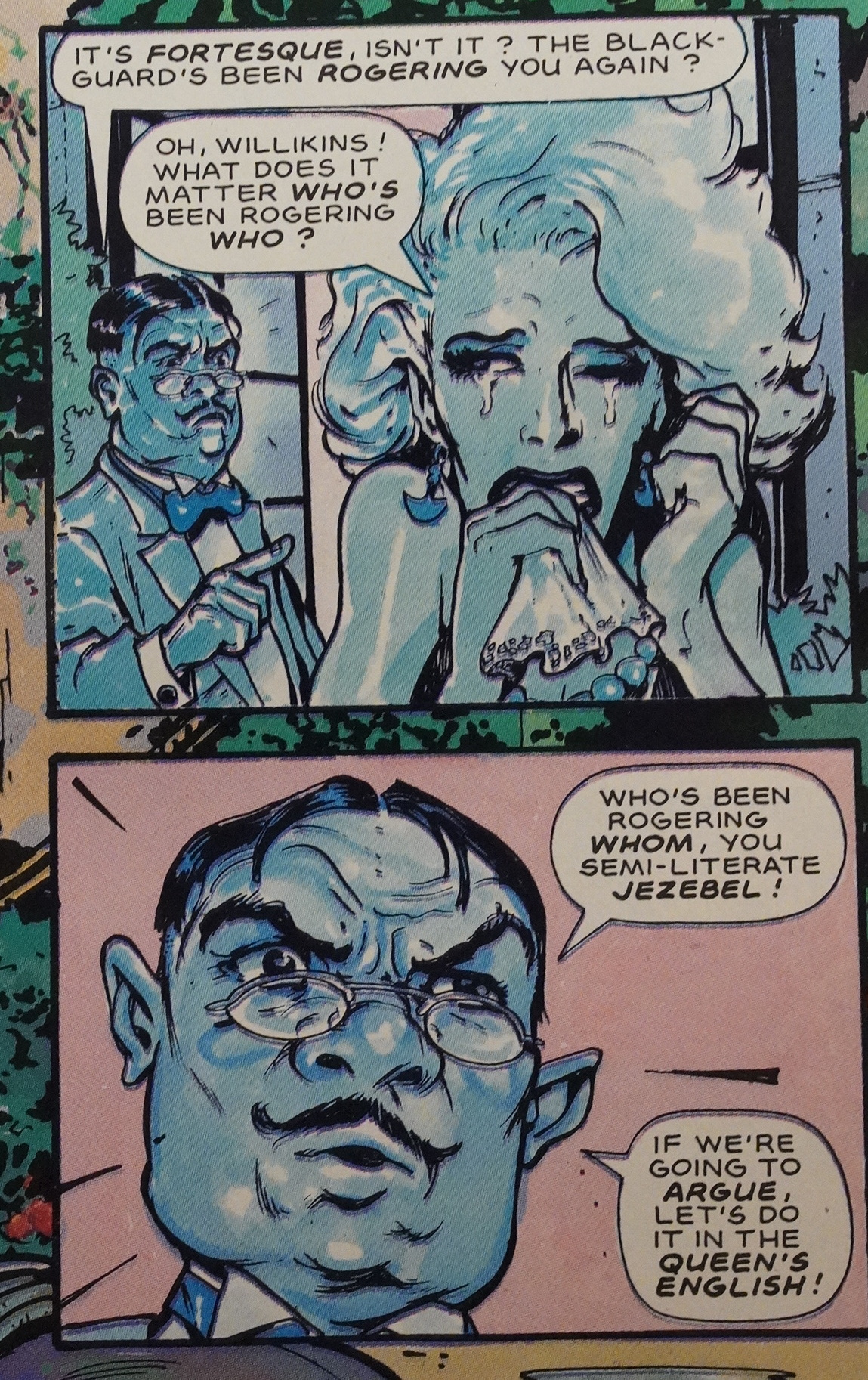
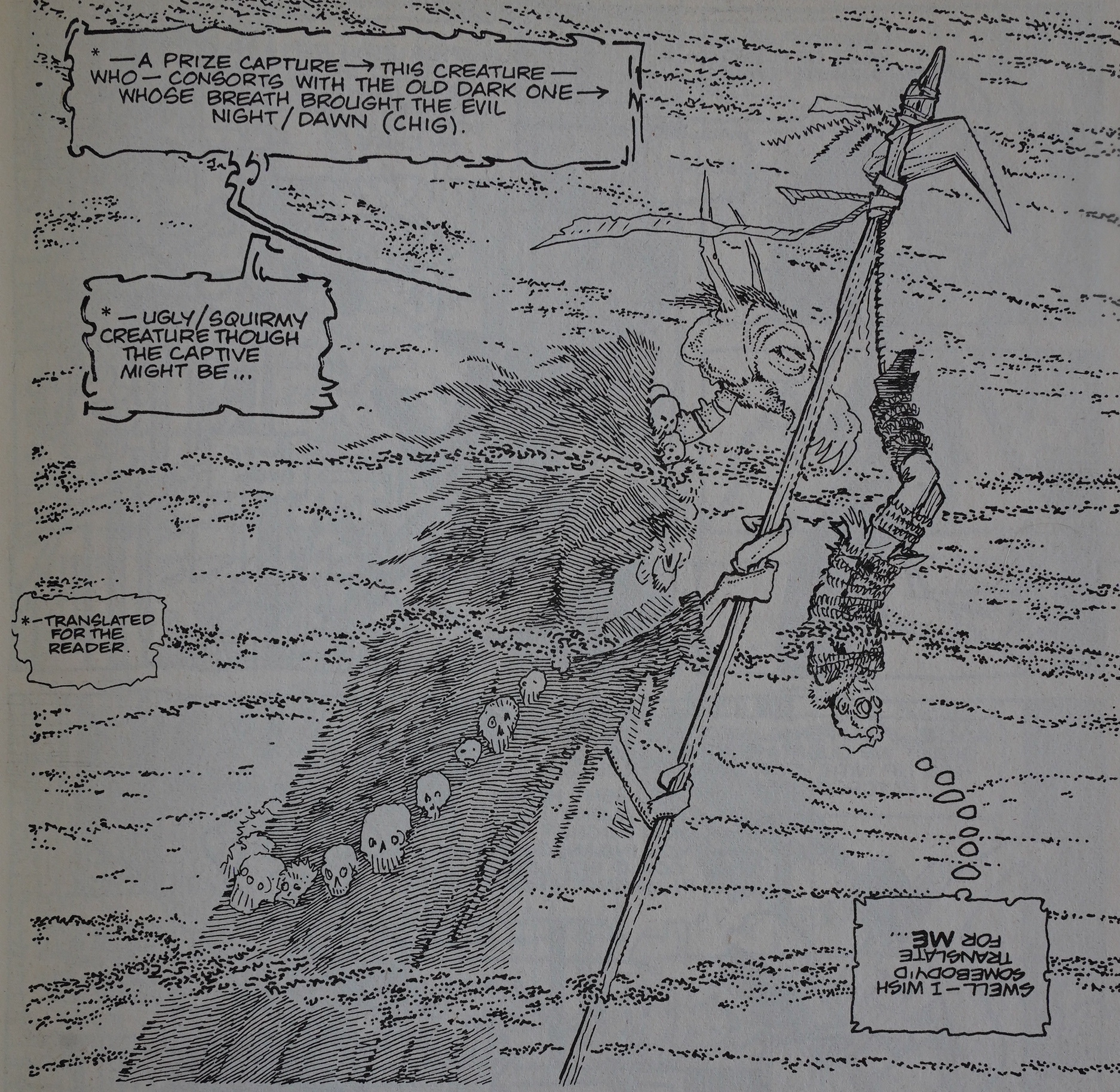
This thing Walton does with their chins is odd, and kinda makes it looks like he’s drawing his characters in profile and straight-on at the same time. Cubismo!
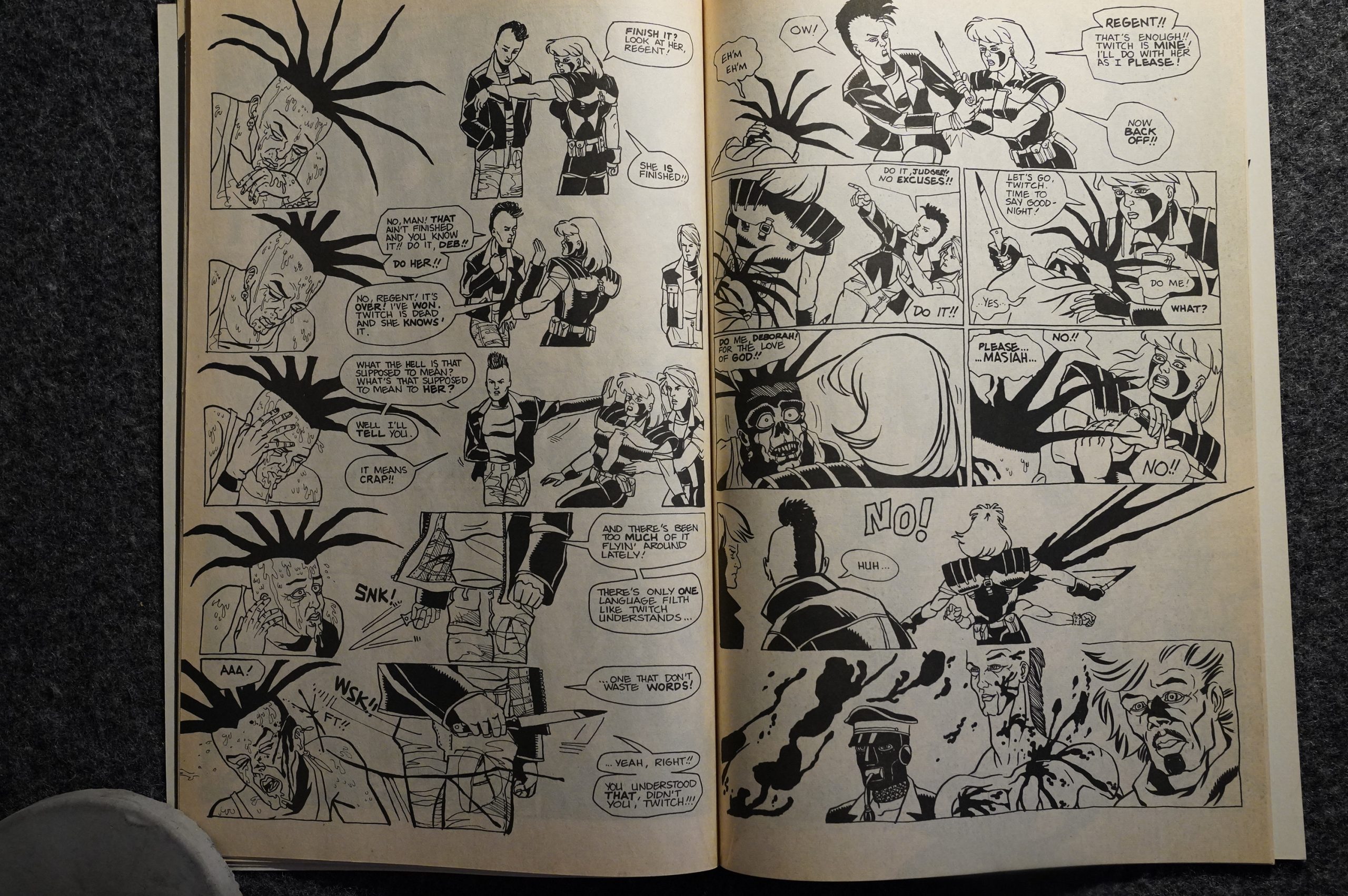
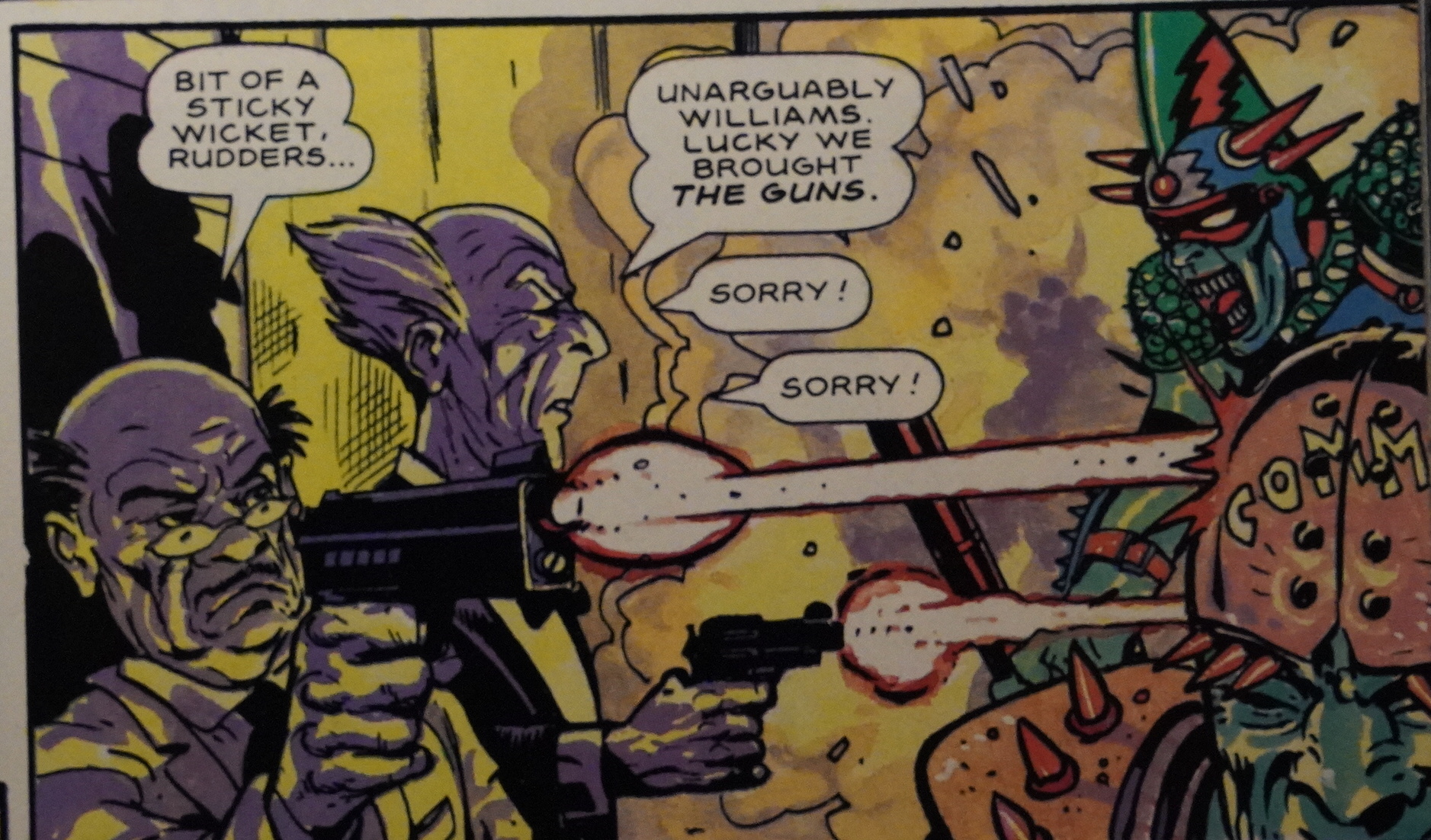
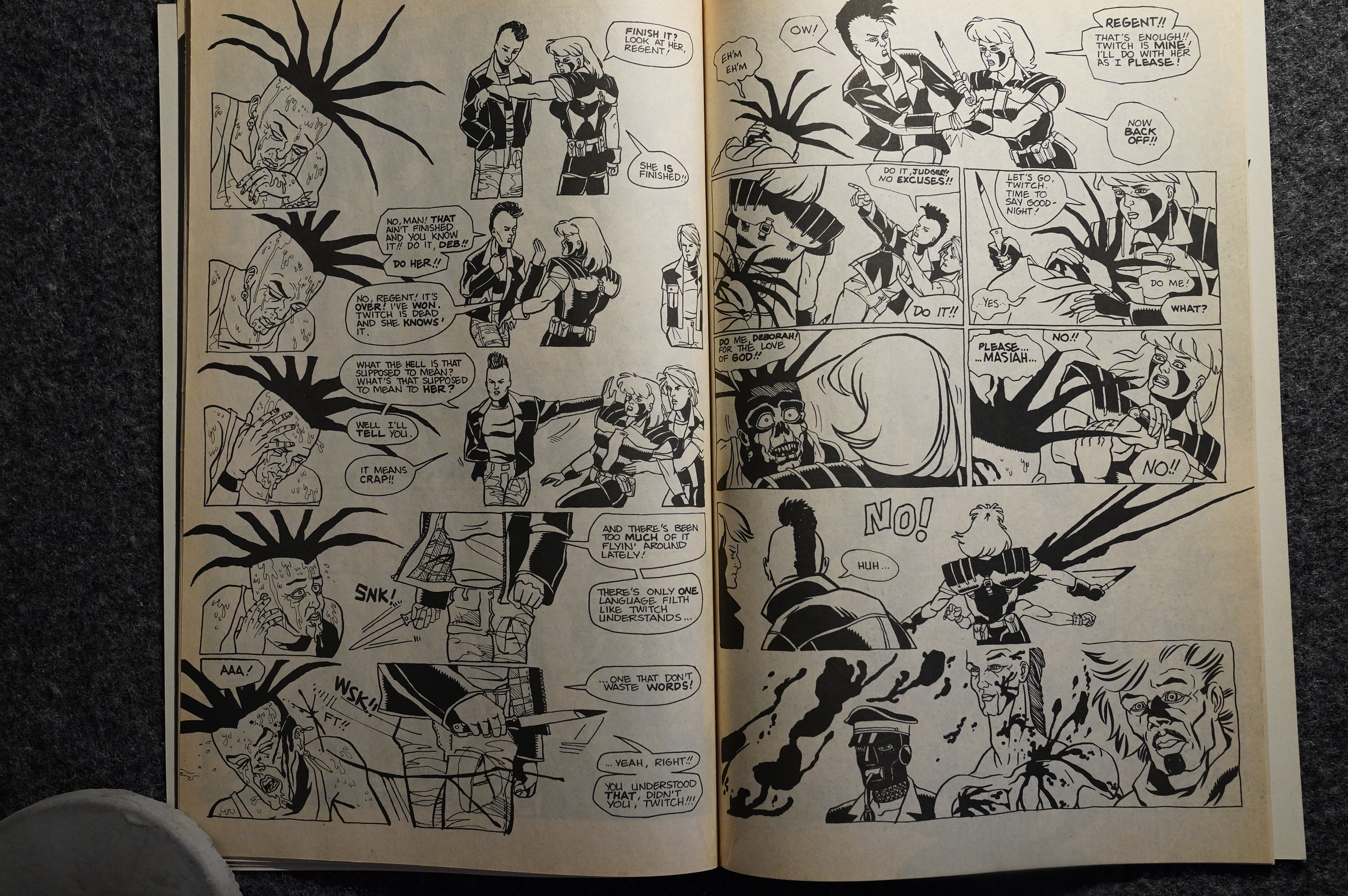
I guess this is why he had that editorial about violence.
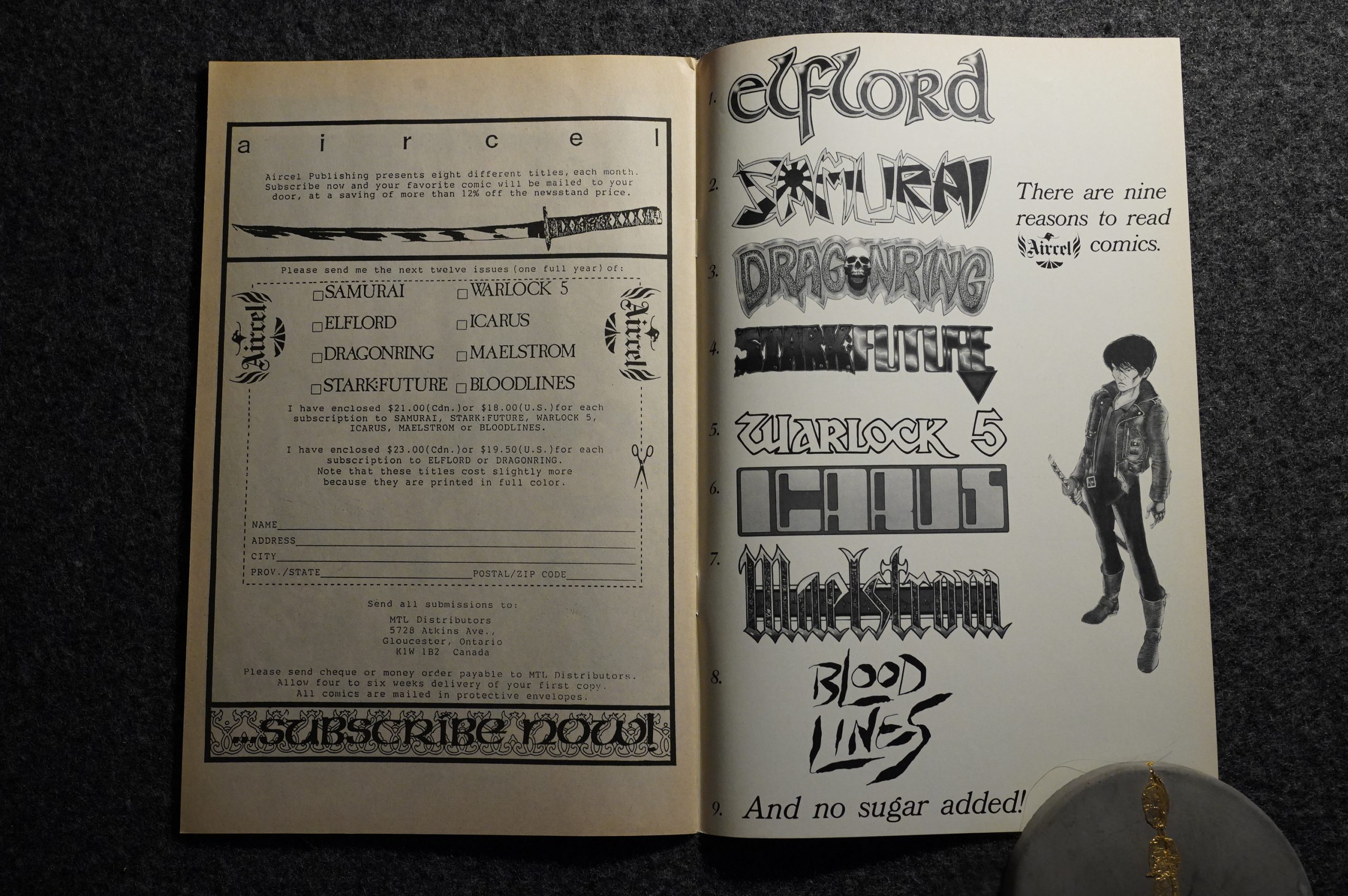
For a comic that’s published by a video store (?), there’s a lot of ads for Aircel stuff in here…
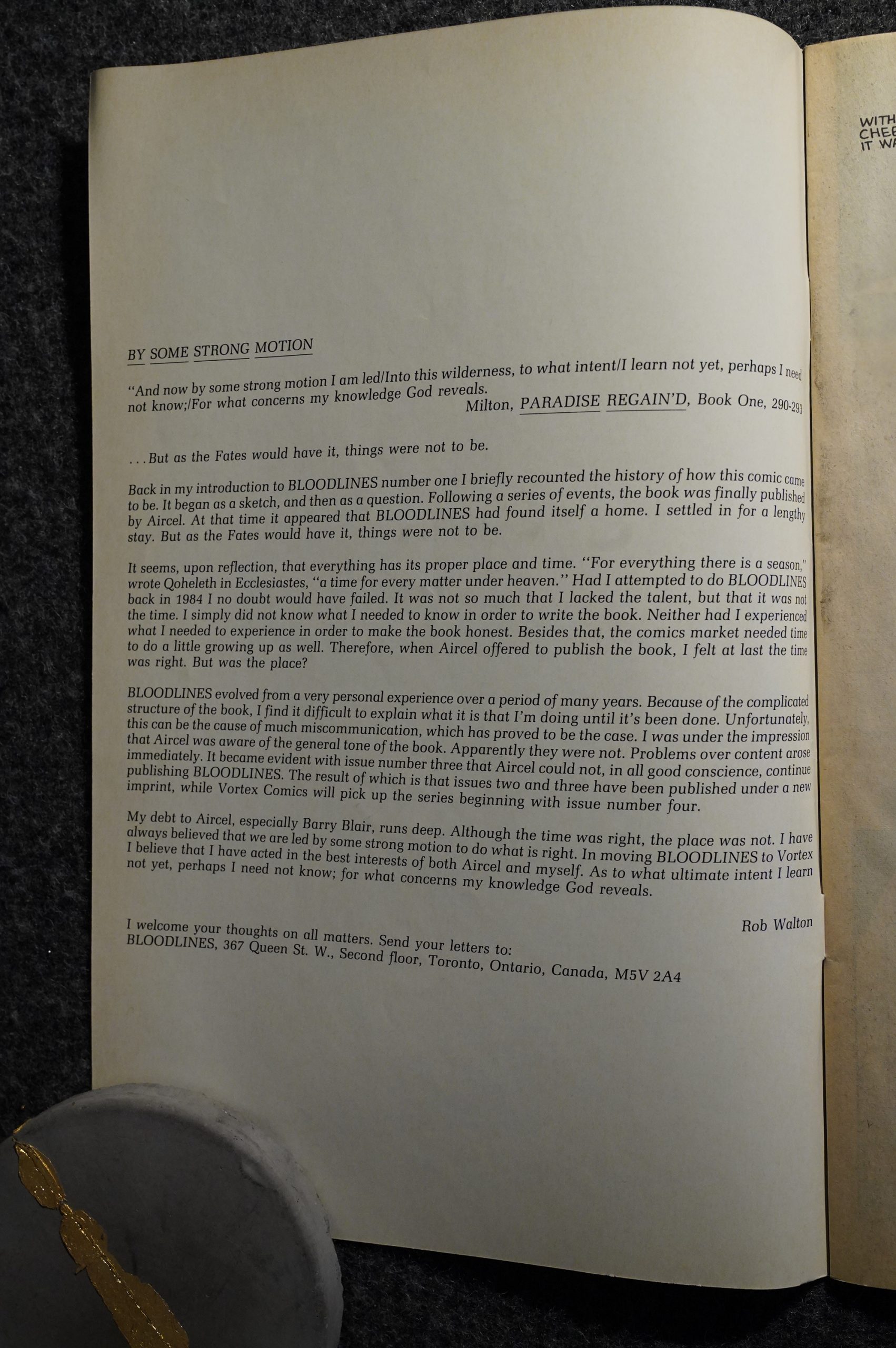
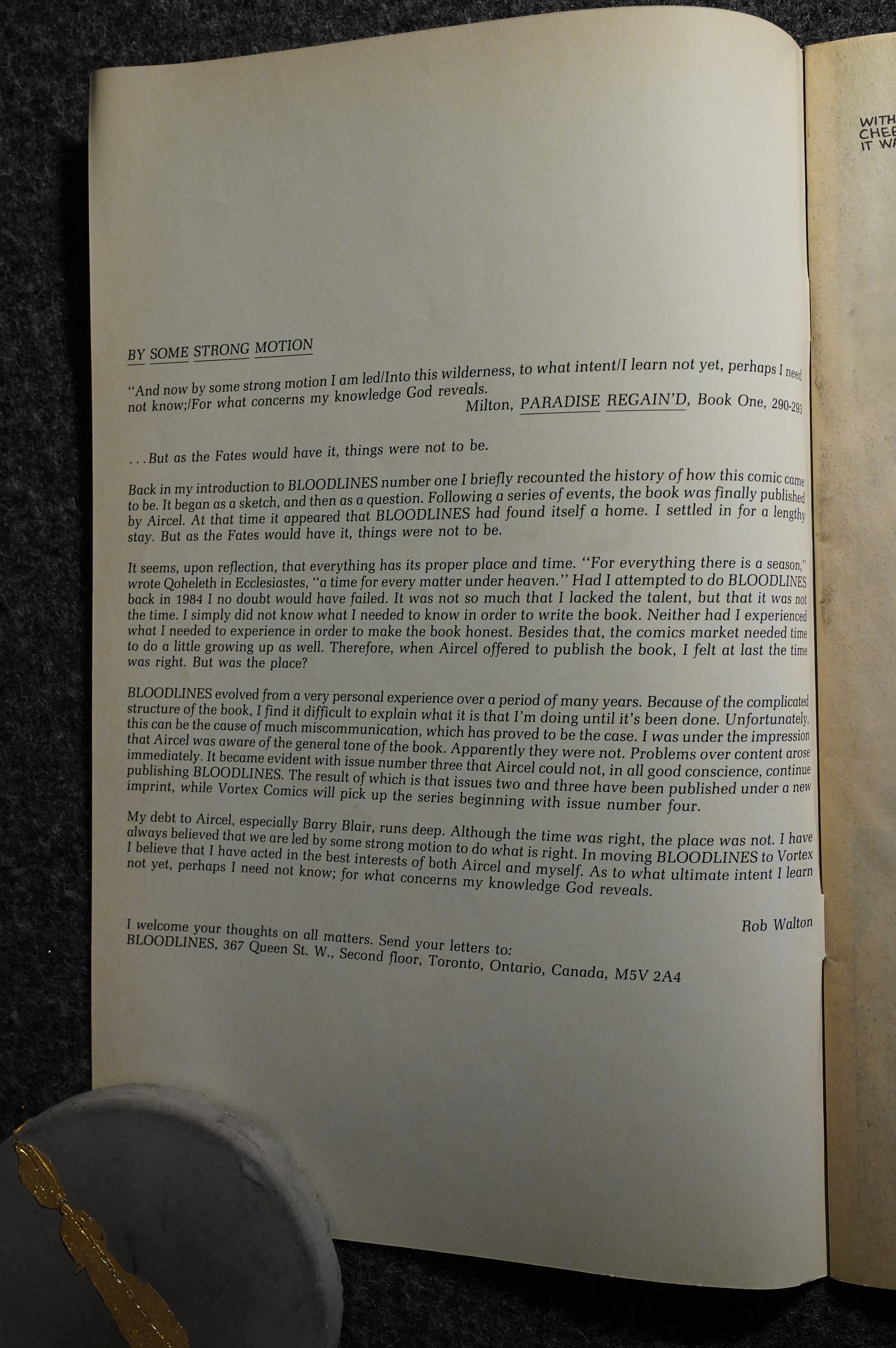
In the next issue, the mystery (of the publisher) is semi-revealed: Aircel didn’t want to publish Bloodlines any more (for unspecified reasons, but not “in all good conscience”), and Blackburn is an “imprint” (of Aircel?), but the book is moving to Vortex in the next issue.
So all this makes me more curious — what was it that Barry Blair (the Aircel owner, I think) had against the book? Was it too violent? I thought I remember Blair being notorious for publishing semi-porny and violent elf comics? But I’m not an expert.
Did he object to there being too much talk about christian stuff in the book? Did he find it blasphemous? Too little blasphemy?
THE MYSTERY! THE MYSTERY!

Heh. Somebody had to hand-stamp “printed in Canada” in all the copies…
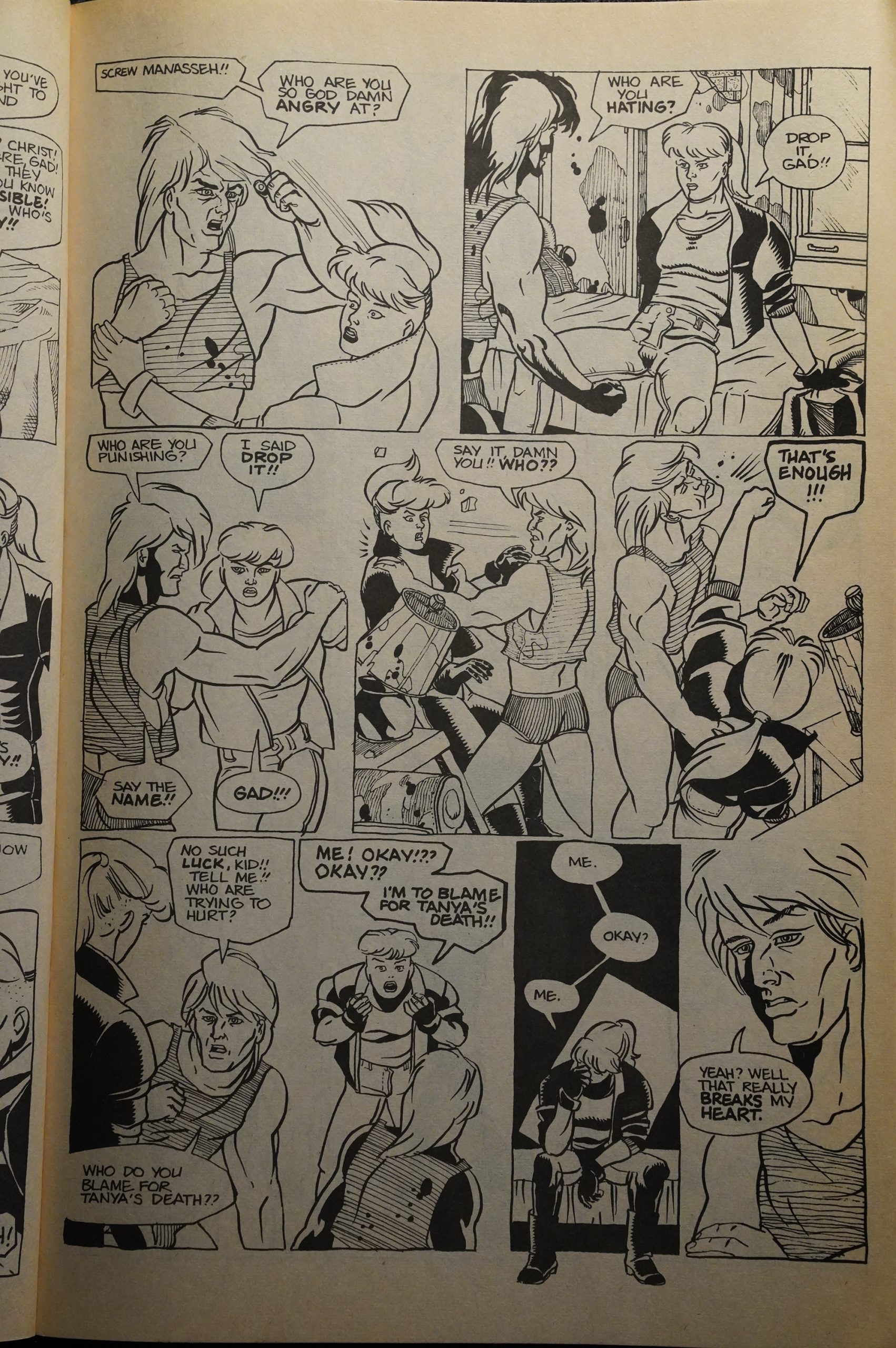
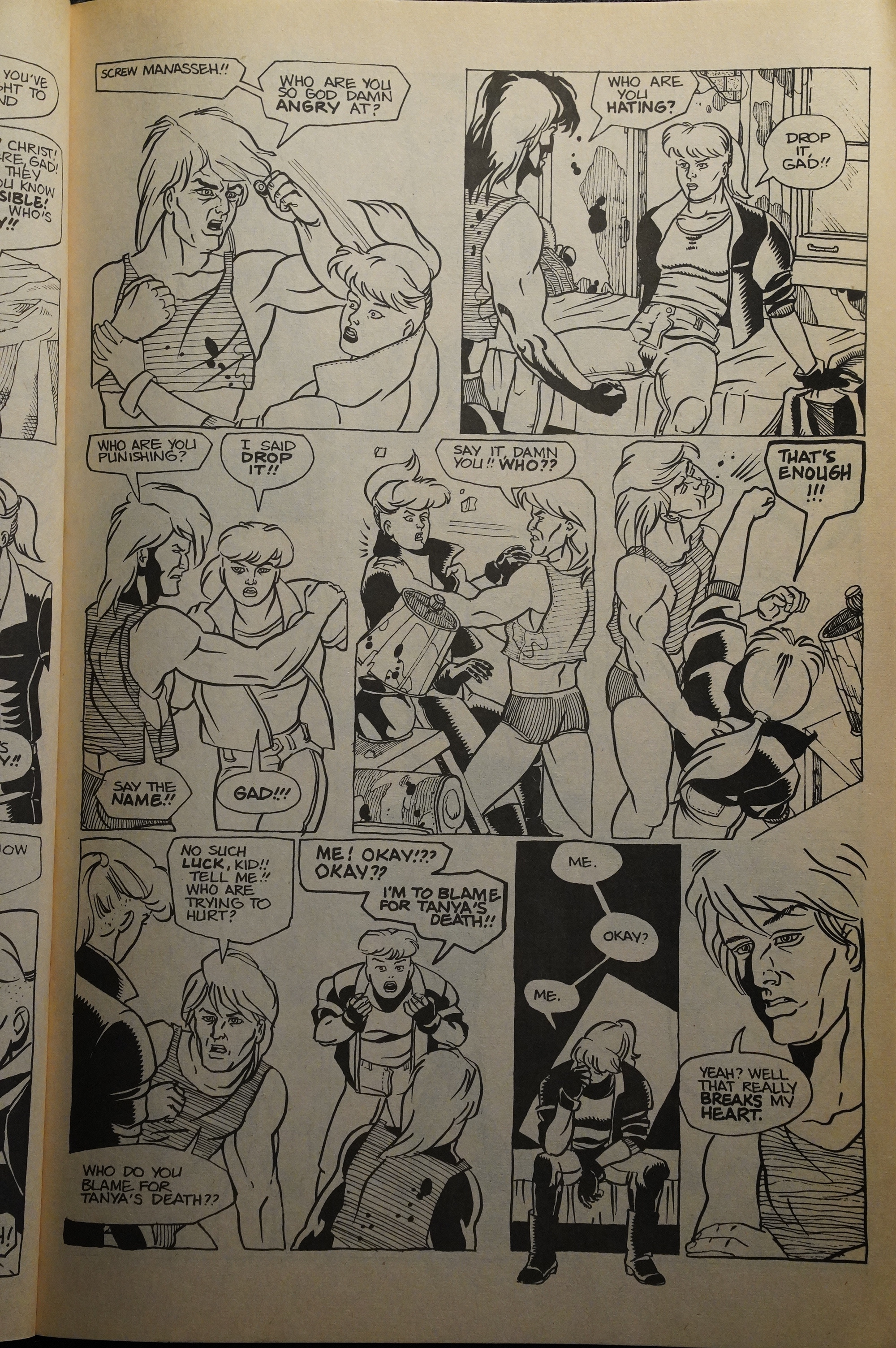
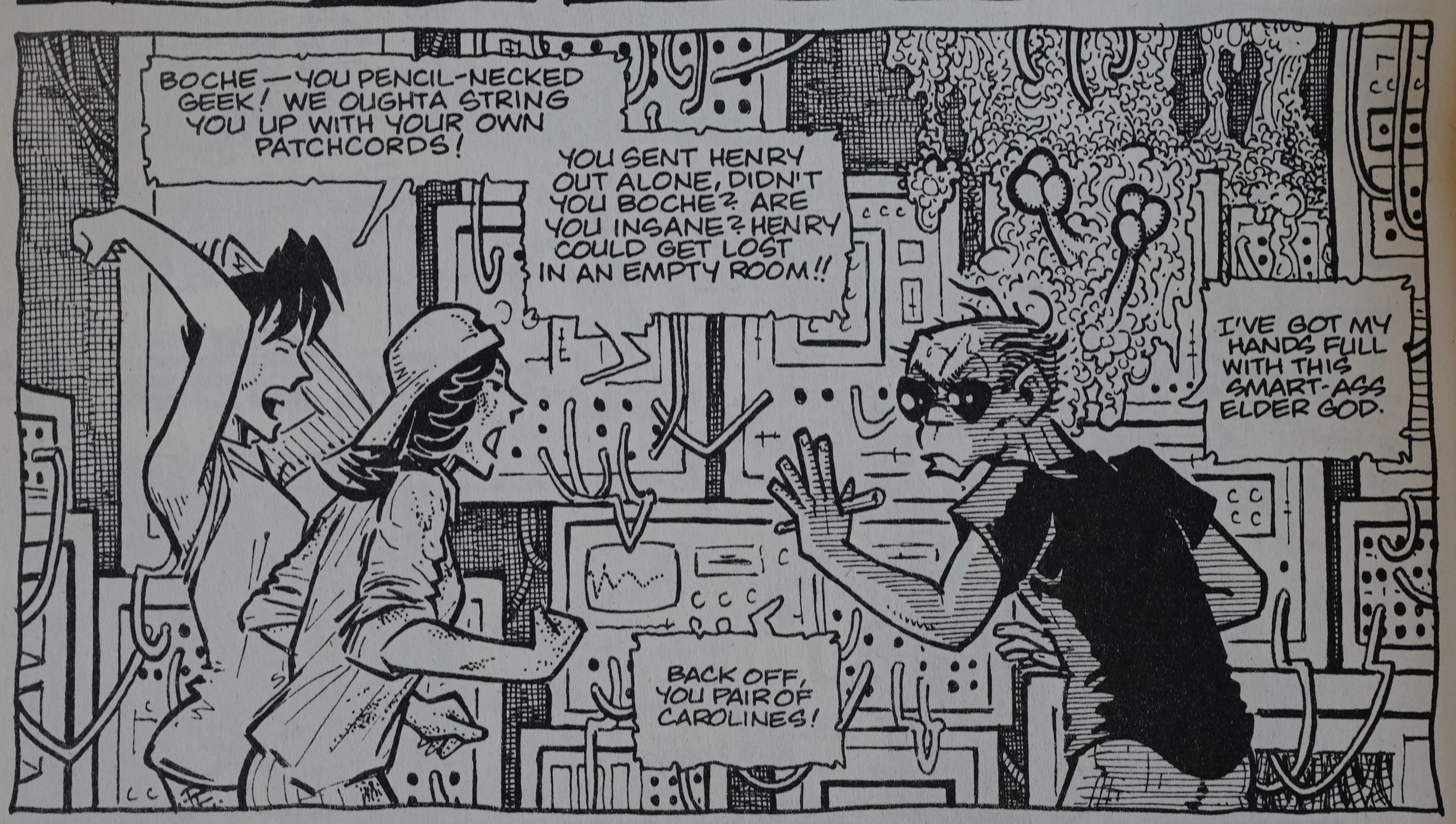
OK, back to the comic: The artwork is getting better. The eyes are still staring out into nothingness, but not as much as before. But there’s just So Much Drama. On every page. The book is basically people shouting at each other on every page, and sometimes they shout while they’re slapping each other, and that’s it. (OK, sometimes they kill themselves while shouting.)
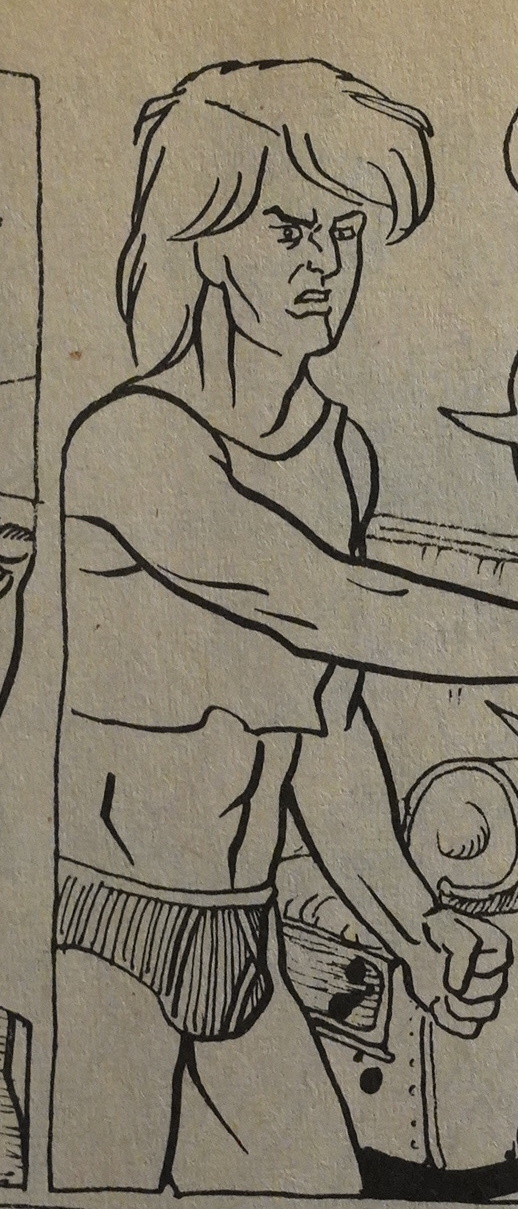
I don’t think that fashion ever took off…
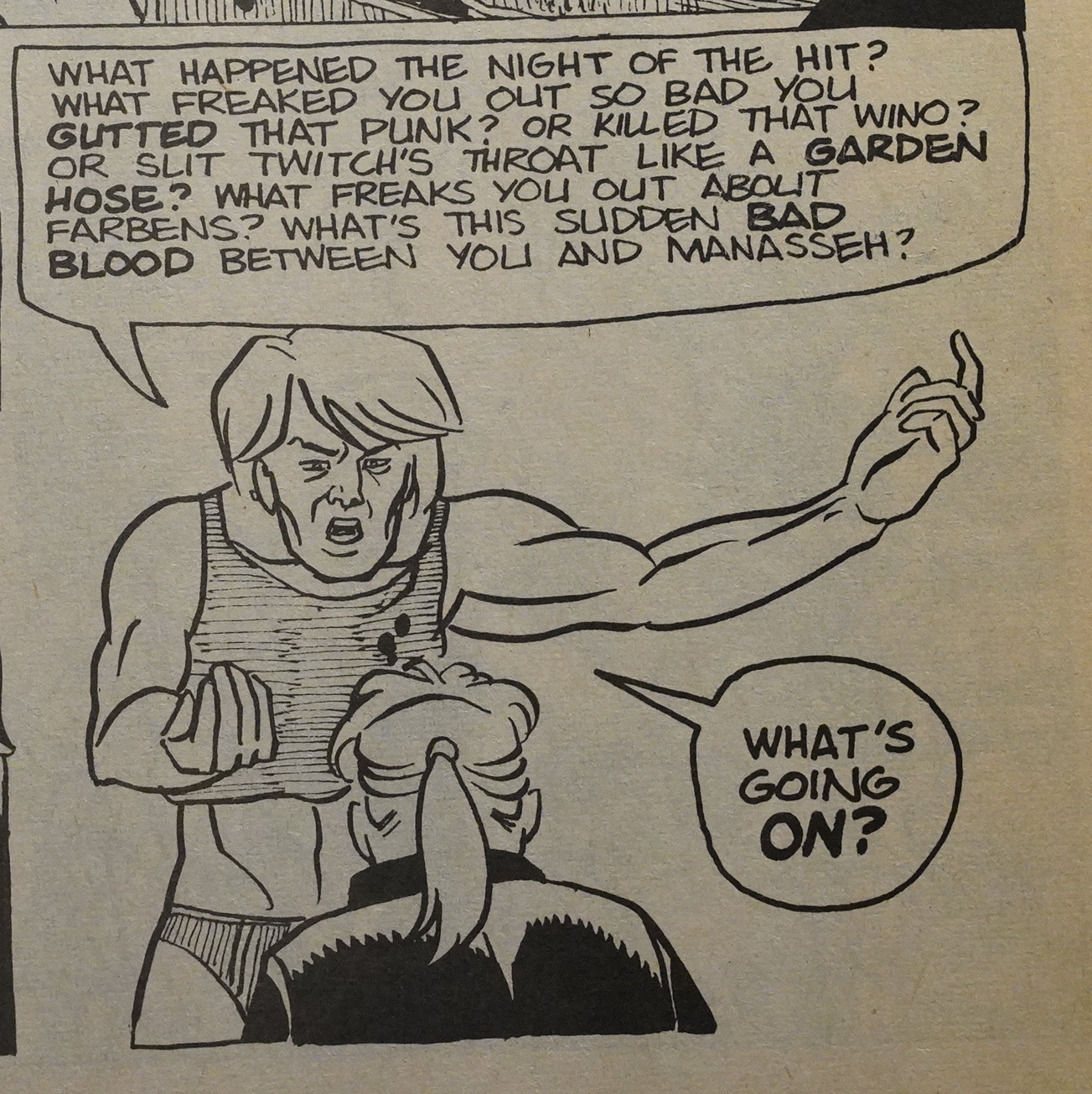
That guy asks the questions we all want to know the answer to.
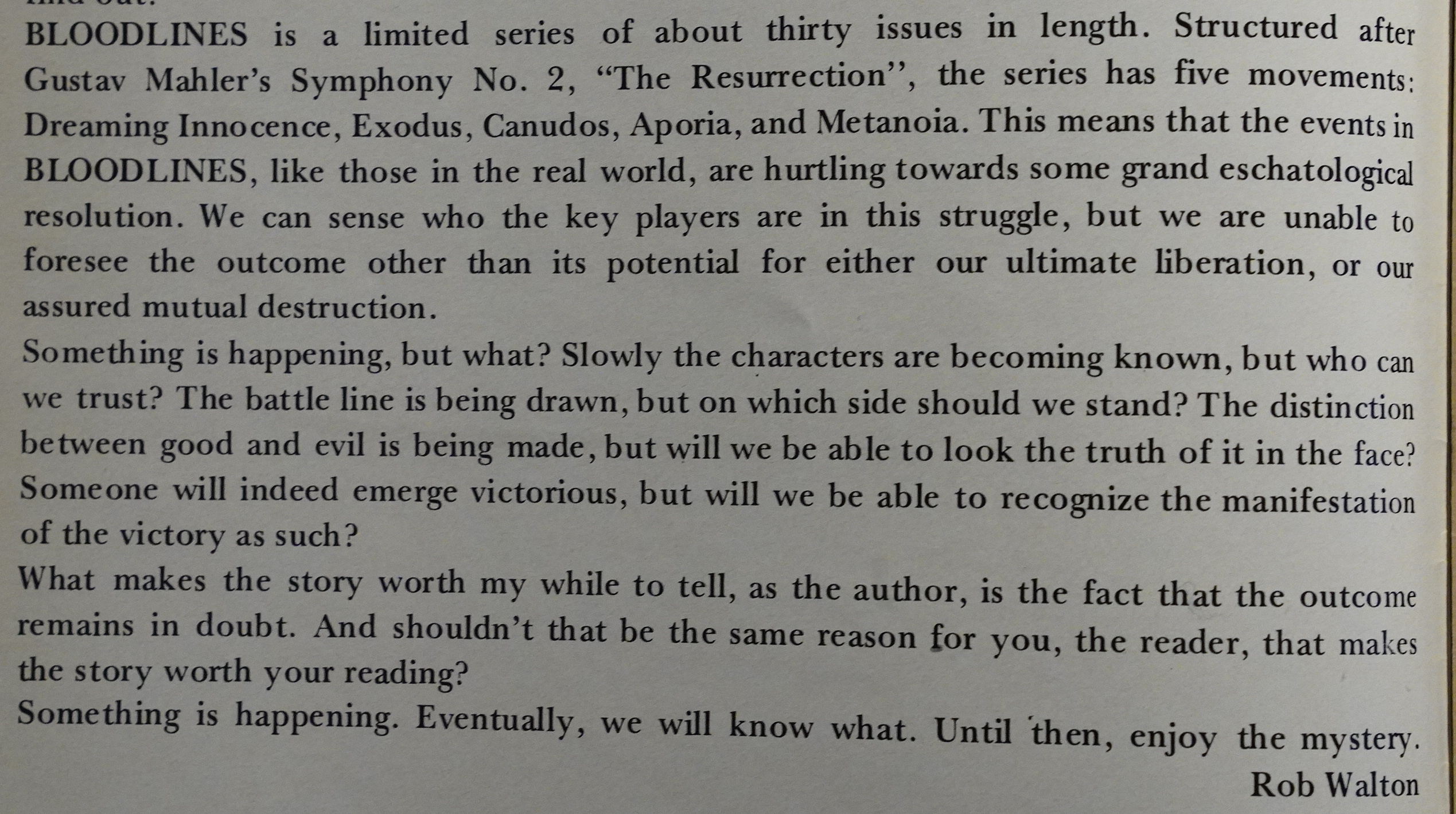
In the first Vortex issue, Walton explains that that the series is going to be about 30 issues, and that it’s structured after Gustav Mahler’s second symphony.
OK.
He also explains that the structure isn’t accidental, but that he wants to let the story reveal itself slowly. I dig that, but the reader has to have confidence that there’s something of interest to puzzle out from the obliquely told story, and… I can’t say that Walton has convinced me. The answer is probably going to be “evil is bad, says the Christian god”, I’m guessing?
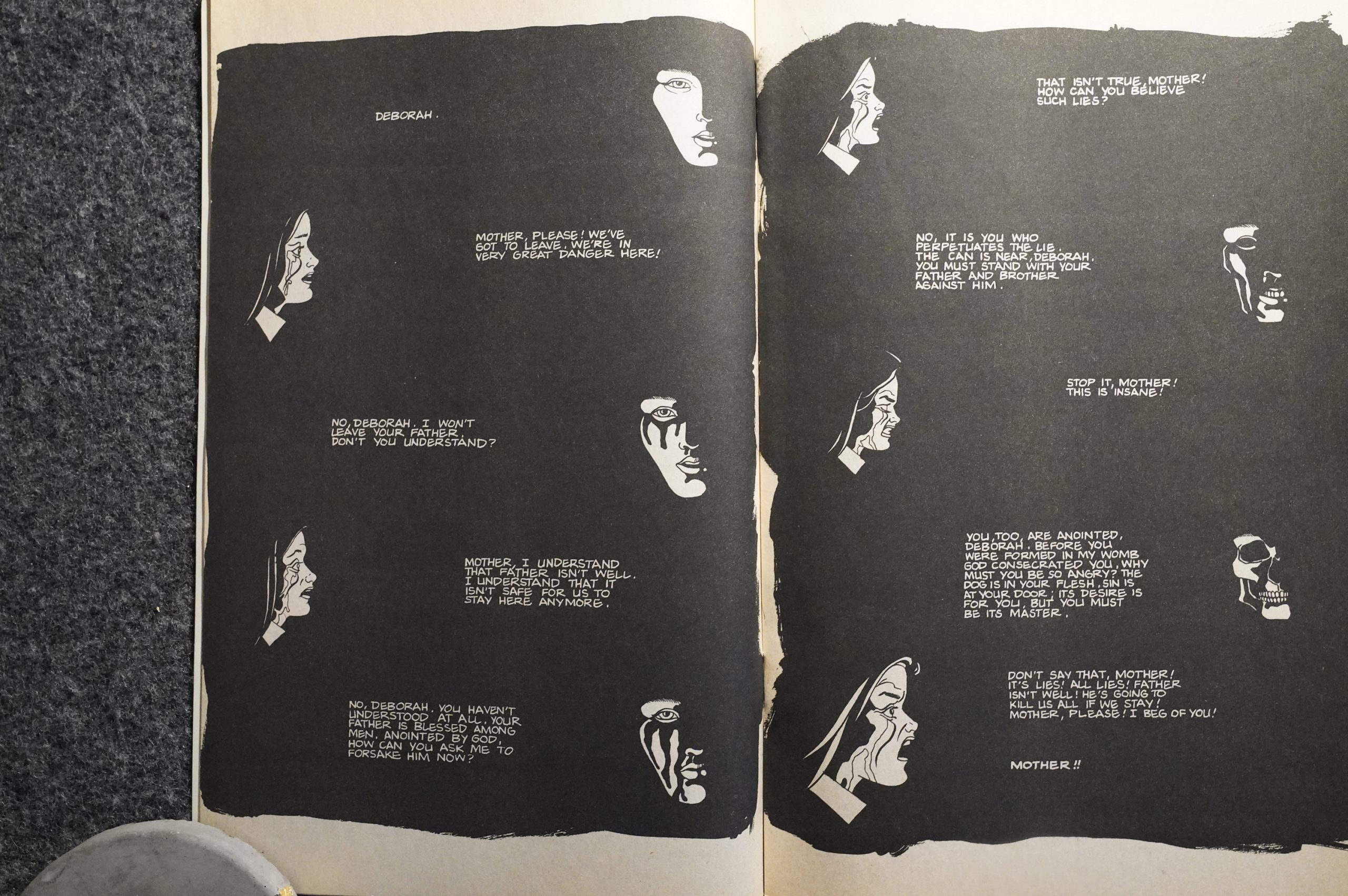
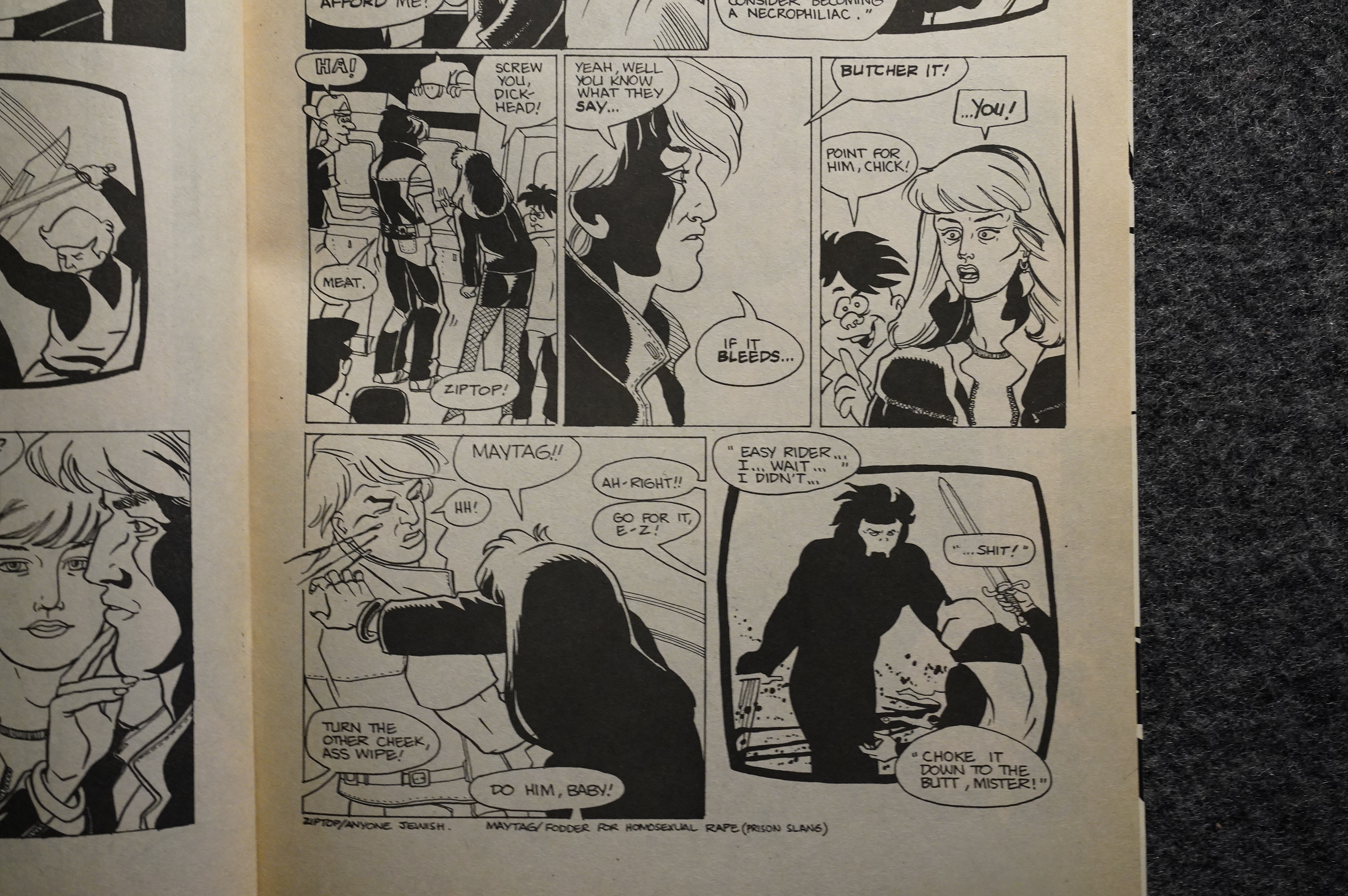
Walton is having a lot of fun with various storytelling approaches…
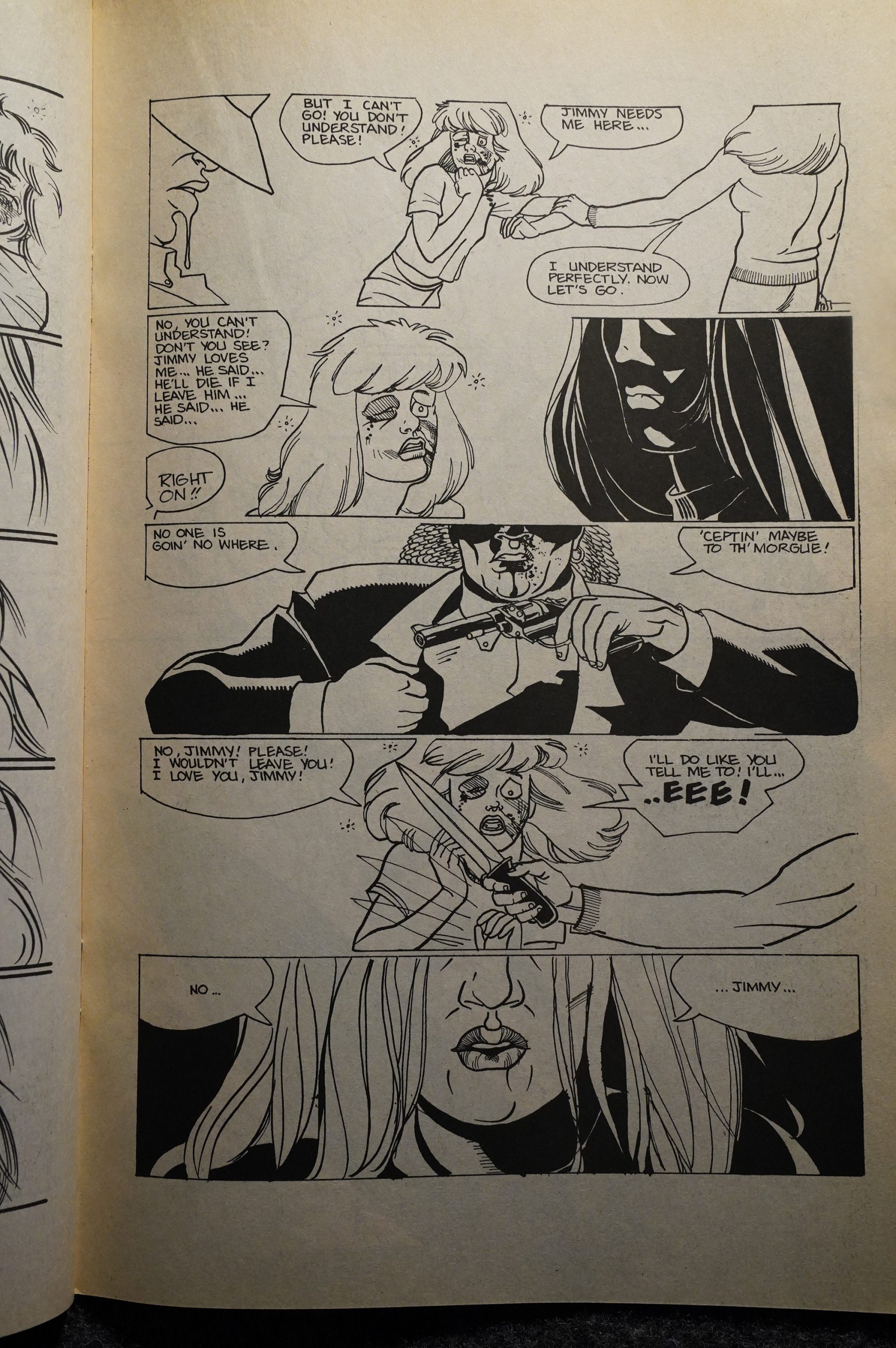
… and so am I. The framing here is a very stylish, and very 1988: Everybody had read Keith Giffen’s Muñoz rip-off pages and been inspired, and this is another example, I guess?
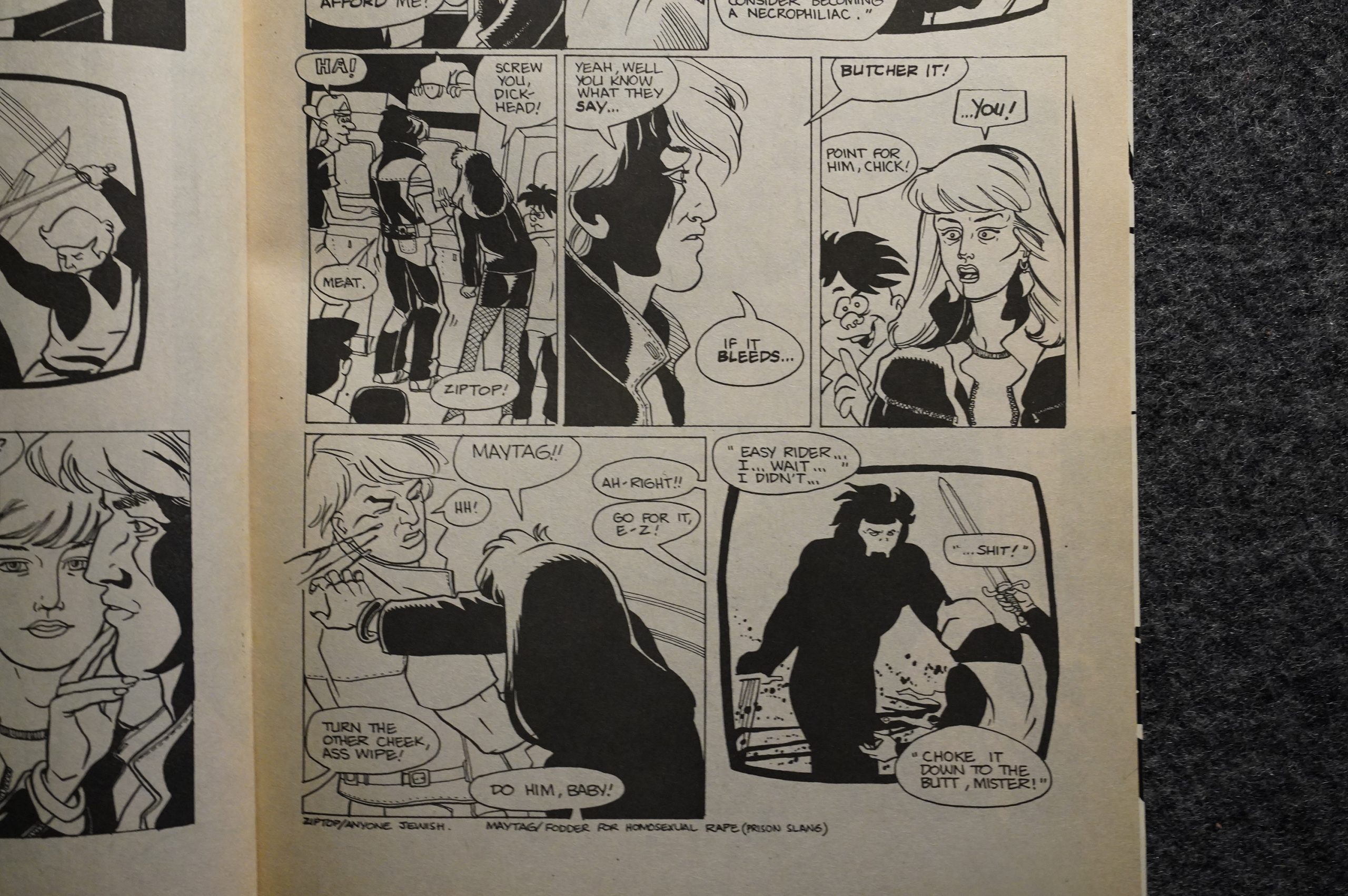
It’s also edumacational. I had no idea what “ziptop” and “maytag” meant. And… I still don’t, I guess. [citation needed], as they say: I googled for “ziptop” and didn’t find anything derogatory. “Maytag” seems to have some provenance, though.
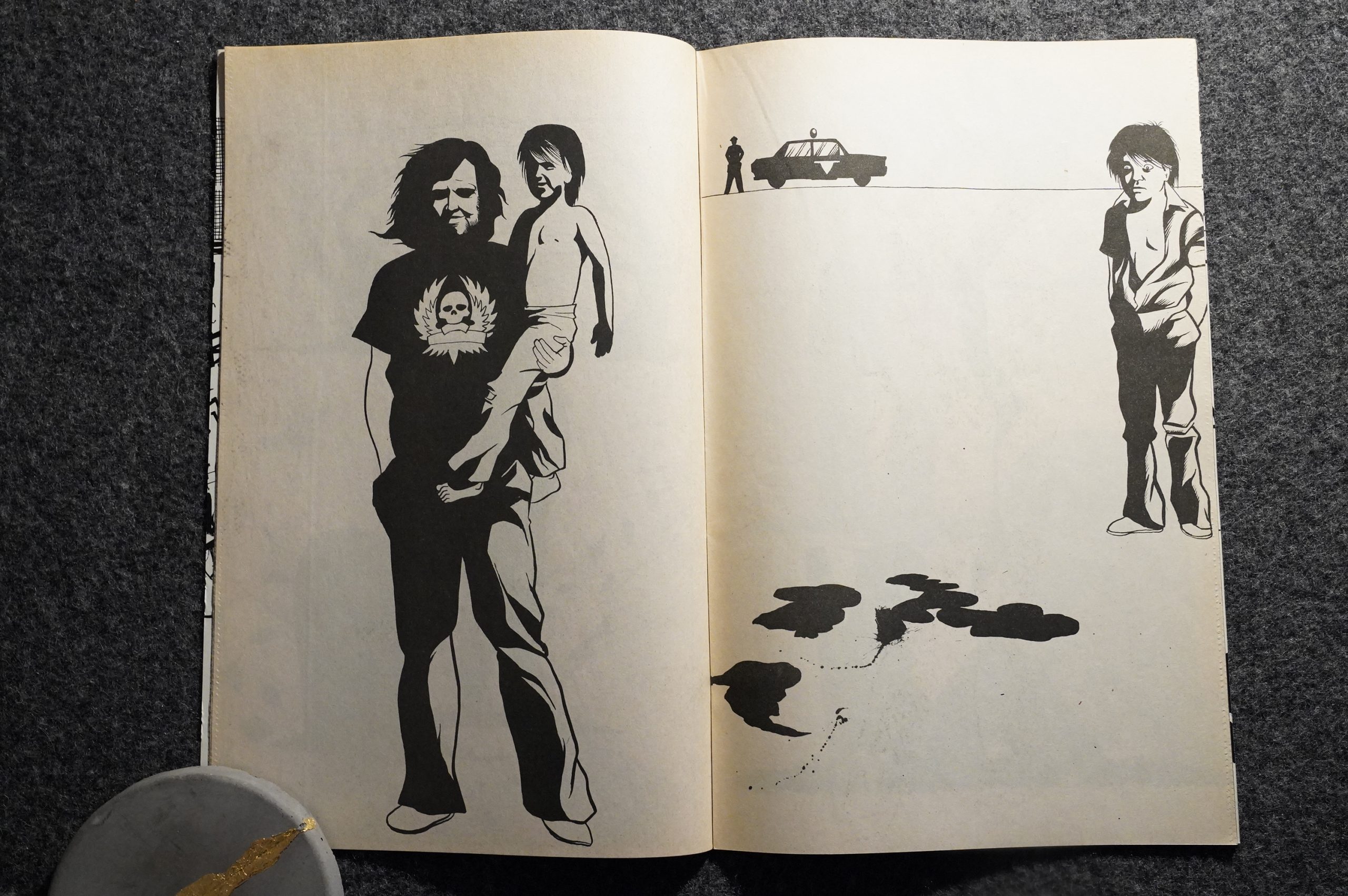
The next Vortex issue is just a bunch of tableaux like this…
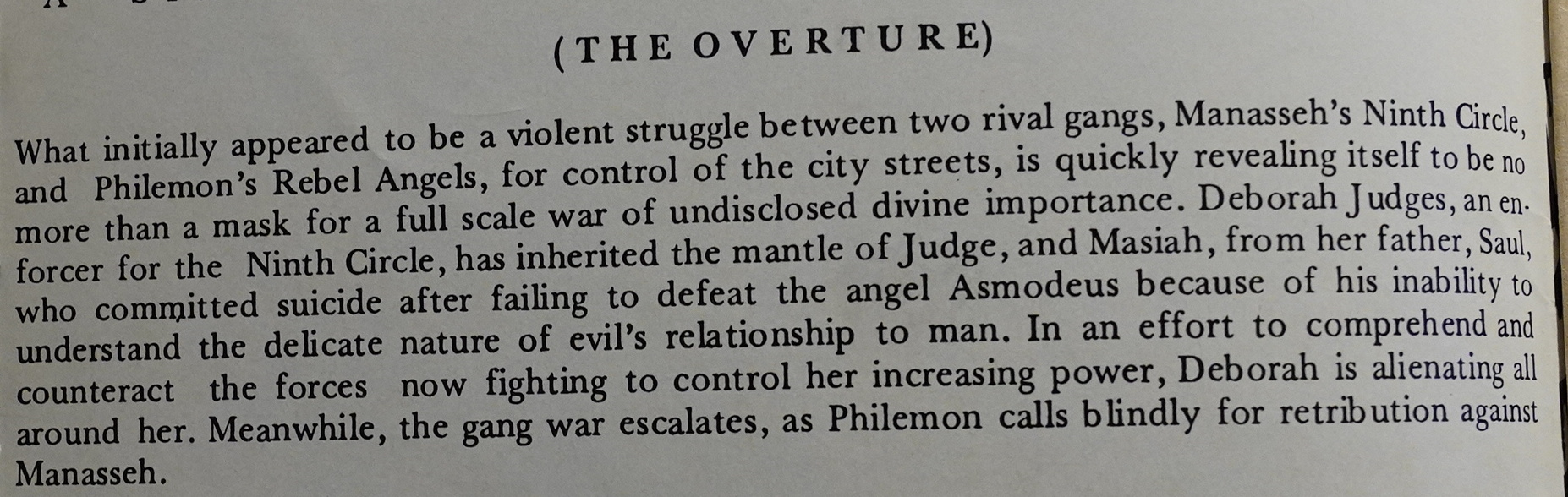
The next issue has a recap of all the previous issues though, and now Walton spells it all out. I think I’d gotten about a third of this?

And the tableaux issue: I had gotten exactly none of that.
Herp derp I eat paste, I guess.
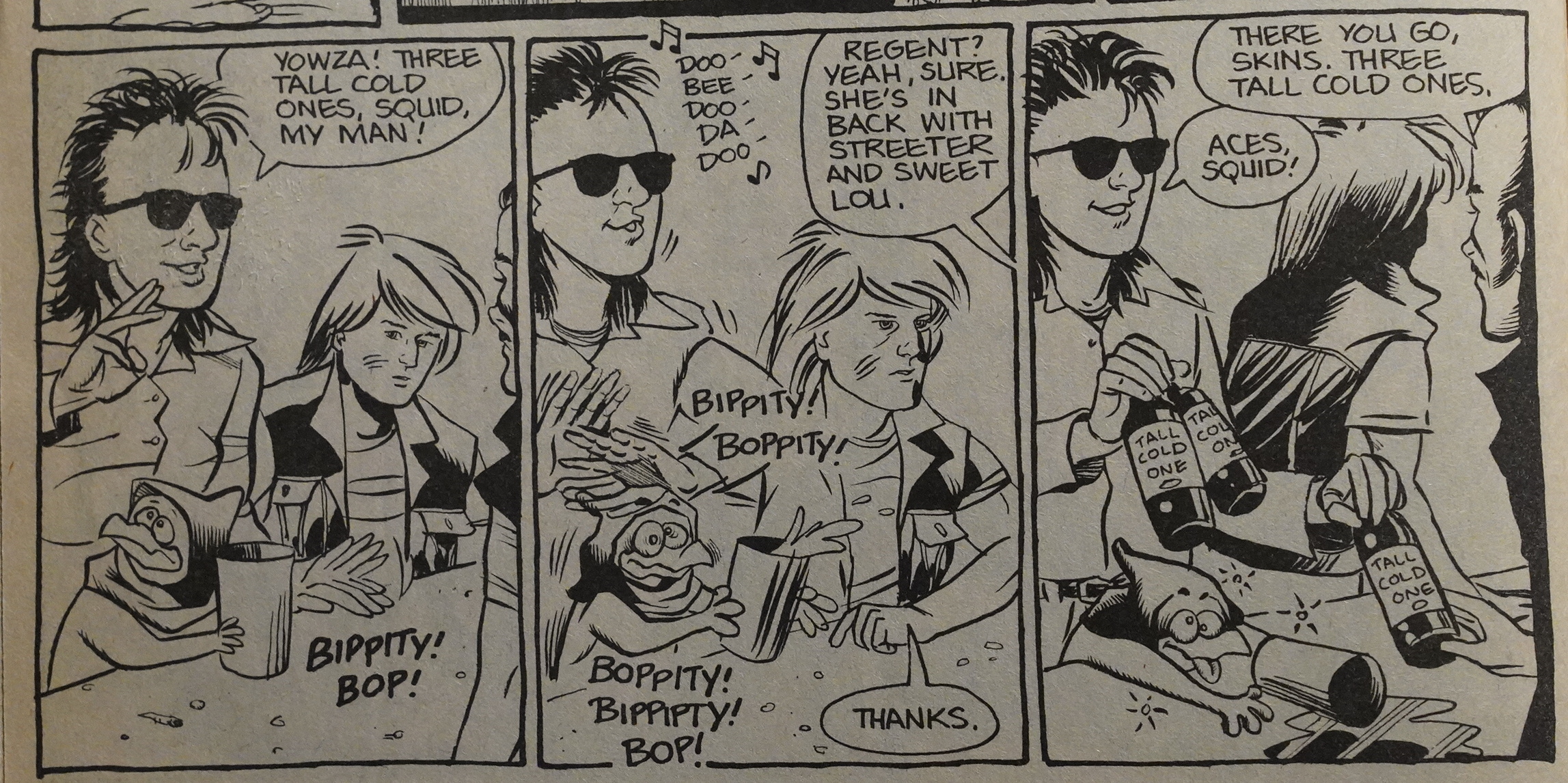
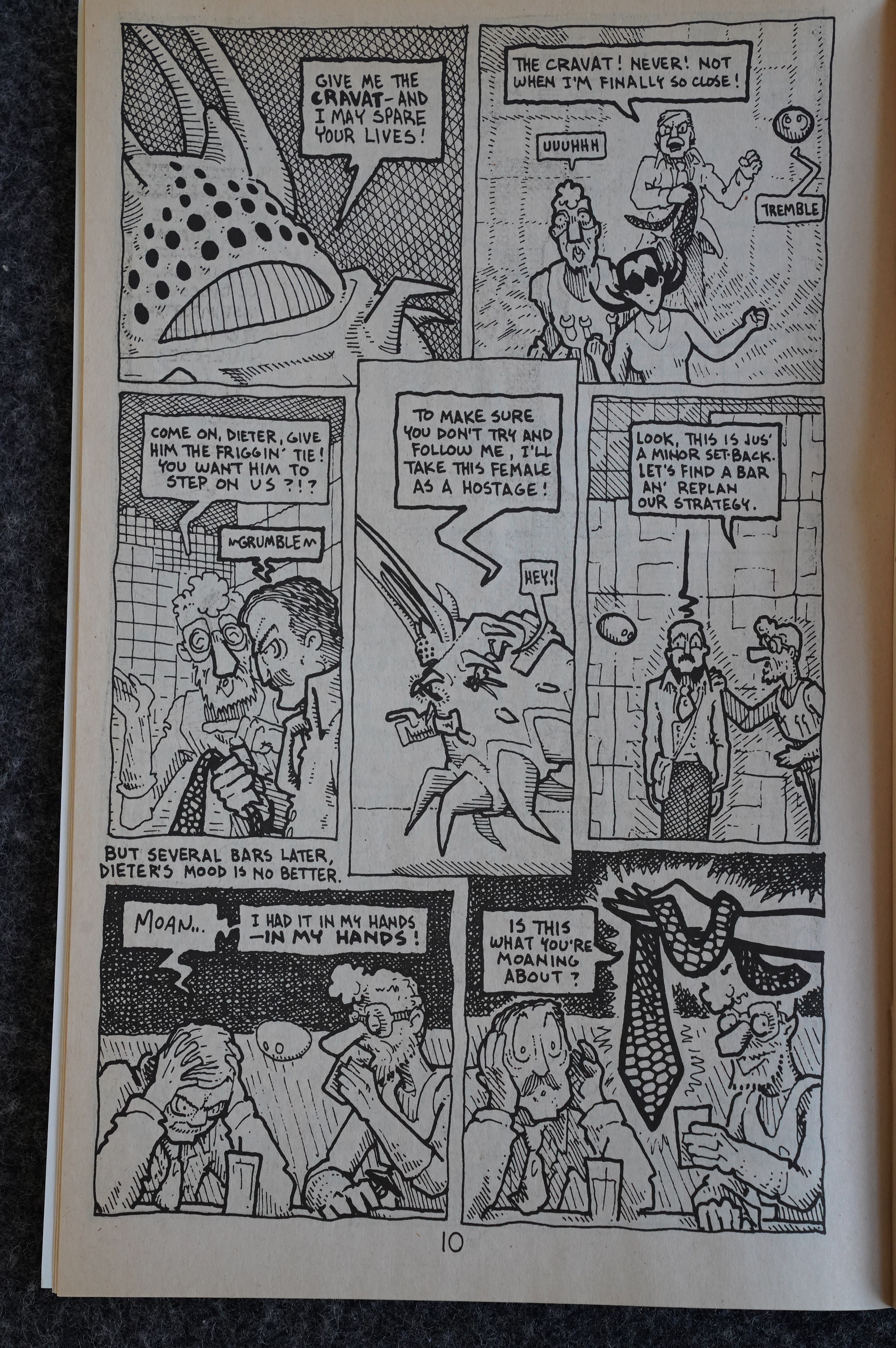
I do love these little … animals? … that sit at the bars and drink without any explanation. They seem to be manhandled by the human(ish) characters a lot; one of them is killed and then shoved into a trash can without anybody commenting much.
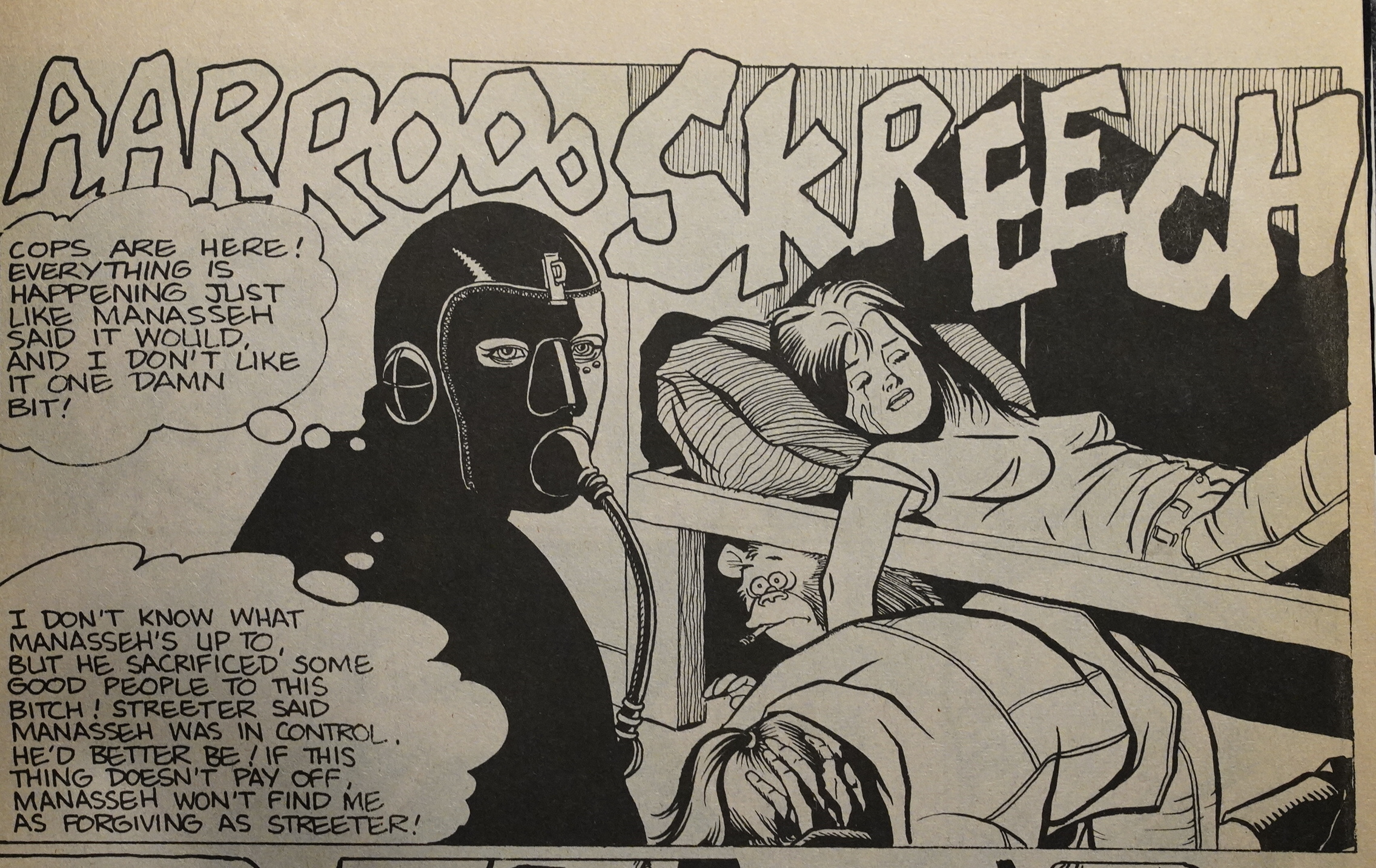
And then in the sixth issue, the charmingly named Treblinka character suddenly starts thinking in thought balloons, conveniently explaining everything to the readers.
So here Walton had totally given up on his plan to let the characters and story reveal itself slowly, and is just infodumping on us.
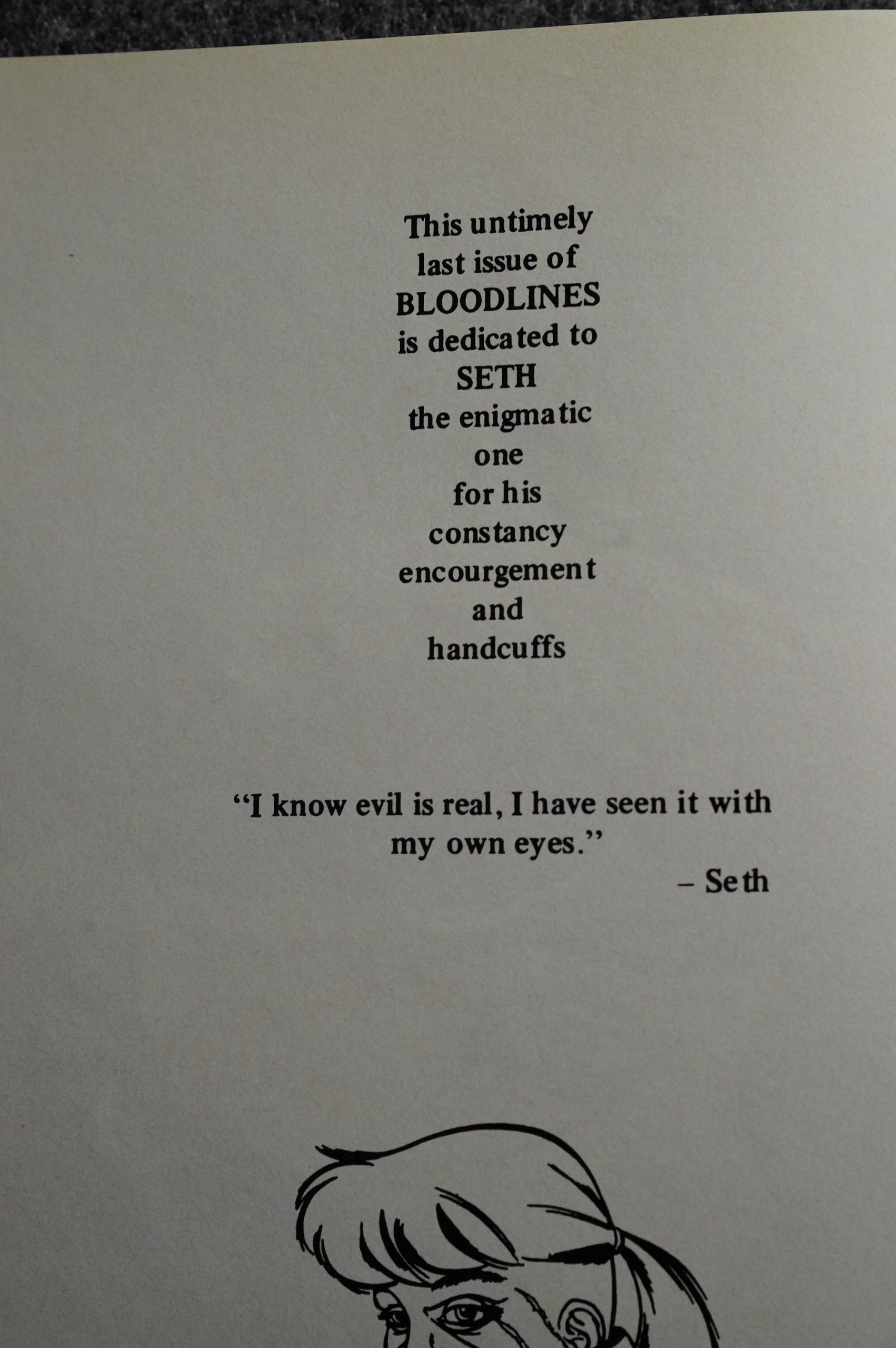
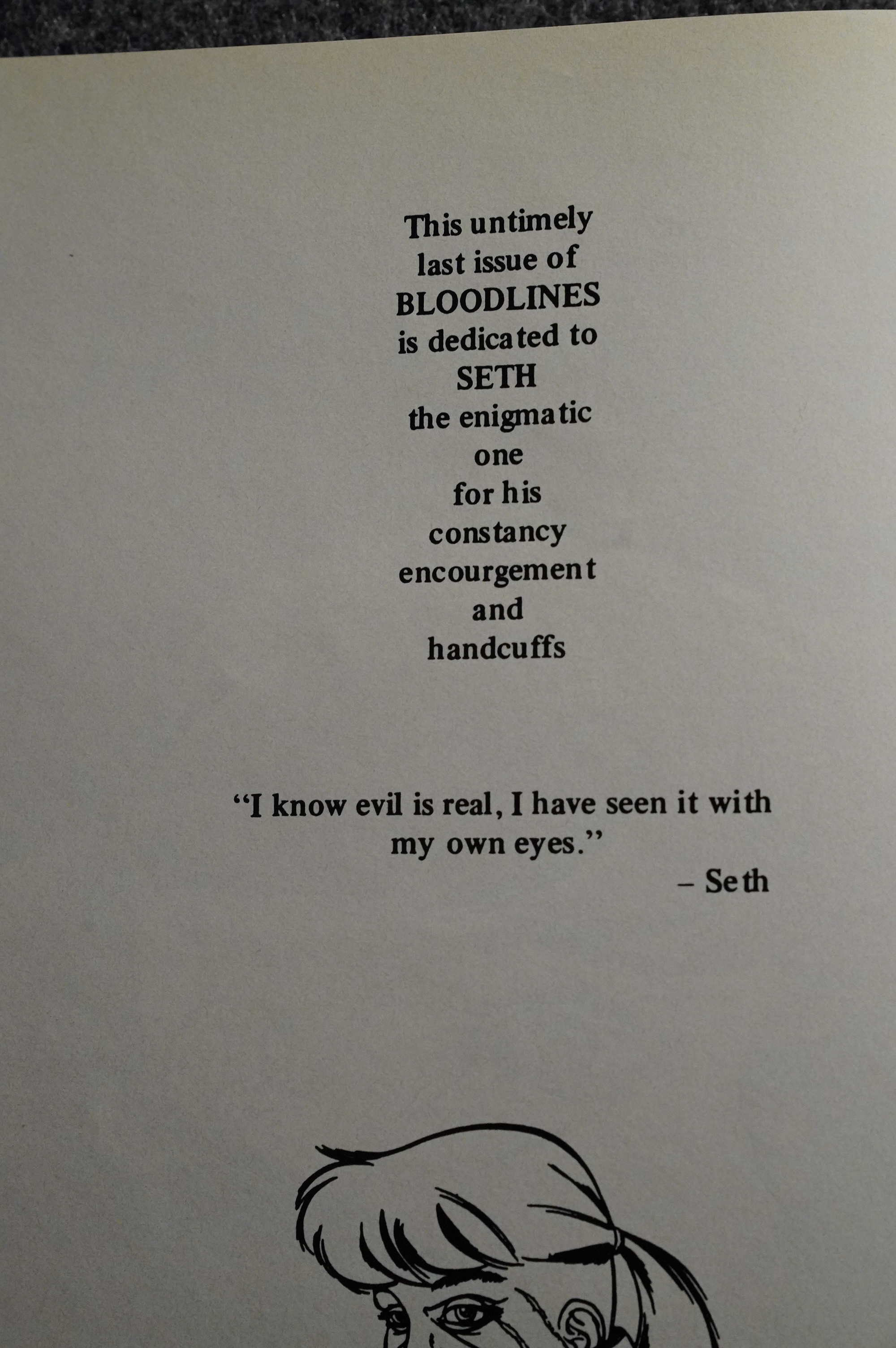
And then the series is cancelled. Dedicated to Seth!? Wat
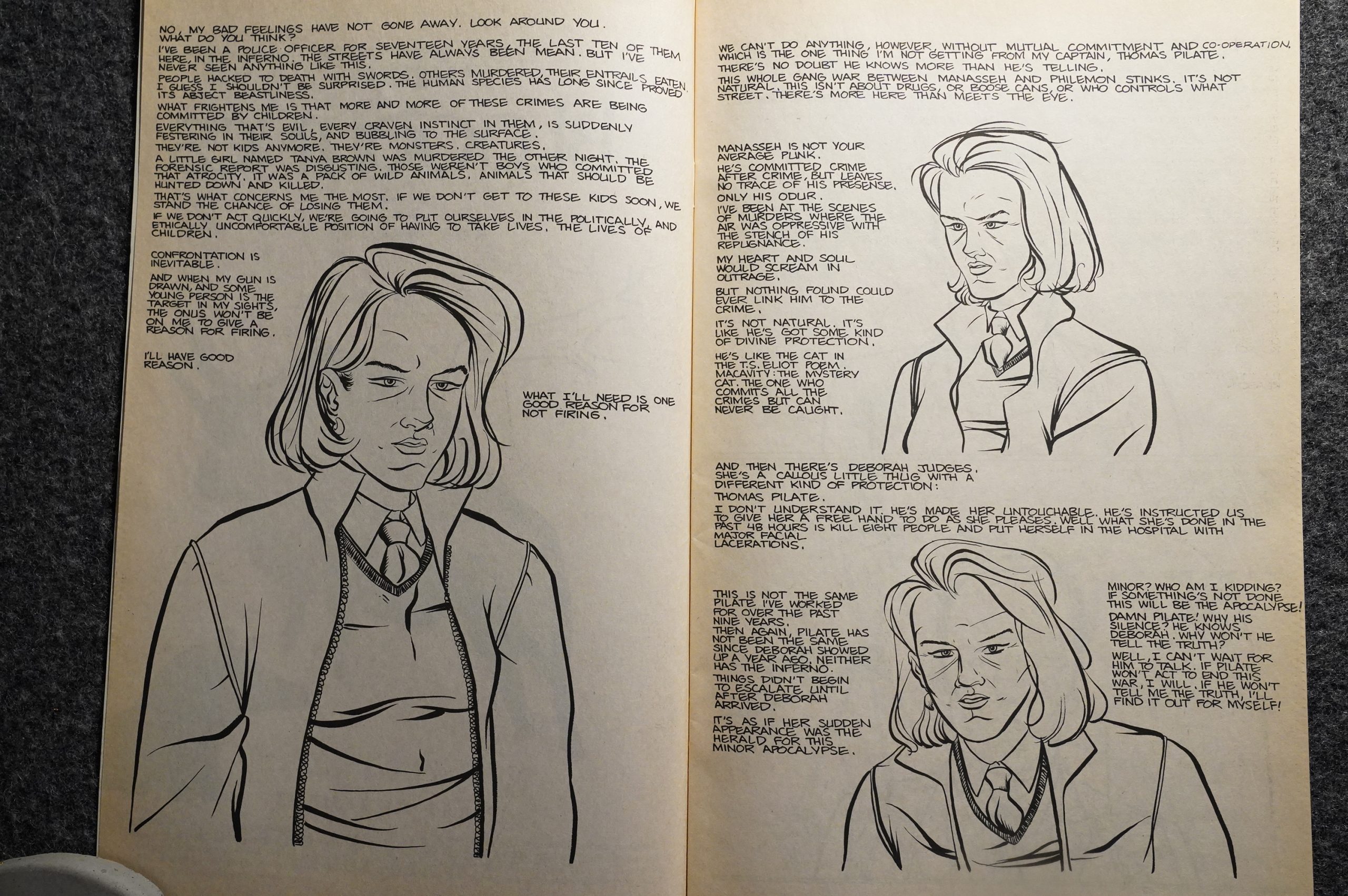
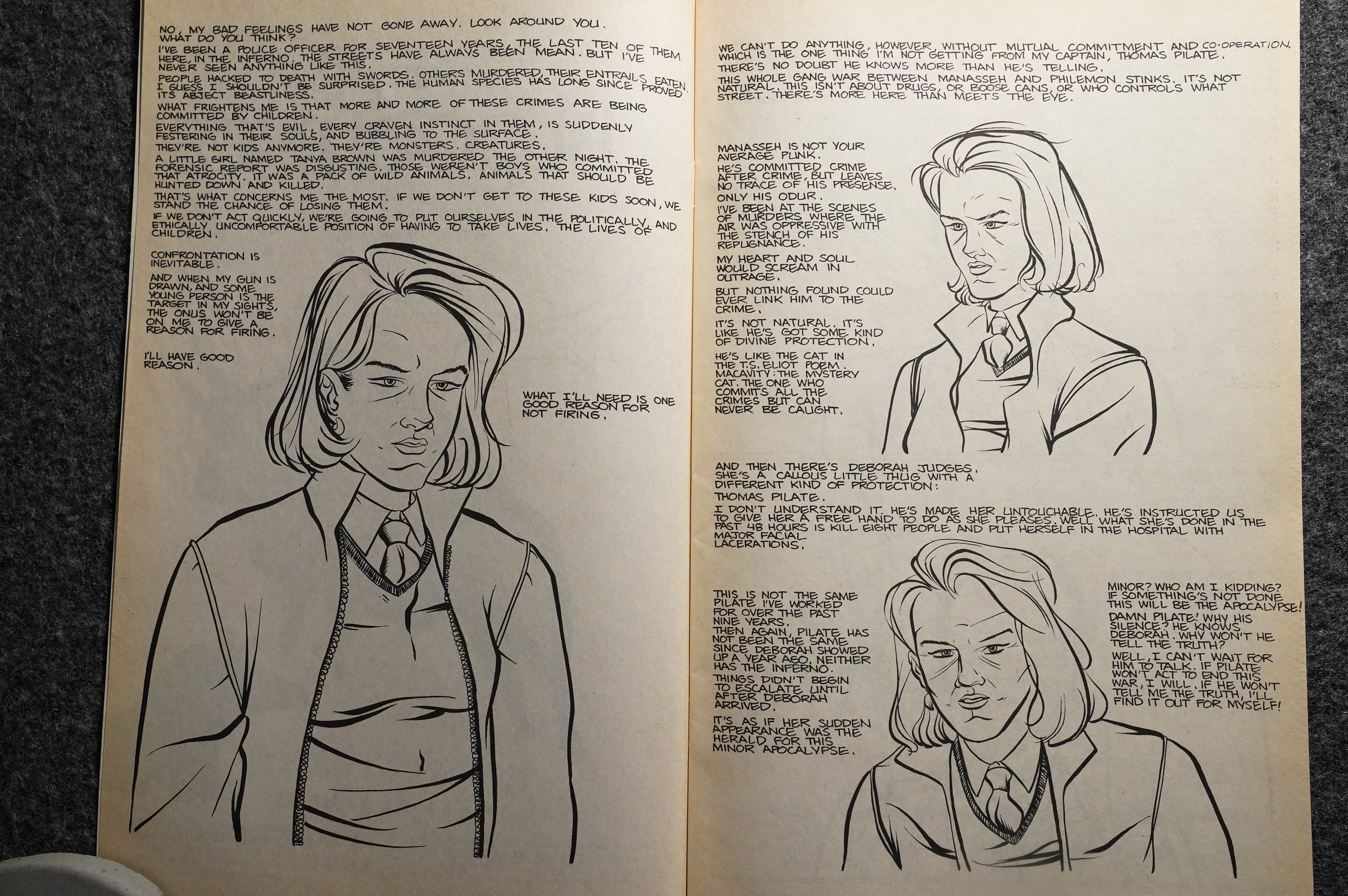
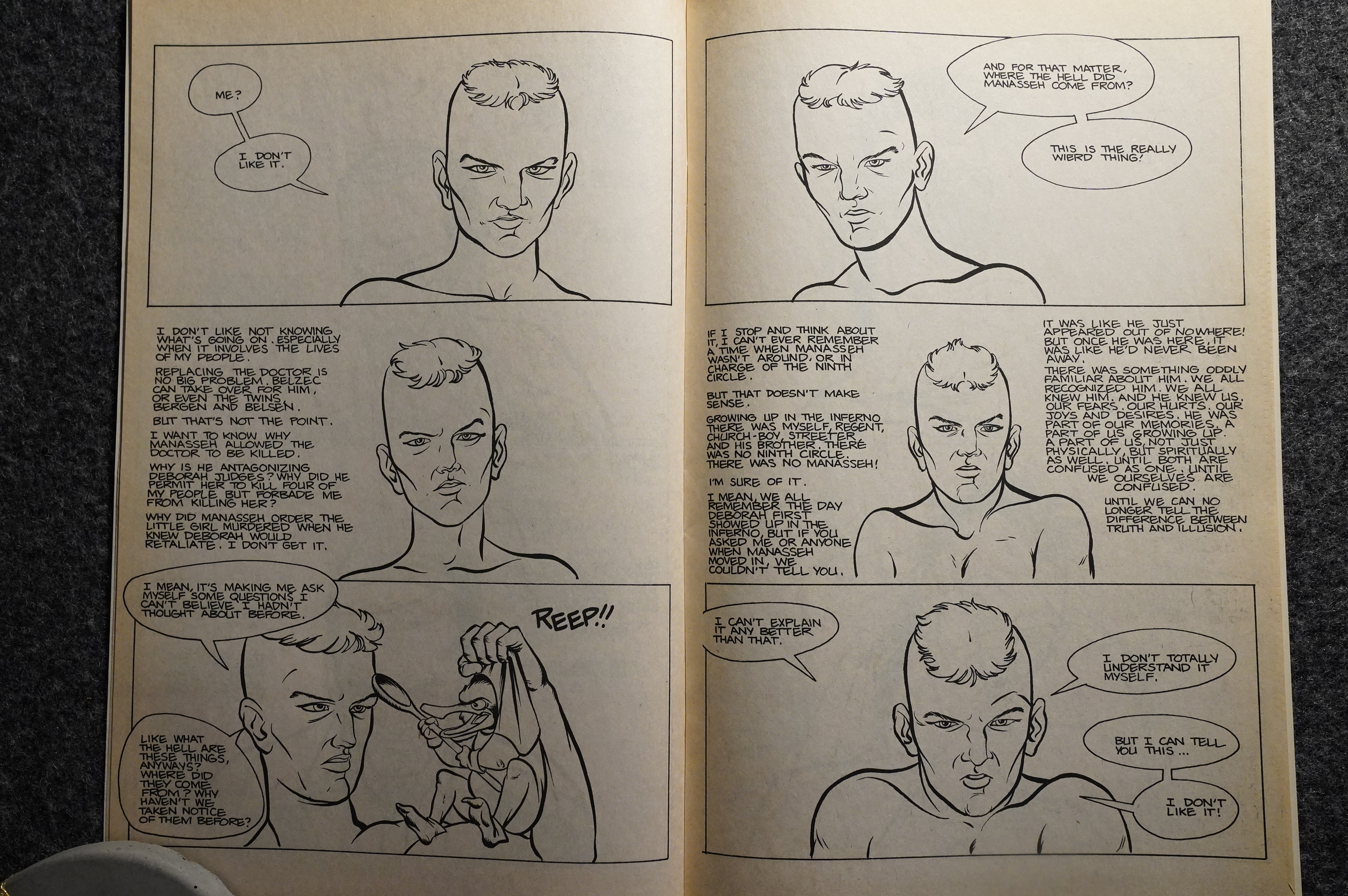
The final issue is all like this. We get most of the er characters we’ve er followed over the issues, and they stand there talking at us, telling us their thing.
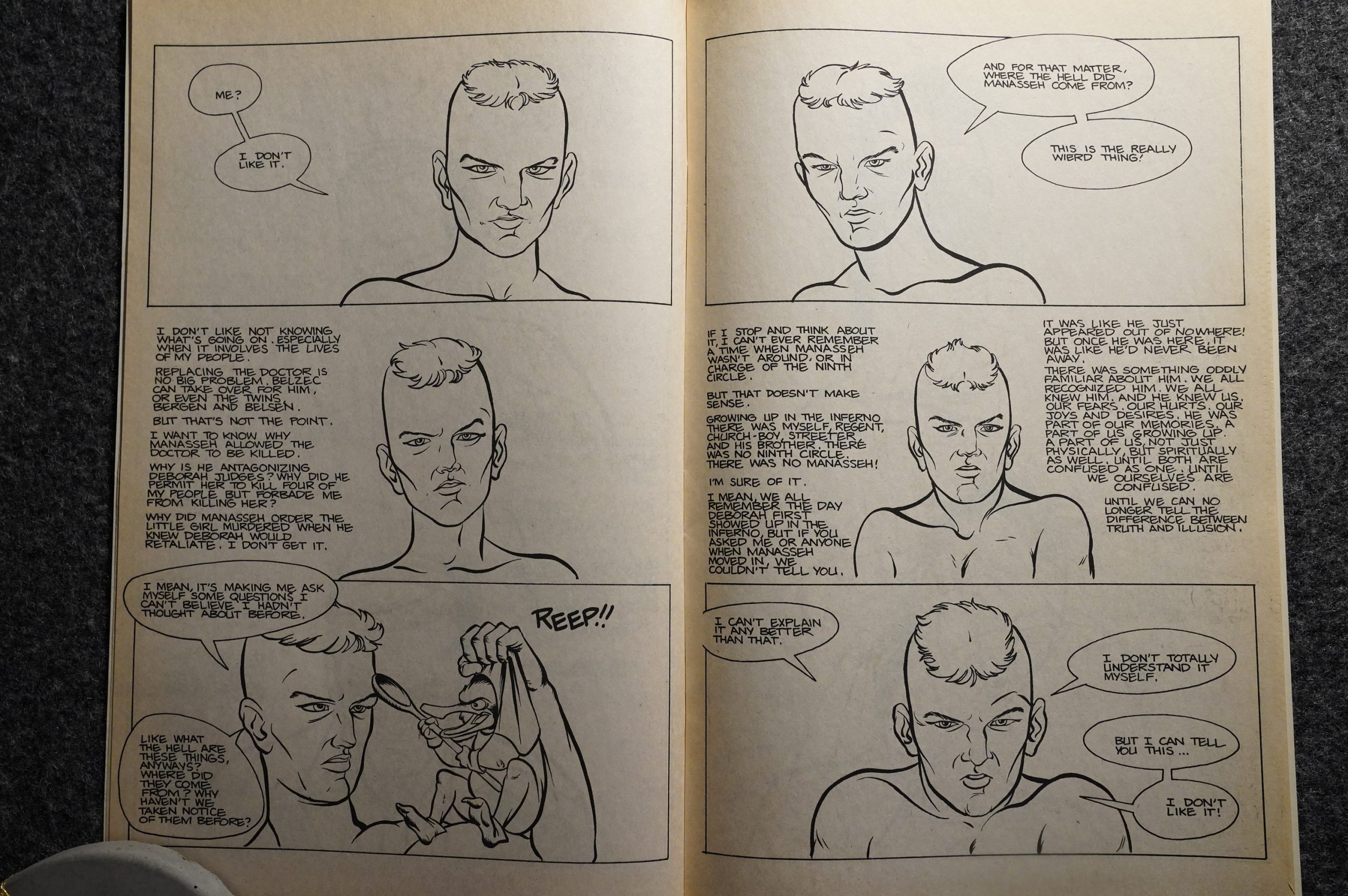
This guy is the most cogent. What were those things!?
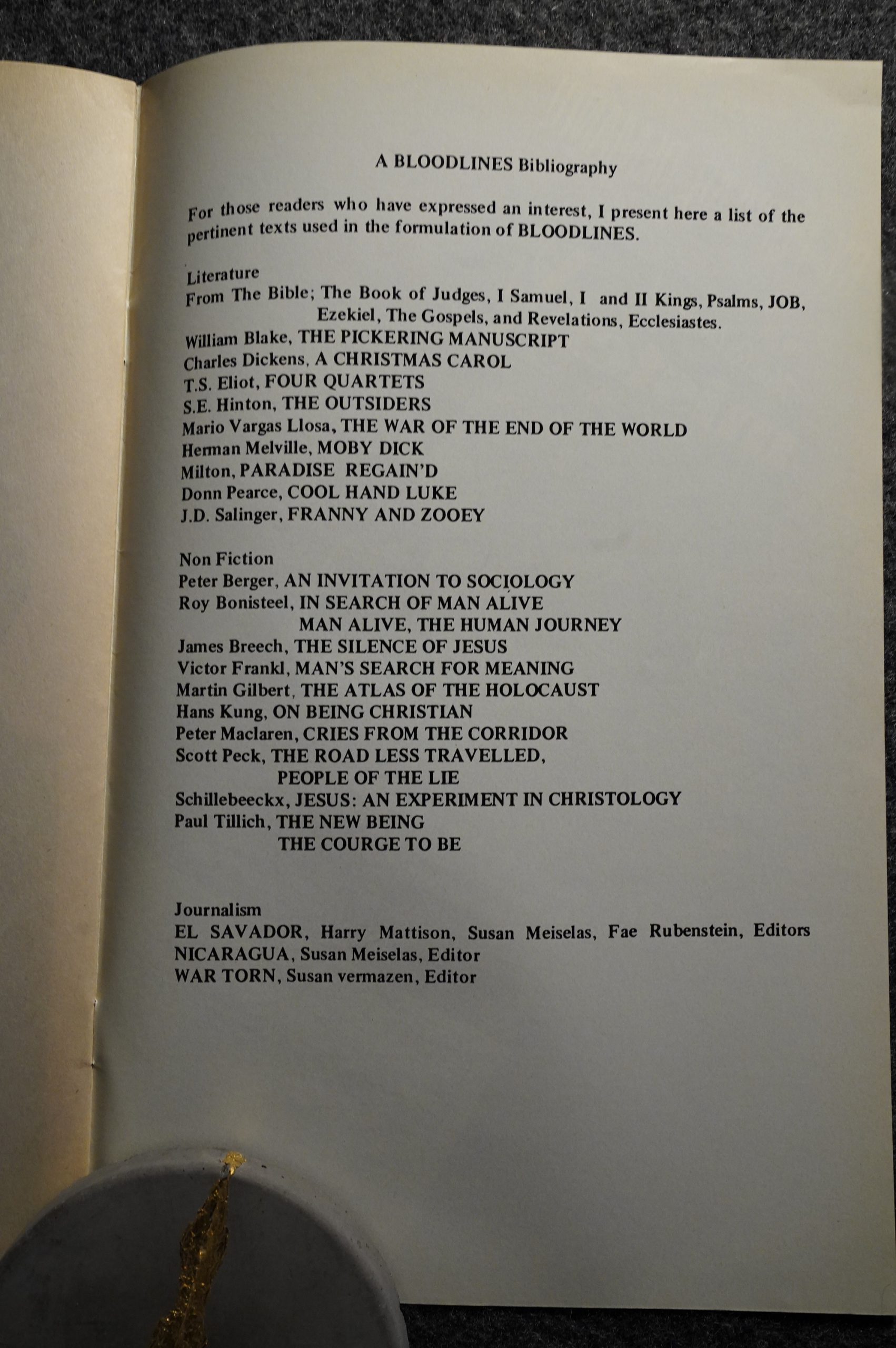
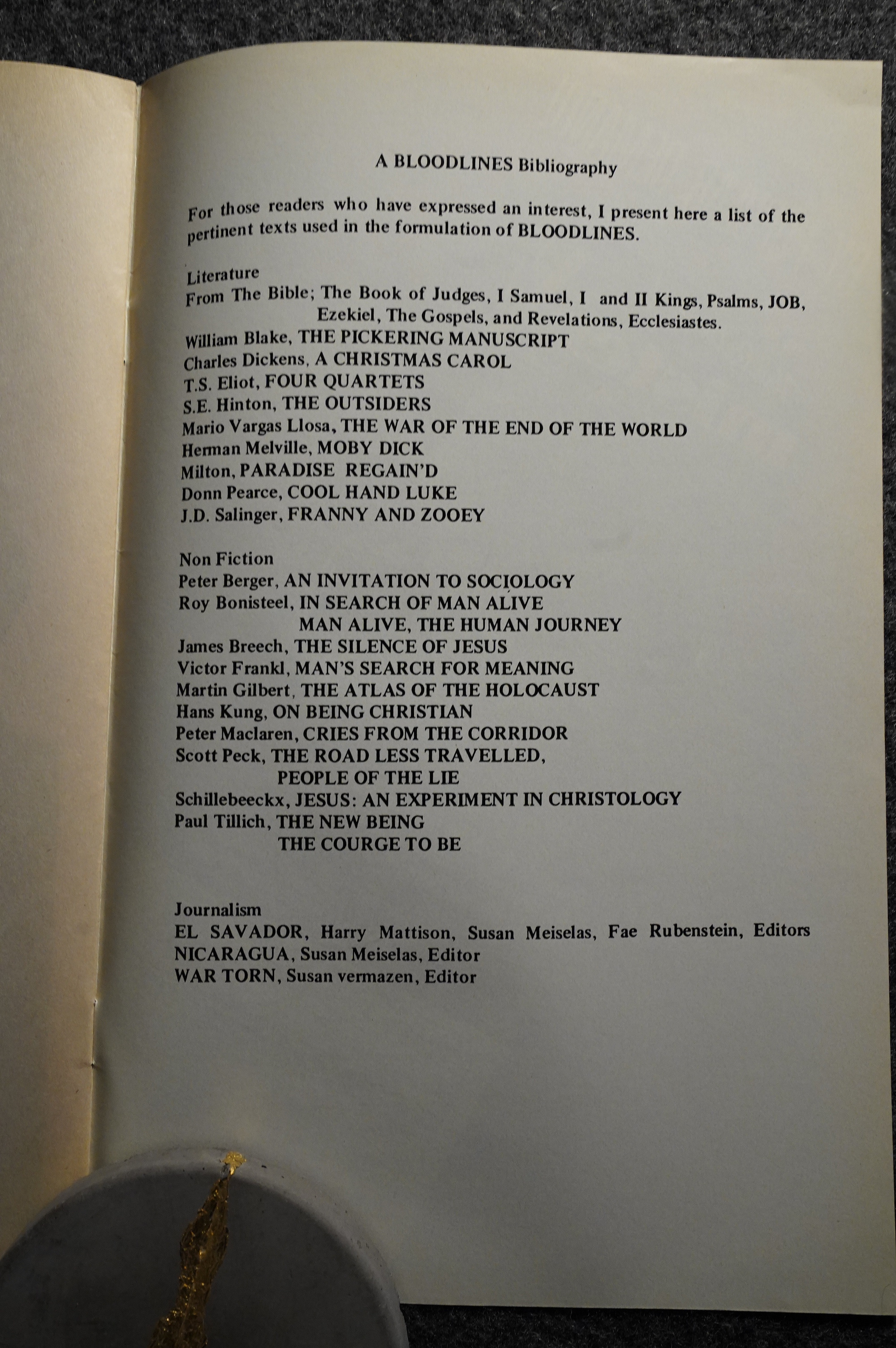
And a bibliography, of course.
Well!
What can I say? It’s a very odd way to end a very, very, very odd comic book. It’s clear that Walton had impossibly high ambitions for this series, and he does almost have the chops to pull it off. Perhaps people who are religious would find the book really, really intriguing? I have no idea; I have no qualifications in that area.
Walton would go on to self-publish the Ragmop series, which is seriously hilarious. Or at least I thought so back then; I haven’t re-read it in a few decades. If I remember correctly, his art style was totally perfect for that series. Like Bloodlines, I think it ended kinda without any resolution? And like Bloodlines, it was also quite ambitious?
Well, let’s research that strange Aircel thing.
“CM” writes in The Comics Journal #124, page 17:
When Aircel Publishing recently
announced that their comic books
would no longer include nudity and
strong language [noted in last issue’s
“Miscellania ‘I, the company was
actually only publicizing what has
Aircel’s in-house policy for over a year,
according to Aircel Publisher Ken
Campbell.
[…]
According to Campbell, the last
flash of nudity in an Alrcel comic was
in a single panel of Elflord which con-
tained an exposed breast. It appeared
nearly a year and a half ago.
Since that time only one major con-
flict has arisen over the policy, with the
comic book Bloodlines, Campbell
said. Rob Walton, the creator of
Bloodlines, produced three issues of
the title for Aircel, which were
published beginning last fall, and was
then told that the comic was more ex-
plicit than his pmposal had indicated.
Walton was given the choice of toning
down the book’s content or leaving the
company. He chose to take the book
to Vortex, Campbell said.
Walton confirmed those events, but
noted that he had discussed Bloodline’s
violent and religious content with
Aircel chief artist Barry Blair before
producing the comics. Walton said the
explicitness only became a problem
when it caught Campbell’s attention.
There… was nudity in Bloodlines? I er didn’t notice?
Somebody writes in Amazing Heroes #133, page 28:
Now that Vortex is publishing Blood
Lines, the company has its first monthly
title. Publisher Bill Marks is very enthu-
siastic about the book. “It’s exactly the
kind of unusual material we look for at
Vortex,” he says. He adds that the book
has been cut to 24 pages frotn 32 in order
to give creator Rob Walton more time to
produce his best work.
Walton is in the process of telling an
ambitious tale which he has structured
after Gustav Mahler’s “Resurrection
Symphony” (#2). The first three issues
of the book correspond to the Overture
and with #4 and 5. we are squarely into
the first movement, “Dreaming Inno-
cence.••
During the “Dreaming Innocence”
issues, we learn a great deal more about
Deborah Judges. We will learn a bit more
about her past and watch her as she
reaches a decision as to whether she will
take up the duty for which she has been
chosen.
The story will progress in a slow
deliberate manner. Being a mystery of
sorts, clues will be laid out to make the
reader think. After all, part of the fun
of mysteries is their unraveling. So things
will slowly become clear to the reader.
This first movement will also set up
adversarial boundaries for Deborah and
Manasseh in a most dramatic manner.
Meanwhile, the roles of the deities
involved (Asrnodeus and Abba) will
remain ambiguous both in terms of their
relationships with each other. and with
Deborah.
Abba, who is also the Grey Monk,
will exert a certain amount of influence
with Deborah. He will figure in her
decision to accept (or not) the duties with
which she has been charged.
The “Dreaming Innocence” storyline
will cultninate in the death of a major
character. It will be dramatic. and it will
be final.
Some items of inteyest for the reader
will give the series a bit tnore depth.
Creator Walton tells us that “Everyone•s
name has literary and philosophical
implications. There is a link between
Abba and Asmodeu.s as their names will
show.
“We’ll be taking a serious look at
Deborah’s fa:nily background. will
find out what happened between her and
her father on the farm that day.
“We will also see these things through
Deborah’s eyes—it will be her interpre-
tation of the events. With her father being
unable to give his interpretation, we will
see only one side.”
Although there is a lot of violence in
Blood Lines, most of it occurs “ofE
camera.” What you see is not gratuitous.
“There are specific purposes behind
everything that happens in the series.
Everything, including the violence,
moves the story along,” says Walton.
According to Walton, we will also
learn more about the cop’s relationship
to Deborah. will find out who knows
whom, and why. And, Maxine will move
up in prorninence in the storyline.
Blood Lines is a complex series that
relies heavily on the form of Mahler’s
second Symphony for its structure and
the Bible for its substance. But above all,
it is a rousihg yarn with vital characters.
fast-paced action and a dash of philos-
ophy.
Creator Walton says that he wants to
tell an intelligent. moving and involving
story. Publisher Bill Marks says that he
is doing just that.
Somebody writes in Amazing Heroes #145, page 41:
In something ofa surprise move, Vortex
has cancelled Blood Lines. The last issue
was #7.
Creator Rob Walton says that for the
time being he will put the title on hiatus
rather than shopping around
for a new publisher.
In the meantime, he is busy giving
Dean Motter an art assist on the Prestige
Fonnat PHsoner series for DC. It should
be out in August and you can find more
info on it a little farther along.
Also, Walton and Charles Vess have
a series planned around the ancient
Norse gcxidess, Skade. spent four
years researching the series, so the book
will be authentic. He says it may seem
a bit like a “Norse Blood Lines.” It will
feature theological underpinnings, as
well as a fast-paced, adventurous
storyline.
Also by then, Walton hopes that he can
have Blood Lines back on track. “It’s a
story I really want to finish,” he says.
“It is ambitious and not like anything
else on the market. It would be a shame
for it to trail off into limbo unfinished.”
Bloodlines has never been collected or reprinted, but you can pick them up cheaply from (for instance) the Koch brothers:

Oh! Walton has written a bit about Bloodlines:
In 1987 I embarked upon an ambitious project that pushed my fledgling abilities to the breaking point and tested the limits of my reader’s patience.
[…]
The non-linear storytelling was unconventional and confusing for readers who put little trust in an unknown artist-writer. Publishers too, lacked support and courage for the project. Aircel abandoned it after three issues due to its controversial material. Vortex canceled the series after issue #7 precipitated by my experimental and disastrously printed fifth issue.
And Miramax was considering a movie based on it, apparently…
This blog post is part of the Into the Vortex series.