A&R1987: French Ice

French Ice (1987) #1-13 by Lelong, Binet and others

You can’t really say that the end is within reach for this blog series, but we are kinda starting to see Renegade winding down: This is the final series they published that reached double digits.

But we’re in February 1987, and the black and white boom hadn’t busted yet. I did have these comics as a teenager, I think, but I remember absolutely nothing about them. It’s an anthology translating stuff from Fluide Glacial? That’s all I’ve got.

Let’s read the first six pages together:

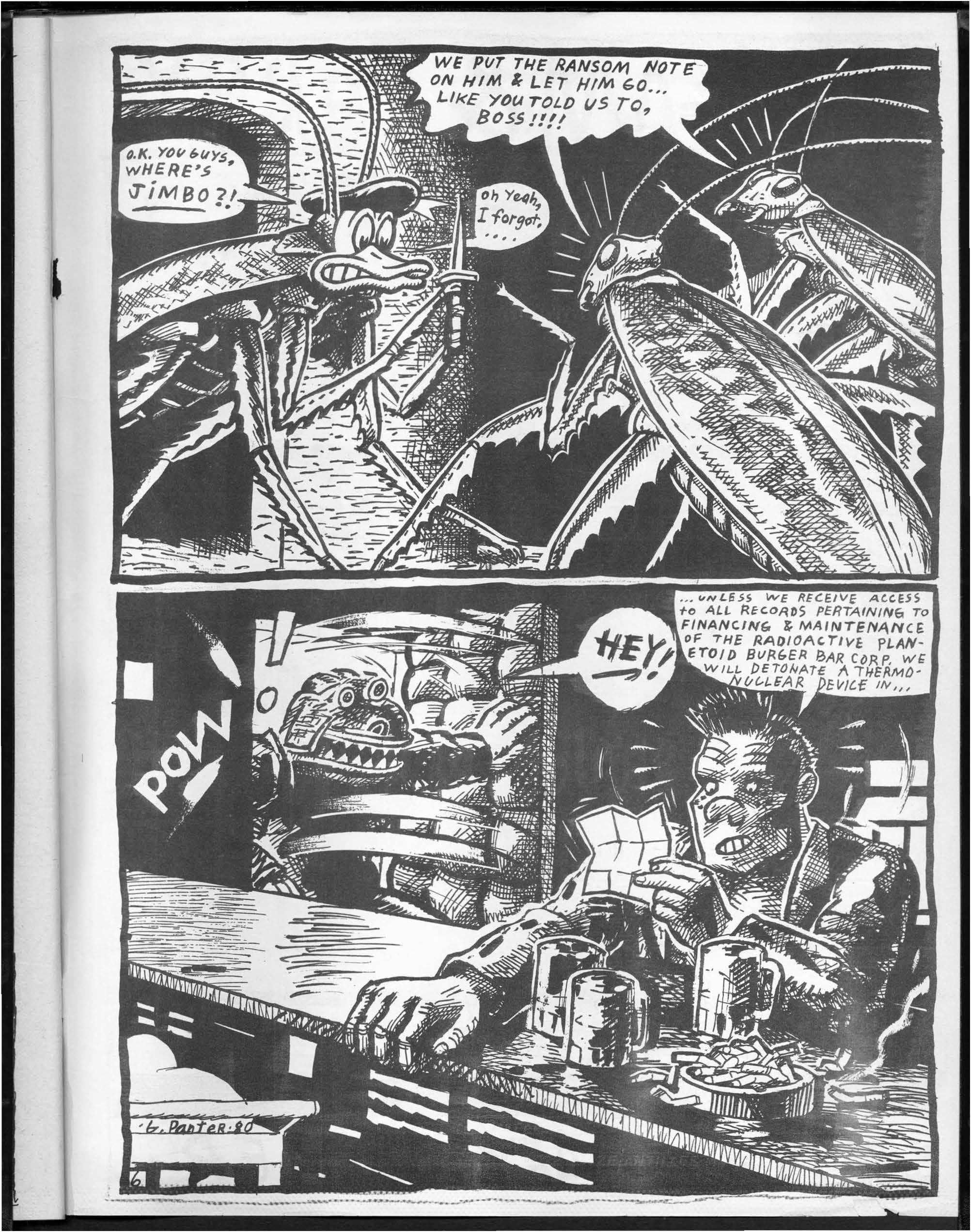
Yup; this is French, and no, French Ice isn’t really an anthology: The first six issues feature nothing but Carmen Cru, and that is indeed a series that ran in Fluide Glacial.

Now, I’m not a publishing genius or anything, but even during the black and white boom, bringing over a humour series about a nasty old woman, drawn in this hard-to-reproduce art style, printed on newsprint, doesn’t seem like the obvious get rich quick scheme. Humour comics are hard enough to get people to buy, but this is a tough sell.

But then again, it ran until Renegade was shut down, so it had to make some money. I’ve seen other inexplicably translated series being published here and there, and those have often turned out to exist because of export subsidies: That is, the Dept. of Culture in whatever country will sponsor translations and publications in other countries… but there’s no sign of that here, so I guess… Renegade just managed to get people to buy it somehow?

At (* 13 24) => 312 pages, this represents something of an achievement for an alternative comics publisher in 1987.

The Carmen Cru stories range in length from three to six pages, so you’d expect reading these would get kinda repetetive when done in a single sitting (as I’m doing today). The stories are also basically the same thing over and over again: Cru is a misanthropic woman with few positive characteristics, and she always comes out on top. I expected Lelong to pair her up with characters that are even worse than her, so that we can get on her side… but no — Cru is mostly taking advantage of people being nice to her, and hilarity ensues. The end.

It’s very French.

As was common with Renegade, the artists name doesn’t appear anywhere in the comic — except for a single signature (seen above). I don’t think that’s by any kind of ill will, but Renegade seemed hands off to an extreme rarely seen at other comics companies: The creator (or translator/editor in this case, R J M Lofficier) deliver a package, and Renegade publishes it, and mistakes happen.

Lofficier sent out xeroxes to a bunch of comics people, so the letters pages have stuff on them from the very first issue.

I had expected Carmen Cru to get more character development… That is, most comedy series that start out with a horrible protagonist feel like they have to make the protagonist more likeable. And that usually kills the humour. Lelong doesn’t really do that — except with Cru’s relationship to animals. Here she’s thrown some water over a cat that annoyed her, and that cat then went on to claw one of her annoying neighbours… which makes Cru become fond of the cat.

I guess that’s a softening of sorts, but… it’s still funny.

Lelong’s character design is absolutely absurd. Look at those three faces. Just look at them!

We get an introduction to Jean-Marc Lelong, and … apparently they’re doing a stage version of Carmen Cru!?

This is Lelong’s favourite storytelling trick: He’ll have some monumental action going on outside the panels, but all we’re getting is the dialogue, and we never see anything other than Carmen Cru walking away (from the disaster she’s created). Is this because Lelong didn’t want to go to the trouble of drawing the colliding trains? Probably! But it also works as a gag.

Also note that they’ve started filling the extra space at the top of the page with some cartoons. (Carmen Cru was originally drawn for “album” dimensions, which is wider and not as tall.)

Heh. Walter Simonson notes the oddness of not actually saying who the creator was in the first couple issues.

Lelong writes in, somewhat apprehensively.

A rare silent sequence of… er… not quite domestic bliss.

But pages like this are pretty difficult to parse immediately, because it’s hard to tell the difference between the characters and the bric a brac. Which makes me wonder whether these pages were originally coloured?

Nope. Doesn’t look like it. But printed in a large format, and with better paper stock, perhaps it’s more legible…
Aww! That’s cute.

In one story, we get Cru’s back story — presented as snapshots from a photo album. It’s very effective (and funny).

Then! Suddenly! With issue 7, we get an additional series: Kador by Binet. (And, yes, you guessed it — Binet’s name isn’t mentioned anywhere except as a somewhat illegible signature on the opening page.)

I think I remember seeing Kador being used as filler here and there in Scandinavian anthologies from time to time. Binet’s got a very classical French gag comic line, and the it’s very high concept: Kador (the dog) is very smart, and his owners are … not very smart.

It’s funny, too.

I think this strip is the closest we get to having some pathos here — Cru obviously wanted to join in the music, but just couldn’t change.

The Lofficiers saw the Carmen Cru theatre production, and it sounds like a good time was had by all.

Kador is definitely more racy than Carmen Cru.

For three pages, Cru goes all nice and stuff! But! Gasp! It fortunately turns out to be a nightmare. A horrible, horrible nightmare.

Deni Loubert lets us know that there’s probably not going to be more than 16 issues — because they’re running out of Carmen Cru strips. And, indeed, there had only been five 56 page albums published by this time.

She also notes that sales weren’t spectacular, but better than what she had expected.

So we get a couple of the very earliest Cru stories, where Lelong was using a more straightforward art style. But Cru’s personality was already in place.

In the 13th issue, we get a “coming next”, but it was never published. This was in April 1988, and Renegade would continue publishing until September, but perhaps Loubert couldn’t find money to finance the printing?

Lelong died in 2004, and only two further Carmen Cru albums were published before he died. (And one posthumous album.) Carmen Cru has never been reprinted in English again after this.

Amazing Heroes #133, page 75:

French Ice will end with #16: “We will
have run out of ‘Carmen Cru’ material
by then,” said publisher Deni Loubert.
“We’re pulling out all stops and printing
stories that I had reservations about
because of the French sense of humor.
It’s very earthy humor and rm not sure
some of the readers will be able to
appreciate it.” For this reason, there will
be warnings on the covers of French Ice
about the mature themes, mostly in the
Kador stories.

[…]

February brings us an all-Carmen Cru
issue, featuring the first two Carmen Cru
stories ever done by Lelong: “Chips &
Peanuts” and “The Crooks.” Fans of
Carmen will be interested to see these
stories because she doesn’t have quite as
refined a look as she has later. Since each
of the special stories is four pages long,
there is for t’M) more Carmen Cru
stories, plus a Kador feature, “Kador on
TV,” in which he gets interviewed on
In March, there will be a special issue:
three Kador stories and one Carmen Cru
story. The titles of the Kador stories are
“The Separation,” “Kama Sutra,” and
“The Punishment.”
“The Attack,” “The Vermin,” and
Carmen Cru continues in French Ice.

Amazing Heroes #122, page 55:

Besides homages (or rip-offs,
depending on how charitable you
want to be), some French comics are
making their way to these shores on
their own. Renegade Press,. for
instance, has a two-dollar black-and-
white title called French Ice featur-
ing a bad-tempered bag lady named
Carmen Cru. And what do you
know—our bon ami R.J.M.
Lofficier has struck here, too, this
time as translator (other credits are
vague, but the strips are signed
Lelong and the copyright notice is
made out to Odaudie-Lelong).
Carmen Cru is an unsettlingly ugly
old ‘*oman who lives by herself in
a run-down house; she may be old
and decrepit and poverty-stricken,
but she is also independent and has
at least a few of her wits about her.
If other people try to take advantage
of her, she usually manages to get
some of her own back. When the
city garbagemen don’t pick up her
trash, she takes it downtown to City
Hall and dumps it in the offices of
the Sanitation Department. Carmen
Cru is not exactly a pleasant or a
very cheerful strip; this is the sort
of occasion where the reviewer gets
to use words like “mordant” and
“biting.”
It’s probably not to
everyone’s taste, but it’s well done
for whatit is, and it may be worth
$2.00 to find Out if Carmen Cru and
your sense of humor play in the
same ballpark.

The Comics Journal #117, page 64:

Renegade Press
deserves meritorious note for introducing
French Ice, [elong’s strip about an irre-
pressible old curmudgeon named Carmen
Cru doing battle with the annoyances of
modern life, as a regular series. [dong’s
is a droll and beautifully-drawn strip, and
the mordant humor is built on the old
woman’s skirmishes with petty bureau-
cracy, bratty kids, worthless relations, and
myriad Other afflictions that conspire to
make life miserable for an old woman.
(As Carmen puts it with exceeding clari-
ty to a laborer digging a trench outside
her door, “They’re taking advantage Of
my senility to persecute me.’ The humor
is unreservedly subversive and anti•social.
She’s earned the right to be left alone and
live Out her years as she wants, but the
world keeps intruding. As a result, you
applaud this bedraggled, impossible sur-
vivor as she engages in the most outra-
geous behavior. Kudos to R.J.M. Lofficier
for a completely successful translation of
the material into English.
If you love the medium, don’t miss this
one. French Ice is classic material, and
it would be a crime if Renegade can’t
make ends meet with this title.

Russell Freund writes in The Comics Journal #116, page 67:

French Ice. It is a tremendous
commercial success, a sell-out,
with the publisher having to cut
reorders by 20%. It is also a riot.

[…]

Everyone in the book is fabulously
ugly, and yet the overall impression
is one of beauty. Lelong’s work is
always poised, exquisitely ren-
dered. and finely detailed. His gift
for caricature suggests Mort
Drucker at times, Goya at others.
He’s great.
French Ice is one Of those rare
books that has the potential to
reach a readership outside of the
usual comic book ghetto. It is a
beautifully-crafted, funny work
utterly unpolluted by the cliches of
the modern mainstream comic. If
the goal is to appeal to a new,
broader audience, that’s one way
to do it.
This blog post is part of the Renegades and Aardvarks series.

A&R1986: Open Season

Open Season (1986) #1-6,
Open Season (1989) #7 by Jim Bricker

Hey! I remember this series from when I was a teenager… well… OK, you got me: I just remember having about half of the issues, but I don’t remember anything about the contents. Except it being kinda… like… sitcom-ish? Or was it more drama-ish? Let’s read the first three pages together and find out:

Oh, yeah, definitely more sitcom-ish. The artwork has a nice kinetic thing going on, but the chops basically aren’t there much, so it’s just basically hard to tell what’s going on here.

And… if you happen upon a drunk guy — is your first impulse to drag him into the bathroom and run cold water over his head? Is that a thing that people do? I mean, outside of sitcoms?

So it feels like a book made by somebody very young. But I’m aboard.

Some of the jokes are kinda… you have to imagine that this could be funnier if what he’s saying made any sense. Why would these women let themselves be blindfolded and then be hickey-ed by… an unknown? And are these supposed to be in college?

I KNOW! I’m overthinking it. It’d work better as an actual sitcom, because then it moves on without giving you time to ponder the complexities of the gag. (So to speak.)
So we’ve got a classic sitcom setup: The jock, the nerd and the bitch. (Don’t blame me! That’s what the jock calls her.) With lots of over-the-top slapstick violence every other page.

“He looks as necessary as…” Necessary? See, there’s a joke here, but it needs some work.

Bricker adds a credits crawl to the end to emphasise the sitcom connection, I guess.

I guess people don’t do these kinds of performative domestic violence bits in humour comics any more? (She’s angry with the nerd because he spilled coffee over some of her papers thereby somehow “ruining” her research. I know, I know. It’s almost there; it just needs some work.)

In every issue, we get a bio of one of the characters.

We get Reagan Dreams as the back-up feature. It’s a riff on Little Nemo in Slumberland, and Slave Labor did an issue of this stuff.

Bricker tells us that there’s three issues planned, and then they’ll see…

Oh, haven’t seen that ad before. It’s for Holiday Out, which I’ll cover later in this blog series…

The second issue is a lot more coherent. Bricker somehow manages to tie all the three characters into a plot involving a heavy metal band, and hi-jinx ensue.
I had assumed that Bricker was very young, but this take on What The Kids Today Listen To kinda smells middle-aged…

Bricker’s artwork is so basic that it’s nice that he labels these caricatures… of the three easiest people in the world to draw. That’s supposed to be Hitler, Khomeini and Stalin.

The storytelling is mostly pretty straighforward, but when Bricker tries doing something non-standard, even something as simple as a double page spread, it doesn’t really work — it’s not easy to guess that you’re supposed to read this across the spread until you’ve read it the wrong way first.

Instead of keeping the sitcom thing going, we suddenly go to drama.

There’s a lot of development over the first three issues, and Bricker basically develops these three characters to same way most sitcoms do over a few seasons: He starts off with three very distinct, not very sympathetic characters, and then he blanderises (that’s a word) the characters. So the bitchy woman becomes all touchy feely, the insensitive jock becomes all sensitive, and the nerd… still keeps on being a nerd.

So sensitive!

Bricker announces that they’re putting the book on a hiatus after the third issue due to the uncertain market situation. This was during the black and white boom (and subsequent bust), so he talks about bringing the book back when things settle down a bit.

I’m not sure that’s the smartest plan…

So, half a year later we’re back, and things carry on much as before…

… but the humour seems to have dissipated further. We’re now in total drama mode.

They moved to North Beach! What a dump! At Union and Grant… Oh! By Coitus Tower…

The sixth issue, “The Black Issue”, is 40 pages long (but for the same low price), and doesn’t continue the storyline.

Instead we get this look back into the pre-history of the strip (I’m guessing this is an older attempt? Or is it?).

Chuck Austen illustrates a story which isn’t much more than an excuse to have Chuck Austen draw some young women…

… and we get this story from the jock’s past, but it looks newly drawn? It’s a pretty odd thing to do, but perhaps Bricker was just fed up with the storyline? But why 40 pages (instead of 24, like the previous issue)? Everybody had to lose money on that…

He does sound fed up. The first issue sold 10K copies, and that was during the black and white boom. The fourth issue (long after the bust) sold… 2K copies! Ouch! So I guess taking half a year off between issues wasn’t a solid commercial plan, anyway.

So it’s all over, except for the letter writing.

But then! Strawberry Jam publishes #7! paul Stockton explains how that came to happen. And I love the list of Strawberry Jam employees.

So we get a recap, and then we continue on from issue five. Cool, cool.

But… while the storyline does progress somewhat, we mostly get the jock’s father telling him that he’ll lose his inheritance unless he gets married within a couple of days, and that’s such a random (but well-used) plot wrinkle that… I think Bricker indeed had lost interest. But it’s a shame he didn’t at least try to bring some sort of resolution. I mean, it’s not like there was a lot of plot going on, but…

It wasn’t.

Half the issue is illustrated by Doug Gray (of Eye of Mongombo fame) and… I love that guy in the top left panel, but that’s it. Eye of Mongombo is a gazillion times better than this. Sorry!

Bricker talks about continuing Open Season as a comic strip, but using the jock character and dumping the other characters.

Derek McCulloch tells us of his plans to bring out a 100 page special night life issue, and that would have a continuation of Open Season, too. But that didn’t happen, either.

*sigh*

Those were tough days for publishing comics.

(I should do a blog series on Strawberry Jam — I remember night life as being really good, and To Be Announced as being hilarious. But it’d be a short blog series.)

Jim Bricker went on to do some Disney comics

It’s mentioned in the final issue that they were thinking about doing a stage version of Open Season, but as Wikipedia says:

A stage play based on the series was produced in 1989.[citation needed]

These comics have never been reprinted, but you can pick them up pretty cheaply:

Uhm…

I hope so, too.

Somebody writes in Amazing Heroes #172, page 13:

OPEN SEASON BEING ADAPTED FOR THE STAGE
Jim Bricker’s realistically-humorous
comic book Open Season is being ad-
apted to the stage by Magic Lightning
Productions of Berkeley, CA.
Strawberry Jam Comics has pub-
lished several issues of Open Season
which follows the lives of three room-
mates and their various friends and
lovers. Bricker describes the comic as
“the struggles of maintaining one’s
sanity in the mire of relationship hell.”
Bricker is writing the script for the
play.
Magic Lightning Productions is
headed by Daniel H. Fogel and
Thomas G. Vernale, both of whom
have worked in comics. They say they
chose to produce Open Season be-
cause of its accessibility and relevance
to an audience beyond comics fans.
“This is the first straight adaptation
of a comic book series to the stage,”
Fogel said. “No singing, no dancing,
no camp. We respect our audience’s
intelligence too much to bastardize
what Jim’s already established in the
comics. It is exciting both artistically
and historically.”
The play is scheduled to premier in
November at the American Zephyr
Studios in San Francisco,

Bricker writes in Amazing Heroes #174, page 104:

JIM BRICKER
San Jose, CA
Credit Mhere It’s Due
Thanks for your cwerage ofthe Open
Season play on page 13 in your Octo-
ber issue. I wanted to direct your at-
tention to one thing if I might.
Renegade Press was the original
publisher of Open Season with issues
#1-6, from ’86 until April
’88. Strawberry Jam Comics has pub-
lished only one issue of O.S. to date
(issue #7, August ’89) and plans still
remain for them to publish the re-
mainder of the series.
I bring this to your attention, not to
rub your noses in an error, nor belittle
Strawberry Jam, but to simply give
Renegade Publisher Deni the
credit she is due.
And thanks for revieving Doug
Gray’s Eye Of Mongombo. Having
seen it develop from his desktop in
Royce Hall, I know it’s damn funny
stuff. I hope he gets the audience he
so richly deserves.
So when does Open Season get re-
viewed?

Heh heh.

Somebody writes in Amazing Heroes Preview Special #11, page 88:

OPEN SEASON:
THE PLAY
Written and illustrated by JIM BRICKER
es; $200 (first issue: 99
Six.issue mn-seties; 24
cents); fromavE LABOR GRAPHICS
Jim Bricker’s slice-of-life comic-book series
about a group of roommates was made into
a play last year—so here we come full circlet
with the comic-book adaptation of the play.
Not much to say about it, except that Neil
Gaiman has written the introduction to the
first issue, which sells for 99 cents, and we
assume the two events are not linked in
some subtle way. (Actually, it’s 99 cents
because the first issue is just 16 pages long.)

This was never published, and I’m unable to google as to whether the play actually happened or not.

I’m impressed with the amount of ads Renegade placed for Open Season in Amazing Heroes (and Comics Journal). I guess Loubert thought the book had legs… and so did I. It’s very readable, and with just some tweaks could have been pretty memorable.

But there’s apparently no reviews of the book in either magazine, which is pretty unusual.

I’m unable to find any talk about the series on the Internetses, either.

This blog post is part of the Renegades and Aardvarks series.

A&R1986: Revolver Annual

Revolver Annual (1986) #1 edited by Robin Snyder

Robin Snyder’s Revolver anthology had been coming out at a steady clip at Renegade — under various names, but with basically the same kind of content: Some Ditko material as the meat of the issue, and then some Henry Boltinoff, and then whatever people had lying around, apparently.

This is thankfully the final issue, and while the Alex Toth cover is pretty amazing, my hopes for this issue is pretty low.

We start with a text piece from Wally Wood (!), illustrated by Ernie Colón. I expected this to end with a cynical joke… and it didn’t. So thumbs up for that. Perhaps this isn’t going to be as awful as expected?

Hey… Snyder printed this apparent introduction to a series that never happened in a previous issue of Revolver. It sucked the first time around, too! (The Romeo Thangal artwork’s fine, though.)

Here’s a newcomer? “Chad”? Like Cher?

Instead of a dire one-pager by Henry Boltinoff, we get a dire two-pager. Above you have the brilliant punchline. I’ll just wait here until you finish laughing; go on.

Then we get a two-page appreciation of Boltinoff. Oh, right — Boltinoff did those amazingly unfunny filler pages at DC… and buried on this page we get the reason why: Murray Boltinoff, his brother, was an editor at DC. But that’s not why he got the gig; no no of course not.

We’re told, with a straight face, that Boltinoff has no favourites among the characters he created for DC. I guess the rest of us can fight it out amongst ourselves: Of these household names, which ones are our favourites? Is it Private Pete? Is it Ollie? Is it Shorty? Is it Lem ‘n’ Lime?

I was going to include a picture of Lem ‘n’ Lime here, but a google image search brings me zilch.

I”M SHOCKED I TELLS YA SHOCKED

Robert Kanigher and Hasen bring us this two pager, and I’m not quite sure I want to even take a stab at guessing what the punch line here is supposed to be.

Doug Moench and Ernie Colón bring us a little ditty that’s kinda fun — it plays around with conventions of the medium… I mean, it’s not hilarious or anything, but at least it’s something.

And finally — the reason why at least dozens of people bought this comic: A Ditko piece, and this time Ditko goes for humour. It’s not actually funny, but it’s satisfyingly chaotic, and it looks like Ditko put more effort into this than usual.

Snyder threatens us with more Boltinoff material unless somebody stops him.

I’m not sure Snyder actually says what the name of the book would have been — he’s very communicative. “Impact”? “In Principle”? If so, comics.org says they didn’t happen.

This blog post is part of the Renegades and Aardvarks series.

Comics Daze

Hang on… I read comics all day yesterday. Is it possible to do that two days in a row? Let’s find out!

Hm… music… I’m still in a nostalgic mood: Let’s go with Talking Heads.

Talking Heads: 77

08:48: I Never Promised You a Rose Garden by Mannie Murphy (Fantagraphics)

So… this is a book about River Phoenix?

I think the printing choices here are odd. Since they lean so hard into the watercolours-in-a-notebook vibe, what’s with the white borders on the pages? This would have looked a lot cooler if they’d gone for the whole “this is a notebook” kinda vibe.

Fantagraphics rarely do stuff like that, though — the books are kinda samey. I mean, as objects.

And then… Murphy expands the subject to be about Oregon and racism. The facts are interesting, sure… but… it’s… It’s structurally a mess. I think I see what Murphy is going for here, and while I agree 9000% with all he’s writing, I got pretty bored.

The Ken Death/Geraldo BIG REVEAL epilogue also seemed kinda odd, because… well… who cares about some Nazi asshole anyway? They’re a dime a dozen.

Talking Heads: More Songs About Buildings and Food

09:53: Orphand and the Five Beasts by James Stokoe (Dark Horse)

The last Stokoe series was absolutely insane.

Darn! This looks pretty normal…

No! It is absolutely, utterly insane! Yay!

Talking Heads: Fear of Music

10:01: Red Rock Baby Candy by Shira Spector (Fantagraphics)

This is absolutely amazeballs! It’s got such a wonderful flow… everything sort of slips and slides from one thing to the next, without ever seeming forced or weird. Well, everything’s weird, but in a great way.

I guess it reminds me a bit of Carol Tyler? And there’s no higher praise than that.

I love everything about this book. I mean, except the physical book itself; I don’t love that. It just feels to heavy and … square.

Talking Heads: Remain In Light

11:17: Mord for ord by Hans Ovesen (Bogfabrikken)

In the early 90s, it seemed like everybody was either emulating Tardi or Moebius. Guess which one this is.

But it’s good! This is a Danish comic from 1991, and it’s a story involving hired killers, a missing manuscript, and lots of intrigue and backstabbing. It’s fun! I guess I should get the other three books the author has made…

Interesting.

Talking Heads: The Name Of This Band Is Talking Heads

11:54: On a Sunbeam by Tillie Walden (First Second)

Wow. Another doorstop from Walden? … Oh! It’s from 2018! I guess I missed it somehow? Hm.

Walden’s super-talented… The plot of this is pretty… er OK, I won’t go into it, but it involves teenagers flying around fixing space ships/buildings, and everybody having a secret and stuff.

It’s totes engrossing, and the artwork is so gorgeous. I did have some problems telling all these people apart, though. And I’m not sure I actually understood the reveal in those caverns…

Talking Heads: Speaking in Tongues

13:50: Š! #39 (Kuš)

This issue is about death and stuff.

It’s fun.

It’s a strong issue.

Nice mix of narrative and non-narrative pieces.

Tom Tom Club: Tom Tom Club

14:14: American Splendor #6 by Harvey Pekar and others

This is it: The last issue of the original American Splendor run that I haven’t read yet. It’s a melancholy feeling… I’ve been a fan ever since I read my first issue (which I think was … *looks at the covers* #11 from 1986 (so probably in 1986, too)).

No Crumb here — Budgett & Dumm, the duo who’ve probably done the most Pekar pages…

Gerry Shamray is always experimenting. I like it.

This is more like his normal style — all crazied lines heavily based on pictures, I guess.

None of the stories here are… er… classics? But it’s still a strong issue.

David Byrne and Brian Eno: My Life In The Bush Of Ghosts

15:09: Children of the Atom #1 by Vita Ayala, Bernard Chang, Marcelo Maiolo and others (Marvel)

I can’t actually remember buying this… is this a crossover thing?

I have absolutely no idea what’s going on on these pages.

It’s very topical.

Hm… it’s not that bad? Perhaps I’ll continue reading it. Finding readable super-hero comics isn’t easy.

David Byrne: The Catherine Wheel

15:29: Bug Boys: Outside and Beyond by Laura Knetzger (RH Graphic)

This is really cute.

I wonder whether some of these stories are a bit on the scary side for the intended age class? Hm… probably not.

David Byrne: Music for The Knee Plays

16:17: Leonardo 2 by Stéphane Levallois (NBM)

So this is another one of those Louvre books…

It’s absolute twaddle.

Tom Tom Club: Close To The Bone

16:33: Castrovalva by David Genchi (Hollow Press)

Wow, this is a huge comic…

Pretty amusing, too.

Jerry Harrison: The Red And The Black

16:48: Wymoning Doll by Franz (Cinebook)

Cinebook is printing this in a smaller format, and it’d doing no favours to Franz’ already-muddy artwork…

I don’t think it’s just the reproduction… I just can’t get into this. I bailed at the halfway point.

17:16: Lon Chaney Speaks by Pat Dorian (Pantheon)

Uh-oh. OK, Pantheon has published some good comics… but a biography of an American actor?

Well, OK, how bad can it be?

Wow, that’s really awkward.

This is horrible! Much worse than I could have imagined.

I bailed ten pages later.

Perhaps I should just call it a day, even if I’ve just read comics for nine hours…

I’ve run out of Talking Heads (and related musics), too. When I first heard Remain in Light as… a twelve year old? I was flabbergasted at how brilliant it was, and I also had this idea that surely somebody who was that effortlessly fantastic had to have created an enormous oeuvre of amazing music… and so it seemed to be: All their old albums, and the side projects (Tom Tom Club, My Life in the Bush of Ghosts, etc) were stunning.

So it felt like such a betrayal when they started to suck, and I couldn’t believe that they kept sucking. Badly! I know it’s absurd, but that’s how I felt as a teenager.

Ten fantastic albums is ten fantastic albums more than most people make. So thank you David Byrne, Chris Frantz, Tina Weymouth and Jerry Harrison.

A&R1986: Eternity Smith

Eternity Smith (1986) #1-5 by Dennis Malonee, Rick Hoberg and others

This is Renegade’s first (and I think only) colour book. And it’s a kinda-sorta super-hero book (well, it’s got a guy running around in leotards who has (augmented) powers, so I think it counts).

Both are unusual things for Renegade to be publishing… and it’s also a strange time to be launching a series like this, as it’s in the middle of the Black and White Boom period.

But perhaps things will become clearer after reading the first three pages:

The text seems to hint at this being a continuation of something? Which is seldom a good way to start off a series like this… and it isn’t, I think?

The “artwork” is by Hoberg, but the “rendering” is by Tim Burgard. I guess that’s a roundabout way of saying that Burgard is the inker?

The colours (by Janice Cohen) are competent and professional-looking, but the artwork looks rather basic.

“D-daddy?” Hm.

“And you are a man. I can see that.” Is she saying that his leotard is a bit tight in the crotch? I’m just saying that this father/daughter banter is really odd.

But everything here is odd.

“That woman seems a likely candidate for physical abuse.” I’m with that guy: “What?”

The lines seem like they’re coming from an alternate dimension where everything is weird and awkward.

“You are vermin!. All of you!”

So this series had originally been a pitch to Eclipse Comics, and reading between the lines (you have to use a microscope), I’m guessing Dean Mullaney passed on it? So somehow Deni Loubert ended up with it.

But Eclipse did publish Champions, also written by Malonee, and it sucked.

Note to people who want to add a mystery to their books: So we’ve been given that this mysterious Tesseract character is a woman, so it has to be one of the female characters in this book. There are exactly three of them: Smith’s daughter and wife, and the wife of his arch nemesis. So it’s obviously either his wife or his daughter coming from the future to save them.

Here’s the note: Add more plausible suspects for more mysterious mysteries.

We get a bunch of essays on various sciency things, and they’re not bad. But the first one is kinda milketoastey.

I can’t stress how bizarre this book is enough. So the arch nemesis is using his own wife as a hostage… and then Smith calls his bluff… and the nemesis goes “You’re of use to me now!” to his wife.

Oh, and the black bodyguard is called “Kung”.

What? “Running boards”? This is a running board:

She’s standing in the middle of the seat there, isn’t she? What? What?

… Oh, he’s saying that she would have preferred to stand on the running board instead of “among […] her crew”?

What?

Well, OK, so that’s kinda amusing? But it means that Tesseract has to be the daughter.

The mystery revealed next issue!

Er… Oh daddy?

OK, paper dolls.

What the fuck is this.

Hah! Tesseract is the daughter! I’m so smart S M R T.

*puke*

A sixth issue is announced, but was never published. But, as you can see, it was meant to be the final issue at Renegade, and then the series would go to a different publisher… which turns out to be Hero Comics. Somehow I’ve bought a couple issues of that (but not the first one, which I surmise finished up the first storyline). This is a blog series about Renegade, but I might as well take a look at the Hero Comics issues I have:

Wow. It looks totally different! Did they swap out everybody?

But no, it’s just a new inker, E. R. Cruz (and a new colourist). It definitely looks like Cruz has redrawn everything, and it’s now in a Spanish lush style. Looks great.

They don’t actually fuck, though.

Cruz is gone the next issue, so we’re back to the normal barely competent rendering.

So: Eternity Smith is really, really odd, and while it’s not totally without qualities, it’s pretty bad.

Hero Comics published nine issues. It looks like a reprinting was attempted in 2017, but was abandoned after two issues?

Mark Waid writes in Amazing Heroes #98, page 46:

According to Hoberg, Eternity Smith
was originally pitched to DC Com-
ics. “I would like to have worked
with them on this, and they said they
wanted to option it, but, after talk-
ing with Deni [Loubert, Renegade
publisher] awhile, we hit it off real
well. We decided to go with Rene-
gade, and now we have total creative
control.”
Hoberg and Mallonee had been
planning to do something together
for many years. “We’ve known each
other for quite a while, and it just
happened that when we got to do
something together last year, which
was an Iron Man story, I found that
we were just terrific together. We’re
an odd couple at best—we have com-
pletely different personalities and
beliefs, but we jell wonderfully on
comics.” They decided that they
wanted to collaborate, and made
time for a brainstorming session that
went outstandingly well.

[…]

“The basic genesis for this idea
is one that I’ve been interested in for
quite a while and Dennis likes it too:
What if a character like Buck Rogers
came back to his own time and had
to pick up his old life?”

Somebody writes in Amazing Heroes #144, page 83:

Eternity Smith is one of those books
that goes in cycles. It started out as
a well put-together project, nicely
written and nicely drawn, with a
fascinating» concept behind it. The
first six issue run, readers were never
sure when (or if) an issue was going
to come out, from what company, and
whether the quality was going to stay
consistent. By the time the sixth part
came out, finishing off the first story,
I had lost interest, and couldn’t
remember what was going on.

[…]

This issue Tesseract, who may or
may not be the incarnation of Skylark
Smith (Ethan’s daughter) in the
future, returns to the past, seemingly
intent on killing her father. To make
matters worse, Skylark herself seems
intent on committing incest with
daddy, who is only slightly older than
she is!

[…]

The scripting of the issue is fairly
tight, although the dialogue tends to
be a little stilted at times. Perhaps
what is most bothersome about the
book is the incestuous nature of
Skylark Smith. This issue she sings
a specially written love song to her
father, while caressing his chest.
Everyone is unnerved (rightfully so),
and I got a sense of deja vu of the
Champions. Mallonee acknowledges
sexuality in his world (something
most writers and companies won’t),
but doesn’t anyone in his world have
a normal, healthy sexual relationship?
The art is weak in places, although
functional as a whole. Burgard and
McClellan do seem to have a problem
with facial structure that could be
worked on. Their anatomy and
scenery are fine, but their faces are
a little distorted at times, and Archie-
like at others.

Russell Freund writes in The Comics Journal #112, page 43:

Want to see what happens when a renegade
tries to run with the pack? Pick up the first
issufe of Eternity Smith, now available from
Renegade press. Other Renegade titles are
black-and-white and pricey; Eternity Smith
is in full color, priced to sell at a buck and
a quarter. Most Renegade titles are small
press projects, hard to classify; Eternity Smith
is costumed action/adventure with zap guns
and ‘bots, and other kiddie sci-fi stuff. It’s
the kind of thing First does all of the time,
but First’s books usually have some kind of
flair. Eternity Smith is just barely compe-
tent.

[…]

I admit that this isn’t the sort of book that
appeals to me much, even when really well
done. But this book is so flat, predictable,
and ordinary that even if it were an example
of the sort of book I loved, I wouldn’t like
it. For one thing, Skylark Smith is ridicu-
lous. She is supposed to be the leader of
some sort of all-purpose assault squad. As
a cover, they book themselves into clubs as
a pop music group. Great idea. Undercover
agent, seeking anonymity, becomes pop star.
I suppose it could be played for comedy,
with the crack team of agents working as
a sleazy, incompetent lounge act, but Eter-
nity Smith is the kind of kiddie book where
the heroine has to be absolutery great at
everything, so we get to have her touchy-
feely song lyrics quoted to us at length, and
we get pictures of people in the audience
having movements in their souls, and pic-
tures of Skylark, mike in hand, as • ‘she
glories in the raw emotion Of the song…
and, once on stage, she loses herself in it,
and in the adulation of the throng.” If
you’ve always wished you could leally buy
all of the Dazzler’s records, or if the idea of
Sheena Easton finishing up a set and dash.
ing off to thwart nuclear terrorists sounds
plausible to you, then this might be just
your cup of weewee.

[…]

As for the art, those of you who just can’t
get enough of Rich Buckler will be thriled
to know Rick Hoberg’s still working. Actu-
ally, Hoberg has his virtues. He presents the
essential action in each panel cleanly and
clearly, and he varies the angle and point
of view from panel to panel with admirable
fluidity. But his drawing and composition
have the familia’r cheerful blandness of the
modern hero book. It’s not bad work, and
it certainly isn’t amateurish, but it’s sterile
and it’s tame, adjectives I would never
dream Of applying to a Kirby or a Ditka.
It has no personality beyond the chipper
efficiency of the mid ’80s costumed adven-
ture book, available at newsstands every-
where.
But isn’t that what’s intended? I get the
feeling this book turned out exactly as Rene
gade wanted it to. Eternity Smith is a totally
commercial product born of the coldest
calculation. Look, the Renegade people
have ambitions too. like to own
houses, nice cars, take swank vacations.
Why should they be content to squat in the
9mall press ghetto, sending out little stacks
of quirky books, to an audience that may
or may not be there? We are living in the
haveit.all ’80s. Let ’em get a little fun out
of life.

I was unable to find anybody on the interwebs that discussed Eternity Smith.

This blog post is part of the Renegades and Aardvarks series.