PX86: Picture Story 2

Picture Story 2 edited by Ben Katchor (214x276mm)

Picture Story Magazine #1 was published by Katchor in 1978… and just eight years later, we have the second issue.

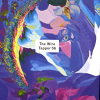
This is a 64 page magazine sized book with cardboard covers and thick interior pages. Jerry Moriarty does the mysterious wrap-around cover.

We start off with some pretty gnomic excerpts…

… and then shorter and longer pieces by a variety of people — here’s Dizi and Martin Millard. Many of these pieces mention somebody named Christian Morgenstern, who turns out to exist.

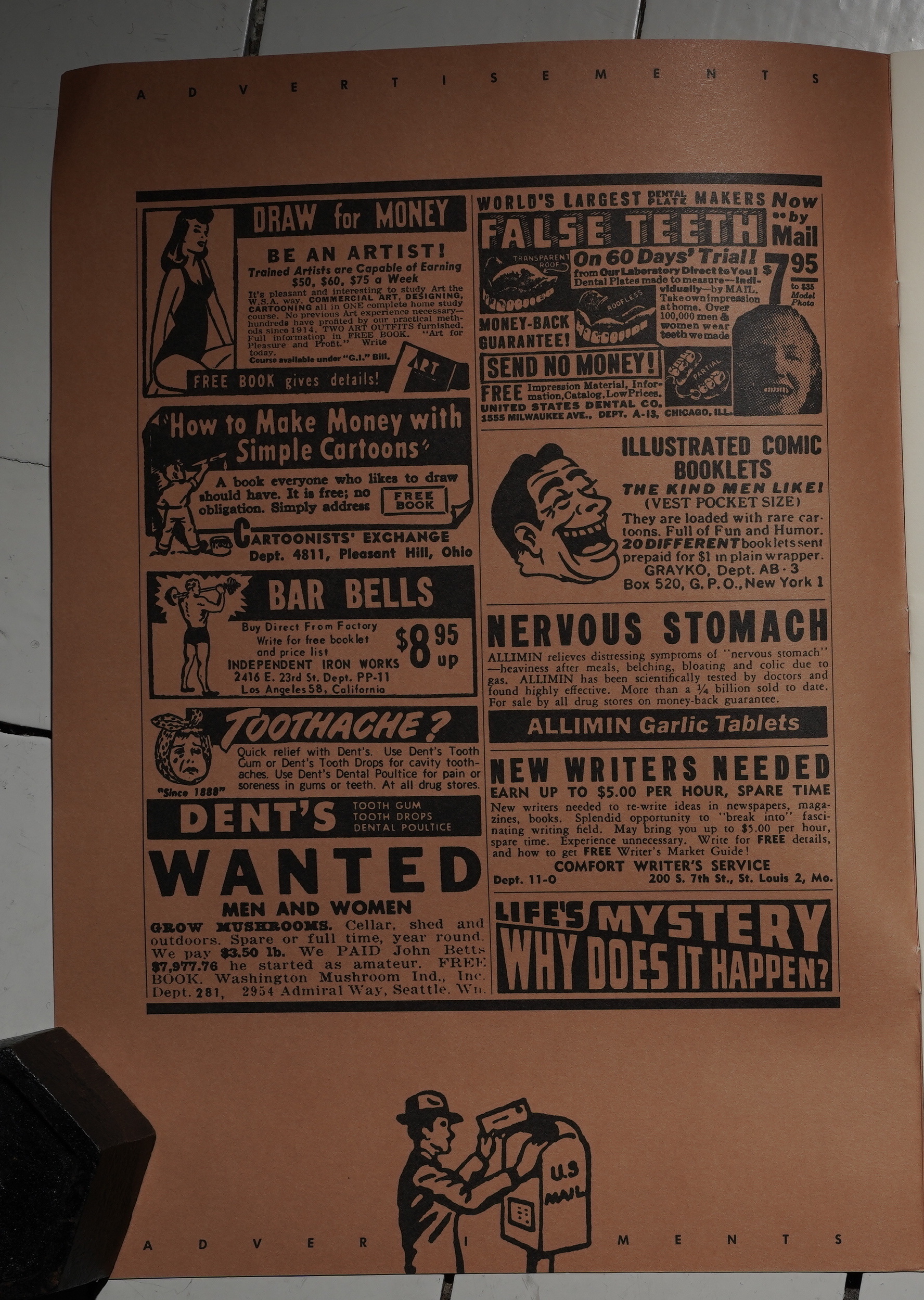
There’s a page of er ads, like The Toy Cigarette by Katchor, and Wartime Experiences by Martin Millard. Which also seems to exist. It’s difficult to tell sometimes with arteests…

There’s about a half dozen of these gorgeously reproduced spreads by Jerry Moriarty. My guess is that the stories came after the paintings?

Peter Blegvad does a thing on imagined/observed/remembered…

What is it this book reminds me of… Oh! It reminds me of Ben Katchor! It’s got this vague, strange logic flowing: It’s hard to pin down just exactly is going on, but it makes sense anyway.

I’ve seldom seen an anthology reflect the editor to this degree. It’s delightful to sit here reading this thing.

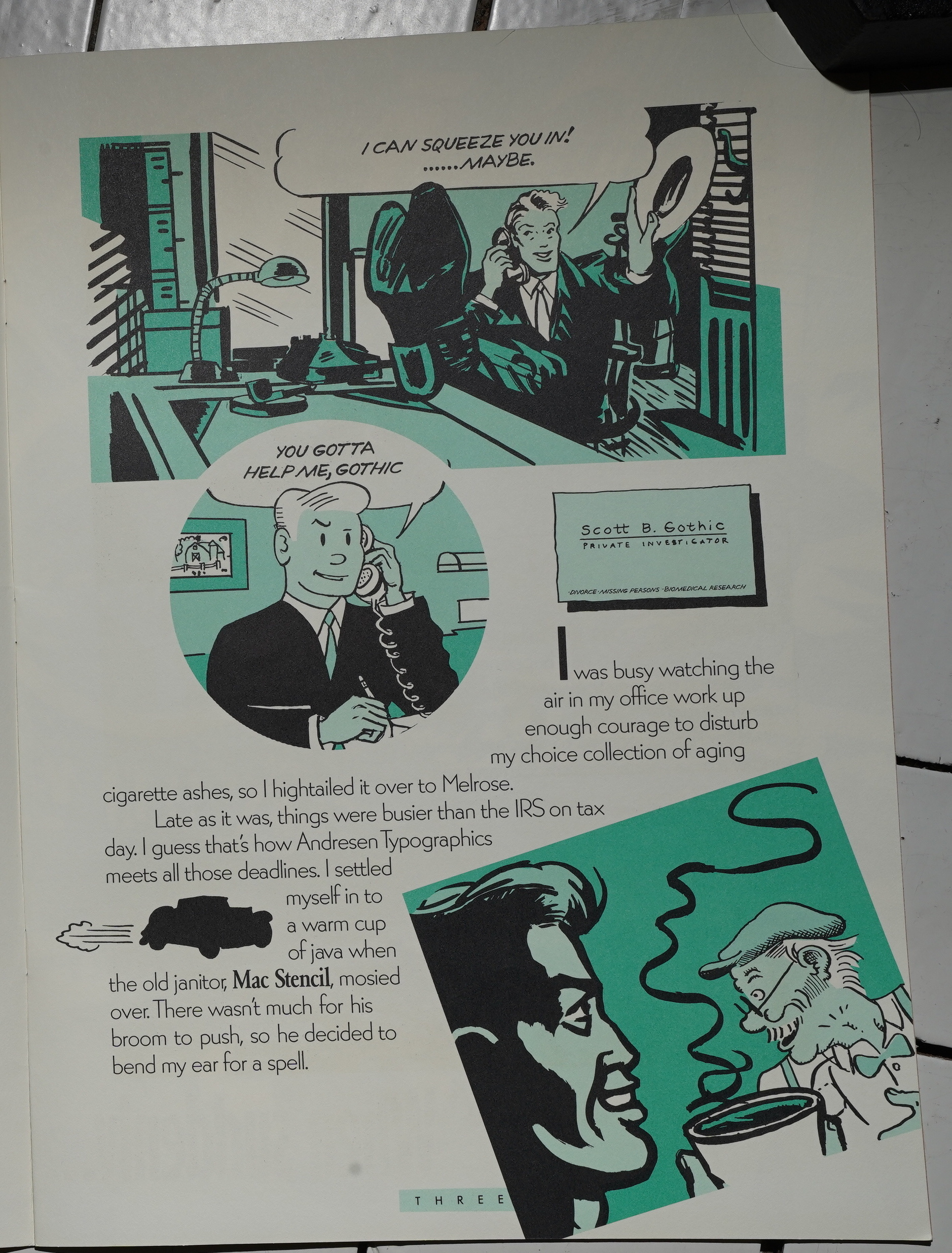
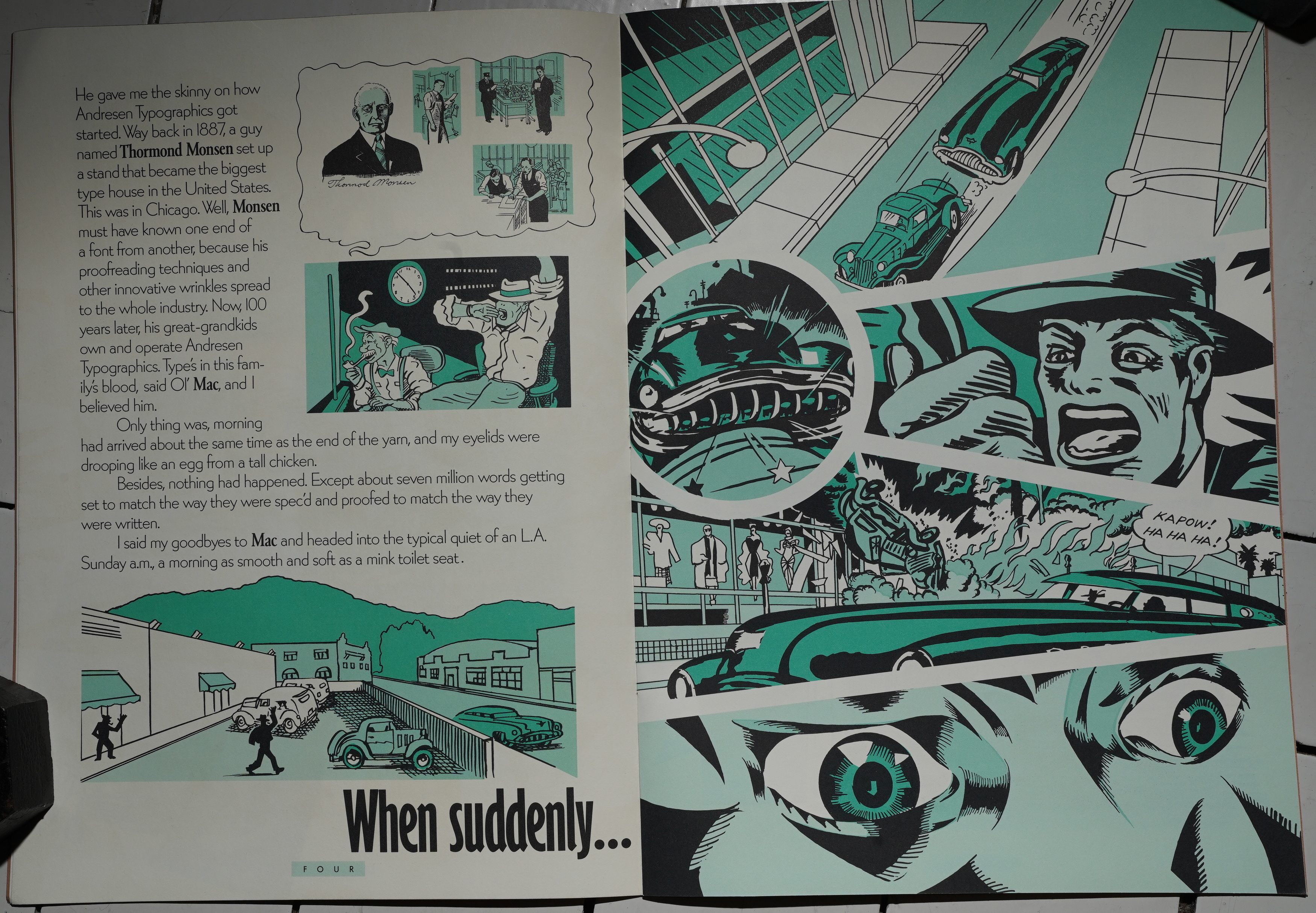
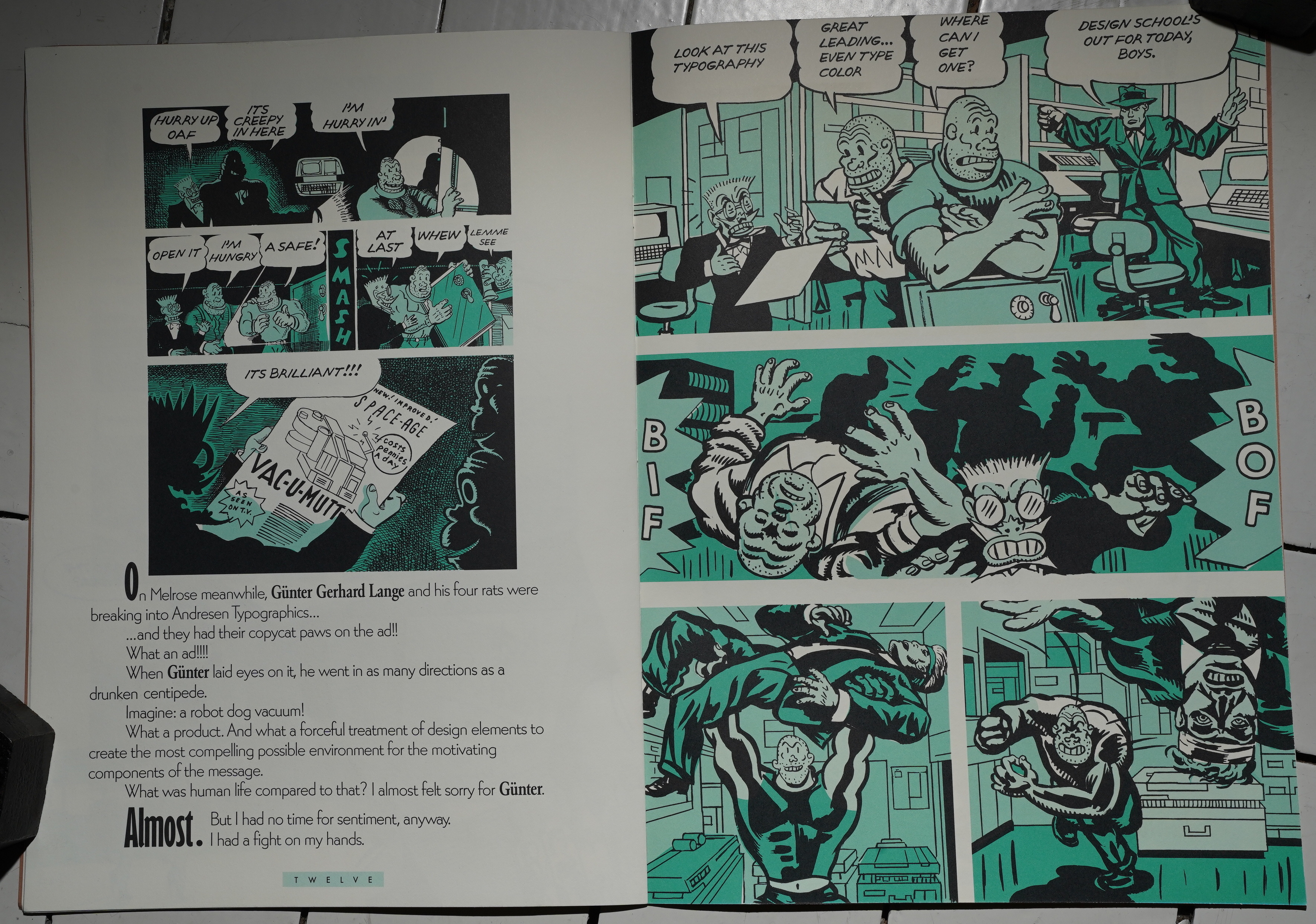
And then Katchor shows up himself, with the decidedly longest piece in the book. It’s 26 pages long, and it’s absolutely prime Katchor. It’s got all these characters and plots that intersect, but it’s never entirely clear just what it’s all about. I read it twice this time over, and I’m still not sure just what the repercussions were for Mr. Laszlo… the printer was going to print something for him, but… what…

Anyway, it’s called The Printer’s Disease, and I don’t think it’s never been reprinted? It’s insane! This thing is amazing!

Frank Santoro interviewed Katchor:

Santoro: When I read one of your stories that’s six to ten pages in length … I feel you have a little more room to create that believable setting you were talking about. I get the same feeling with the strips, but … the sense of place, the believable setting that comes across in the longer stories…

Katchor: Well, hopefully with all the weekly strips it does that by accumulation. I think if you show someone one strip, they might not get it. And some people only understand it when they see it in book form. They read eighty of them in one sitting.

Santoro: (laughs)

Katchor: And some people never get it.

Santoro: Y’know, that story The Printer’s Disease, for me, it was the first story of yours that I had ever read. I had seen your strips here and there, but that story really knocked me on my ass. I felt as if I was given a key of some sort to look at your work in a different way. Then I approached the strips and they really began to sing.

Katchor: Yeah, I don’t know. All I know is that 90% of the people who contact me are not comic readers. They say, “I don’t know anything about comics, but I like your strip.” So, I don’t know what it is … I mean as a child, I was a comics reader. So I don’t know what that is, why that is. I don’t know if it doesn’t appeal to people who read comics, I just know it’s a demographic fact.

There’s even an uplifting Mark Beyer story in here. (Yeah, yeah, you can guess how it goes.)

The first Picture Story magazine had its charms, but this one is amazing.

The Comics Journal #119, page 46:

I missed the first issue of Picture
Story, but the second issue—edited
and published by Ben Katchor—fea-
tures an array of unusual graphic
material by such New York graphic
talents as Katchor. Mark Beyer, and
Jerry Moriarty. I mention this trio in
particular among the contributors only
to solicit name recognition. (Each has
had work impressively showcased in
RAW over the past years.) In addition,
Beyer has published his own work in
various underground comics (Dead
Stories), and Moriarty has had a col-
lection of his painterly. evocative Jack
Survives strips published by’ RAW
Books.
I was most impressed by the
residual power of the longest piece,
Ben Katchor•s 26-page story, “The
Printer’s Disease.” The story—about
a printer whose life disintegrates when
his health fails and his wife runs off
with another man—is almost painfully
banal in outline, but Katchor unfolds
the tale with unexpected and subtle
narrative twists. (The story alprs to
trail off in a number of meandering
visual and aural asides, though all the
elements cohere by the story’s close.)
It’s an affecting. moody piece of
naturalism, executed in a style of
visual storytelling that is distinctive-
ly Katchor’s. It’s all of a piece.
Moriarty contributes a number of
short pieces—more like highly con-
densed image poems. actually—that
describe violent. sometimes surreal
incidents and events. In one, “Spoilt
Milk.” a farmer climbs aboard a
World War II-vintage Spitfire that has
landed in his yard and machine guns
a barnful of cows. (That one was my
favorite.) In another. “Sex is A
Memory.” a man climbs a tree, sees
his wife making love to a neighbor-
hood girl and falls from the tree. thus
crippling himself sexually and other-
wise forever. The unrelievedly glum
disillusioned tone of these pieces pulls
Moriarty into the domain of self-
parody. (It crossed my mind that the
self-parody might be intentional.)
Moriarty does create a number of
eeries. unsettling images, and you
discover a different perspective on the
satirical sensibility of the Jack Sur-
vives strips in these stories.
Mark Beyer’s four page Tony Target
strip, “Destiny,” the title character
run the gamut of panic. nausea, and
paranoia within the context of a frac-
tured narrative. The images are
rendered in the startling outlines of
Beyer’s expressionist mode of
representing an intimidating reality.
Other features include two wordless
graphic tales, “Truck Jouney” and “A
Trip To Wales” by Martin Millard; a
series of meditations (edited by
Moriarty) on the aesthetic contours Of
sound, and a series of intriguing,
skillfully drawn images that are “im-
agined, observed, remembered” by
Peter Blegvad.
Picture Story has been impressive-
ly printed on high-quality stock. The
color values of Moriarty’s cover
image—which is impossible to
describe but somehow features an
American Indian. a lesbian seduction
scene, and the Church of the Holy
Rabbit—are wonderful. as are the
muted tones of interior color in the il-
lustrations that accompany his short,
short stories.

This blog post is part of the Punk Comix series.
PX99: Big Baby

Big Baby by Charles Burns (235x312mm)

Oh, the edition I have has a glued-in signature sheet, as well as a screenprinted print.

Anyway, this reprints all of the Big Baby things — starting with the first two-pager from ram #5. It’s definitely the creepiest one, and Burns says (in the back of this book) that he didn’t really want to go further down that road…

… so in the second piece here, The Curse of the Molemen (reprinted from Raw One-Shot #5), Big Baby is more of a bystander.

The larger format for this story doesn’t look quite right? I mean, Burns always looks great, but it looks even better in the smaller Raw edition. And look at the difference in printing here — the ink is so much blacker in the Raw book.

The bulk of the book reprints the Big Baby comic strip that Burns had serialised in various alt-weeklies. The first part (Teen Plague) is basically a dry run for Black Hole, Burn’s magnum opus about teenagers and sex and teenagers having sex.

The artworks still super sharp, but the faces, as odd as they are, look a lot less striking and alien than his earlier work.

The last section, Blood Club, is the weakest one: All the creepy subtext seems to have disappeared, and this is basically a (quite good) straightforward horror story.

We finish up with a history of Big Baby, as well as several pages of various ephemera — this is a very complete Big Baby collection, which is nice.

But… reading these pieces all together, it’s weird how much that lessens their impact. The first two-pager is still perfect, but the other three stories which I remember having a pretty big “whoa” impact on me at the time, now seem almost… er… is there a positive word for “pedestrian”? They seem almost ordinary?

This blog post is part of the Punk Comix series.
PX Stuff

Drawing in ink and gouache? on paper by Mark Beyer.

I remember where I got this one — it was at the Lambiek comics store, and it was the most expensive thing I had ever bought. I was a student, and I really couldn’t afford it, but I had to have it.

I think. Or did had I just started working? Oh, yeah! I had bought a poster of this drawing a couple years earlier, and it was hanging in my “work area”, but then I saw the real thing on display at Lambiek, and I asked whether it was for sale.

He took it down from the wall and said “six thousand guilder”, so I guess this was before 1999, when Euros became a thing? I said “gulp” and he said “cash” and I had to go and get money from various ATMs around Amsterdam.

So that was… about… three thousand Euros? Wow. I really couldn’t afford that at that time.

At all.

Everything for art! It was probably the first expensive-expensive thing I ever bought?

(Or did he say “five thousand guilder for you?” He may have. I didn’t haggle or anything, but I seem to remember him lowering the price spontaneously. Perhaps because of my *gulp* and general fashionably sloppy me-ness.)

This drawing was made into a poster and was part of a postcard set, too… which I used to have, but I can’t find it now. Here’s a copy from the interwebs:

This blog post is part of the Punk Comix series.
PX86: Raw One-Shot #5: Big Baby: Curse of the Molemen

Raw One-Shot #5: Big Baby: Curse of the Molemen by Charles Burns (158x236mm)

The end papers set the scene: We’re in a 50s child’s world.

Well, that’s nice! “To my Big Baby — Jeffrey”. Or… is it?

(I’m not sure whether snapping pics like this is an invasion of privacy or not, so I’ll just not mention even the possibility.)

This is a little hardback volume, and it feels so well designed. Yes, it’s a very mid-80s design, with Futura and all, but everything, from the covers to the binding to the end papers to even the indicia and the page numbers just show the care and dedication that has gone into this. And the printing: It’s so razor sharp it feels like you can cut your fingers on those lines.

Big Baby’s insectile design is something to behold.

In some ways, Charles Burns was the odd man out at Raw — his stories are very 50s influenced and not very “punk” or “new wave” or whatever at all. But he’d be the odd man out in an Underground Comix setting, too — sure, he’s having fun with this material, but there’s also something unnerving about it all. This isn’t Eraserhead by any means, but it’s tapping into some of the same things.

Some EC references in that lower left hand panel…

Anyway, it’s a solid read, and very satisfying as an object.

Dale Luciano writes in The Comics Journal #113, page 45:

In Big Baby: Curse of the Molemen (a
recent RAW on&shot), Burns relates the
story of how a young kid (Big Baby, Burns’s
version of the typical American boy as
bizarro) witnesses the killing of a jealous,
wife-beating neighbor by the neighbor’s
downtrodden wife. Thisis the indirect out-
come of a plot which, as the schlock title
cleverly implies, promises a more conven-
tional follow-through of the story’s B-movie
origins. Burns initiates the Story from the
kid’s point of view—Big Baby sees a monster
crawling out Of a hole being excavated for
a swimming pool in the neighbor’s yard
and, later, sees the monster carry a human
victim back into the hole. We anticipate that
Burns will somehow deliver on the basic
horror storyvremise.
He does, but in shrewdly conceived, unex-
pected ways. Big Baby is a good example of
the displacement that occurs in the best hor-
ror stories. What Big Baby enconters When
he finally ventures down into that hole may
or may not be the product of a hyperactive,
hysterical imagination, but the horror of the
mean-spirited, suburban who
feels he has license to use his Wife as a
punching bag overshadows anything else in
the story. When Big Baby learns that the
Creatures are “lady monsters” Who kidnap
human males for their own sexual purposes,
the metaphor for the perversion Of natural
impulses within the constraints of middle-
class marriage is eerily brought to the fore.

Uhm… OK…

This blog post is part of the Punk Comix series.