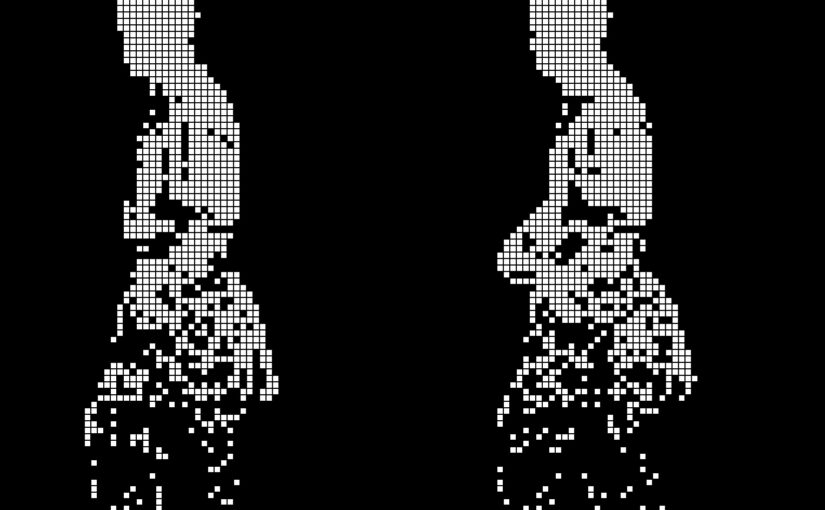
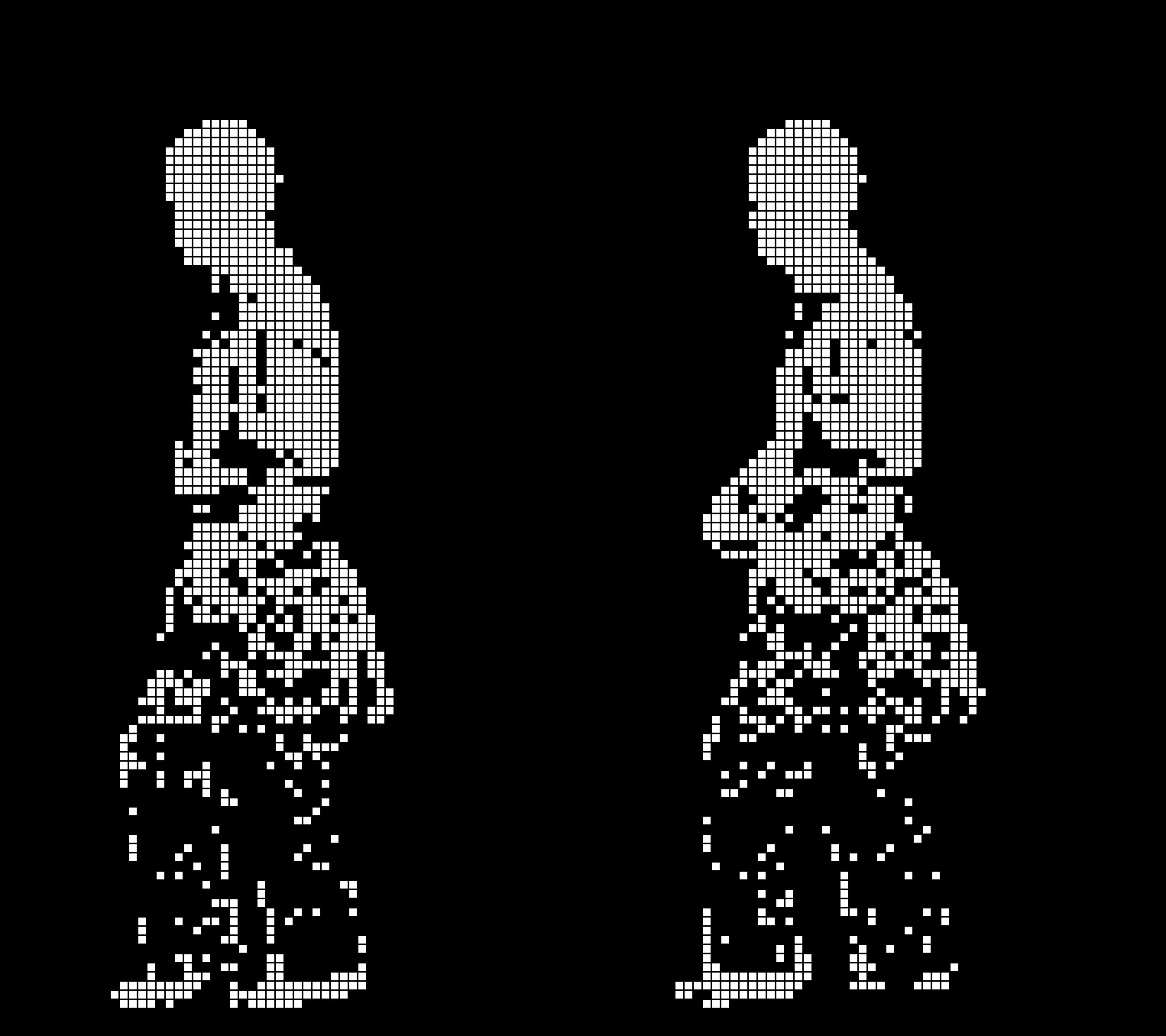
While falling asleep yesterday, I was thinking about frame rates for the hall er installation. I was playing the pixilated imaged at a six frames per second frame rate, and it does look kinda cool. But I wondered — the original film is 24 fps. Would it be possible to interpolate the images and then run the resulting mp4 at a higher frame rate? Make things less jittery?
Now, interpolating film usually looks pretty bad — artifactey and smeared — but in this case I have a 200×100 grid of monochrome pixels, so interpolation means “just move these blocks around a bit to be more in the position they should be in the next frame”, right? So perhaps it’ll look interesting?
I asked ChatGPT to write the script, and the (no doubt horrible) results are on Microsoft Github, if you’re curious. But this kind of hobbyist tinkering with one-off scripts is something that LLMs have gotten pretty good at. They know the syntax for ImageMagick commands much better than any human in the history of computing, so you just have to correct certain things like “no, -threshold 5% means the opposite of what you think” and then you have something that works for you.
(Unless the LLM suddenly decides to put in a supply chain attack into your script — you never know. And remember to stop before slipping into an LLM psychosis!)
Anyway, after running the script for six hours…
It works! I think?
Heh, and Denis Lavant’s pixels look good in the hall mirror, too:
And finally, for no reason at all:

A music video.