

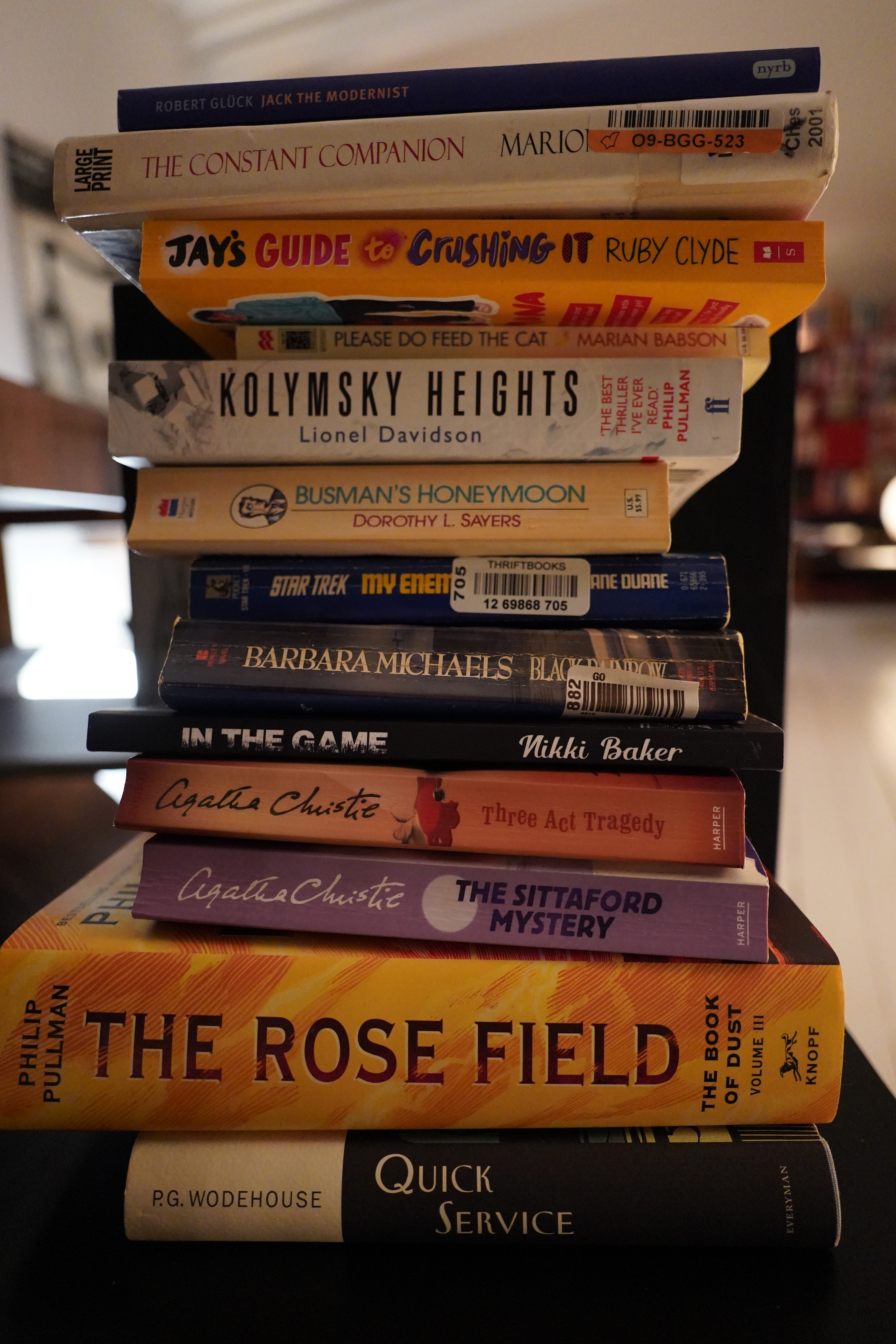
After I finished my Book Club 2025 blog series, I found that I missed blathering on about books I’ve read… so I thought I might perhaps start doing a “what I read last month” thing? We’ll see how it goes, because in January I managed the amazing feat of reading (almost) exclusively junk. And you’d think there’d be nothing to say about junk, but I find that the junkier, the more there is to blather about.
So I’m not going to say anything about the books I had nothing to say about.
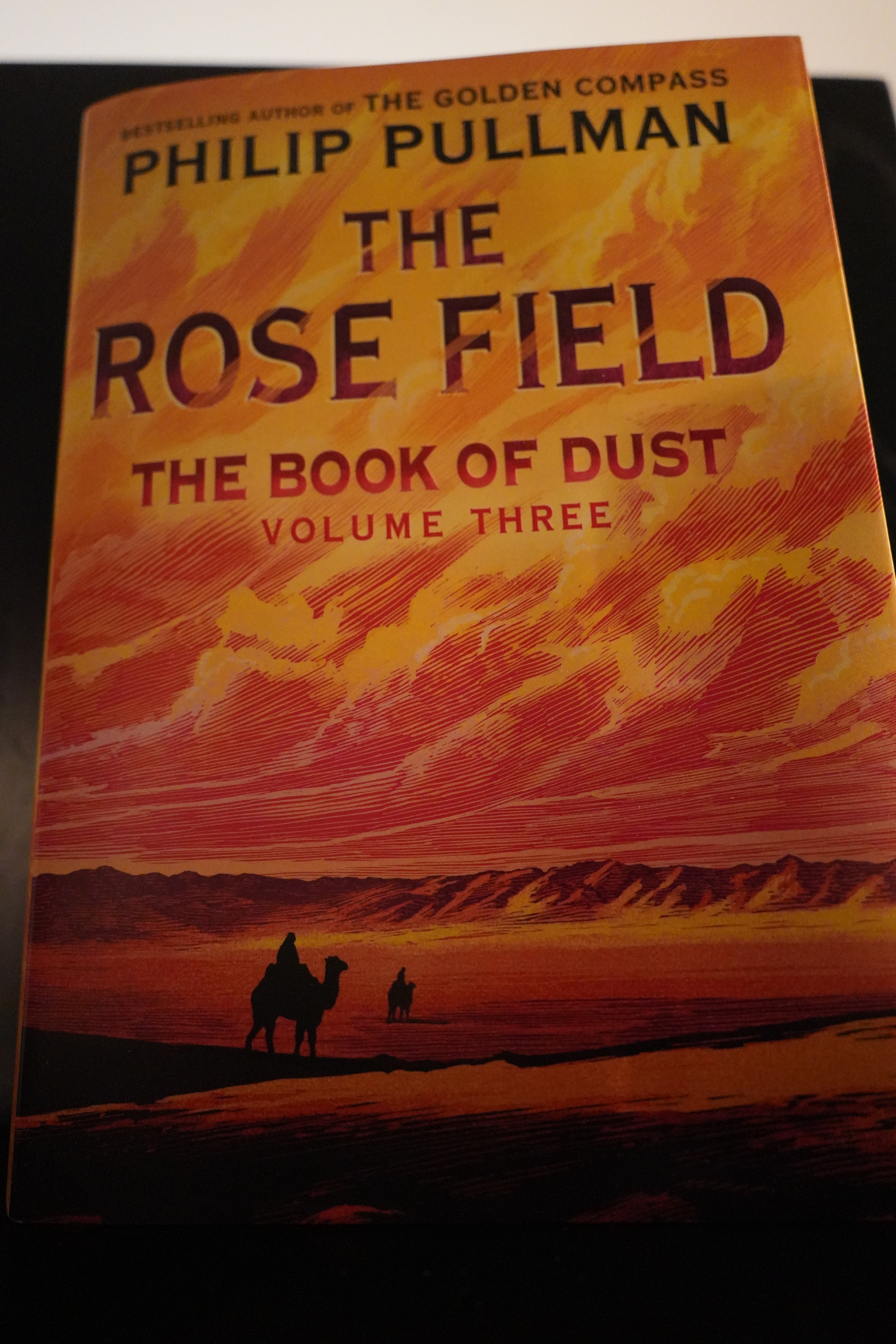
First of all, I have to say that I really enjoyed spending the time with these 650 pages of Philip Pullman’s The Rose Field. On a page-to-page basis, it’s very exciting and a lot of fun. It’s well-written and propulsive. Whenever I sat down with it, I went “yay”.
But.
There’s so many problems. We follow a large number of characters on a “third person tight” basis, but out of the blue, Pullman would just drop into omniscient narrator and go “and of course, the man Alice is talking to is the same one that Lyra was running away from three years earlier”. Like he’s talking out loud to himself. It’s very disturbing, and I wondered whether this was a sign Pullman had incipient dementia while writing the book? It took six years to finish, apparently.
And oh, the plot… We’re introduced to so many new characters, and their stories go nowhere. We follow some older characters, too, like Alice. As the book was getting towards the end, I was scratching my head as to how Pullman could possibly pull all these threads together. “Er… perhaps… er… Alice will… uhm…” “Perhaps Oakley Street will regroup and… er…”
And then nothing happens to any of these plot strands. Lyra gets a sort of resolution, but not very satisfying. For the rest of the characters, the book just stops. The first thing I did after finishing it was to google whether there’s more volumes coming. And there’s not.
It’s the least satisfying end to a fantasy I can remember reading.
Pullman got a lot of pushback on the previous book’s romance plot — an older teacher (who cared for her when she was a baby) falls in love with her, and it’s all kinda yucky (but very typical for an older male author). It’s obvious that Pullman is pretty angry about that reaction, because he not only has a nazi-equivalent cop investigating that teacher for inappropriate sexual behaviour, but he also has a 400 year old witch telling him that his age gap is nothing — she often has sex with man that are 370 years younger than him. “Numbers have little to do with it.” *gack*
But then at the end, he and Lyra don’t end up together after all — the rumours on the interweb says that an editor convinced him to remove that from the ending. I find that pretty unlikely — I mean, that this book had an editor. If it had, surely that editor could have pointed out all the other problems the book has? Much more serious ones?
But then again, Pullman is 79 now.
Anyway: I liked reading the book, but it’s maddingly frustrating in the end.
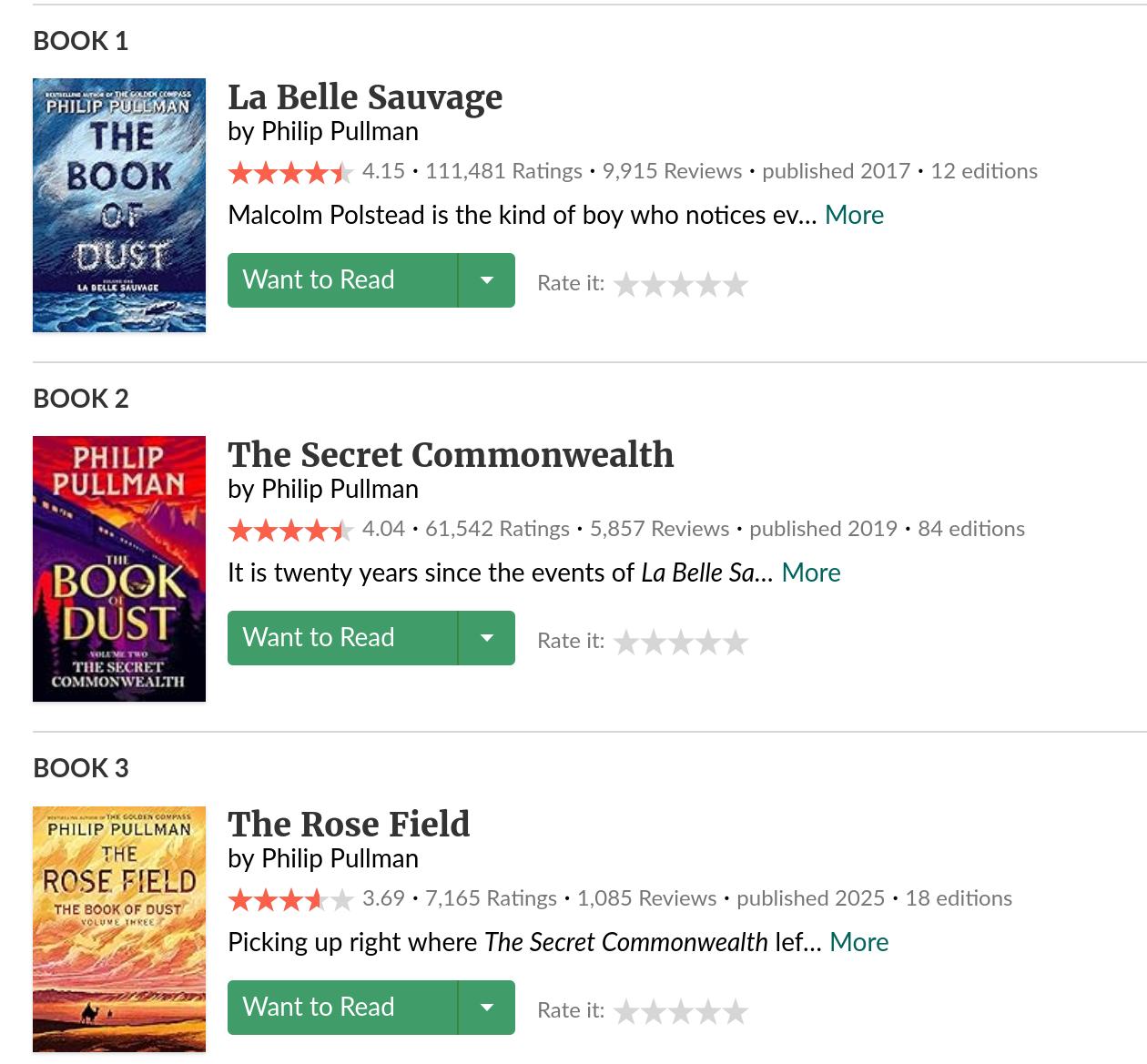
The people on Goodreads didn’t like it — you seldom see scores reduce that way between volumes in a series.

With lots and lots of people — fans of the original trilogy — wishing they hadn’t read this one at all. (Because it retcons a lot of stuff in a way that makes no sense, and diminishes what happened in those books, really.) So I’m sympathetic to that.
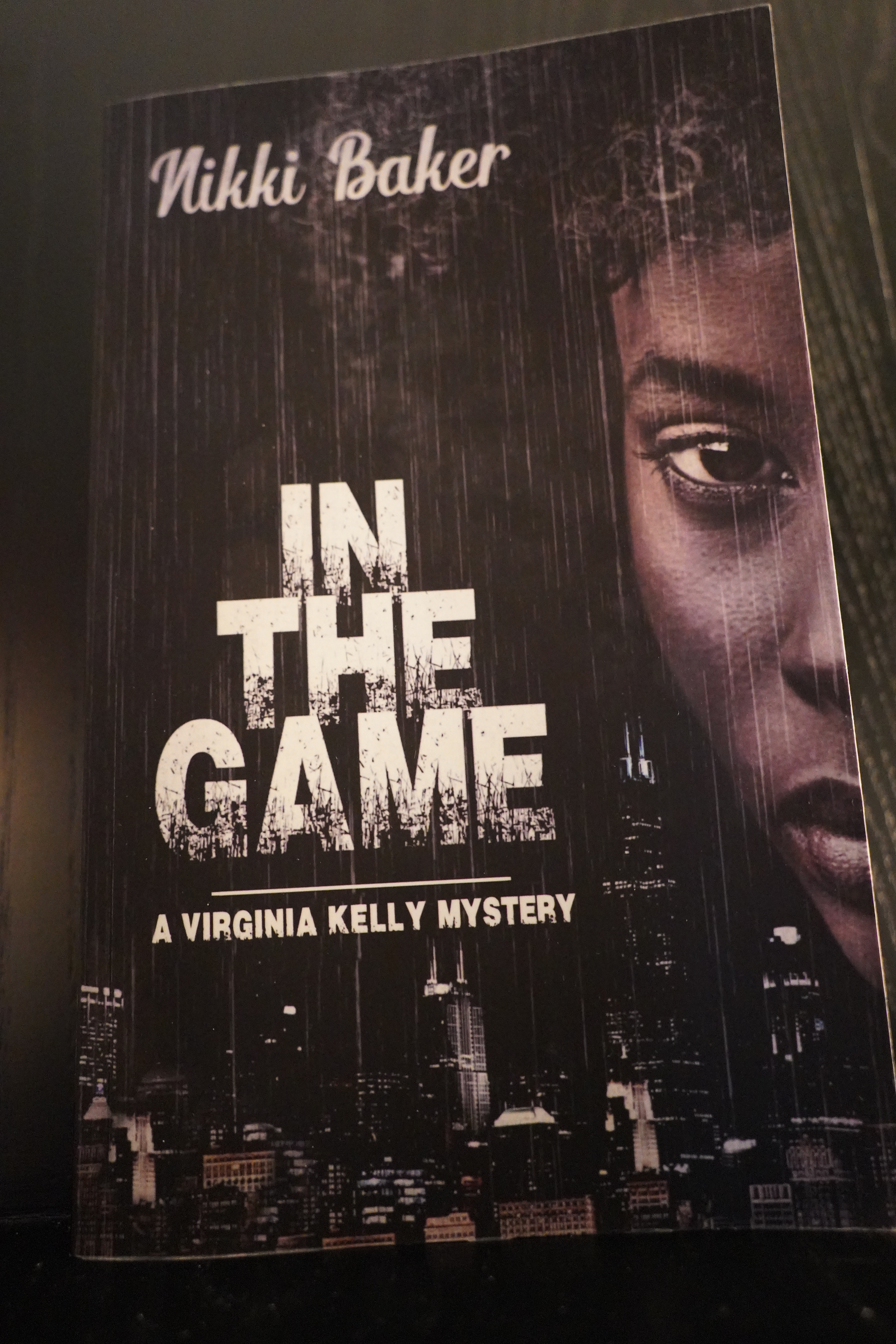
In The Game is a pretty weird mystery. It’s obviously the author’s first book, because she uses it as a dumping ground for all her observations about Chicago and life in general. I guess she had a lot of things stored up she just had to get off her chest, and in 1991 people didn’t have blogs, so they dumped it in their mysteries instead.
So nothing happens until 50 pages in, and then things continue not to happen at least until page 80, when I gave up.
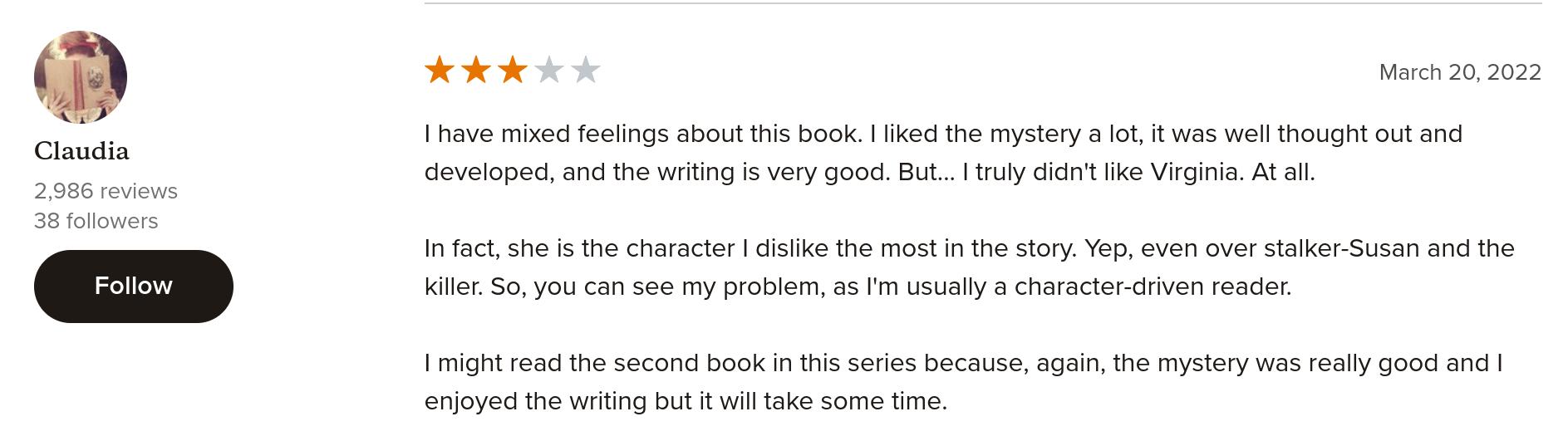
And I usually totally disagree with things like the above — I don’t care whether the protagonist is “likeable”. But in this instance, it was so egregious… She’s supposed to be an investment manager (!), but kinda happy-go-lucky anyway, and quite smart and stuff. So she seems like a wish fulfilment character in many ways… but then she goes and does the most horrendous and horrendously stupid things! Things that would only make sense in an over-the-top comedy, which this isn’t. So what we’re left with is in effect some kind of psycho that we’re supposed to really like?
It’s very strange, and not compelling at all.
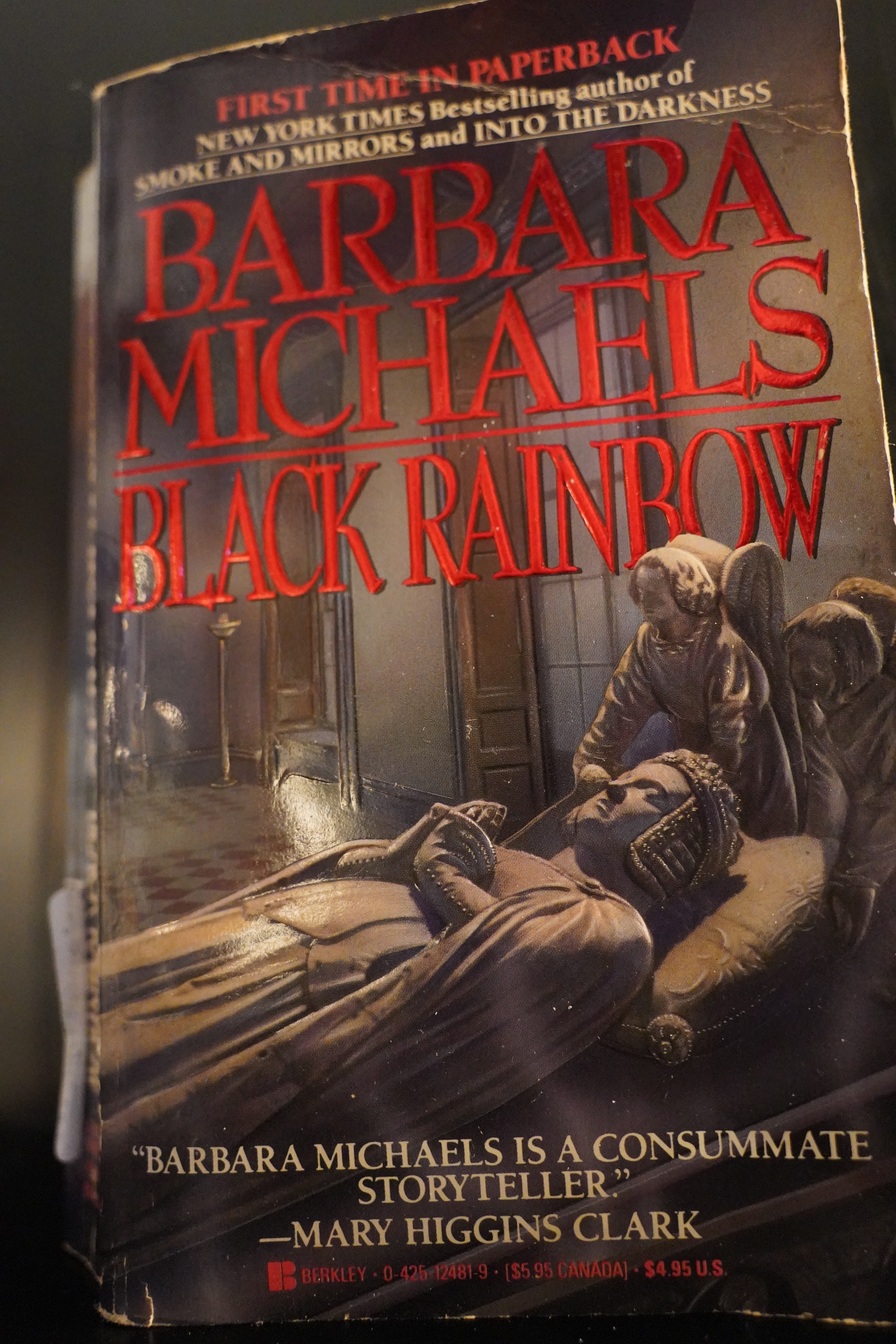
I enjoyed reading this — I haven’t read many Gothic romances. However, it’s a bit on the long side? It’s one of those books where you can’t really see anything that can be cut, per se, but it still seems to take an excessive amount of time to read.
If there is a main problem, it’s that the “solution” to the problem is obvious from the start: Edmund is a total prat, and there’s no way out of the problems presented in the book other than to kill him. So I was just waiting for our heroines to pull themselves together — for hundreds of pages — and off him. Which is probably what the author intended the reader to feel, but perhaps she could have… had, like, a progression?
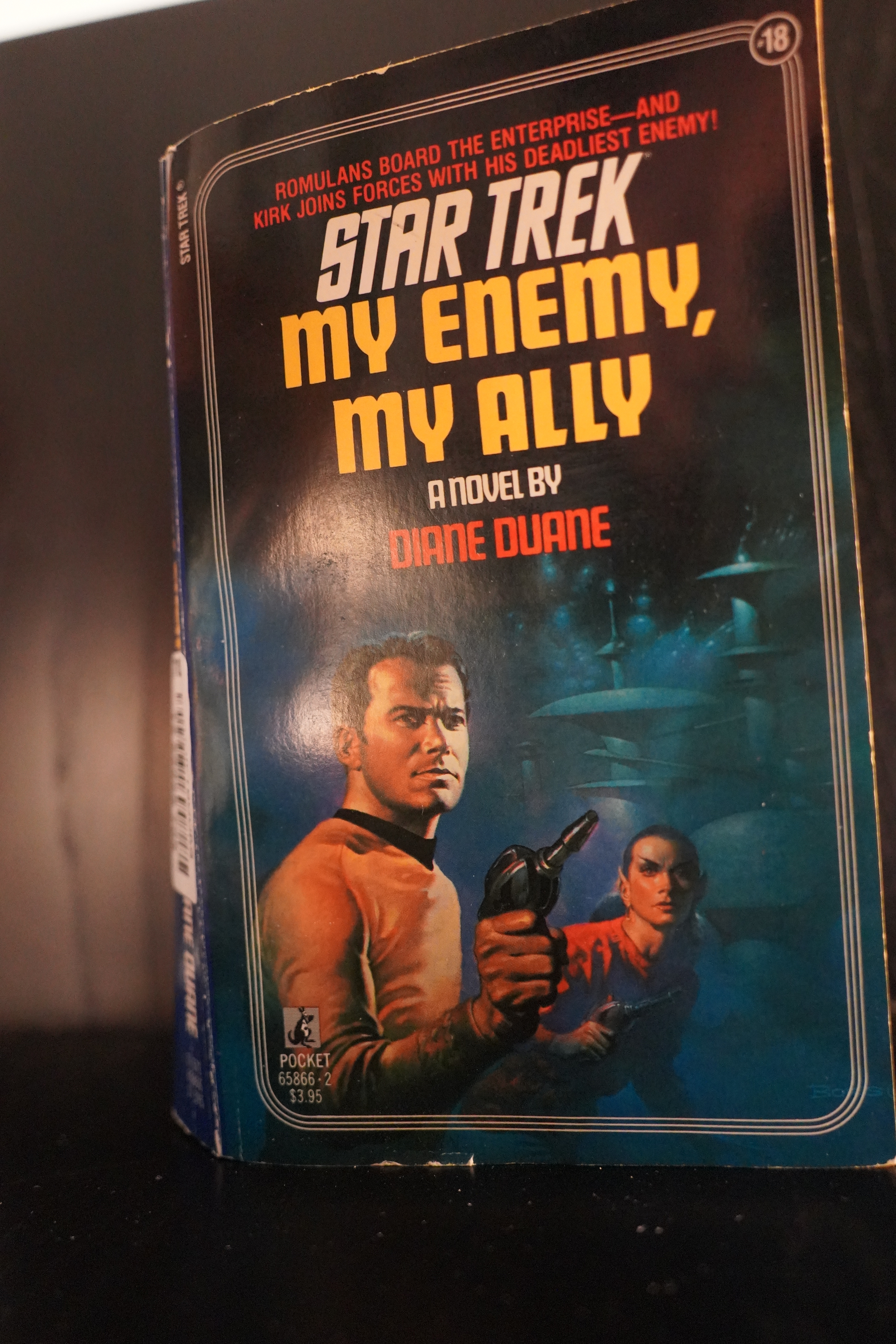
I like Star Trek as much as the next person, but I’m not a big enough fan to read the Star Trek novels. However, I saw somebody wax poetic about how great this particular one is, and since I remember liking Diane Duane’s other books, I thought “what the hey”.
And it’s… I wouldn’t say I was bored silly while reading this, but I felt such intense waves of disinterest. I should have ditched it, but I persevered, which was a bad decision. The book is like reading a novelisation of a pretty mid Star Trek episode — one where they didn’t have a very high budget, so much of the episode is about 4D chess and stuff. The emphasis is on Kirk/Spock/McCoy repartee, and Duane obviously had a lot of fun writing it.
It’s not badly written on a scene by scene basis at all — it’s just really, really hard to be interested in what’s going on on the pages. Perhaps if I were a bigger Star Trek fan, it’d be more fun?
As for the recommendation — it’s a common thing with older books like this: A person read the book when they were, say, eighteen, and then 43 years later, they remember quite liking it, and then say “it’s the best book ever!!!” Recommendation Strength should decay by the number of years since you read a book.
And… those were the only four books I wanted to mention, apparently? Okidoke.
Oh, yeah, I also wanted to mention:
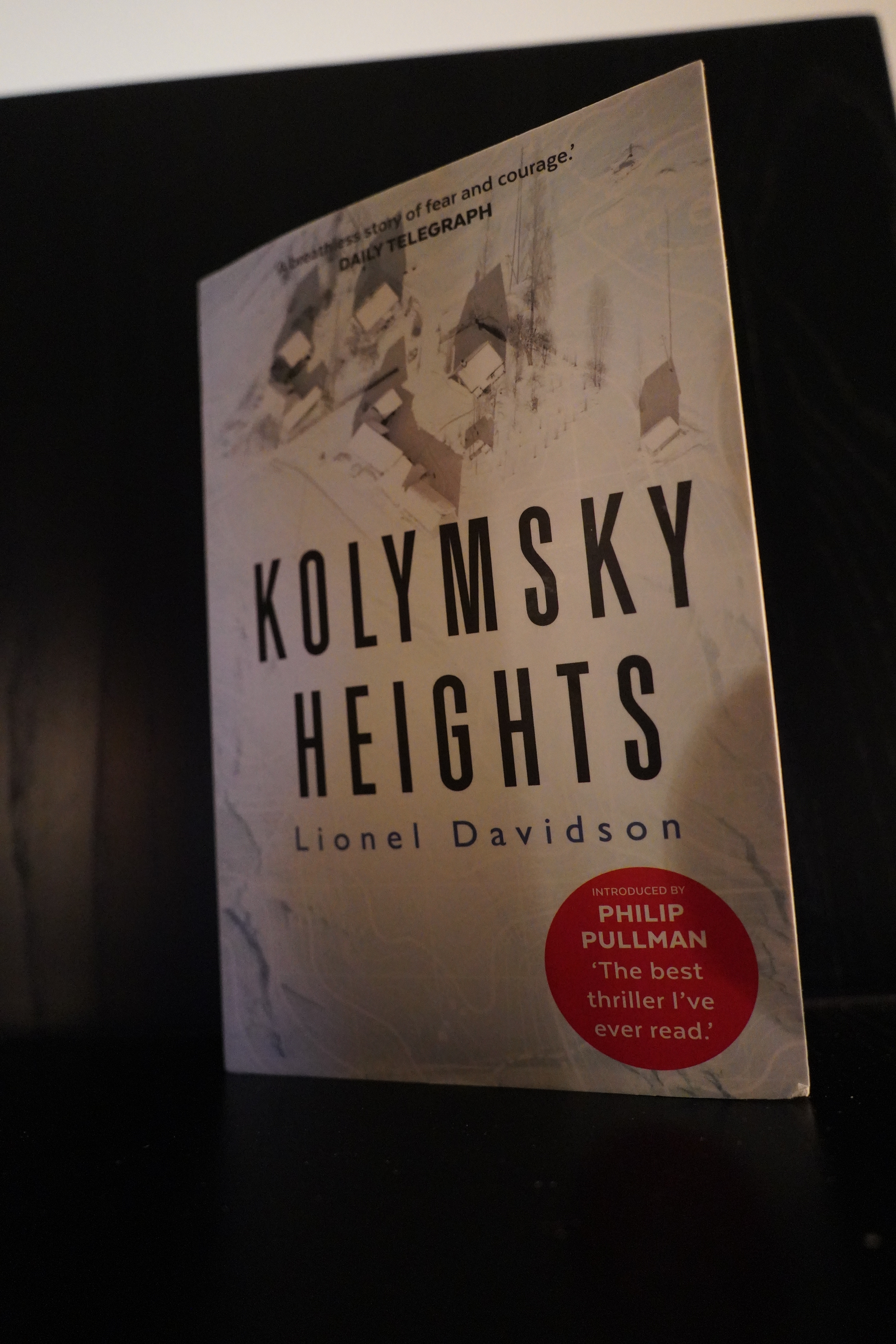
I probably bought it because of the Pullman quote — “The best thriller I’ve ever read”. I mean, that’s really selling it.
Unfortunately, the book is shite, and I dropped out after about a hundred pages.
I wrote most of the preceding text after reading each book (and just added this postscript and the introduction now), but I note that I had a lot of stuff to say at the start of the month, and less and less as the days progressed, so perhaps this’ll be the first and last post in this blog series.
Ou pas.